I know I'll have to drop whatever pretense I have of being a hipster who's full of post-modern irony. But I do indeed have reasons to give thanks. Not least among them is that I didn't have to travel yesterday or today, and that I still got to share a Thanksgiving dinner with people I love. And I got to ride a bit before going there--on a really nice bike. I know there's more, but those are certainly ample reasons for giving thanks!
24 November 2011

23 November 2011
Up The Col Du Galibier: The Day Before Thanksgiving

In the last moment of my life, I saw the day before Thanksgiving...
I'd just pedaled a few strokes around the virage; a bed of wildflowers turned, in an instant, into a glacial field. The sun was so bright it turned into the kind of liquid haze through which dreams skip and float along with the words that make sense only in those dreams.
It was noon. We were all lined up--the boys on one side, the girls on the other--to leave school for the day, the next day, and the three days that would follow. For some reason, when I was a kid, that was always my favorite moment of the year. Even the seemingly-capricious discipline of the Carmelite nuns who taught in our school could not make that moment less happy. They could cast a pall over the day before Christmas Eve, over Holy Thursday. Whether or not they loaded us down with homework, they left us in such a mood that Christmas, even if we got the gifts we hoped for, seemed more like a truce, and Easter was just too holy of a day to really consider as a vacation, even if we were home for the week that followed.
But noon on the day before Thanksgiving always seemed like the most carefree moment of the year. In most years, it began the last interlude of Fall; the lights of Christmas only accented the darkness that consumed ever-larger parts of the days that would follow. In that moment, on the day before Thanksgiving, one could still see the last flickerings of the autumnal blaze that burned green leaves into the colors of the sunset. Somewhere along the way, they turned as yellow and, for a few days, as bright as the sunlight that filled the air around the mountain I was climbing on my bike.
It was just about noon; I would soon be at the peak of le Col du Galibier, one of the most famous climbs on the Tour de France. From there, I would have a long effortless ride to the valley. In the meantime, each pedal stroke would become more arduous. I'd been pedaling all morning, but even more important was the altitude: I was more than a mile and a half above sea level. The air is thinner, and even though my breath steamed as I puffed up that mountain on that July morning, the sun burned through the layers of sun screen I'd lathered on my arms and face.
Bells rang. Dismissal? Or the cows in the herd down the mountain? I stopped for a drink and one of the crepes I'd packed into my bag. I took a bite and a gulp.
You're free. I wasn't sure of whether I was hearing that. Perhaps I was giddy from the thin mountain air. Yes, you're free. But I wasn't hearing it: It was being told--or, more precisely, communicated--to that child who was being dismissed from school on the day before Thanksgiving. You can go now. What are they talking about? Who's "they"?
You don't have to do this again. I'd never heard that before, certainly not in those days. What did that mean? What won't I have to do again? Climb this mountain? Go to school?
Down the Col du Galibier, through the Val de Maurienne, as the eternal winter of that mountaintop turned into the hottest day of summer in the valley, my mind echoed. What, exactly, wouldn't I have to do again?
Near the end of that day, I reached St. Jean de Maurienne, just a few kilometers from Italy. There, I would see the stranger who, inadvertently, caused me to see that I could follow no other course but the one that my life has taken since then. A year later, I would move out of the apartment I'd been sharing with Tammy; about a year after that, I would change my name and begin my treatments.
22 November 2011
Riding Off Into A Sunset Of Foliage
November is a strange and interesting month, especially this year. It may have to do with the fact that we had a warm, wet fall before our late-October snowstorm, which seems to be the reason why the foliage (Can you call it that in Brooklyn or Queens?) has changed colors later in the season than it has in previous years. And, while the red and gold trees may not be as striking here as they are in, say, Vermont or the Adirondacks, the city's buildings can provide a nice backdrop to the leaves of sunset.
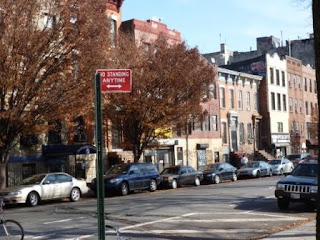
I took that photo just before starting to ride with Lakythia and Mildred to the Canarsie Pier and the South Shore of Brooklyn.

Off into the "sunset" we rode!
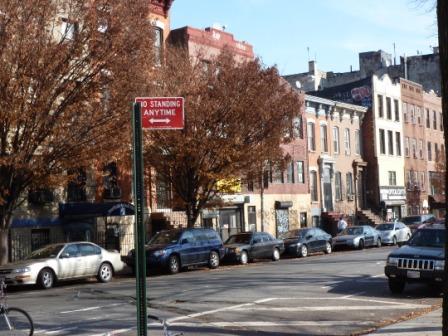
I took that photo just before starting to ride with Lakythia and Mildred to the Canarsie Pier and the South Shore of Brooklyn.

Off into the "sunset" we rode!
19 November 2011
Power To The People: Bicycles At Occupy Wall Street
I haven't been posting as often as I had been a few months ago, mainly because my classes are bigger this year and, it seems, falls into one of two categories: those who need more and those who demand more. I guess that's just part of being in the current economic situation.
And so is Occupy Wall Street. I've gone to it three times and learned that bicycles are becoming an integral part of their protest, movement, or whaotever you want to call it. That's not surprising, really, when you consider than in much of the world (and, increasingly, in some parts of the US), bikes are transportation for the "99 percent." And, as a form of recreation, it's far less energy-intensive, and less expensive than other activities.
However, bikes are an important part of OWS for practical reasons. Some of the protestors got there, or come and go (as I did) on two human-powered wheels. Some of those who've stayed are transporting food and water (which, interestingly,they're getting from the taps of local homes and businesses) on bike-towed trailers or tricycles.
But what I found most interesting of all can be seen in this photo:

Yes, this young man is powering his cell phone and laptop computer with power he pedals into a generator. Someone at OWS started rigging up these bicycle-powered generators after police seized the gas-powered ones they'd been using. Now, in addition to making power for cell phones, laptops and other electrical and electronic devices, the generators are being used for a variety of milling and grinding purposes, including the making of compost, which they are using themselves in Zuccoti Park and giving to farmers who are selling fruits, vegetables and other foods in nearby markets.
While I'm on the subject, Crowdrise, Times Up and other organizations are accepting donations of bicycles, as well as tires, tubes and other parts--and, of course, money to buy bikes and parts--for OWS.
If OWS turns into a full-blown revolution, will bicycles be credited (or blamed)? After all, what revolves more--and is therefore more revolutionary--than a bicycle wheel?
And so is Occupy Wall Street. I've gone to it three times and learned that bicycles are becoming an integral part of their protest, movement, or whaotever you want to call it. That's not surprising, really, when you consider than in much of the world (and, increasingly, in some parts of the US), bikes are transportation for the "99 percent." And, as a form of recreation, it's far less energy-intensive, and less expensive than other activities.
However, bikes are an important part of OWS for practical reasons. Some of the protestors got there, or come and go (as I did) on two human-powered wheels. Some of those who've stayed are transporting food and water (which, interestingly,they're getting from the taps of local homes and businesses) on bike-towed trailers or tricycles.
But what I found most interesting of all can be seen in this photo:

Yes, this young man is powering his cell phone and laptop computer with power he pedals into a generator. Someone at OWS started rigging up these bicycle-powered generators after police seized the gas-powered ones they'd been using. Now, in addition to making power for cell phones, laptops and other electrical and electronic devices, the generators are being used for a variety of milling and grinding purposes, including the making of compost, which they are using themselves in Zuccoti Park and giving to farmers who are selling fruits, vegetables and other foods in nearby markets.
While I'm on the subject, Crowdrise, Times Up and other organizations are accepting donations of bicycles, as well as tires, tubes and other parts--and, of course, money to buy bikes and parts--for OWS.
If OWS turns into a full-blown revolution, will bicycles be credited (or blamed)? After all, what revolves more--and is therefore more revolutionary--than a bicycle wheel?
14 November 2011
Strange But True In NYC
New York City may well be the "Frankenbike" capital of the world. Even if you live here for a couple of decades, you'll see permutations of bikes you simply won't see anywhere else.
Today I'm going to show you two "Frankenbikes" that were parked near a train station in my neighborhood.
Until I saw the first, I never realized what, exactly, my commuter bikes have always lacked:

They are mountain bike "bar ends," which were very much in vogue during the mid-'90's. I used a pair myself. There was a good reason for them: Mountain bikes, at least as they were configured then, didn't offer a variety of hand positions. That could be very tiring on a ride of an hour or more. So, bar ends like these were made to clamp on the ends of flat bars. Most, like these, used a wraparound clamp; a few had ends that inserted into the handlebar, much like a bar-end shifter or brake lever.
Here, the person mounted them on the middle of the handlebar to get an "aero" position. That's exactly what the owner of that bike needs.

It's a Schwinn Suburban from, I'd guess, the early 1970's or thereabouts. Essentially, it was a Varsity or Continental with upright bars, fenders and a single rather than a double chainring in the front. Like the Varsity or Continental, it's a tank. At least the "aerobars" can help its rider lop a few seconds off his or her commute.
The bike also has a generator lighting system. I wonder whether it works. Lots of people buy or inherit used bikes like that one that have generator lights on them. Often, the person who buys or inherits the used bike never even knows whether or not the lights actually work, for they do no night riding--or, perhaps, even know how to use the light. Or the person riding the bike may well know that the light doesn't work but simply doesn't bother to take it off.
At least the generator and lights are where they're supposed to be. The same can't always be said for any bike you'll see parked here in NYC:

A headlight in a water bottle cage--on the top tube of a women's bike? In some crazy way, it seems ingenious. After all, the light on that bike is in a less prone position than it would be on other parts of the bike. Plus, it could be really useful for checking runs in my stockings or rips in my pants legs.
No kind of bike paint job is more widely detested, justly so, than the '80's fades. (Some of the most unfortunate samples from that genre were found on Klein bicycles of that era.) However, around the same time, there was another kind of paint job that was as almost as bad, and common on European bikes (or bikes for the European market,at any rate). I call it the tricolored Easter egg look:

The owner of this bike, or the person from whom the owner bought or was given this bike, probably brought it in from Italy or someplace in Europe, as I don't think this model was ever inported to the US. In fact, I think that around the time the bike was made, Atala bicycles were no longer being imported to this country. Some of their better models were rather pretty, but I was never particularly impressed with the rides of the ones I tried. Plus, the workmanship was such that we used to joke that its paint and chrome flew off when the bike was operated at too high a speed.
Anyway, even though these two bikes caught my attention, they're hardly the most mutated bikes I've seen here in New York. Unfortunately, I never photographed the crazier bikes I saw. But then again, I'll probably see others that are just as zany.
Today I'm going to show you two "Frankenbikes" that were parked near a train station in my neighborhood.
Until I saw the first, I never realized what, exactly, my commuter bikes have always lacked:

They are mountain bike "bar ends," which were very much in vogue during the mid-'90's. I used a pair myself. There was a good reason for them: Mountain bikes, at least as they were configured then, didn't offer a variety of hand positions. That could be very tiring on a ride of an hour or more. So, bar ends like these were made to clamp on the ends of flat bars. Most, like these, used a wraparound clamp; a few had ends that inserted into the handlebar, much like a bar-end shifter or brake lever.
Here, the person mounted them on the middle of the handlebar to get an "aero" position. That's exactly what the owner of that bike needs.

It's a Schwinn Suburban from, I'd guess, the early 1970's or thereabouts. Essentially, it was a Varsity or Continental with upright bars, fenders and a single rather than a double chainring in the front. Like the Varsity or Continental, it's a tank. At least the "aerobars" can help its rider lop a few seconds off his or her commute.
The bike also has a generator lighting system. I wonder whether it works. Lots of people buy or inherit used bikes like that one that have generator lights on them. Often, the person who buys or inherits the used bike never even knows whether or not the lights actually work, for they do no night riding--or, perhaps, even know how to use the light. Or the person riding the bike may well know that the light doesn't work but simply doesn't bother to take it off.
At least the generator and lights are where they're supposed to be. The same can't always be said for any bike you'll see parked here in NYC:

A headlight in a water bottle cage--on the top tube of a women's bike? In some crazy way, it seems ingenious. After all, the light on that bike is in a less prone position than it would be on other parts of the bike. Plus, it could be really useful for checking runs in my stockings or rips in my pants legs.
No kind of bike paint job is more widely detested, justly so, than the '80's fades. (Some of the most unfortunate samples from that genre were found on Klein bicycles of that era.) However, around the same time, there was another kind of paint job that was as almost as bad, and common on European bikes (or bikes for the European market,at any rate). I call it the tricolored Easter egg look:

The owner of this bike, or the person from whom the owner bought or was given this bike, probably brought it in from Italy or someplace in Europe, as I don't think this model was ever inported to the US. In fact, I think that around the time the bike was made, Atala bicycles were no longer being imported to this country. Some of their better models were rather pretty, but I was never particularly impressed with the rides of the ones I tried. Plus, the workmanship was such that we used to joke that its paint and chrome flew off when the bike was operated at too high a speed.
Anyway, even though these two bikes caught my attention, they're hardly the most mutated bikes I've seen here in New York. Unfortunately, I never photographed the crazier bikes I saw. But then again, I'll probably see others that are just as zany.
12 November 2011
Another New Addition (!)
No, I didn't buy another Mercian. (Having four is almost an embarrassment of riches, really!) Rather, my "new addition" was installed on Vera.

She, like many other bikes built at the same time (early 1994) she was, has low-rider rack mounts on the front fork. Vera is, if I remember correctly, the third bike I've owned with those mounts. However, I've never before used a low-rider, or a front rack of any other kind.

Had I kept Marianela, she would have gotten a front rack. I've had handlebar-mounted baskets on other bikes but felt they mounted too high, which worsened the bikes' road-handling. Given that most of the bikes I've used as commuters had more relaxed head angles and, hence, less responsive steering, than my road bikes, that was no small consideration.
So, I decided that I was going to mount some sort of fork-mounted rack on Vera. I really wanted to use the lowrider mounts. However, I was willing to consider other ways of mounting the rack.
I first considered the Velo Orange front racks because the materials and construction looked good, and their prices were relatively reasonable. However, the VO Randonneur front rack wouldn't have worked, because the legs are too short to reach the low-rider and are not adjustable. (Constructeur rack legs like the ones on the VO Randonneur mount higher on the fork than lowrider bars.)
I also looked at the VO Pass Hunter. Its struts bolt onto cantilever/V-brake bosses, which Vera has. It's a somewhat larger and beefier version of the old Mafac racks that bolted onto the centerpull brake pivots. Although I would have preferred to use the lowrider mount, I wasn't opposed to using a brake-mounted rack. However, I wasn't willing to do something else the Pass Hunter would have necessitated: drilling out my front fork crown.

That crown is drilled and tapped for 5mm bolts, like the ones used on most water bottle cage and rear rack braze-ons. The Pass Hunter has an integral mounting bolt that's meant to fit in a hole large enough for a brake pivot bolt. I simply didn't have the heart to drill out that nice classy fork crown.
So, that left me with two other options, apart from getting a custom rack. One would have been to buy one of the front racks made for mountain bikes: They mount on the cantilever braze-ons but have an adjustable strap (like the kind found on Blackburn-style rear racks) through which the brake bolt passes. The rack is cheap, and looked sturdy enough, but wouldn't have looked good on Vera.
So, with a sigh, I resigned myself to spending the money on a Nitto M-18. I know, from using other Nitto parts, that their quality is second to none. And, often, their prices aren't, either. However, I was lucky enough to find a really good deal on one from Tree Fort Bikes in Ypsilanti, Michigan, which also matched another retailer's price on another item I bought at the same time.
Still, the Nitto had the same problem as the VO Randonneur: the struts weren't long enough to reach the lowrider mount. Luckily, the struts are replacable with longer ones that Nitto makes. It seems that Rivendell is the only retailer that carries those struts (Even the Japanese retailers didn't have them!), so I placed my very first order with Riv.
The struts are really made to attach to a front dropout.

So I cut them, and within fifteen minutes, I had the kind of rack I wanted on Vera.

It, like the Pass Hunter and Randonneur, is really intended as a handlebar bag support. But I plan to use a basked on it or simply to strap my purse or shoulder bag on it when I ride to work.

She, like many other bikes built at the same time (early 1994) she was, has low-rider rack mounts on the front fork. Vera is, if I remember correctly, the third bike I've owned with those mounts. However, I've never before used a low-rider, or a front rack of any other kind.

Had I kept Marianela, she would have gotten a front rack. I've had handlebar-mounted baskets on other bikes but felt they mounted too high, which worsened the bikes' road-handling. Given that most of the bikes I've used as commuters had more relaxed head angles and, hence, less responsive steering, than my road bikes, that was no small consideration.
So, I decided that I was going to mount some sort of fork-mounted rack on Vera. I really wanted to use the lowrider mounts. However, I was willing to consider other ways of mounting the rack.
I first considered the Velo Orange front racks because the materials and construction looked good, and their prices were relatively reasonable. However, the VO Randonneur front rack wouldn't have worked, because the legs are too short to reach the low-rider and are not adjustable. (Constructeur rack legs like the ones on the VO Randonneur mount higher on the fork than lowrider bars.)
I also looked at the VO Pass Hunter. Its struts bolt onto cantilever/V-brake bosses, which Vera has. It's a somewhat larger and beefier version of the old Mafac racks that bolted onto the centerpull brake pivots. Although I would have preferred to use the lowrider mount, I wasn't opposed to using a brake-mounted rack. However, I wasn't willing to do something else the Pass Hunter would have necessitated: drilling out my front fork crown.

That crown is drilled and tapped for 5mm bolts, like the ones used on most water bottle cage and rear rack braze-ons. The Pass Hunter has an integral mounting bolt that's meant to fit in a hole large enough for a brake pivot bolt. I simply didn't have the heart to drill out that nice classy fork crown.
So, that left me with two other options, apart from getting a custom rack. One would have been to buy one of the front racks made for mountain bikes: They mount on the cantilever braze-ons but have an adjustable strap (like the kind found on Blackburn-style rear racks) through which the brake bolt passes. The rack is cheap, and looked sturdy enough, but wouldn't have looked good on Vera.
So, with a sigh, I resigned myself to spending the money on a Nitto M-18. I know, from using other Nitto parts, that their quality is second to none. And, often, their prices aren't, either. However, I was lucky enough to find a really good deal on one from Tree Fort Bikes in Ypsilanti, Michigan, which also matched another retailer's price on another item I bought at the same time.
Still, the Nitto had the same problem as the VO Randonneur: the struts weren't long enough to reach the lowrider mount. Luckily, the struts are replacable with longer ones that Nitto makes. It seems that Rivendell is the only retailer that carries those struts (Even the Japanese retailers didn't have them!), so I placed my very first order with Riv.
The struts are really made to attach to a front dropout.

So I cut them, and within fifteen minutes, I had the kind of rack I wanted on Vera.

It, like the Pass Hunter and Randonneur, is really intended as a handlebar bag support. But I plan to use a basked on it or simply to strap my purse or shoulder bag on it when I ride to work.
11 November 2011
What If They Had Bicycles?
Some of us have cycled for so long, or done so much cycling, that we simply cannot imagine our lives without it. So, it's hard to remember that, even though the bicycle has a longer history than most forms of transportation, it's still a recent invention.
Knowing that, I found myself wondering what some of the most important, wonderful and cataclysmic events in history, literature and art would have been like if bicycles had been available.
One of the first events that comes to mind is this:

Now I find it ironic that the culmination of the greatest technological advances of the time made the world stand still for a day. I know; I remember that day: 20 July 1969. Everything, it seemed, was closed--and everywhere you looked, you could see the lumescent gray and silver shadows bobbing from television screens through windows. Quite possibly more people heard this phrase--"One small step for a man, one giant leap for mankind"--at the moment it was uttered than heard any other phrase at the exact moment it was spoken.
I was eleven years old at the time. It was hard not to be mesmerized by those (literally) otherwordly images; even adults forgot whatever else they'd been doing so they could see an event that, until then, had been in the realm of fantasy.
Now I wonder: How would history (not to mention the Space Program) been different if Neil Armstrong had a bicycle to ride in the low-gravity atmosphere of the moon. (If nothing else, there would have been no excuse for using carbon fiber!) What if those lunar footprints had been, instead, tire tracks?
What if the battles of antiquity had been led by generals or muses on two wheels?

Or what if the people of Concord heard the cry "The British Are Coming!" over the whirr of two wheels?

Wouldn't you love to see that on the next Tweed Ride?
Speaking of Tweed...Imagine how fashion could have changed if the bicycle had come along earlier in history:

Now she's definitely someone who could have benefitted from having a Mercian!
Knowing that, I found myself wondering what some of the most important, wonderful and cataclysmic events in history, literature and art would have been like if bicycles had been available.
One of the first events that comes to mind is this:
Now I find it ironic that the culmination of the greatest technological advances of the time made the world stand still for a day. I know; I remember that day: 20 July 1969. Everything, it seemed, was closed--and everywhere you looked, you could see the lumescent gray and silver shadows bobbing from television screens through windows. Quite possibly more people heard this phrase--"One small step for a man, one giant leap for mankind"--at the moment it was uttered than heard any other phrase at the exact moment it was spoken.
I was eleven years old at the time. It was hard not to be mesmerized by those (literally) otherwordly images; even adults forgot whatever else they'd been doing so they could see an event that, until then, had been in the realm of fantasy.
Now I wonder: How would history (not to mention the Space Program) been different if Neil Armstrong had a bicycle to ride in the low-gravity atmosphere of the moon. (If nothing else, there would have been no excuse for using carbon fiber!) What if those lunar footprints had been, instead, tire tracks?
What if the battles of antiquity had been led by generals or muses on two wheels?
Or what if the people of Concord heard the cry "The British Are Coming!" over the whirr of two wheels?

Speaking of Tweed...Imagine how fashion could have changed if the bicycle had come along earlier in history:

05 November 2011
A Helmet Meets A Name
Last year, I contrasted the two places in which I'd been teaching in terms of the number and kinds of bikes parked by them. Since then, what was my second job became my main job. And, at my now-main job, all of the racks are full on nice days, and one can find some bikes parked on campus even in the winter--except when there's a foot of snow on the ground. On the other hand, at my now-second job, my bike is usually one of only four or five parked on campus.
What's just as interesting at my main job is that sometimes I'll see signs that some faculty or staff member is riding to work: He or she is carrying a bag that is obviously intended for use on a bike. Or he or she is wearing cycling shoes. Or, most commonly, a helmet is dangling by its straps from his or her fingers.
Yesterday, on my way to my first class, I crossed paths with a helmet-toter as I climbed, and she descended, the stairs. "Elena" works in one of the offices that provides services to students; she accompanied the director of her department. I'm guessing that Elena is within a few years, in either direction, of my age, and she has been cycling to school or work, she said, ever since she was an undergraduate at a nearby college.

It was one of those conversations in which we talked about one thing and another before we learned each others' names. They were surprised to find out that I, indeed, am the name that they've seen any number of times on the college's online "Community Dialogue." What surprised them, I don't know. Perhaps I don't look like the opinionated and, if I do say so myself, passionate person they've seen in my comments, criticisms and responses on eCollege.
The director had to go to a meeting, but Elena and I continued to talk about some of our "war" and horror stories about cycling to the campus, and generally. It was good to know that I'm not the only cyclist on campus who believes that the bike racks, as they're set up, are impractical. She said she'd spoken with campus officials about this and other matters. I offered to help in any way I could to encourage more people to cycle to and from campus, and to make it more convenient and safer for them to make such a choice.
Now that I think of it, we could start some sort of organization for cyclists on campus. There are certianly enough of us for that. I wonder, though, how long it will take for us to get together if anyone else is meeting his or her cycling colleagues in a way similar to the way I met Elena yesterday.
What's just as interesting at my main job is that sometimes I'll see signs that some faculty or staff member is riding to work: He or she is carrying a bag that is obviously intended for use on a bike. Or he or she is wearing cycling shoes. Or, most commonly, a helmet is dangling by its straps from his or her fingers.
Yesterday, on my way to my first class, I crossed paths with a helmet-toter as I climbed, and she descended, the stairs. "Elena" works in one of the offices that provides services to students; she accompanied the director of her department. I'm guessing that Elena is within a few years, in either direction, of my age, and she has been cycling to school or work, she said, ever since she was an undergraduate at a nearby college.
It was one of those conversations in which we talked about one thing and another before we learned each others' names. They were surprised to find out that I, indeed, am the name that they've seen any number of times on the college's online "Community Dialogue." What surprised them, I don't know. Perhaps I don't look like the opinionated and, if I do say so myself, passionate person they've seen in my comments, criticisms and responses on eCollege.
The director had to go to a meeting, but Elena and I continued to talk about some of our "war" and horror stories about cycling to the campus, and generally. It was good to know that I'm not the only cyclist on campus who believes that the bike racks, as they're set up, are impractical. She said she'd spoken with campus officials about this and other matters. I offered to help in any way I could to encourage more people to cycle to and from campus, and to make it more convenient and safer for them to make such a choice.
Now that I think of it, we could start some sort of organization for cyclists on campus. There are certianly enough of us for that. I wonder, though, how long it will take for us to get together if anyone else is meeting his or her cycling colleagues in a way similar to the way I met Elena yesterday.
27 October 2011
Mid-Life Cycling Mysteries
I've been cycling for a long time. Well, at least, I've been riding for longer than most people, though the current shape of my body might belie that. Still, even after more than three decades of riding even when I had no logical reason for doing so, there are still some things I can't explain.
Here's one of them: In spite of my advancing age and declining strength, my past few rides--whether commutes or pleasure rides--have been faster and smoother than I expected them to be. Now, what I am saying is completely unscientific: I am saying them mainly on the basis of having finished the rides I took in less time than I anticipated, or than I would normally take to do them. And this has happened without any effort on my part to make to make "better" (i.e., faster) time.
What's more, I have noticed this on riding three of my four bikes: Arielle, Tosca and Vera. I guess if I want to make a really valid claim, I have to take Helene out, too. (It's been a month or so since I've ridden her. I can rationalize it this way: For the rides on which I would have taken Helene, I rode Vera in order to fine-tune her.) But if I were to ride her with the intention of testing this hypothesis, it would sort of invalidate what I'm saying, wouldn't it?
On the other hand, there have been times in my life when I was in much better shape than I'm in now, yet the rides were slower and more arduous than the past few have been.
Have you, dear readers, experienced anything like what I've described? If so, can you account for it in some way?
Here's one of them: In spite of my advancing age and declining strength, my past few rides--whether commutes or pleasure rides--have been faster and smoother than I expected them to be. Now, what I am saying is completely unscientific: I am saying them mainly on the basis of having finished the rides I took in less time than I anticipated, or than I would normally take to do them. And this has happened without any effort on my part to make to make "better" (i.e., faster) time.
What's more, I have noticed this on riding three of my four bikes: Arielle, Tosca and Vera. I guess if I want to make a really valid claim, I have to take Helene out, too. (It's been a month or so since I've ridden her. I can rationalize it this way: For the rides on which I would have taken Helene, I rode Vera in order to fine-tune her.) But if I were to ride her with the intention of testing this hypothesis, it would sort of invalidate what I'm saying, wouldn't it?
On the other hand, there have been times in my life when I was in much better shape than I'm in now, yet the rides were slower and more arduous than the past few have been.
Have you, dear readers, experienced anything like what I've described? If so, can you account for it in some way?
24 October 2011
The Tour I Missed
All right. I'm going to show you some photos I took during my ride yesterday, and I'll let you guess where I rode.
My first stop brought me here:

Here is another shot from that same stop:

A few miles later, I was struck by the lines of the tree in the foreground:

A bunch of miles later, I took a detour. Actually, I think Tosca detoured me, for she felt right at home here:

Some more miles later, I stopped to visit some friends:

They weren't far from this:

or this:

And thus did my journey end:

All right...So you want to know where I rode? Well, I'll tellya: What I just said ought to be a clue. I was in da Bronx. My detour, during which Tosca posed in front of the floral shop window, took me through the Westchester County communities of Mount Vernon and Pelham Manor.
I had planned to join Lakythia and Mildred for the Tour de Bronx, one of the few organized bike rides that's still free. I've always known that there were a surprising number of good places to ride and interesting sights in what may be New York City's most maligned borough. And, I'll admit, I wanted the opportunity to show them to Lakythia and Mildred. However, teaching evening classes has thrown off my body rythms, and I don't get up as early as I did when I was teaching day classes. So I got to the Bronx after registration had ended and the riders left. I thought I might catch up to them, but I might've made a wrong turn or two. Plus, I realized that in a large organized ride, I might not find them. So I gave up and gave into a ride that basically happened. When I'm riding alone on as beautiful a day as we had yesterday, I don't mind that.
I must say, though, that today I noticed changes in tree coloration for the first time this year. I'm not the only one who think it's happening late this year. Although trees and plants have their own internal "clocks", at least one person who's knowledgeable about such things has suggested that that the relatively warm and very wet season we've had might've wreaked havoc with the trees' timing.
In any event, it was a fine ride, but it would have been better with Lakythia and Millie. Does this mean I should return to teaching day classes?
My first stop brought me here:

Here is another shot from that same stop:

A few miles later, I was struck by the lines of the tree in the foreground:

A bunch of miles later, I took a detour. Actually, I think Tosca detoured me, for she felt right at home here:

Some more miles later, I stopped to visit some friends:

They weren't far from this:

or this:

And thus did my journey end:

All right...So you want to know where I rode? Well, I'll tellya: What I just said ought to be a clue. I was in da Bronx. My detour, during which Tosca posed in front of the floral shop window, took me through the Westchester County communities of Mount Vernon and Pelham Manor.
I had planned to join Lakythia and Mildred for the Tour de Bronx, one of the few organized bike rides that's still free. I've always known that there were a surprising number of good places to ride and interesting sights in what may be New York City's most maligned borough. And, I'll admit, I wanted the opportunity to show them to Lakythia and Mildred. However, teaching evening classes has thrown off my body rythms, and I don't get up as early as I did when I was teaching day classes. So I got to the Bronx after registration had ended and the riders left. I thought I might catch up to them, but I might've made a wrong turn or two. Plus, I realized that in a large organized ride, I might not find them. So I gave up and gave into a ride that basically happened. When I'm riding alone on as beautiful a day as we had yesterday, I don't mind that.
I must say, though, that today I noticed changes in tree coloration for the first time this year. I'm not the only one who think it's happening late this year. Although trees and plants have their own internal "clocks", at least one person who's knowledgeable about such things has suggested that that the relatively warm and very wet season we've had might've wreaked havoc with the trees' timing.
In any event, it was a fine ride, but it would have been better with Lakythia and Millie. Does this mean I should return to teaching day classes?
Subscribe to:
Posts (Atom)