01 June 2018

A Mercian That Looks Like a Motobecane?

It has one of the most iconic looks of '70's bicycles:


The Motobecane Grand Record was also finished in other color schemes, such as silver/black and yellow/black.  But the black with red panels and headtube, and gold lug lining, is the most eye-catching and probably the most sought-after.

But it wasn't just a "looker":  From all accounts, it was a nice rider--sort of a  more refined version of the Peugeot PX-10.  

Like the Peugeot, the Grand Record was constructed with Reynolds 531 tubing and Nervex lugs, though Motobecane's finishing work was clearly better.  The two bikes share another trait that isn't surprising:  French components.  Well, the PX10 was all French, except when it came with a Brooks Professional saddle. (Sometimes it was supplied with an Ideale 90.)  The Grand Record, on the other hand, always sported the Brooks Pro, and usually came with the Swiss short-reach Weinmann Vainqueur centerpull brakes.  (Occasionally they arrived with Mafac Competitions.) It also had non-French components that, ironically, gave the bike its name:  Campagnolo Record derailleurs and shifters. Otherwise, with its TA Pro Vis 5 or Stronglight 49 double crankset, Normandy Luxe Competition hubs, Super Champion rims, Robergel spokes and Phillipe bars and stem, it was as Gallic as the PX-10.

Of course, people have turned Grand Records into touring bikes or classy commuters/city bikes because of its performance--and looks. (It was also available in a twin-tube mixte models, unusual for a bike so high on the food chain.)  In fact, the black-and-red scheme was so popular that Motobecane would later offer some other models with it.

Now, if you have been reading this blog, you know I'm a Mercian aficianado. (I own four of them.)  So, here's my question:  If I love Mercians and the look of the Grand Record, should I want a Mercian that looks like a Grand Record, sort of:
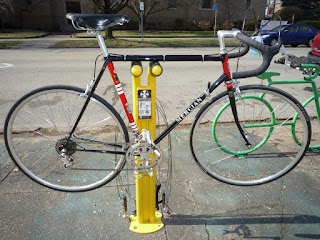


Well, that's what someone's selling on e-Bay.  And it has a vintage Campagnolo gruppo.  The price is good--and the bike is my size, more or less.  Hmm...Do I want a Mercian---that looks like a Motobecane?


31 May 2018

A Day of Spring

It's been called "The Year Without Spring."

Here in New York, people talk--and complain--more than most farmers about the weather.  This year, though, they do have reason to complain:  Since March, we've had days or weeks when it's been cold and wet punctuated by a day or two of summer-like heat.

Yesterday was one of the few spring-like days we've had, at least temperature-wise.  The mild air, though, was humid, probably because of the heavy clouds that covered the area until mid-afternoon, when the sun broke out.  Also, we had march-like wind.

So what did I do?  I pedaled into that wind--to Connecticut.  Yes, I cranked most of the 70 kilometers (43 miles) up to the Nutmeg State into a 30KPH wind.  I had to remind myself of that when I arrived, more tired than I'd been on previous rides this year.  I thought I'd grown soft over the past couple of weeks, when papers, exams and other end-of-semester duties made me more sedentary than usual.


At the Veterans Memorial in Greenwich, the flowers--and flags--were in full bloom.  Unfortunately, my camera wasn't up to the occasion (or I'm the most technologically incompetent person writing a blog today).  Fortunately, Arielle was.*


Of course, the ride back was--if you'll pardon the expression--a breeze.  

*--I'll be riding more of Dee-Lilah, my new Mercian Vincitore, soon.  I have ridden her a couple of times, mainly to test things, but I wanted to save her for the nice weather--and my birthday, for which she is my gift to myself!

30 May 2018

Gooooal?

The World Cup football tournament starts in a couple of weeks.

Perhaps even the US, which didn't qualify, is getting ready:


Will the "ball" go through the" posts"?  If it does, and Andres Cantor isn't there to announce it, does it count as a goal?

Interesting, what you can see on a bike ride in the Bronx!

29 May 2018

From Cars To Bikes, On A Highway

Twenty-five or thirty years ago, streets in Chinese cities were as choked with traffic as the Long Island Expressway (a.k.a. The World's Longest Parking Lot) during peak commuter hours.  The difference was, of course, that the throngs of people going to work or school in Beijing or  Shanghai weren't enclosed in four-wheeled motorized vehicles.  Instead, they were astride bicycles:


Westerners--especially Americans--were amused by the idea of "bicycle traffic jams."  The Chinese who were part of them, like people stuck in any kind of traffic jam, probably weren't (or so I would assume).  But within a decade or so, their problem would be "solved":  Instead of being surrounded by cyclists on their way to work, they would be stuck in automotive gridlock that would make a trip across the George Washington Bridge at 8 am seem like, well, a bike tour along la route departementale 618 from France to Spain.

Now some folks in Beijing are realizing that driving isn't always as quick or convenient as they'd hoped. They, especially the young are--you guessed it!--getting back on their bikes.

I haven't heard any reports of bicycle traffic jams like the ones the city experienced when few people had cars.  But city planners might be anticipating them--or responding to folks who want their bike commutes to be safer and more convenient.  To that end, construction on a 6.5 kilometer bicycle highway is set to begin this September.  

Because it will cross major highways, much of the bike route will be elevated.  There will be no traffic lights, and its use will be restricted to pedal bicycles without motors.  Moreover, it will have a gated entrance--a feature borrowed, along with others, from the world's longest elevated bike path in Xiamen.

That southeastern Chinese city was mainly a port city until three decades ago, but has morphed into a center for financial services and technology.  It has also become, interestingly, the city frequently cited as "greenest" or "most livable" in the country.  The influx of highly-educated professionals probably has something to do with that.

Those are the same sort of people who live and work in Zhongguancun, the district in the northwestern part of Beijing where the new bike highway will be built.  It's often called "China's Silicon Valley."  If the area's scientists, engineers, venture capitalists and creative people are anything like their counterparts in California, it's not surprising that they've taken to cycling--and want better conditions for it.

What I find fascinating is that the move from bicycles to cars and back has happened more or less within a generation.   Here in the US, the cycle has taken a century--that is, in those areas where there are people who ride to work and school, and for pleasure.

28 May 2018

Ride And Remember

Is there a Tomb of The Unknown Cyclist?


One could be forgiven for believing such a thing, especially after the way the Cynergy Cycling Club (of southern New Jersey) publicized its Memorial Day ride two years ago.

Whatever you do today, I hope you ride and remember!

27 May 2018

What's The Difference Between Security And Entanglement?

These days, we see lots of bicycles on the "Web".

But unless you let your bike sit too long without riding it, you're not likely to see a web on your bicycle....


From The Web Awards


...unless you had to park and forgot to bring your lock with you!

26 May 2018

When Nutley Ruled The (Cycling) World

Even during mountain biking's peak of popularity--about a quarter-century ago--most mountain bikes never saw a trail or dirt, let alone a mountain.

These days, something similar might be said about track bikes.  If someone is obsessed with building a bike that's NJS-compliant, chances are that it will never go anywhere near a velodrome.

It's just as ironic that as track or fixed-gear bikes have grown in popularity, interest in track racing, as a participant or spectator sport, doesn't seem to be on the rise.  Most fans, at least here in the US, seem to focus their attention on major road races like the Tour, Giro and Vuelta.

Time was, though, when track racing was more popular than any other sport in the 'States, with the possible exception of baseball.  In fact, the top cyclists earned even more money than guys who could hit or throw spheres of stitched horsehide.

There are few remnants of that time because, for one thing, most of the great riders of that time have passed on.  Also, most of the venues in which they rode are gone.

One of them was located about a morning's ride--half an hour on a ferry and two on a bike--from my apartment.  In its day, it hosted some of the best cyclists of the day--including Alfred Letourneur, the French rider who set speed records on both sides of the Atlantic, as well as local heroes like Charlie Jaeger and Frank Kramer.

Jaeger and Kramer hailed from Newark, then a major cycling center.  After that city's velodrome closed in 1930, a businessman and cycling enthusiast from neighboring East Orange tried to keep the torch burning, if you will, and built a new velodrome on the site of a former quarry.

Joseph Miele's track, the Nutley Velodrome, opened on 4 June 1933.  Twelve thousand fans turned out that day to see Letourneur and Jaeger, as well as other star riders like Italy's Giovanni Manera, Belgian Gerard Debaets, Franz Deulberg of Germany and Brooklyn's own Paul Croley.


For two years, Nutley was "an international dateline," according to Michael Gabriele, whose book, The Golden Age of Bicycle Racing in New Jersey was published in 2011.  "All the wire services covered the events," he explained.

But around 1936 or 1937, the popularity of six-day and other track races declined, and the velodrome was used for boxing matches, midget car racing and other sports.  The venue's last event was held on 15 September 1940, and it was demolished in 1942.

A few months before the Nutley Velodrome's last event, another event was held that would continue New Jersey's status as one of cycling's US centers:  the Tour of Somerville.  For decades, it was the single most prestigious bike race in America, and one of the few that attracted riders from abroad.  It also ignited the popularity of the criterium, which continues to be the most popular type of cycling race.

Though the Nutley Velodrome, which opened 85 years ago next month, lasted less than a decade, it still holds an important place in American cycling.  Nutley provided thrills for thousands of people, but in recent years the city has done more to calm people down:  Until 2013, it hosted the US headquarters of Hoffman-Laroche, where Valium and Librium were developed. 


25 May 2018

Because They Are Able

The Place de la Concorde is one of the world's most impressive public squares.  The first time I saw it, however, I tried to imagine it "covered with blood," as more than one writer of the time described it, as members of the French nobility and royal family were guillotined.

I have seen other beautiful places with terrible histories.  Sometimes their histories make their beauty all the more wonderful, in much the way lilacs are (and smell even better) because they bud and bloom at the end of winter.  

(Last week, I clipped some that were growing in a lot near the RFK Memorial Bridge.  They're some of the latest I recall picking or buying, and their scent was all the more intoxicating because it seemed our winter simply would not end.)


All of this brings me to Elliot Lake, Ontario.  It's in the northern part of the Canadian province, above Lake Huron.  I've never been there, but the photos I've seen are enticing.  I hear that people go there for outdoor sports--or to retire.

Not so long ago, however, it was known as the "uranium capital of the world."  Just about any kind of mining is dangerous to the miners and the place being mined:  All you have to do is look at parts of West Virginia and Southeastern Colorado to know that.  The Elliott Lake area is no exception.  Though it doesn't seem to have suffered the environmental devastation some mining areas incurred, plenty of miners and other workers were injured, disabled or even killed while doing their jobs--not to mention those who got sick from uranium poisoning.  

Well, today some cyclists are going to set off from Elliot Lake and ride 170 kilometers to two other former mining centers in Ontario:  Massey and Sudbury.  What's interesting about this ride is that some of the cyclists were themselves injured or made ill on their jobs.  Friends and family members will ride with them, in part to support injured workers, but also to protest the cuts in benefits paid to such workers.

24 May 2018

How I Wandered Into Common Sense

If you're a regular reader of this blog, you have seen a few photos of me riding, and a few more with one or more of my bikes.

Now, if you are a truly committed and dedicated reader of this blog (translation:  if you are reading this blog when you should be riding), you might have wondered what I look like when I write these posts.

Well, today I am going to reveal all:


All right, so I don't have an outfit like that.  And if I did, why would I wear it while writing--or riding?

That is actually a figure of Thomas Paine writing "Common Sense".  At least, that's how someone remembers or imagines him writing it.

So, apart from the fact that he wrote one of the most important documents in American--and possibly human--history, why am I showing an image of him?

Well, this afternoon I snuck out for a ride.   I got done what I needed to get done and scarcely a cloud was besmudging the sky.  So, out I went, with no particular destination in mind--although I kinda sorta started on one of my routes to Connecticut.

But I took a couple of turns I wouldn't normally take and found myself pedaling up and down hills in unfamiliar parts of somewhat familiar towns.  After riding up a hill to avoid traffic headed for the Thruway, I came upon this:

Yes, Thomas Paine lived here.  No, he didn't ride that bike.


Thomas Paine lived in this house from 1802 to 1806.  It was originally one of several buildings on a 300-acre farm the State of New York gave him for his service to the state, and the cause of independence.  The State had seized the farm from Frederick DeVeaux to punish him for treason:  He worked as a spy for the Crown during the Revolution.

The house contains a number of artifacts as well as some charts and dioramas describing, among other things, the roles Jews and the descendants of the Huguenot settlers of New Rochelle played in the Revolution.  (The city was founded by Huguenots from La Rochelle, France, who were escaping the wars of religion.)  

One interesting fact I learned is that the Hessians weren't actually mercenaries, at least in the way we define that term today.  They were conscripted into their national armies, and the Landgrave (Prince) could basically use them as he saw fit.  In essence, Landgrave Frederick II of Hesse-Cassel rented those troops to King George III--whose grandfather, George II, just happened to be Frederick's father-in-law.  And Frederick pocketed the money.

Today the house sits in a part of New Rochelle with sprawling houses and lawns.  In addition to the old house, another remnant of the farm remains


one that suggests, if obliquely, one of Thomas Paine's occupations before he became a pamphleteer:


Yes, he was a sailor.  No doubt he guided boats in or out of another stop on my trip this afternoon:


Mamaroneck is just a couple of towns up from New Rochelle on the western end of Long Island Sound.  Not surprisingly, its harbor is a favorite spot for walkers and idlers, as well as a destination for cyclists.  And a wedding party or two has been known to be held there.

I can't help but to wonder whether Thomas Paine was looking out toward that expanse of water when he envisioned a new nation free from the rule of a king on the other side of the ocean.

23 May 2018

He Couldn't Run Away. But He's In The Running.

Was he practicing for a Darwin Award?

According to police reports, Brady Michael Phipps pilfered some merchandise from a Verizon store in Redding, California.  From there, he ran across Hilltop Drive and entered a Dick's Sporting Goods store, where he climbed a ladder and stashed the stolen items in the rafters.

Police officers came in.  Now, I know that outside my hometown of New York, Big Box stores are even bigger than they are here.  Still, I think that Phipps' chances of eluding capture weren't the greatest, especially since multiple officers were in the store.

That, apparently, is not what he was thinking. He grabbed one of the bicycles the store was selling and rode it through the aisles and racks in an attempt to escape.

One officer knocked him down.  He continued to resist arrest, but the officers managed to take him into custody and book him.  The charges:  suspicion of obstructing an officer, petty theft...and violating parole.Turns out, he's been booked into the Shasta County jail twelve times since 2017.  

Brady Michael Phipps, from the Shasta County Sheriff's Office


Maybe I've lived a sheltered life, but small-time shoplifting doesn't seem like the smartest thing to do when you're on parole.  Nor does stealing a bike in an attempt to elude cops.  

Also, I can't help but to think that in the confines of a store, being on a bike might've made it easier for the police to capture him, if for no reason than it was easier to knock him off the bike than it would've been to tackle him while he was running.

Brady Michael Phipps made it easier for some police officer to take him out of circulation.  At the rate he's going, he'll take himself out of the gene pool and therefore be a candidate for the Darwin Awards.