28 June 2021

Here Comes The Heat

 Apologies to George Harrison for the title of this post!

This morning I took an early ride. It was pleasant, if not challenging:  a bit more than an hour in a loop that took me down to Sunnyside and Woodside, then up past LaGuardia Airport and Citifield, along the World’s Fair Marina promenade—on Tosca, my Mercian fixed-gear bike.

As I pedaled the promenade, I was really glad that I took an early ride.


The haze in the distance was a harbinger of the heat that would blast us later.

I have to admit that I’m following the news about the heatwave in the western part of the US and wondering whether it will reach us.  As hot (and humid) as it is here in New York, our weather is spring-like compared to theirs.

If that heat makes it here, I guess I’ll have to start my rides earlier.

27 June 2021

More Signs

 When I’m on my bike, I can’t help but to notice signs.  As I mentioned in earlier posts, sometimes their meaning isn’t clear, or what their creators might have intended.

A case in point is what I saw the other day on Point Lookout.


I mean, it’s nice that the village now has a bocce court.  But what do they think the players are doing after games?

The day before, I pedaled to Connecticut, which involves crossing the RFK Memorial-Triborough Bridge.  Like most other crossings in this area, it has a sign for those who are thinking about going to the other side—and I’m not talking about Randall’s Island.

As someone who’s lost people to suicide, it’s not something in which I normally find humor.  I must admit, however, that I chuckled when I saw this.


“Don’t waste the trip.  Take Don Jr. with you.” I would prefer, though, that Darwin would find a way to deal with the son of El Cheeto Grande—and the big cheese himself.

26 June 2021

Pour Boucler La Boucle

Demi Vollering


The women’s version of the Tour de France was called, for a time, la Grande Boucle.  Literally, it means “the big loop”and referred to the fact that, like the men’s Tour de France, the race took riders around the country.

The name now seems weirdly appropriate.  Yesterday, La Course was held.  It’s billed as the feminin  version of the Tour,  At one time, the Boucle could legitimately make such a claim, as it was a multi-stage race.  Now, however, it’s a one-day prelude to the men’s Tour—as it was during the early years of the Boucle.

You could say the race a boucle la boucle (has come full circle), though not in the way cyclists or women’s sports advocates might have hoped.  

After expanding to 15 stages in the 1990s, organizational and logistical problems led to its shrinkage and, for a few years, it’s cancellation.  The race and riders were always scrambling for sponsorships, and race organizers scheduled stages in whichever cities contributed money.  That led to long and awkward transfers between stages.

For the record, Dutch cyclist Demi Vollering won yesterday’s La Course, held in the northwestern French town of Mur-de-Bretagne, about 130 kilometers from Brest, where the Tour started yesterday.


25 June 2021

Easing The Shock Of Gravel

 What are some telltale signs of an early '90s mountain bike?

One might be bar ends, especially those from Onza and Club Roost.  Another could be early Rock Shox or Manitou suspension (or "telescoping," according to the Brits) front fork--or a sprung rear triangle.  


Another popular form of suspension was built into handlebar stems, such as the ones from Girvin or Softride.  I never tried one myself, but I suspect they didn't do nearly as much to dampen shock--and make a ride more stable--as a suspended fork or rear triangle.  I suspect, though, another reason why they fell out of favor is that spension forks led to two nearly-simultaneous changes:  28.6 mm (1 1/8") steerer tubes replaced 25.4 (1") as the new standard, and threadless headsets became an industry standard.  Girvin and other suspension stems were of the "quill" type and manufacturers couldn't, or didn't want to, make threadless suspension stems.


Well, in the cycling world, very few ideas actually die.  SunTour made cassette hubs and indexed shifting in 1969.  I've never seen them, but from what I've read and heard, they worked well. The market wasn't ready for them, however, until Shimano re-introduced them a decade and a  half later.  Likewise, suspension stems didn't end up as road- (or trail-) kill.  A recent trend has brought them back from the dustbin of cycling history.

Gravel biking is credited for showing that wider tires aren't only for mountain bikes or beach cruisers.  It also has renewed interest in minimalist, lightweight forms of suspension.  Most suspension forks are simply too heavy, and too dampening, for gravel bikers' tastes.  Those forks also have straight or nearly-straight blades, which negate the benefits of the low-trail bikes' geometries.  And I don't know how feasible rear-triangle suspension is for a gravel bike.


During the past couple of years, some new suspension stems have appeared on the market.  Unlike Girvin and Softride, the new Shock Stop and Kinekt models are threadless stems.  The former uses swappable elastomer inserts, rather like a few of the 90s suspension forks and USE fork.  Not coincidentally, Shock Stop offers an elastomer-equipped seatpost to complement its stem. Kinekt, on the other hand, uses a parallelogram system reminiscent of the Soft Ride.


In my limited experience with suspension systems, one problem I found with elastomers is that dirt, moisture or cold stiffened them.  A mechanical system like Kinekt might be heavier, but more reliable, and avoids the problem of manufacturers who discontinue replacement elastomers (or go out of business).  I am not making any recommendations, as I have never used any new or old suspension stem.  I do find it interesting, however, that a new trend in riding has given an old idea a new lease on life.

24 June 2021

Cycling For Our Lives

Whenever I went to Florida during the summer, I woke up before sunrise so I do a ride before midday. Or, if I started later, I would plan to spend a couple of hours at the beach, or in a shady area, at lunchtime.  The idea was, of course, to avoid the midday heat and humidity, which could be unbearable.

For me, that was not an imposition.  If I did an early ride, I could have lunch and go to a movie or to stores--which are air-conditioned--with my parents during the hottest part of the day.  And who could complain about spending time on a beach in Florida?

But for others, the consequences of extreme weather are more extreme.  I'm hearing stories about parents who, during the current record-breaking heat wave in much of the western US, wake their kids up before dawn just so they can go outside for a couple of hours before the heat is not only unpleasant, but sometimes dangerous.  

Others, though, face much worse, including the loss of their homes, their livings or even their ways of life.  As an example, aboriginal peoples in Arctic regions will lose everything from their culture to their traditional diets if the ice continues to melt at current rates.  Likewise, people in coastal regions all over the world face displacement, and in still other regions, famines could result from crop or fishery failures or destruction.

James Baldwin once remarked that the future is like heaven:  People exalt it, but they don't want to go to it now.  He was talking about the Civil Rights struggles, but he could have been describing the current situation:  People know we need to change our ways, but not now.  Policies for reducing greenhouse emissions set goals for 2050 or some other year many of us won't see.  During the past few years, however, we've seen and heard evidence of accelerating climate change and environmental degradation. 

"The worst is yet to come, affecting our children's and grandchildren's lives much more than our own."  That blunt assessment came from an unlikely source:  a report compiled by the United Nations' Intergovernmental Panel on Climate Change, a group of scientists who have been studying the issue.   The 4000 page document is not scheduled for official release until February 2022, but Agence France Presse received a draft yesterday.


From Ecoist magazine


I have devoted a post to this report because there is hardly a better reason to encourage cycling.  One of the chief causes of climate change is fossil fuel combustion, and one of its main sources is motor vehicle use.  I understand that, given the realities of how too many places are designed, and the ways in which some people make a living, some driving is necessary and inevitable.  But every time I ride by a line of SUVs transporting only their drivers, I have to wonder whether they're just going to the store down the street.

23 June 2021

Truck Plows Into Bike Race

He shook hands with, and wished good luck to, a fellow cyclist.

Such a scene is repeated before races all over the world, especially if they are amateur or club races.

Each rider might go home to his or her family or friends after the race.  Or they might share a beer or lunch.

Neither, I reckon, imagined what happened next.

A few minutes after they shook hands, Tony Quinones would witness the other cyclist, whom he had just met, flipped onto the hood of a pickup truck, along with other cyclists and their bikes.

When that truck approached the road on which they were riding, Quinones said he expected the truck to turn toward a nearby parking lot.  Instead, its driver aimed straight for the group of cyclists--and accelerated.

He didn't stop until he hit a utility pole.  Other cyclists pounded on his window, screaming for him to get out.  Instead, he made a U-turn and headed back toward the cyclists.  Quniones feared he'd strike again.  Instead, the driver sped away.

Later, that driver--identified only as a 35-year-old male--was shot by police when he didn't comply with their order to stop.

As many as ten cyclists were hurt, six of them seriously. One is in stable condition.
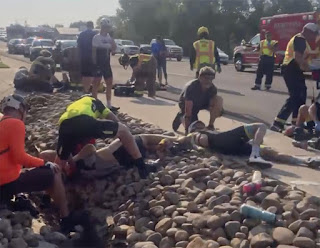

Photo by Tony Quinones


Authorities in Show Low, Arizona--the site of the incident--haven't ascertained the driver's motives.  About all they know is that he didn't fall asleep or have a heart attack at the wheel.

Call me paranoid, but I can't help but to wonder whether resentment and the hyper-politicized environment of the past year and half had something to do with his motivations.  

As more people cycle, and more bike lanes and infrastructure are built, I sense--and have experienced--more hostility from motorists. Some believe we are taking "their" streets from them. I also sense that some see riding a bicycle the way others (or, perhaps, they themselves) see wearing a mask.  A former colleague of mine lives in an area full of Trump supporters and was, and is, ridiculed, harassed or even threatened for covering her face.  Although she's vaccinated, she continues to protect herself because of underlying medical conditions that aren't readily visible.

And it just so happens that Arizona is one of the states where the election was most contentious.  President Joe Biden was the first Democrat the state elected to the White House in decades, and the Secretary of State has been assigned a security detail because of the death threats she's received in the wake of her refusal to overturn the election results.

Of course, I can't speak of the driver's motivations.  But could he have seen those cyclists, or anyone who wears a mask, as an "enemy?"   

22 June 2021

An Epic And CNN

One of the great things about cycling is that you can get from place to place faster than you can walk, at eye level. And you can stop without having to alert a bus driver so you can hop off.  An example is a ride I took yesterday afternoon. I zigzagged through industrial areas along the Broooklyn-Queens border.  Some of the old factories and warehouses have become studios and shops but, thankfully, there's still a lot to see from the street.

You can even witness an epic battle that doesn't involve gangs.


One piece I saw in Bushwick, however, reminded me of old-school hip hop, when it wasvcalled "the CNN of the ghetto.


Is he warning the neighborhood about something?

The world moves on.  Things change--including ourselves and, in some cases, our bikes.  I just hope that we don't lose the spirit of those graffiti murals--and that I can see them simply by taking an afternoon bike ride!

21 June 2021

The Longest Day


 The Summer Solstice arrives today in the Northern Hemisphere. It’s the official first day of summer, and “the longest day.”

Some clubs and individuals have planned “longest day” rides to take advantage of the long stretch of daylight.  I am going to take such a ride later.

In my youth, I did a “longest day” ride that spanned the entire day and state of New Jersey. We began at dawn at High Point, where the states of New Jersey, New York and Pennsylvania meet, and pedaled just over 200 miles to Cape May, about 50 miles south of Atlantic City.. (No, we didn’t go to AC.)

Honestly, I don’t remember much about the ride.  I hadn’t slept the night before because I was so concerned about missing the meetup—at 3am, if I recall correctly—and van ride to the start point.

The flickering of dawn was about the only sunlight we saw that day.  The good  news was that the sun wasn’t beating down on us on that humid day.  The bad news  was that the humidity fell on us—as showers somewhere around Clinton and in a torrent just south of Prlinceton.

Cape May juts into the Atlantic Ocean and Delaware Bay about 50 miles south of Atlantic City. (No, we didn’t go to AC!) The pizza we ate, in large quantities, wouldn’t have passed muster in my old Brooklyn neighborhood or northern Jersey Shore (Long Branch and Asbury Park) hangouts.  And I have no idea of what kind of beer we drank, pitcher after pitcher.  Few things, though, have ever tasted better—or more earned, at the end of the Longest Day.

P.S.  There is an edited version of Saturday’s post on The Daily Kos.


19 June 2021

Juneteenth Ride And Reflection

Today is Juneteenth, the date in 1865 when slaves on Galveston Island, Texas would become the last to learn they were no longer slaves--at least, not officially.

This morning I took a bike ride out to Fort Totten. I wanted to get some miles in before the heat and rain roll in this afternoon.  Plus, I wanted to do something easy after pedaling to Connecticut yesterday.  My morning ride totaled about 20 miles, which I did on Tosca, my Mercian fixed gear.

Just this week, President Biden signed the bill declaring Juneteenth a Federal holiday, which was observed (and offices were closed) yesterday, as today is Saturday.  That means the holiday will be observed on Friday or Monday next year, as it will fall on Sunday.


From the Detroit MetroTimes


As I rode, I reflected on this date.  In my first paragraph, I said that the slaves were officially free. But just how free are African Americans today. I pondered, for example, whether I would have been taking my ride alone--or at all--were my skin and hair darker.  Given the stories I've heard from friends and acquaintances, and of Ahmaud Arbery,  I have to wonder how many African-Americans or dark-skinned Latinx people--or, in some places, Asians--don't go out for a bike ride, a run, a hike or even a walk because they don't know whether they'll make it back.  That could be one of the reasons why African-Americans of nearly all age, education and income levels have worse health outcomes than even poor white people who didn't finish high school.  (In my home state, the Bronx--which is overwhelmingly nonwhite--ranks last in health outcomes of New York's 62 counties.)

If people don't feel free to leave their homes so they can exercise--or shop, go to a library or museum or attend a concert--just how free are they?

That is why I am glad that President Biden made Juneteenth a holiday.  I am all for commemorating it with bike rides and other events.  I just hope that it doesn't degenerate into another orgy of shopping or other excesses, which too many other holidays that should be serious occasions have become.