18 January 2022

Food, Fashion And...Bike Lanes?

This post will be a tale of two cities--without the capital letters. 

They have roughly the same population.  One is the capital of its nation; the other is, at least in some senses, in its country.  They could be said to be rivals because they are renowned for many of the same things:  food, fashion, finance, the arts, education and technology.

Now one of those cities is not only wants to emulate something the other has been doing; it plans to do even more of it.

I am talking about urban bike lane networks.  While Copenhagen and Amsterdam are seen, perhaps rightly, as the most bike-friendly capitals in Europe, Paris is leading the way in creating new bike infrastructure.  It plans to have 680 kilometers (423 miles) of bike lanes in the City of Light and its surrounding areas.  


Rental Bikes by the Duomo Cathedral, Milan.  Photo by Alessia Pierdomenico for Bloomberg


Well, in the city's chief rival for food and fashion--Milan--the City Council has approved a plan that will include 750 kilometers (466 miles) of lanes that will connect not only major areas of the immediate city, but also its suburbs and some rural areas.  The goal of the Cambio Biciplan is to make bicycling the "first and easiest" way of getting around Metropolitan Milan.

One of the motivations for this plan is a problem the city is trying to tackle.  Among Italian cities, only Turin has worse air pollution; both have some of the worst air quality in Europe.  The factors contributing to that toxicity are similar in both cities: population density, industrial activity and automobile density.  That pollution intensifies in winter, when temperature inversions trap pollutants in the lower atmosphere, leaving a toxic blanket of smog.  Also, I suspect that each of those cities shares a problem with Denver: the mountains that surround (Turin) or abut (Milan) those cities also trap some of the pollutants. (Denver consistently has some of the worst air quality in the US.)

So, in the near future, bike advocacy groups may well emulate fashion and culinary institutions in seeing their "capitals" as New York, Paris and Milan!

17 January 2022

What Would Dr. King Think Of Cheap Bikes Or Rich Riders?

Last week, I wrote two posts that might indicate a future direction for this blog.  (Don't worry, I'll still write about my rides, bikes and all things related to them!) One post, about a German study, discussed who is becoming a new cyclist, and why.  The other discussed a mechanics' petition calling for repairable bicycles:  Turns out, most of the new cheap bikes, which are usually the ones bought by people with limited funds, have faultily-designed frames made from shoddy materials and are equipped with proprietary parts that break easily or wear out quickly.  

In brief, those new cyclists on nice new bikes bought in Cannondale, Giant, Specialized or Trek showrooms are mainly people with advanced educations who live in fashionable or gentrifying urban areas.  They might be riding to work or school, or simply for exercise and, as often as not, they are signaling that they care about their health and/or the environment. In other words, they are cycling by choice.

On the other hand, folks buying the cheap bikes, if they're not cycling for the first time in decades and therefore don't want to spend a lot of money,  are buying that big-box special in a big box because they can't afford anything else, including a bus or train pass--if indeed there is a bus or train that will get them from wherever they sleep to wherever they work.

One of the sad ironies--following the logic of the German study--is that we see a kind of social, economic, racial and gender segregation that would have astounded or appalled the man who is being commemorated today in the US:  Martin Luther King Jr.


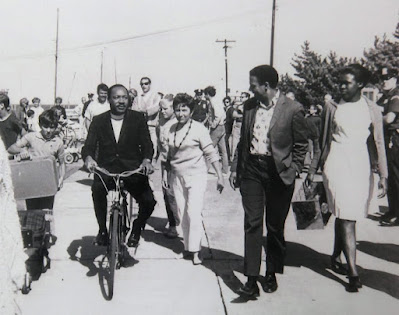
Now, I don't think King would have denounced cycling or cyclists per se:  He was often seen riding, which he probably saw as a way of bringing him closer to some of the people he was trying to help.  And, because he was turning more of his attention to economic justice issues in his last days, I can somehow see him advising bike share organizations on ways to bridge the cultural divides and media representations that cause some people to believe they can't ride because they're not white and don't look good in lycra--or those who harass cyclists because they see us as entitled jerks (the educated riders of the German study) or the scum of the earth (cf. police who are trained to automatically assume that any cyclist in a low-income neighborhood is a criminal).

So...while I wasn't thinking specifically of King, or any activist in particular, when I was writing the posts I've linked in this post, thinking about King today is causing me to realize that my almost half a century of cycling--and nearly two decades of living as a woman--makes it all but impossible not to connect my experiences and even the things I most love (bicycling, reading, writing, food, travel, animals) to questions of justice.   In other words, the work of Martin Luther King Jr is one of the major byways, if you will, of my journey.

16 January 2022

Spinning A Good Ride

When I first got serious about cycling, nearly half a century ago(!), the question was:  Reynolds 531 or Columbus SL?  Sometimes Vitus 971 was included, and within a few years,Tange and Ishiwata (The latter was seriously underrated, in my opinion!) would become part of the discussion.

Later, cyclists argued about whether to ride frames made of aluminum, titanium, carbon fiber--or steel. When serious cyclists said "steel," of course, they didn't mean the gaspipe-grade stuff used on bikes sold in big-box stores:  They were referring to Reynolds, Columbus and Tange (though in new configurations), Dedaccai and other makers.

Today, I am going to settle the question about frame materials, for once and for all.  Or, to be exact, someone more famous (and therefore more of an expert) than me--will give us the answer we've all been waiting for:


By Mike Joos


15 January 2022

It's The Stories That Matter

During the past couple of days, it's been colder (in NYC) than it's been in, probably, a few years. Today is definitely a tomato-soup-and-grilled-cheese-sandwich kind of day. Now, to all of you dear readers in Minnesota and North Dakota, this might be a beach day (on Lake Superior?  the Red River?).  But you have to remember that those of us in the Big Apple, everything is bigger, brighter, dirtier, hotter, colder, and generally more intense, and everybody is tougher, stronger and smarter, than in any other place in the universe.

Of couse, I jested (Is that a real word?), but only somewhat, with my previous sentence.  But like any true New Yorker, that's what I tell myself.  And the tourist bureau wants you to believe stuff like that so you'll tell yourself that you'll never, ever come here--until you do.  And you meet someone like yours truly.  And someone else like me. (Yes, believe it or not, there such people.)  And another.  And another.  Then you go home and tell your friends that everything in New York is bigger, brighter, dirtier, louder, more intense--and more expensive--but, you know, those New Yorkers are rude and gruff but they have hearts of gold.

My late uncle Joe was that kind of person.  He was born and lived in Brooklyn until he was about 60, when he and my aunt moved upstate. He never lost his straight-out-of-Red Hook  (I bawt a boddle uv alluv earl in da staw on toity-toid and toid*) accent--or his sense of humor and generous spirit.  

I am thinking of him now because of a feature article in a local newspaper of a place I've never seen. Uncle Joe was an avid motorcyclist until he couldn't ride anymore.  I don't recall him riding a bicycle but he talked fondly of the one he rode as an adolescent in the 1950s:  a Schwinn Phantom, in black.  He said the bike always "felt right:"  in spite of its weight, "it moved."  And somehow, he said, the gearing felt just right:  "I felt I could pedal into anything!"

Now, perhaps that last exclamation had more to do with his youthful energy than the bike, or anything else--though, I must say, if his bike was anything like the two black Phantoms I've seen, he probably felt like a real badass when he rode it.  I know, I probably would have, too.


Howard F. Gordon of Lower Burrell, Pennsylvania has one of those bikes.  And, I would guess, another, perhaps in another color.  And other bikes from that period, and earlier--over 100 of them!

From what I read in the article and saw in the accompanying photos, all or most of those bikes are of the balloon-tired "cruiser" variety made by Schwinn, Columbia and many other American companies until the 1960s.  He calls his 1951 Monark "the Cadillac of bikes.


Even though he admits he has "too many" bikes, he's always on the lookout for new treasures, at garage and estate sales.  "There are so many bicycles in garages and attics that are worth money," he explains. Whenever he buys a bike, he disassembles it and cleans every part before reassembling and restoring the bike to something like its original condition.


One of his more interesting observations regards the condition of the bikes he finds.  Generally, he says, girls' bikes are in better condition because they were better cared-for. Boys, he observed, usually rode their bikes into the ground.

That observation is part of what keeps him interested in vintage bikes:  the stories, known or imagined, by them.  "Every one of those bikes had a rider who can tell you something about the adventures they took on it," he explains.  "A bike is a kid's first feeling of freedom."  Sometimes kids pedaled their bikes to places their parents never knew they went. (Can you see me and Uncle Joe winking to each other?)  

In case you were wondering, Gordon rides.  "My wife and I go on riding dates," he relates.  "We stop for ice cream.  We enjoy the nice weather.  It's great exercise."

That sounds like a story behind at least one of his bikes! 

*--Translation: I bought a bottle of olive oil in the store on Thirty-third and Third.

Photos by Louis B. Ruediger, for the Tribune-Review

14 January 2022

Egyptian Art Deco Catholic In Jackson Heights

 Jackson Heights is five to six kilometers from my apartment.  I have ridden through it, many times, along various routes.  Still, a ride can lead me to some interesting corner or structure I’d never seen or noticed before.


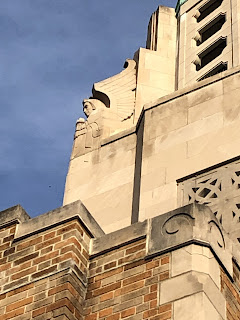
This is one such building.  At first glance, it doesn’t seem out of place: Like most of what is now in the neighborhood, it was built during the late 1920s:  around the same time as the Empire State and Chrysler Buildings. Also, many palatial movie theatres were constructed during that time, just when movies were becoming the most popular form of popular entertainment.  So it would be easy to take this building for a Loews or RKO cinema, especially when you look up.


Those “movie houses” often combined the line structures and geometric shapes of Art Deco with Egyptian motifs. They sound like an odd pairing until you look at them—and you realize that Howard Carter discovered King Tutankhamen’s tomb in the early 1920s, setting off a fad for all things Egyptian just as Art Deco was becoming the most influential style in architecture and design.


That is why this building doesn’t look out of place in Jackson Heights and would look right in parts of the Bronx or Miami Beach, which were also developed around the same time.

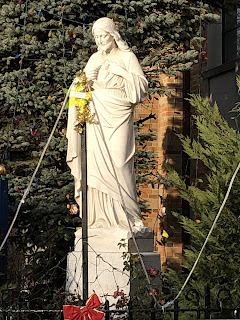
What makes this building so unusual, is this:


I grew up Catholic and have entered all sorts of church buildings and cathedrals here, in Europe and Asia.  I can’t say, however, that I’ve seen any other Catholic Church building—or, for that matter, any other house of worship—that looks quite like this one. 

And to think:  I came across it just because I decided to make a turn, and ride down a street, I hadn’t before.  That is one of the joys of cycling!

13 January 2022

In Philadelphia, You Can Park By A Hydrant If....

Firefighters might be one of the most loved and respected groups of people.  Even they, however, sometimes incur rage for doing their jobs.   As an example, one firefighter told me about the man who showed up at his firehouse, irate.  Turns out, the guy parked next to a hydrant and the firefighters had to damage his car to route the hose and ladder to an inflamed building.

Philadelphia has one of the largest communities of bicycle commuters in the US.  In one part of the city, nearly a fifth of all commuting miles are done by bicycle. Riders in the City of Brotherly love have similar complaints to their peers in other cities.  One is the lack of bike parking spaces:  Especially in central areas, where many work or go to school, cyclists find full racks when the try to park their bikes.

So, you ask, how are those two stories related?

The common thread was woven when three young people met in graduate school for industrial design. Grace Choi, Corey Jameson and Colin Lew formed an alliance called Team Sophon.  Under that moniker, they submitted a proposal to the Rack 'Em Up Bike Parking Competition.  Along with 16 others entries, Team Sophon's ideas were judged by a panel that included members of the city's Office of Transportation, Infrastructure and Sustainability (OTIS), Parking Authority, Fire Department and other agencies.  Five of  those entries were short-listed, and Team Sophon's was ultimately chosen.


Team Sophon's prototype, called "Harbor,"  would include a designated space in front of a hydrant where cyclists would stop and steer their bikes to the racks. That space--painted green--would be segregated by flexible barriers like the ones used to separate bike lanes from streets. Steel bollocks were initially proposed for the purpose, but selection committee members expressed concern that they could be dangerous in a crash.  And the racks, made from thick steel tubing, would sit under a canopy illuminated by solar-powered lights that would be activated when users enter.

Team Sophon's victory comes with a $3500 prize.  To begin, at least two Harbors will be built: one in West Philadelphia and another in the Old City, near a garage owned by the Philadelphia Parking Authority.

Those facilities will at least make some firefighters and cyclists happy.  Motorists, maybe not so much.


12 January 2022

Can't Fix Your Bike? It's An Environmental And Economic Justice Issue

When I first became a dedicated cyclist--nearly half a century ago!--bicycles were touted as environmentally friendly alternatives to gas guzzlers.  At the risk of sounding like someone who pines for "the good old days," I'll say that most adult cyclists of the time were not merely "signaling" their concern for our habitat; they, as often as not, made other choices in line with their values.

Today, while some are "bikewashing" their lifestyles, there are some who are genuinely concerned with such matters as human-enhanced climate change.  So, while they might cycle to work or school (or, at least to the bus or train that takes them there), recycle the bottles, cans and other packaging they use during their lunch breaks and, perhaps, try to buy as local as possible, they could unwittingly be making at least one choice that undermines their other efforts.

To wit:  Their bicycles might be part of the problem.  Now, I don't mean to be pick on such folks.  Most people, especially if they're buying their first bike in decades, aren't familiar with how or where their bikes are made, or anticipate the normal wear and tear--and repairs--that come with regular use.  They also assume that "new is better," which is sometimes, but not always true.

Most mechanics, or anyone who's been cycling for, say, two decades or more, won't necessarily agree that "new is better."  It's true that almost any derailleur made today shifts better than almost any made fifty or forty years ago.  And, depending on your point of view, some other parts today are more efficient, convenient or lighter than their predecessors.  


But one problem is that most of those parts--or the bikes themselves--are not built to last because they're not made to be fixed.  "If I get a Huffy from the '90's, chances are I can actually make repairs to it," says Mac Liman. It will be heavy, but at least "the steel will hold together," she explains, and the result will be a serviceable, if inelegant, piece of basic transportation.

Liman would know:  She's been a mechanic for 19 years, the past  14 at Denver's Bikes Together shop.  Those Huffys were sold mainly in big-box shops like Wal-Mart, which sold out all of its bikes in March 2020.  "We're already starting to get those bikes," Liman lamented, "And we can't fix them."

One problem is the shortage of available parts caused by COVID-19-related manufacturing and supply chain disruptions. But an even bigger issue is simply the poor quality of those bikes:  Their frames crack and they have non-standard parts that can't be replaced at a reasonable price. "I've seen bearing cups that just fall out of hubs, so there's no way you can rebuild them," Liman says.

Her experiences have led her to join a petition calling for bikes to be repairable.  Its earliest supporters were mechanics at non-profit bicycle co-operatives and training programs like Recycle-A-Bicycle.  Cheap bikes from big-box stores are often donated, or brought in for repair, to such shops.  And people who buy bikes from such places are looking for something good and reliable for not very much money.

Now I have to admit that I was once one of those elitist bicycle snobs who snickered when I saw a department-store bike.  But I now understand that people buy such bikes, not because they're stupid, but because they don't know (yet!) why they should--or can't afford--to buy something better.

So, making unrepairabe bikes, like making almost anything else that's disposable, contributes to degrading the very environment some for which some folks are signaling their support by being seen on a bike.  And, as with so many other environmental issues, it's also a matter or social and economic justice, because it affects the working poor even more than those who buy those shiny-new Linuses and Brooklyn bikes.

11 January 2022

Cologne Study Tells Us Who's Riding

 Two people, about the same age, have just achieved a major career--and financial--milestone. They decide to purchase a new vehicle for their commutes, and for pleasure.  One buys a 'Benz.  The other opts for a Brooklyn bike--or, if they want to splurge, a Brompton.  Why?

Well, an answer can be found in a University of Cologne study on cycling patterns and trends.  The Mercedes-Benz customer I've mentioned could be someone with a successful business or who's just scored a major contract.  The bike buyer, on the other hand, probably is more educated, more likely to be in a profession--and to live in an urban area.


Image from REI


According to the University of Cologne study, those bike buyers accounted for nearly all of the increase in cycling in Germany from 1996 through 2018.  At the end of that period, people with a high level of education (Arbitur) were cycling, on average, 70 minutes per week:  twice as much as they were pedaling at the beginning of that era. That also means they're riding three times as much as rural dwellers without Arbitur, whose cycling habits were all but unchanged.


From We Love Cycling


So what accounts for the differences I've mentioned?  Well, according to the study, people with Arbitur are more likely to live in urban areas--like Cologne--where cycling to work, school or shop is a practical alternative.  On the other hand, people in rural and suburban areas have to travel greater distances and buy more and larger items--which are harder to transport on bicycles--when they shop.

But, according to the study--conducted by sociologist Dr. Ansgar Hudde--there is another reason, perhaps more compelling to the educated folks themselves, why they choose to two pedals and two wheels rather than a gas pedal and an internal combustion engine for transport or other short trips.  It isn't cost:  Most  people with Arbitur, at least in Dr. Hudde's study, can afford a car or to use mass transit.  It also isn't time, though I have to wonder whether the experiences of folks in Cologne (or Hamburg, Berlin or Dusseldorf) parallel those of folks like me, who can ride to work in less time than the same trip would take on a train or bus, or even a car.  

Rather, a chief reason why those educated urban dwellers ride their bikes is the same reason why corporations quote Dr. Martin Luther King in their advertising:  signaling.  Those companies want to signal that they care about diversity and are otherwise socially conscious.  Likewise, urban folk with Arbitur are sending a message that they care about the environment or health, just as the guy with the shiny new Mercedes or Lexus is showing friends, family and others that he's "made it."

(Now I'm recalling that not so long ago, a stereotype of professors was that they drove Volvos.  They were more expensive than most American cars but, from what I understand, very well-made.  But their rather stodgy appearance contrasted with Mercedes polish or the frankly ostentatious looks of American-made luxury cars like the Cadillac Eldorado or Lincoln Continental. So those academic folk were signaling that they weren't signaling that they'd "made it.") 

Anyway, I found the Cologne study interesting for several reasons--one of which is how closely its findings parallel what I've observed here in the US.  While some people--men, mainly--in poor and immigrant communities ride bikes for cost or convenience, once their economic circumstances improve (and many of them move away), they buy cars, abandon their bikes and never look back.

10 January 2022

A Trek To World Domination?

 Until a certain manufacturer started fabricating its wares in Wisconsin, Schwinn was regarded as the best American bike brand.  In fact, many, including Sheldon Brown, argued that it was the only U.S. marque with even a pretense of quality.

That reputation among the few dedicated adult cyclists of the pre-Bike Boom era was based largely on the fact that it made the Paramount, which was constructed from Reynolds 531 tubing and Nervex lugs and ridden by the US Olympic Team. But Schwinn also had a high reputation among the general public—it was the first brand that came to most people’s minds—mainly because it was the first company to have a network of authorized dealers.  Those stores were usually spacious, clean and well-lit and resembled automobile showrooms more than the small, cluttered shops that usually catered to cyclists.

(Some would argue—with justification, I believe—that the network, which helped the company prosper for a couple of decades, ultimately factored in its undoing. That is the subject of another post or article.)

It looks like Trek—the Wisconsin-based company I mentioned at the beginning of this post—is trying to replicate that sort of network and, perhaps, to wield or share control of the quality  (i.e., not sold in Walmart-type stores) bike market.  

Last week, Trek announced it bought Race Pace’s seven Baltimore locations.  That is the latest in a string of acquisitions of other local and regional chains as well as independent shops that were Trek dealers.


Commenters on an industry chat group are, naturally, speculating on what Trek’s buying spree—which has also spread, if to a lesser degree, to UK shops—might mean. Some see it as a strategy for competing with Specialized, which has followed a similar strategy for about two decades.  Others see it as a bid to dominate the market.

But they would probably agree with the commenter who said, “I think if you are a Trek dealer and Trek is not actively trying to buy your store, then your store is not part of the long-term plan.”

Could we see a future in which most bike shops belong to one of the Big Three or Four—say, Trek and Specialized and, perhaps Cannondale and/or Giant, in much the same way that, during the 1980s and ‘90’s, most bookstores were part of Barnes & Noble, Waldenbooks or Borders?

09 January 2022

Hide Or Seek?

There are two interesting, and opposing, theories about urban street bike parking.

According to one school of thought, you should leave your wheels in the most visible place possible.  The thinking behind this is that would-be thieves are less likely to do their work if they're being watched.

The other notion is that the bike should be hidden, camouflaged even.  The idea behind that, I believe, is that a thief won't take what he or she can't see.

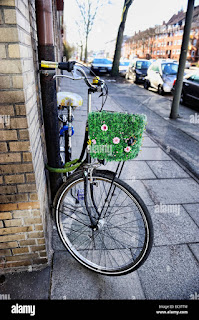
Perhaps the owner of this bike can't decide:


Or is the bike playing peek-a-boo?