09 March 2022

These Bikes Could Emancipate Them, Too.

Yesterday was International Women's Day.  I'll repeat one of her most famous quotes:  "Let me tell you what I think of bicycling.  I think it has done more to emancipate women than anything else in the world."

Now I'll tell you what I think. Bicycling can do more to emancipate people than almost anything I can think of. People who use their feet to spin bike pedals rather than to pump gas pedals can free themselves from the costs--financial, physical and mental-health-wise and environmental--of excessive automobile dependency.

Also, I feel that cycling can change a person's outlook in other ways.  Though there's always that group of cyclists who's obsessed with having the newest and latest gear (I was once one of them!), I find that cyclists are, on the whole, more conscious of how and what they consume and less status-conscious than other people.  And, I like to believe, we are more socially conscious.

At least, we try to be. Like all people, we have our blind spots, individually and as a community.  One of those areas, I believe, is people with disabilities.  Sure, we can volunteer to take blind or deaf people on tandem rides or lead rides for those who have mild- to- moderate cognitive disabilities. (I am using terminology as I understand it.  If you are a professional in those areas, or simply more knowledgable than I am, please feel free to point out any inaccuracies.)  But, on the whole, cycling isn't very accessible to those who have impairments of one kind or another.

Among them are a group of people that, I blush to admit, I very rarely think about:  those who live with dwarfism. (I only recently learned that some consider it derogatory to call such people "dwarves."  Every now and again, a person with dwarfism will try a kid's bike and find it very unsatisfying.  I can't blame them:  Most kids' bikes aren't made to be responsive and, frankly, too often look cartoonish.  

Another, more important, reason why child-sized bikes don't work for adults with dwarfism is that they aren't built like children or scaled-down versions of average-sized adults.  For example, people with disproportionate dwarfism, or achondroplasia, have torsos similar in size to people without the condition, but shorter arms and legs.  So, while a child-sized bike might provide them with the proper seat height, if they ride it, they will be as cramped as if they were stuffed into a car trunk.

Designing a bike for a person with dwarfism is therefore difficult because, "You can't just lop bits off," says Steve Scott of  the Dwarf Sports Association.  That is what his father did for him mainly because there weren't any better alternatives.  His father motivated him to stay in the sport, but too many other people with dwarfism abandon it or never take it up in the first place because of the difficulties in getting bikes to fit, among other things.


Islabike Joni24


So Scott collaborated with Islabikes of the UK.  After several years of work, they've come up with the Joni 20 and 24 for adults and the Cnoc 14 and 16 for kids.  The numbers in each model name refer to the tire size, and the frames are proportionately sized.  The Joni is a 7-speed with a SRAM rear derailleur and trigger shifter; the Cnoc is a single-speed (freewheel) with a fully-enclosed chainguard.  In addition to their specially-designed frames, both bikes also have brake "micro levers" as well as cranks specially made in shorter lengths.


Islabike Cnoc 16


At the moment, the bikes are being sold only in the UK and for delivery in Europe. One hopes that they, or bikes like them, will become more widely available so that people with disproportionate dwarfism, wherever they are, can be liberated as Susan B. Anthony would have women, and all people.

08 March 2022

Stacking Up

 Around 1980, “aerodynamics” became all the rage in bicycling.  Certainly, there are advantages in shaping parts to minimize air drag for some riders, particularly time trialists.  But studies have revealed that, for the most part, the benefits of aerodynamics accrue only to cyclists riding at more than a certain speed—45 KPH, if I remember correctly.

Still, that didn’t stop bike and component manufacturers from making “aerodynamic “ bikes and parts for loaded bike touring or even “aerodynamic” versions—which looked as if they’d wandered into a vise—of Huffy and Columbia ten-speeds sold in department stores. 

Now, it seems there is a trend in the opposite direction. At least one European team is making part of its rolling stock less aerodynamic.

I’m not talking about the bikes.  Rather, a new anti-aerodynamic principle is being applied to the team cars and vans that follow riders during major races.  Typically, these vehicles carry one or two spare bikes and, perhaps, some wheels and other parts.  But, lately, some teams have been stacking five or more bikes atop those cars and vans.


The reason, apparently, is to create a slipstream for the riders ahead of them.  Not only does a taller stack, like a higher wall, blocks more wind.  But, because the vehicle is moving, it pushes air ahead of it—in the direction of the riders.

As far as anyone knows, neither the Union Cycliste Internanationale (UCI) nor any other governing body has a rule against this practice.  If the UCI were to pass such a rule, I have to wonder if it will do as much to deter bad behavior as, oh, their anti-doping rules.

07 March 2022

Acorn Bags: Nuggets Of Beauty And Function

Some would argue that a true artist, or even artisan, wants the focus to be on his or her work rather than him or her self.  They may have a point:  After all, while some (yes, I include myself) might be interested in the details of  Rodin's, Picasso's, Shakespeare's, Louis Armstrong's or Georgia O'Keefe's personal lives, what matters is the images, sounds and words they left us.

So I could understand Ron's wish not disclose his wife's name, or even his last name.  For the past fifteen years, they've done work that has, rightly, attracted attention in the cycling word--and outside of it. 

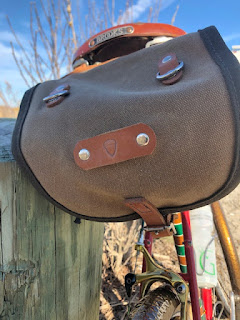
One day this past fall,  when I was crossing underneath the Hudson on the PATH train with Dee-Lilah, my custom 2018 Mercian Vincitore Special, two young couples asked me about the bike, with its lovely (if I do say so myself) paint finish, intricate lug work and a couple of nicely-made bags--or, if you prefer, pieces of bicycle luggage.


A male member of one couple, and a female of the other, seemed to be regular cyclists and wanted to know about the bike itself.  But the male member of the other couple--who told me he rides, but is "not a bike fanatic"--was interested in the bags because, he said, he's thinking of leaving his regular job and becoming a full-time maker of custom bags of all kinds.  He could see the workmanship on the bike's bag, he said, and was curious as to who makes such items.


A couple of weeks ago, when I pulled into a service station/convenience store on Point Lookout with Zebbie, my 1984 Mercian King of Mercia, someone asked about both the bike--which, while its lugwork isn't as intricate as Dee-Lilah's, has a unique paint job--and the bags I'd attached to it. 

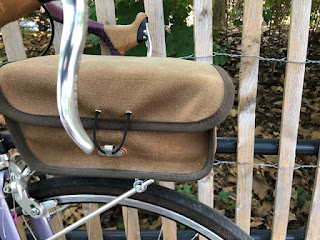
In both instances, folks were curious about bags, or bicycle luggage, made by Acorn Bags in California.  I've been using them (along with Ruthworks Bags, which I've mentioned in previous posts) for about three years.  They haven't quite developed the "patina" canvas bags like it acquire because, since I have several bikes (and a bunch of bags), there isn't one, or even a set, that I use every day.  But I feel I've ridden the Acorn bags enough to comment on them.

First of all, I want to say that while they might seem expensive in comparison to mass-produced bags of synthetic materials,  Acorn's prices are actually quite reasonable, especially when you consider the materials used and the hand work that goes into making them.  

More important, the materials and workmanship on them are impeccable. The canvas is as strong as it is aesthetically pleasing, and the stitching is consistent and formidable.  Currently, Acorn's bags are made in three colors:  black, gray and brown.  Every couple of months, Acorn makes a run of bags in one of those colors.  They post a list of colors and anticipated availability dates on their website, so if you have your heart set on a particular color or model, sign up for their mailing list.

While I like all of their colors, my particular preference is for brown.  It looks both earthy and classy, like a leather bag or pair of boots made in a similar color.  Also, it's similar to a color in which Specialites TA-LaFuma bags were made for several years.  


I've been using their medium randonneur bag, front "bread box" bag and two of their saddle bags.  With the exception of their "bread box" bag, all are inspired by classic French and English designs.  It's hard not to notice the similarities between the Medium Rando bag on the front rack of Zebbie and its Specialites TA counterpart, the Medium saddlebag on that bike and the Berthoud "banana" bag, or the saddlebag on Dee-Lilah and some Carradice or Brooks designs.


But Ron and his wife don't seem content to copy traditional designs as much as possible.  They seem to have thought of how those beautiful, durable bags can be made more convenient.  For example, the Medium Rando bag can be used, with light loads, without a decaleur as long as you mount it on a rack like the Nitto M12 or M18 or Velo Orange racks with the "tombstone."  (The "bread box" bag is also designed to be ridden with such racks.) With somewhat heavier loads, you might want the decaleur, but I've managed to stabilize the bag with a small bungee cord attached hooked onto the D ring on either side and passed underneath the rack.  And, while I haven't tried it yet, I imagine that it might be possible to use the large saddlebag--with an exterior size and inner capacity like that of the Carradice Barley--without a support because of the ways in which the bag is reinforced in key spots.


The "breadbox" bag is somewhat smaller in capacity than--and, perhaps, not as "classic" looking as--the Rando bag. But one thing I really like about it is the way it fits on the rack:  Its profile almost perfectly matches the platforms on the Nitto M18 rack on Dee-Lilah or the Velo Orange Constructeur front rack on Zebbie.  And, its flap provides easy access to all of the bag's contents, though I advise tightening the elastic closure.

In all, I can confirm all of the good things you've read and heard about Acorn bags.  They are worthy of the finest handmade frame and will add a touch of class and personality to a mass-market bike. But, most important, Ron and his wife have managed to make functional improvements to beautiful classic bags--and to imbue them with the pride of true artisans and artists.

06 March 2022

Food For Thought

Definitions of a good cycling diet have changed and diverged during my nearly-half century of dedicated riding.  Around the time I first started taking rides more of more than an hour from my family's home, Eddy Mercx broke the hour record in Mexico City on a day when he downed toast, ham and cheese--all of which he brought from his native Belgium--for breakfast.

Over the years, we've been told not to eat meat or dairy during a ride, or at all.  We've also been advised that we should consume carbohydrates and  everything from GORP (good ol' raisins and peanuts) to Himalayan foxtail millet cakes slathered with  yak butter touted as  the ideal cycling foods.  

Deep down, though, we all  know there's one food all cyclists--in fact, all people--love:


Aside from showing a woman eating a slice while cradling a box of pizza on her exercise bike, this photo is funny in other ways.  For one, it could only be from the '80's:  When else would someone wear sport an outfit or hairdo like hers?  Or wear a waist pack on an exercise bike?  

But eating pizza:  That's always permissible.  It's one of the few things that never goes out of style, among cyclists or anyone else!   

05 March 2022

Riding In A Yellow Submarine

I'm not a fan of science fiction or books, films or TV programs about paranormal phenomena.  In spite (or maybe because) of that, one of my favorite TV programs of all time is The X Files, which ran from 1993 to 2002I mean, what's not to like about a program about two FBI agents--one of whose belief in the paranormal may have been influenced by his sister's claimed alien abduction, and the other a medical doctor and skeptic who is nonetheless a devout Roman Catholic.  I guess that's what I liked best about it:  I never would have envisioned such characters, but I found them--and, more important, their relationship, which changes over time--interesting and believable.

I got to thinking about that because, lately, there seem to be more reports than usual of unidentified objects. Perhaps the Russian invasion of the Ukraine has something to do with it:  Such as a conflict could escalate too easily, and who knows what kind of weapons might be sent where, and what they might look like.

Turns out, you don't have to look to the sky or even the sea for objects that, to someone, might look as if they pose a threat to national or international security.  At night, on the side of a lonely road, one might find--a yellow submarine? 


Or a spaceship?  That's what one driver thought, for a moment, he saw along US 41 on Florida's west coast.  

The spaceship/submarine was, of course, a recumbent bicycle:  one in which you ride in a semi-supine position.  I have never tried one myself, for the very reason the driver and investigating officer mentioned:  They can be difficult to see, especially in traffic.  I would like to try one some day because I can see the advantages of such a bike for certain kinds of time trials or land speed records--or for people who have the strength and endurance to pedal for long distances and periods of times but, because of injuries or infirmities, may have trouble mounting or straddling a more traditionally-configured bicycle. 

What made the bicycle really strange, I think, was the fairing, which is most likely for aerodynamics.  But if I ever try a recumbent, I'm not sure I'd want to ride with a fairing for the same reason I have no desire to get into a submarine, even if one of my favorite bands has sung that we're in one whether we like it or not!

04 March 2022

He Doesn't Support The Invasion. He Just Wants To Build His Bikes.

French authorities have seized a cargo ship near the English Channel port of Boulogne sur Mer.  That vessel is owned by a Russian bank whose CEO is the son of his country's former chief intelligence officer and served as prime minister. At the other end of the country, les douaniers grabbed a Russian oligarch's superyacht parked for repair in a Mediterranean port.  The country's security officials believe that the boat's owner, as well as those of other vessels docked in the area, were preparing to flee to the Maldives, which doesn't have an extradition treaty with the US or most European countries.

In New York and London, officials exploring ways to take the co-ops, condos and other real estate owned by Putain-, I mean Putin-connected billionaires in those cities.  And measures have been taken to keep those uber-rich Russians from accessing their bank accounts, stock holdings and other assets.

Such moves make headlines.  So does talk about sanctions, though the actual and possible results of them aren't as widely known.  One reason is that those sanctions, which devalue the ruble and prevent Russian exports of everything from natural gas to vodka, affect everyday people who are mostly invisible to anyone outside of their communities and country.


Among those everyday Russians is Dmitry Nechaev.  You probably haven't heard of him, but you may have seen his work:  He custom-builds titanium frames under the name Triton. Perhaps not surprisingly, most of his sales are to cyclists outside of his home country. But, during the past twelve weeks, he says, he hasn't received a single foreign order.  

Although the sanctions--which prevent him from receiving payments via PayPal, among other things-- would explain the past couple of weeks, his sales drought began earlier, when rumors trickled out of Russia.  Even if he'd had orders, he wouldn't have been able to build frames because, like his frame-building peers in the US and other countries, he depends on foreign suppliers.  Paragon Machine Works, a frame-part supplier, could not ship to Nechaev and other Russian builders and manufacturers because Federal Express and DHL stopped shipping to Russia.

So Nechaev, who emphatically condemns the Russian invasion of the Ukraine (and is of Ukranian and Jewish heritage via his mother) realized that he could no longer work from his Sochi shop.  Because he holds an Israeli as well as a Russian passport, he fled to Tel Aviv last week.  He has bought a car to pick up fellow Russian refugees from the airport and plans to leave a note at the Wailing Wall in Jerusalem.

He plans to continue building his bikes, but he doesn't know where just yet.  It's difficult not to believe he's thinking of the USA.  In the meantime, he's asking for support from the industry.  Specifically, he appealed to the fact that he, like them and nearly everyone else, opposes the invasion and expressed hope that suppliers and customers in the US and other countries will continue working with him.


03 March 2022

Made To Maim

 In many rural areas of the southern and western United States, the only way between Point A and Point B is a highway.  Cyclists and pedestrians therefore must share these thoroughfares with motor vehicles, including 18-wheel trucks, running at speeds of 60 MPH or more.

In some of those areas, as cycling has grown more popular, shoulders or lanes of those highways have been designated as bike lanes.  This causes resentment—and aggressive behavior—from motorists angry that cyclists are “taking “ their roads.

Sometimes the aggressive behavior includes driving that endangers cyclists—and, often, pedestrians and other drivers.  I’m talking about drivers who swerve into the lanes, brush by or throw debris at cyclists and shine their high beams into the eyes of cyclists riding in the opposite direction.

Other times, though, the aggression is more passive and includes breaking glass containers and leaving other hazardous debris in bike lanes. Some of the perpetrators may believe they are merely inconveniencing cyclists by puncturing their tires.  But from what I’ve seen and heard (especially from people who don’t know I’m a cyclist), some are trying to injure, or even kill, us.

How else can anyone explain leaving these on the bike lane of a Mesa, Arizona highway:


Several hundred of these spikes, called caltrops, were found in that lane—after a woman riding with a group flatted.  Fortunately for her and them, she was riding behind them at moderate speed.  But had she been riding in front of someone—say, if another rider had been “drafting” her—or riding at a higher speed, the results could have been catastrophic, given that the spike punctured her front tire.

I can’t help but to think that a more dire outcome was the intention of whoever left the caltrops:  Unlike broken glass and other kinds of debris, a caltrop always points one sharp spike upward from a stable base, no matter how it’s placed.

People have also reported finding these weapons of destruction on local hiking trails.  Tonto National Forest encourages anyone who finds them to report it to susan.blake@usda.gov  or 602-225-5200. Caltrops or other hazards in the highway bike lane should be brought to the attention of the City of Mesa.

02 March 2022

The Law, In All Of Its Majestic Equality

In Le Lys Rouge (The Red Lily), Anatole France wrote, "La loi, dans un grand souci d'egalite, interdit aux riches comme aux pauvres de coucher sous les ponts, de mendier dans les rues et de voler du pain."  The law, he says, in all of its majestic equality, forbids the rich as well as the poor from sleeping under bridges, begging on the streets and stealing bread.

Inspector Javert, who pursues Jean Valjean in Victor Hugo's Les Miserables, could have uttered that--without irony or sarcasm.  France, though, meant it as an indictment of folks like Javert and what they represent:  They might pursue justice "blindly," but the wrath of it falls more on the poor and otherwise vulnerable and marginalized:  Not only are we less able to defend ourselves if we're stopped, arrested or charged; we are more likely to be arrested and charged--or simply stopped and questioned--whether or not we committed any offense.

(Trust me, I know from whence I speak.*)

Moreover, those stops and arrests do little to nothing to enhance public safety and do little to nothing besides undermining people's trust in the police and the criminal justice system.  

The previous paragraph isn't my opinion, or that of a public defender or judge in the Bronx.  Rather, it's a paraphrase of the rationale a State Attorney in Hillsborough County--at the western end of Florida's I-4 corridor, politically one of this country's quintessential "swing" areas--gave for a new policy.

Six weeks ago, Andrew Warren issued a memo sent a memo saying that it's no longer appropriate to prosecute someone stopped on a bike if their only offense is that they resisted an officer without violence.  In that memo, he noted that while Black defendants make up a third of misdemeanor cases in the county, which includes Tampa, they represent 49 percent of all "resisting without violence" arrests.  And more than 70 percent of such cases that resulted from a bike or pedestrian stop had Black defendants--even though roughly one in five county residents is Black.


These findings did not surprise Black residents of the area, especially in light of a 2015 report documenting that Tampa police stopped disproportionate numbers of cyclists, 80 percent of whom were Black.  Those numbers were so egregious they drew the ire of the Department of Justice and helped to popularize the lament, "Bicycling While Black."

Warren's memo became the basis for his declaration that it is no longer appropriate to prosecute those stopped on bikes if their only charge is resisting an officer without violence, and as long as the "stop" is not related to some other, more serious, offense. While the number of affected cases, he admits, is small (about 40 or so per year), it will not tie up police time and other resources that could be deployed against crimes that are true threats to pubic safety, but also make, if in a small way, the criminal justice system fairer by not burdening poor and Black cyclists, most of whom are young, with criminal records for minor offenses.   

After all, the law, in all of its majestic equality, not only allows the poor as well as the rich, Black as well as White, and female as well as male (or genderqueer) to cycle or simply go about their business.  At least, it should. 

*--More than once, I have been stopped by police officers who had absolutely no reason to do so.  Once, in Lido Beach, Nassau County, the officer claimed I was "riding between cars'--where in the books such a law is embedded, I don't know--when, in fact, I was riding on the shoulder of the road, to the right of the two lanes of traffic.


01 March 2022

Just Another Road Obstacle

In my decades of cycling, I've toured, commuted, road raced, ridden off road and done just about anything else one can do on a bike besides BMX or Polo.  And, on the roads and trails, I've encountered all manner of obstacles. They include include debris blown or thrown into bike lanes, mounds of snow, motor vehicles parked or idled and animals ranging from a chipmunk (I never would run over anything so cute!)  to a pack of  macaques and, of course, the random cat, dog or deer.  

(I have never had to stop for an elephant, but I did see one from about five meters away on a ride in Cambodia.)

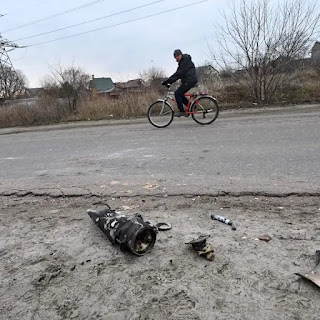
Of all the living beings and inanimate objects that have found their way into my line of riding, I must say that I have never encountered any like this:


Now, tell me: What do you do when a tank is blocking your trading ride?  Do you turn around or ride around it?  If you choose the latter, do you curse at the driver or remind him/her/them to give you three feet (actually, a meter, since the cyclist is in Kyiv) of space?  Does a three-foot/one meter rule exist there? If it does, would a Russian tank operator adhere to it?


28 February 2022

How Should The Cycling Community Respond To The Ukraine Invasion?

 In response to the Soviet invasion of Afghanistan, the United States and several other countries (including, ironically, the then-new enemy of the US, the Ayatollah Khomieni-led Iran) boycotted the 1980 Summer Olympics, which were held in Moscow.

Some  hailed the boycott as a strong statement of principle.  Others thought they unfairly penalized athletes, particularly those in sports for which the Games are the most prominent stage—and the end-point of athletes’ careers, especially in sports as diverse as gymnastics, wrestling and, yes, bicycle racing (at least for countries like the US that didn’t have professional racing circuits).

That last point makes an article in Velo News all the more interesting and relevant. “Where does the line end and begin between sports and politics?” Andrew Hood wonders.

Specifically, he relates that question to Putain’s, I mean Puto’s, I mean Putain’s, invasion of Ukraine.  Very astutely, he points out that while the Union Cyclisme Internationale’s  condemnation is laudable, it actually won’t do much to pressure the Russian sports establishment or government, let alone Putin himself.


While there are a number of world-class Russian cyclists—in particular, sprinters—there aren’t any major UCI-sanctioned road races—which, let’s face it, are the most-followed events in the sport—in Russia.  Moreover, there aren’t any major bike brands with a sizable market outside the country.

In brief, a full-on boycott by the UCI or any other cycling body will do more to hurt individual Russian racers, just as the 1980 Olympic boycott penalized individual athletes—and, arguably, accomplished nothing beyond a retaliatory boycott of the 1984 Los Angeles Olympics.