18 March 2022

Bikes Not Going Their Way


For the past two years, you may have had difficulty in buying a bike—the one you want, anyway. If you managed to find your machine of choice, you probably had to pay more for it than you would have in 2019.

You may have had a similar experience in procuring parts to repair, refurbish or update your favorite ride—or even if you were looking for accessories like water bottle cages or a pair or riding glasses or gloves.

The reason for the situation I’ve described is the COVID-19 pandemic. It disrupted supply chains and even closed production facilities at the very moment when folks took up cycling as a way to avoid buses and trains or to get exercise or mental cleansing in a way that allows for social distancing.

But at least you could get something you could ride, whether or not it was your first choice, as long as you were willing to pay and could wait. 

The folks in Russia aren’t so lucky. (Ok, the Ukrainians have it worse, but bear with me!) The way things are going, they won’t be able to get bikes, parts, accessories, apparel—or much of anything—at all.

A number of bicycle and bike-related companies have suspended their operations in the country. The list includes SRAM, Trek, Specialized, Tern and Quality Bicycle Products (QBP). Also, leading bicycle tire manufacturers Continental, Michelin, Pirelli and Bridgestone have joined their ranks.  

Those companies, no doubt, were motivated by the difficulty of doing business in Russia due to banking sanctions and that some shipping companies, including Fed Ex and UPS, have stopped delivering to the country.  But one representative also says “there’s a social aspect too” in the companies’ actions.


17 March 2022

A Joycean Parade of Cyclists

 Today is, of course, St. Patrick’s Day.

Since I am not Irish (at least, not to my knowledge!), I will not tell you whether or how to celebrate this day.  I will say, however, that so much of what we’ll see today is what I’ll call Celtic Kitsch. (Confession:  I was in college before I knew that the “C” at the beginning of “Celtic” is pronounced like a “k.”  Until then, I’d been pronouncing the word as “sell-tick,” like the basketball team in Boston.) The truth is, few can agree on what is “authentically” Irish. Although schools teach the Gaelic language, nearly everyone speaks (beautifully) the language of their colonizers.  And, apart from Roman Catholicism with a strong monastic tradition—which the young are largely abandoning—we actually know little about pre-Anglo Irish culture and history.

James Joyce understood as much.  Although all of his writing is set in his native country—which he lived away from for most of his adult life—he is not part of a “Celtic revival.” Instead, he used Ireland—Dublin, mainly—as a lens through which he could explore how people move through life, and how it moves through them—and, perhaps most important, our minds re-assemble it all, whether in images or language—or simply deal live with it as the chaos it is.  

Some have said that Joyce’s works—specifically Dubliners and Ulysses—are therefore to literature what Picasso’s Cubist paintings are to art.  Others have called him the first “cinematic” writer.  I agree with both, and would add that his narrative style is like a bicycle ride:  Whenever I take a ride, even one I’ve done hundreds of times, I see not only people and things I haven’t seen before, but a building, a city block, a tree or a seashore from an angle or in a different kind of light (or darkness) from what I saw on that same ride on a different day.

Martina Devlin, Darina Gallagher and Donna Cooney seem to understand as much.  On Sunday, they participated in a Dublin St. Patrick’s Day parade that includes a procession of 100 cyclists dressed in Ulysses-themed Edwardian clothes. They took spectators on a journey through places in the book.


Martina Devlin, Darina Gallagher and Donna Cooney (Photo by Norma Burke)


Cooney, the artistic director of the Dublin Cycling Campaign (now there’s a job I wouldn’t mind having!) said this year’s bicycle procession and St.Patrick’s Day parade are particularly special because February was the 100-year anniversary of Ulysses’ publication.  But the essence of the event might have been best summed up by Devlin, a writer whose speech included an excerpt from the novel and began with this:  “One of the landmark days in my life was when I learned how to ride a bike.”

“I felt as if I were on the road to somewhere.”

As were the cyclists and marchers in the Dublin parade, 100 years after Ulysses came into the world.

16 March 2022

Agonizingly Rewarding

I've cycled in the Green Mountains, Adirondacks, Catskills, Sierra Nevada, Pyrenees, Alpes Maritimes and the Alps of France, Italy and Switzerland.  I've also done some challenging climbs in places like the Greek island of Milos, where the road up the mountain, I think, was first built long, long before I was born and simply paved over.  

I don't know whether that climb was tough (but rewarding) because of the less-advanced state of engineering at the time it was first carved out, the hot weather or my age.  But it felt nearly as arduous, at times, as one stretch of the Col de Portillon, on the Spanish border.  I climbed it--and was both terrified and exhilarated by the views from the guardrail-less virages--on a bike loaded with full panniers.  I don't know whether that stretch--about a kilometer of a 10 kilometer climb --was steeper than the most vertical stretches of the Alpe d'Huez or Col d'Agnel (a.k.a. Colle d'Agnello: It's on the Italian-French border) but I remember a group of people applauding me when I made it to the top. 

Well, there is one climb that claims to put those, and all others, to shame.  Every year, the Mount Washington Auto Road Bicycle Hillclimb takes cyclists to the top of the highest peak in the Northeastern United States. The route can lay claim to one of the world's steepest climbs:  The average grade is 12 percent; extended sections rise at 18 percent and for one part near the end, cyclists have to pump their way up a 22 percent climb.  

When bumper stickers proclaim, "This car climbed Mount Washington," you know it has to be quite ride for cyclists. (The road is closed to auto traffic on the day of the ride.)  What makes the ascent all the more laborious is the weather, some of the most severe and changeable in the world. For years, the race was held in September, but cold, wind, rain and snow caused organizers to move it to August--where there is still a chance of starting off in typically summer-like conditions but pedaling through cold, wind and freezing rain before reaching the top.


At the start of the 2017 ride. Photo by Joe Viger


Mark Greenleaf would know.  He plans to participate for the 35th time when this year's edition is held on 20 August.  

In 1983, he was living in Providence, Rhode Island when, one day, he grabbed the mail before going out to dinner with friends.  Among that day's delivery was a copy of Bicycling! magazine, in which he noticed an article about the ride.  "After a couple of beers, we dared each other to do it," he said of his friends at that fateful dinner.  The following year, he did it for the first time.

After each climb--which he completed--he always felt it was "agonizingly rewarding."  I could say the same for the climbs I've made.

15 March 2022

An Early Sign?

Under a canopy of wizened limbs


They rise from catacombs of winter horizons

Fit For An Emperor Or Empress’


 Beware the ides of March.

Those words are, of course, Shakespeare’s:  A soothsayer emerges from a crowd to warn Julius Caesar in the Bard’s eponymous play.

In much of the Northern Hemisphere, Spring is about to arrive.  It is a time of change:  Many of us look forward to longer periods of daylight and, yes, warmer weather.  But it’s also a time other changes, some of which are already underway. 

Anyway, I typed “ides of March bicycle” into a Google search window just to see what would come up.


This Ides of March bicycle chain bracelet is fit for an emperor or empress*—or, at least, the King of the Mountains.


*—What is a gender-neutral term for emperor or empress?  

Who but I—or a transgender or non-binary historian—would ask such a question?

14 March 2022

A Messenger For Equality

March is Women's History Month.  As I've mentioned in other posts, the bicycle--as Susan B. Anthony herself said--has played an important role in liberating women. It led to a revolution in the way we dress--freeing women from corsets, hoopskirts and bustles--which, in turn, gave us more independence and mobility, not only into the physical places where we could go, but also in what we could do for paid work (or whether or not we could do paid work at all!) as well as in our free time.

It also took us on our path toward something that, in the US, only men were allowed to do from 1776 until 1920--and a right given only to white men until 1865. I am talking, of course, about voting.  Almost nobody would dispute that when women were able to partake of the other liberties I've described, it made it possible for even the most conservative men to realize that we have the powers of discernment derived from life experience that give us at least the same ability to decide what is best for our selves, families, communities and nation as the other 49 percent of the population.  

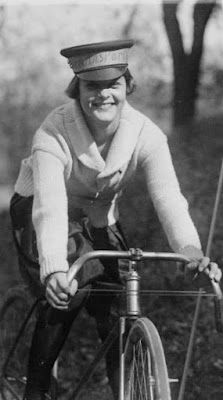
What can't be overlooked, however, are the mundane tasks women performed as part of the project of achieving the right to vote.  Here is a bike messenger--in bloomers, one of the sartorial innovations wrought by women on bicycles--at work for the National Women's Party headquarters:


From the National Women's History Museum

Okay, I'll admit that today's post is, at least in part, an excuse to post that image!  She looks about as happy as anyone I've seen in doing her work.  And well she should have been.

13 March 2022

Sunday funnies, funny bicycle images, folding bicycles

 I have ridden several folding bikes but have owned two. One was  a Dahon Vitesse 5 on which I commuted for about a year and a half. The other was a 1970s Chiorda I found in the trash on a Jackson Heights curbside. I rode the bike a couple of times before I gave it to a local mechanic who gave it to his girlfriend.

Neither of those bikes bore any resemblance to this one:


12 March 2022

The Future of Bike Parking in Your Neighborhood?


In October, I wrote about a bicycle parking locker the Brooklyn startup Oonee installed by Grand Central Station.

Now, the company’s founder, Shabazz Stuart (cool name, isn’t it?) is taking his idea “on tour,” if you will.  Yesterday, the parking pod was brought to Manhattan’s Meatpacking District, where it will remain for a month.  Following that, it will go across town to the Lower East Side and Union Square before crossing the bridge in June to Stuart’s home borough of Brooklyn, where it will spend a 29-day “residency” on Vanderbilt Avenue—near Barclays Centre, Atlantic Terminal and the Brooklyn Academy of Music.  Finally, it will trek up to my home borough—Queens—and my neighborhood, Astoria. At each location, the city’s Department of Transportation will grant access to a spot on the curb for 29 days.

The mini pod is free to use but requires an Oonee membership, which allows access by a key fob or mobile app.  

Although its scale, at the moment, is small, Stuart calls it “ powerful step forward.” He notes that this pilot marks “the first time any big city in the United States has had a secure bicycle parking facility on the curb.” He plans to expand his idea to other parts of the city and to cross the Hudson to Jersey City and other parts of the Garden State.


11 March 2022

Pit Stops In The Pelican State

One of my recent posts is titled “Paint Is Not Infrastructure.” Too often, planners and policy-makers act as if painting lines on a road shoulder makes a bike lane, and that bike lanes are the beginning and end of bicycle infrastructure.

At least some folks in Louisiana understand as much and are enlisting business owners.  Bike Baton Rouge and Bike Easy, advocacy organizations in the state’s capital and largest city (New Orleans) are partnering to create a network of emergency pit stops for cyclists in their cities.

The two groups are working to secure sponsorships from ten businesses in each cities.  The money will be used to purchase emergency supplies that will be housed in bundles housed at the sponsors. 


The plan is to form a web of businesses where cyclists who need spare parts, air for their tires or even sunscreen can stop.

This, I believe, could help to ease the anxiety some people feel when they consider commuting or even recreationally.  As an example, I’m often asked, “What if you get a flat?” or “What about the weather?” when people learn that I pedal to work, school or anywhere else.

I also can’t help but to think that at least one business owner will see an opportunity.  If someone riding to work or school stops to pump a tire, get sunscreen or simply to rest at, say, a store, there’s a good chance that cyclist will return to shop.

10 March 2022

An Eagle Lands At A Repair Station

As a transgender woman, it's ironic for me to say that I was once an altar boy--or Boy Scout. Today, they are known as "altar servers" and "Scouts."  But in my time, those positions, if you will, were open only to the young of the male gender.

Anyway, while I enjoyed some aspects of Scouting--which included the opportunity to earn merit badges for bicycling and reading, two things I have always loved to do-- I got distracted, if you will,  and therefore never attained its highest distinction:  Eagle Scout. However, Mason Tiller of Gulf Breeze, Florida recently achieved that milestone.


One requirement for attaining Scouting's highest rank is a community service project.  Tiller came up with something I wish I could've thought of:  building a bicycle repair station.  To do that, of course, he needed to find a spot, the necessary equipment--and funding, which he solicited from local businesses and individuals.

Whatever else one might think of Scouting, I think it's great that the definition of "community project" has expanded and that the role of bicycling doesn't begin and end with earning a merit badge. 

Note:  The article I linked has a paywall.  I wrote as much as I could about Mason Tiller, who deserves recognition for his efforts, as I could glean from searches.