In the middle of the journey of my life, I am--as always--a woman on a bike. Although I do not know where this road will lead, the way is not lost, for I have arrived here. And I am on my bicycle, again.
Listen to the news, and you’ll hear employers recount their woes in recruiting workers. Some are offering incentives, such as cash bonuses and flexible schedules.
And housing. At least one employer—a bike shop owner—is offering his next mechanic free use of a house he owns.
Some might think that having some of the world’s most breathtaking scenery as a backdrop to one’s riding—and anything else in one’s life—might be reason enough to take a job at Cycles of Life in Leadville, Colorado. And, of course, there are the added perks of industry discounts and the opportunity to blend passion and profession.
Turns out, those last two bonuses don’t carry as much currency as they once did. Cycles of Life proprietor Brian Feddema placed a classified ad for a head mechanic/service manager nearly a month ago in Bicycle Retailer And Industry News (BRAIN). He is offering free use of the 500 square foot house, within walking distance of the shop, in addition to pay of $20-25 hour and spring and fall performance bonuses, partly in the hope of casting a wider net. “There is no one currently residing here in Leadville with the knowledge, skill set and drive we need,” he explained.
He once had a mechanic who stayed for seven years until “he moved away with his girlfriend.” But, he said, mechanics typically stay for a couple of years because “most don’t consider it a profession.”
Jenny Kallista, president of the Professional Bicycle Mechanics’ Association, said this is the first time she’s heard of an offer like Feddema’s. Ron Sutphin, the United Bicycle Institute president, “can only recall one recruitment offer that included housing.” That one, he said, “was some time ago, in Hawaii,” where the notoriously-expensive housing market is rivaled (at least in the US) only by San Francisco, New York and Los Angeles and perhaps a few other cities.
In addition to the reasons Feddema articulated, I can think of another why he’s offering free housing. It has to do with another “perk” he can’t offer: Bike mechanics and shop service managers can’t do their work remotely.
Putain's, I mean Puto's, I mean Putin's invasion of Ukraine has sent a tide of refugees across Europe. It won't be long, I think, before the waves reach American shores.
Traditionally, refugees, like other arrivals from faraway lands, land in large cities like New York, San Francisco and Chicago that may already have communities of the new arrivals' compatriots. But more recently, people who've fled wars and other disasters, manmade and otherwise, have been resettled, at least for the time being, in smaller communities away from the major metropoli. One major reason is housing costs, especially for families. But, I think it might be easier for some folks, especially if they come from small towns or rural areas, to find their way in such communities.
Also, in a smaller city or town, people are more likely to come into contact with new arrivals. While there might be resistance at first, it might also be easier for longtime residents and emigres to get to know each other--and be willing to help them.
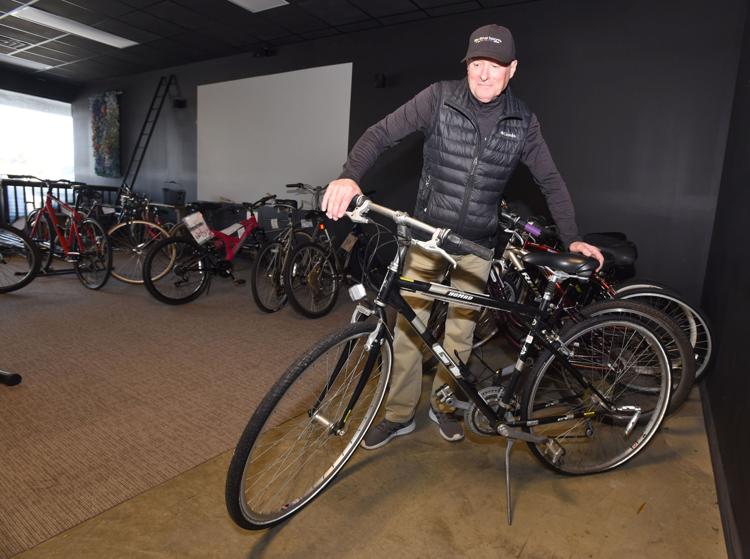
So I was happy, but not surprised, to learn that folks in Owensboro, Kentucky have been collecting, repairing and distributing gently-used bikes to their new neighbors.
Holly Johnson, a Physical Education teacher in Apollo High School, is also a member of Bicycle Owensboro. Her organization solicited the donated bikes, and Be Real Sports Cycling & Fitness repaired them. Owensboro Health donated helmets, lights and locks that will be distributed with the bikes.
Johnson said that recipients will get a safety demonstration, along with information about the Greenbelt and other places to ride in town, with their bikes. Also, they will fit their bikes and helmets and be sure "they know how the gears on each bike work, and that they understand the local bike signage," she pledged.
Larry Myles, owner of Be Real Sports Cycling & Fitness and a member of Bicycle Owensboro, with a bicycle that will be given to a refugee student. Photo by Alan Warren, for the Messenger-Inquirer.
She hopes that the bikes will help the students and their families in their everyday lives. Some of those bikes will be used by more than one person in the family. So, while the bikes are being distributed as spring break is about to begin, she hopes to do a second round of donations "for younger kids" before the summer.
She understands that the bikes not only provide a means of transportation and recreation, but are also a way for new arrivals to get to know their new surroundings. That's why, whenever I go to a place where I've never been before, one of the first things I want to do is take a bike ride.
If you buy a new bicycle with hand-operated brakes in the United States, it will most likely be set up so that the left lever operates the front brake, and the rear is activated by the right lever. That setup is that is mandated by the Consumer Products Safety Commission. My own bikes are set up that way because, even though I am a "minority" in some senses, in another, very important area, I'm very much in the majority: I'm right-handed. (Please don't infer anything about my politics, or any other preference of mine, from that!)
So, I suppose, was whoever made that CPSC regulation. It makes perfect sense if you're right-handed, because the rear brake is inherently less powerful, in part because of its longer cable, than the front. Therefore, it takes more hand force to achieve a given level of braking force, or even to modulate, the brake.
I might also assume that Carol Penkert is right-handed. She is suing Costco Wholesaler and San Diego e-bike company Phantom because, she says, her machine was set up in violation of CPSC mandates. But she isn't merely playing a "gotcha!" game. Rather, she claims, the setup caused her to flip over the handlebars when she hit the brakes. As a result, she lost her right eye and suffered a number of facial fractures.
She wasn't aware of the setup until the mechanic servicing the damaged bike spotted it. The suit alleges that Phantom knowingly shipped, and Costco knowingly sold, her the bike, which she bought fully assembled, without any warning that it had an irregular setup.
The Paris-Roubaix race is often called "L'enfer du Nord": the Hell of the North. This "classic," a long one-day road race, is held early in the Spring and has run through all kinds of weather, from snowstorms to heat waves. It also includes mud and some of the roughest cobblestone roads in Europe. Many riders who excelled in other kinds of races avoided Paris-Roubaix, or didn't fare well in it: Bernard Hinault, arguably the most dominant racer not named Eddy Mercx (and, like Mercx, a five-time Tour de France winner) entered P-R only once. He won, but vowed never to ride it again, in part because the tendinitis that afflicted his knees was aggravated by the vibration of the cobblestones and the weather
If P-R is the "Hell" of the North, Belgium's Ghent-Wevelgem might be its Purgatory. The annual race winds through Flandrian towns anc countryside and includes those notorious those notorious Belgian cobblestones that challenge the best dental work as well as other parts of riders' bodies.
The Paris-Roubaix and Ghent-Wevelgem are, like other classics including Milan-San Remo, considered Tour-level (elite) races. For decades, they were dominated by riders from northern and western European countries like Belgium, France and Italy. Since the fall of the Soviet Union, riders from former Bloc countries have made their mark, as they have in the Grand Tours (Tour de France, Giro d'Italia, Vuelta a Espana). So have cyclists from the Americas, mainly the US, Canada, Mexico and Colombia.
For a long time, observers believed that the first non-European or American riders to establish a presence in the European racing circuit would come from Japan, which has long had a strong tradition of cycling. Also, China looked ready to become a cycling powerhouse because they have done so in other sports and it, like Japan, has a long tradition of cycling.
Perhaps they, or some other Asian country, will infiltrate the ranks of Tour-level riders. But, perhaps not surprisingly, the latest cyclist to interrupt the European hegemony has come from a place that, however quietly, has been turning out other world-class athletes.
Yesterday, Biniam Girmay defeated favorites Christophe Laporte of France and Belgian Dries van Gestel in the latest edition of Ghent-Wevelgem. The 21-year-old hails from Eritrea, an East African country across the Red Sea from Yemen. He rode with a mastery and discipline that belied his youth: Although he mastered the cobblestones, he left enough in the tank for a perfect sprint finish.
Biniam Girmay (l) celebrates his victory. Photo by Kurt Desplenter, for Agence France- Presse.
Perhaps this is a sign that the World Championship will one day live up to its name--in cycling as well as other sports.
Every once in a while, an animal crosses my path while riding. Usually, the creature is a cat or dog who darts away when I get within a few feet. When I've ridden in Florida, little green lizards played "chicken" with me as I rode along the paths and sidewalks. In Cambodia, macaques sat guard on the side of the road as I pedaled between the temples of Siem Reap. And in Laos, an elephant stopped and stared at me and the couple with whom I rode in and around Luang Pr'bang.
Only once did I have a too-close encounter with an animal: On the return leg of a ride to Point Lookout, a cat (black, no less!) charged into my path and glanced off my front wheel--something I've never experienced before or since. I tumbled into the rear of a parked car and ended up with bruises and a couple of days' worth of pain, but no serious injury.
At least I was more fortunate than a woman in Argentina. As she pedaled into a Buenos Aires intersection, an ostrich--yes, you read that right--charged into her.
Now, since I have never encountered an ostrich that wasn't caged, I had no idea that they could run so fast: They can attain speeds of 70KPH (44MPH). One thing I know is that an ostrich is bigger than, say, a sparrow. So the force of that earthbound avian's impact knocked that woman, I am sure, harder than the cat who ran into my front wheel in Ozone Park.
So, perhaps not surprisingly, she got hurt worse than I did: The bird, after hobbling, toppling over and continuing on its way, left the woman with a broken wrist and a large cut on her head.
Argentine authorities haven't said what charges, if any will be leveled against the bird. For one thing, the Argentine speed limit is 40KPH (25MPH) in residential areas and 60KPH (37MPH) in urban areas. A review of videos could reveal whether the ostrich--which seems to have escaped from someone's home--was doing its "personal best." Oh, and I have to wonder what Argentinian law says about leaving the scene of an accident.
In previous posts, I have advocated "Idaho Stop," which allows cyclists to roll through stop signs at empty intersections and to treat stoplights as "stop" signs. As the name indicates, it was first codified into law in The Gem State--in 1982. Despite proof that it does more than almost anything else to promote cycling safety--after all, an intersection is the most dangerous place for a cyclist--it's been slow to spread to other jurisdictions.
Now, Colorado might be ready to join them. A few cities and towns within the Centennial State have already legalized it, or modified versions of it. But a bill that would allow the "Idaho Stop" statewide is about to go to Governor Jared Polis' desk, having passed both the state's House and Senate. A spokesman for the Governor did not say whether or not he'll sign it.
Massimo Alpian hopes he does. A lifelong cyclist, he surely understands how such a law will help to make cycling safer by reducing the risk of, say, being clipped by a right-turning vehicle in front of him. But the also believes the "Idaho stop" could be a racial justice issue.
Photo by Hart Van Denberg, from CPR News
Years ago, he recalls, he was riding blazing down a road near Boulder. Three cyclists in front of him shot through a "Stop" sign. He followed, "right around the same speed," he says. Then "I was pulled over and ticketed," he recounts.
Now, some might say that as officers in such situations are wont to do, they went after the "low hanging fruit," i.e., the last cyclist in a line. But Alpian, all of these years later, still wonder whether something else was at play. You see, he is the son of immigrants from Latin America and the Middle East. The three cyclists in front of him were Caucasian.
I get the impression that his diplomacy skills are better than mine. He says he was "confused" as to why he was targeted. "If I was doing something blatantly egregious, sure, I'd feel bad that maybe I was breaking the law or putting other folks at risk." But what he did would have been perfectly legal under an "Idaho Stop" regulation and, law or no law, put nobody at risk. So, it's hard to blame him for harboring any thought that he was stopped because of his brown skin.
That, he says, is one reason why he wants Governor Polis to sign the bill into law.
I wonder whether the cops who stopped him went on to become Senators from Texas and Tennessee.
How would you like a lamp that gives off as much light as five 100-watt bulbs but weighs less than two?
Yes, for your bike.
Well, BYB Tech is promising with their Focus One light. What's more, the Italian start-up says you'll be able to regulate the amount of light and how often it flashes from a small button on the device, or from a remote handlebar control.
Those aren't the only promises or claims BYB Tech is making. While they don't claim to be the lightest bike light of all, they say that the Focus One is the "world's smallest 5000 lumens light" and that it will allow cyclists to be "seen like a car."
Of course, like almost any new technology, it isn't cheap to buy--or produce. To address the latter, BYB Tech has opened a Kickstarter campaign that will help them, well, kickstart production. If you want to buy one now, making a donation to the campaign will reduce your price for a unit.
Senate Judiciary Committee hearings can be all kinds of fun to listen to. Sometimes you get to hear good uses of the Socratic method. Other times, though--like yesterday--they're a unique spectacle because they bring a brilliant mind or a bold spirit in contact with the damndest asses this country has to offer.
To wit, I would have found Marsha Blackburn's lecturing of Ketanji Brown Jackson hilarious if the esteemed judge didn't have to endure the vapidity of the most ignorant member of Congress on this side of Louie Gohmert. Ms.Blackburn completely butchered a speech Judge Brown-Jackson gave a few years ago. Of course, almost any time a member of the Evangelfacist wing of the Republican Party utters the term "critical race theory," it never takes more than four of five more words to show that a) they don't know what it is and b.) they are making an issue out of something that isn't. (I know a number of teachers at every level of education and have some familiarity with what they teach. Not one of them has ever taught "critical race theory," and only one--who taught a graduate seminar--even mentioned it.)
If she is the ditziest member of Congress, then Ted Cruz might be the most gratuitiously mean--and most sactimoniously dishonest. That is, when he sticks to the topic at hand. Thankfully, he didn't. Instead of asking actual questions about the judge's history or judicial philosophy, Cruz gave a speech or went on a rant, depending on your point of view. But what really got me was when he said, "Supreme Court confirmations weren't always controversial" and gave the example of Bushrod Washington (George's nephew), whose confirmation took only one day. Surely he must have known about the nominee's relationship to our First President, the fact that he was a slaveowner, and that there were far fewer members of Congress two centuries ago. Oh, and has it occurred to him that Supreme Court confirmations are controversial, in part, because of folks like him.
I guess I shouldn't be so hard on them. After all, they found ways to express their racism without actually coming out and saying that Brown-Jackson is unqualified to be a Supreme Court judge because she's black--or, at least, because the way she's black isn't like Clarence Thomas or Candace Owens.
I mention the proceedings for one very good reason: They provide a contrast to something else that went on in Washington, DC. What I'm about to mention actually served a purpose and may well have helped to accomplish something useful. And the person responsible for it is one of my new heroes.
Zachary Petrizzo may not have brought the so-called "People's Convoy" to a standstill all by himself. However, he did manage to slow down and frustrate the truckers who tried to do what their Canadian counterparts did in their country's capital: tie it up to express their frustration with COVID rules. While the haulers north of the border brought their city to a standstill to the point that citizens had difficulty getting to and from school, work and other everyday activities, the ones in the good ol' U S of A have been hobbled by breakdowns, permit denials and D.C. commuters whom the truckers believe are members of antifa. And a lone bicyclist who did what even John Forester, the late author of "Effective Cycling" couldn't have done better.
You see, Mr. Petrizzo did exactly what any cyclist should do in his situation. There was no bike lane or even a sidewalk, so he had to ride on the road. And, he understood that "riding as far to the right as possible"--which most motorists believe cyclists are supposed to do--can get you "doored" or put you in other kinds of harm's way.
What I especially love about what Mr. Petrizzo did, however, has nothing to do with whether or not he was giving a clinic on safe cycling. When the road widened into multiple lanes, a driver pulled up alongside him and yelled, "JHey, what are you doing? You've got a bunch of trucks behind you."
Petrizzo's response: "What's that? I didn't hear you? What did you say?"
"You've got a bunch of trucks behind you," the driver repeated.
Petrizzo cupped his hand to his ear. "Can't hear you, sorry, it's too loud," he yelled as truck horns blared away.
His responses would have been just as appropriate if the estimable Ketanji Brown Jackson used them on two grandstanding politicians who, instead of interviewing her, lectured and tried to browbeat her
If you've been reading this blog for a while, you know that I don't give a blanket endorsement to roadside bicycle lanes. Too many, at least in the US, are poorly-conceived, constructed and maintained. The worst sort of lanes are the ones that serve no pratical purpose-- the ones I call lanes from nowhere to nowhere--because they do nothing to encourage cycling as a practical alternative to driving for commuting, errands and other purpose-driven trips. And the most dangerous ones are the ones that separate motor traffic from cyclists by nothing more than a line on the pavement. As I've said on more than one occasion, "paint is not infrastructure."
Studies have shown that painted cycle lanes do nothing to reduce injuries and "advisory lanes"--one which motorists are allowed to enter--are worse than no lane at all: they increase the odds of injury by 30 percent.
The only news, for me, in those studies is the number: I know, from experience, that a painted is as much a margin of safety for cyclists as a swath of fishnet scotch-taped at the nose bridge offers against COVID-19 or any other contagious virus. And too often, motorists use "advisory" and even painted "bike-only" lanes to pass or double-park; the latter is often done by drivers of delivery trucks.
To be fair, drivers, until recently, have been inculcated with the notion that they are the "kings of the road": that motor vehicles take priority over cyclists and pedestrians. If they haven't cycled during their adult lives, it's hard for them to un-learn such an attitude. Also, some lanes, especially the "advisory" ones, aren't marked in ways that motorists can easily see, especially if they are driving large vehicles.
But some of the worst offenders, in my experience, are police officers in their "cruisers." I can't begin to tell you how many times I've seen them parked in the middle of lanes while munching on donuts and sipping coffee. And I've had a couple of close encounters with constabulary cars that weren't responding to an emergency call. At least, I don't think they were: their lights weren't flashing and their sirens weren't blaring.
Some have debated whether what was captured in that image was indeed a "close call" with a police car. However, Andrew Frogley on the Road.cc blog, who didn't think it was such a "close call," nonetheless agreed that one blogger had a legitimate question: "What's worse? The painted cycle lane or the close pass?"
Geoff Hickman had, I believe, the best answer: "One enables the other."