03 October 2022

Blaming Ian

As you've heard by now, Hurricane Ian trashed parts of Florida's west coast and did a lot of damage elsewhere.  Here in New York, we escaped the vice of his grip, but his sleeve brushed us, if you will.  So, while no part of Long Island resembles Sanibel Island, we were tossed and drenched as if we were passengers on an unstable ship.

Fortunately for us, there wasn't much damage and I didn't hear about any power outages.  But, from Friday evening through this morning, enough fell from the sky, and the wind was strong to keep me off my bike for the weekend.

I think the last time I went a whole weekend without riding at this time of year was when I was "doored" two years ago.  At least I had an excuse then:  thirty stitches and a torn muscle.  I suppose that to someone who's not a dedicated cyclist, I had an excuse this weekend. I don't mind wind or rain, up to a point.  If precipitation turns into a cataract and I can't see more than a few bike lengths in front of me, or if I can barely make headway against the wind, I won't ride unless I must.  

Even if I had an "excuse," I feel like a bit of a wimp.  But, I tell myself, I'll ride again and I didn't see carbon lycra crowd in the bike lane outside my apartment.  Not that I think they're any standard of a "dedicated cyclist," but I feel somehow vindicated.  They'll ride, and I'll ride.  I like to think that even if I don't have a lot of years left, I expect to continue riding, however slowly, long after they've moved on to other things.  And I was cycling before they were born.

All right, you didn't read this to hear me being smug and self-righteous.  So I'll leave you with something I saw while riding home late Thursday, before Ian came knocking.


02 October 2022

Once You Get There, You Need To Get Around

Recently, NASA announced its intention to send humans to the moon for the first time in half a century.

I hope that the astronauts will have everything they need:


From Pinterest

After all, once they get there, they'll need to get around.  And, from what I understand, transportation options are limited on, let alone under, the lunar surface.

01 October 2022

Securing Your Bike Without Weighing It Down

One of the biggest "arms races" in cycling doesn't involve technological innovations in the equipment Tour de France riders use.

Rather, it has to do with what transportation and recreational cyclists use to keep their bikes.  Ever since Kryptonite and Citadel introduced U-locks (or, as some call them, D-locks) in the mid-1970s, nearly every bike security system is a variation on the design.  The changes have mainly been in the locking mechanisms themselves, as thieves typically found ways to pick them.  

Lock-makers found ways to stay one step ahead of the perps until another kind of technological development--in batteries--made power tools lighter and more portable.  So, now a professional or habitual bike thief's weapon if choice is more likely to be an angle axle grinder, which he or she uses to erode the lock's shank.

In response, U- and D- lock makers beefed up them up, using harder steel and more of it. One unfortunate consequence, which you might be familiar with, is that such locks have become very heavy.

Knowing that, a British company has created a new line--the Litelok X series--of D locks (their terminology).  They are fashioned from something called Baronium, a composite material that is fused to a hardened high-grain, high-tensile steel core. The makers of these locks claim that their products will resist grinders better than any others on the market at about half the weight of conventional D locks.


Litelok's makers say the locks are rattle-free, owing to the tight clearances of the shackle and the dual-locking design.   Each come with the company's new Twist + Go mounting system, which they claim will fit any bike.  The firm has also partnered with British bag maker Restrap to make a belt-fitting holster that will allow you to carry the Litelok on your person.

Two different models of the lock, the X-1 and the X-3, will be available.  The X-3, the more expensive one, is slightly smaller and heavier, but has an Abloy Sentry lock--currently considered the "gold standard'--while the X-1 has an ART 4-accredited cylinder.  Both items exceed the new Sold Standard bicycle lock ratings.


30 September 2022

A New Regime Ushers In A Bike Boom For Half Of The Country

According to the stats for this blog, most of you, my dear readers, live in what policy-makers call "advanced" economies with relatively stable political systems.  Thus, I would surmise, many, if not most, of you are cycling by choice. You know that it's good for your health.  Or you're trying to reduce your carbon footprint, or simply your energy bills.   Pedaling to work or school may be more convenient than other forms of transportation, especially if you live in a large city or don't have to commute long distances.  Finally, you might be riding just because you enjoy it.

There is at least one place where, for understandable reasons, I have few, if any readers.  One of those reasons has to do with access to Internet content:  Whether or not its rulers have restricted it through censorship and other forms of subterfuge, as has been rumored, many people simply have no way to connect.  That has to do with a second reason:  poverty.  Not only do many people not have the means to pay for access, the ways they use bikes--if they have access to them--are very different from what I often discuss. And, finally, I suspect that the authorities might block or scramble this blog, not only because of some of the opinions (some not bike-related) I express, but because of who I am.

In that locale, some might be pedaling for their health, though I suspect that, relative to the United States, few are fighting "the battle of the bulge" and its attendant diseases like diabetes.  I doubt many are riding for environmental reasons, not because the people aren't conscious of climate change, but because their carbon emissions, currently and historically, barely register at all.  And I don't think they're cycling to work, school or the market as an "alternative" form of transportation because, really, there aren't many alternatives for them.

So what place am I talking about?  It's literally on the other side of the world--socially and economically, as well as geographically--from where I am.  That place is the capital of one of the world's more remote countries:  Afghanistan. Whether or not it was their intention, the Taliban have loosed a surge of bicycles on Kabul's streets.  

Over the past thirteen months, since the Taliban took control of the nation, sanctions have seized up banking and trade. At the same time, aid from Western countries has disappeared. As if those things weren't bad enough, Putin's invasion of the Ukraine have sent fuel prices skyward.   Owning and driving a private car was prohibitively expensive for most residents even in the best of times.  Now it's all but impossible, and the dire economic situation has put bus and shared taxi rides out of reach for many.
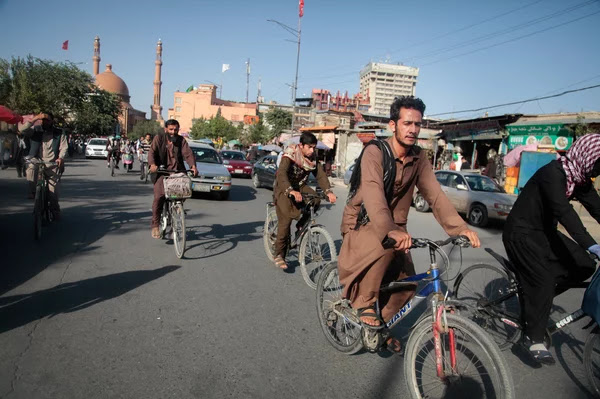

Photo by Diaa Hadid


So, workers and students have taken to cycling and bike shops are popping up all over the city.  While they, and the more established shops, may have new bikes for sale, most people buy used bikes or fix up old ones, not only because they are less expensive, but the condition of many streets and roads ensures that new bikes won't look that way for long.

While some may return to taking buses or cabs if the economy and their incomes recover, some say they enjoy riding and have found other unanticipated benefits.  Ahmad Fahim, a 25-year-old radiologist, observed that in addition to weaving through traffic, his bike "gets me through Taliban checkpoints" where motor vehicles are typically stopped and searched. 

There is one dark side to this new Afghan bike boom.  It, too, was sparked--if not directly, then almost certainly intentionally--by Taliban rule.  If you know anything about the Taliban's fundamentalist Islamic beliefs, you might have guessed it:  The cyclists are all of one gender.  

The Taliban doesn't explicitly forbid women from cycling.  It doesn't have to.  It simply tells women to stay home and, if they step outside, to cover up and be in the presence of a male guardian.  Those edicts effectively ended the mini-bike boom Shannon Galpin helped to create among Afghan women for more than a decade.  She recalls, "It was like popcorn.  It just took off."  There were women's bike clubs and teams, and even a coed multi-day race in the relatively liberal province of Bamiyan.

When the Taliban took power, Galpin helped dozens of female cyclists flee the country.  The ones who couldn't now watch, with sadness, depression and anger, male cyclists.  "When you see men can do that and you can't do that, it feels like  injustice," laments a woman who asked that her name not be used because she's seeking asylum in the US.

It's a sad irony that she has to seek a new life in an unfamiliar country to enjoy something the Taliban have enabled in her own. I hope she finds the refuge she seeks--and that she continues to cycle, by choice.

29 September 2022

Danger In My Backyard

As I've mentioned in other posts, for several years running, Florida is the US state where a cyclist is in the most danger of being killed by a motorist.  No other state comes close in that category.

Of course, that doesn't mean the Sunshine State has a monopoly on intoxicated or distracted drivers, supersized diesel-powered pickup trucks with bodies customized to take up an entire roadway, drag racers (though the state is home to Daytona) or inherently dangerous roads.

As for the last item on that list:  The single most dangerous road (excluding Interstates and other highways where bicycles are prohibited) for cyclists in the United States is in my home state of New York.  In fact, it's in my backyard.

All right, since I'm an apartment dweller, I don't have a backyard.  What I mean is that said thoroughfare is near me.  In fact, I've crossed, though not ridden, on it a number of times.

According to the Nassau County and Hempstead Police Departments, drivers struck 320 cyclists and pedestrians on the 16 mile-long Hempstead Turnpike (a.k.a. New York State Route 24) between 2011 and 2021. Mind you, that is only the number of such incidents the constables know about through 911 calls.  Of said victims, 13 died.  Another six were killed just during the past year.  The road is so dangerous for cyclists and pedestrians, in fact, that most of the fatalities were cyclists or pedestrians trying to cross the road so they could continue along one of the many streets that intersect with it.  

The most impatient and hot-tempered drivers I've ever encountered, anywhere were along that road.  When the light turns green, it's like a dam opening: a torrent of vehicles rushes through.  Woe be to a cyclist or pedestrian, even one in a wheelchair, who happens to be in the path of that storm surge.

OK, so I mixed my metaphors a bit. But I think you have at least a partial picture of what I'm talking about.  The drivers are indeed in a hurry to get to the store or through the next red light, but if someone wanted to design a traffic conduit that would bring out the worst in such drivers, he or she could hardly come up something that better fits the purpose than the Hempstead Turnpike.


Photo by Levi Mandel


One problem is that, in some stretches, it's even wider than an Interstate (like an Autobahn or Autoroute).  Through most of its length, it has eight lanes of traffic, with dividers that are low to the ground or nothing more than lines painted on the asphalt.  Also in keeping with the worst in highway design, it has no bike or pedestrian lane or, for most of its length, sidewalks.  

But unlike superhighways, it's not elevated or in a trench:  It's at the same level as other streets.  And, as it passes through residential and suburban residential neighborhoods, many two-lane and one-way streets cross it.  That means many people must cross in order to get to work or school or go home.

What exacerbates all of these deficiencies is that the Hempstead Turnpike begins in an area of southeastern Queens that has one of the highest population densities in the United States but almost no mass transportation.  That means people are car-dependent.  That part of Queens is also relatively low-income and has few stores besides bodegas and small grocery stores.  Thus, residents of that area frequently drive to the Nassau section of the highway, with its abundant stores (including supermarkets and chain stores), which offer more variety and lower prices.  

Also, many residents work in those stores and in other area businesses.  Meanwhile, the fact that on its Queens end, the highway connects with the Grand Central Parkway--a major artery to western Queens and Manhattan--also guarantees that many Nassau County residents drive their daily commutes on it.

When the Hempstead Turnpike isn't clogged with traffic--on most days, only from about 2 to 4 in the morning--it becomes our local version of Daytona.  Sometimes the wannabe racers even test the limits of their machines, in speed and maneuverability, when there's traffic.  The worst part is that they're not the only ones exceeding the 30- to- 40 mph speed limit.  In fact, according to a grim joke or local folk wisdom (depending on whom you believe), police officers give tickets to drivers who don't speed because they're the ones the cops can catch .

Having crossed the Hempstead Turnpike many times, I'm not surprised to learn that it's officially the most dangerous road in this region, and probably the nation.  Ironically, when I was "doored" nearly two years ago, I had just crossed the Hempstead Turnpike.  It wouldn't surprise me if the driver who opened her door into my path--or the drivers who honked their horns out of frustration over having to stop for a cyclist lying in their path--had just turned off the Turnpike.

28 September 2022

On The Hook: Old Inner Tubes

Nearly two weeks ago, I mentioned Nicolas Collignon's article, in which he expresses consternation and frustration that "sustainable" urban and transportation planning, too often, doesn't include bicycles.

The other day, I wrote about a rather surprising (in that someone hadn't thought of it earlier) way transportation cycling and sustainability have been integrated:  bike lanes with solar panels in the Netherlands and South Korea.

Today, I am going to present another, if smaller, way in which cycling and sustainability meet.

What I am about to describe is also rather surprising, but not because it hasn't been done before.  Rather, it seems almost-unexpected because it's an idea that seems to be revived and forgotten every few years--and because many people don't remember, or weren't paying attention to, its previous iterations.  What also makes the fact that it's not more common so surprising is that, even with all that we toss, I think we, as cyclists, are more conscious of, and conscientious about, recycling than most of the public.

Lots of replaced bicycle parts are tossed out every day, by shops as well as home mechanics.  Most, I imagine, end up in landfills.  Some, like old cables and housings, are difficult to re-use because the metal is rusted or has lost too much of its strength from the stresses of use.  But other parts can find new life in all sorts of ways.

One such part is an inner tube.  On my Bontrager Race Lite Mountain bike, I strapped a Pedro's under-seat bag made from an old air chamber. In it, I carried--you guessed it--a spare inner tube in addition to a patch kit, tire levers and the great Park mini-multitool. I've seen other accessories made from old tubes and once even wrapped a pair of handlebars in them.

Another way I've used inner tubes are as tie-downs. Think of a bungee cord without the hook:  I've strapped small loads to rear racks and have bound together all manner of items, on and off the bike, for any number of purposes. 

I'm sure I'm not the first to have used old inner tubes in that way.  But it took someone with a more inventive or entrepreneurial mind than my own to come up with the Daily Hook.


It's what it sounds like:  a section of inner tube with a hook at the end of it.

The difference, though, is that the hook is better-made and more practical than any you've seen on a bungee cord:  It's machined from aluminum and fits onto the end of the tubing section through a stainless steel backplate.  I would imagine that it allows the hook to be re-used on another section of tube when the original one fails.


Speaking of which:  Daily Hook's Swiss manufacturer claims--correctly, in my experience--that the tube section will last longer than fabric cords, which have a tendency to unravel or break.  And, if and when the tube does fail, the hook won't get tangled in your spokes or cogs because it has a spring clasp that holds it mechanically to your rack or wherever else you attach it.  Moreover, if your rack is anodized or painted, the finish won't be marred, as the hook is coated in grippy rubber.


The Daily Hook weighs about the same as an elastic cord of the same length.  Its only drawback, as far as I can see, is its price, though if it outlasts a bunch of fabric cords, it could be worth the investment.

And, of course, it gives old inner tubes new life. 

27 September 2022

What Will Be Influenced By This Report?

The 1980s gave us, in addition to The Smiths and some really good movies and TV shows, one of the most risible failures and one of the most-needed successes of American public policy.  

The failure is the so-called War on Drugs.  It did little, if anything, to reduce the demand for illicit substances.  If anything, it made criminals, in this country and others, rich and allowed gangs to become the de facto governments of neighborhoods and even, arguably, of whole countries in Latin America and other parts of the world.

Related to it is the success:  the campaign against drunk driving.  The relation of the War on Drugs and the crusade against inebriated driving is the subject of a longer piece of writing that would be far outside the scope of even this blog! Suffice it to say that both policies were two sides of the coin of a kind of puritanism that swept over this country and continues to blanket us today.

Now, I am not condoning drunk driving or, for that matter, the excessive use of any substance, legal or otherwise.  But, while the so-called War on Drugs did nothing to stop people from using or buying--or, for that matter, bring to account those who were responsible for its worst excesses--it can be said that while intoxicated driving hasn't been entirely eliminated, there is almost certainly less of it, and lives have been saved, as a result.

That said, I had a mixed reaction to a report documenting the rise of bike accidents in which the cyclist was under the influence of a drug.  


Because the statute of limitations has expired, I can now say that while some of youthful euphoria came from cycling itself, let's just say that feeling was, ahem, enhanced.  Now, being in middle age, I can tell young people "Do as I say, not as I did."  I really and truly do not recommend riding under the influence of mind-altering substances--even if they come in pint bottles or cans, and even if Dr. Albert Hofmann did it and lived to be 102.

While I laud the intention of the report--if indeed its intention is to call attention to intoxicated cycling and, by implication, warn against it-- I worry that folks who are already anti-cyclist will further demonize us.

You know how that works:  When any member of a minority group (and that's what we are in the US) commits a crime or does anything the rest of society doesn't approve--or is simply accused of such a thing--every member of that person's group is painted with the same broad brush.  

Also, as the report states, many of those cyclists were high or impaired by drugs, including opiods (and, in some states, cannabis) their doctors prescribed.  So were at least some drivers who struck and killed cyclists, including one I reported earlier this month.  But that incident, or others like it, don't cause drivers to be tarred in the way a single incident becomes emblematic of scofflaw cyclists.

So, in brief, while I laud any attempt to bring awareness to the problem of impaired cycling, I hope it isn't used to further marginalize us. 


26 September 2022

Where Cycling Really Means "Power To The People"

A bit more than a week ago, I mentioned Nicolas Collignon's article, in which he wonders why bicycles aren't in planners' thoughts about sustainable transportation and other aspects of urban planning.

A bit more than a year ago, I described one of the rare examples in which transportation cycling has been made a part of sustainability planning:  a bike lane with solar panels in--where else?--the Netherlands.

Well, I have just learned of another bike lane with solar panels--in South Korea.  The Asian path, however, is not only much longer (about 32 km vs 330 meters), but also has a very different design from its European counterpart.

The Maartensdijk ribbon has solar cells embedded in its prefabricated concrete blocks.  The lane from Daejeon to Sejong--the country's administrative capital--sits in the middle of a major highway and is segregated, not only from that highway, but (at least in part) from the elements.  That lane is covered by a series of canopies of solar panels, which, its designers say, not only generates clean energy, but also encourages cycling in less-than-ideal weather conditions--and shields melanin-deficient folks like me from the rays that are being harnessed for power.

The Korean bike lane has been open and widely used since 2014.  Given all of the talk about sustainability, I wonder why so little attention has been paid to it.

I also wonder why there aren't more similarly integrative solutions to the problems of sustainability.  And, like Nicolas Collignon, I wonder (actually, I know some of the reasons why, but still...) why bicycles aren't included in the first place, especially here in the US.


25 September 2022

A Concrete Example

During the many years I've cycled and worked in bike shops, I've seen plenty of "innovations" that made me wonder, "Why?"

Sometimes, of course, the answer is, "because we can!"  I'm sure would've been the answer from the creators of a concrete bicycle.  

Yes, you read that right:  a bicycle made from the same stuff that lines sidewalks and encases the enemies of organized crime bosses tossed into bodies of water.

Of course, there is no earthly reason for such a bike:  It's too heavy and inefficient to move faster than a crawl.  That's probably a good thing because the bike is too brittle to survive much more of a shock than a crack in one of the sidewalks that could have been made from its material.

At least they gave me a good subject for my weekly "Sunday funnies" series.


24 September 2022

Riding Into Their Sunset


The other day, late in the afternoon, I rode to East Williamsburg for my monkeypox booster.  Something told me to be sure I had my lights with me.  Good thing.  On my way back, I made a couple of wrong turns then took a couple of deliberate detours through industrial areas that straddle Brooklyn and Queens.

At that time of day, factories and warehouses close and the evening exodus begins.  On some streets, I zigged and zagged among 18-wheelers, pickup trucks and hipsters on scooters--the latter on their way to clubs found, sometimes, on the same block as, or around the corner from, the workshops where workers--none on scooters--were leaving.


 My wanderings took me to an industrial area on the Queens side--in North Maspeth, to be exact--that I'm not sure any of the scooter crowd is even aware of.  A railroad track that looks like it hasn't been used in decades (but still marked by a sign warning people not to stop or loiter on it) winds  through it:  the factories and warehouses on one side, the worn, sometimes shabby, tenements and small houses occupied, it seems, by families who have been there longer than the factories and warehouses, on the other.  


Whatever outsiders see in a place is almost never seen by those who have always lived in it.  So I wonder what they might have made of me, an outsider--the fact that I was on a bicycle was almost enough, by itself, to mark me as one--taking photos of their sunset.  Or, more important, whether they see the unique light it casts on the tracks and everything it divides.