Last week, I wrote a post on the 50th anniversary of Title IX becoming enshrined in U.S. law.
The
following day, the Supreme Court struck down Roe v Wade.
I
am writing about that now because I fear that so much of what Title IX made
possible can be reversed--or, at least, the law could be rendered all but
meaningless.
One
thing enslavers know is that keep people servile, all they have to do is
restrict the movements of the people they want to keep in bondage and take
their bodily sovereignty from them. The Taliban understands that lesson
quite well: They didn't have to close schools or bar women from opening
businesses or practicing professions. All they had to do was make them
wear clothing that inhibited their movements and make it all but impossible to
leave their homes without a related male escort. In a matter of months,
they reversed all of the gains Afghan women and girls made during the previous
two decades. Until recently, a similar situation prevailed in Saudi
Arabia (enforced by a royal family that, ahem, the United States props up)
until women were allowed some elementary rights like riding bicycles and
driving cars.
One
result of the restrictions in Afghanistan and Saudi Arabia is that
women's health deteriorated. Women's bodies were seen, as they are in all
fundamentalist and orthodox religions, as incubators: Their health care
is seen as important only to the extent that it allows them to bear and rear
children. Because women could not go anywhere without a related male escort,
they could be denied care because their husbands didn't want them to take off
their clothes in the presence of a male doctor (never mind that a female doctor
may not be available) or simply decided the women didn't really need care.
So
how does this affect us, in a country where we don't have to wear burkas and
can come and go as we please? (Well, OK, there are some areas where we
don't go alone.) As a transgender woman, I often think about bodily
autonomy: What if I'd been told I couldn't take hormones or have
surgery? Or what if there wasn't a therapist and social worker available
who understood my situation and could guide me into my transition? If
abortion can be denied, what else can a government--whether national, state or
local--tell us we need or don't need, or can or can't have?
For
that matter, could politicians and judges tell us what we can and can't do in
our free time--or as a profession? Think about it. In some states,
women have been arrested for having miscarriages or stillbirths. Why?
Those miscarriages and stillbirths were considered as manslaughter or even
homicide on the grounds that some behavior--drug use, drinking, smoking or even
diet or activities--induced them. What if some accident or injury in
cycling--or some other sport--were considered as "causes" or
"contributing factors?"
You
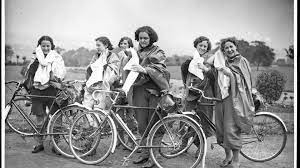
might say that I'm being hysterical or alarmist. In the days before Roe v
Wade, girls were discouraged from sports with this admonition: "It'll tip
your uterus." Or our other "tender parts" would be
irrevocably damaged, or the effort of pedaling or running or jumping or
whatever would contort our pretty little faces. (They obviously never saw
mine!)
And
I fear that women's health care--which is still nowhere near the level it
should be--will revert to its pre-Roe state. Of course, I'm not talking
about the technology. Rather, I mean that an attitude Roe
engendered--that women, as sentient beings, are worthy of health care in their
own right--could revert. If it's harder to obtain care, and care for
ourselves, it will be more difficult to not only particiapate in sports, even
recreationally, but also to determine our careers and other areas of life.
Our
journeys take many unexpected turns. I know mine has. I just hope
ours don't go off a cliff with the Supreme Court overturning Roe v
Wade.


