One hard lesson I learned in my gender affirmation journey is that the euphoria of a victory, whether personal or for a community, is all but inevitably followed by a backlash. Such a reaction could come from the same individuals or groups who initially supported the positive and necessary changes you and your community made.
In my own life, I think of how relatives, co-workers and (former) friends—and, yes, a lover—turned on me after voicing support when I started living under my current name and gender identity and, later, when I had my surgery.
Since its Civil War, the US has witnessed two major vocal, and often violent reactions against efforts to create a more just society. The first followed Reconstruction, when newly-freed African Americans were doing everything from running their own farms to running for office. In response, White supremacist groups like the Ku Klux Klan formed and Jim Crow laws were passed. The second reactionary movement is one we’ve witnessed during the past few decades: the current far-right movement, which includes, again, White Supremacists, allied with Christian nationalists and other reactionaries. It is the counter-current against the Civil Rights, feminist and LGBTQ+ movements of the past six decades or so. Far-right members often talk about “taking back” “their” country. Some were once part of the very movements they’re reacting against.
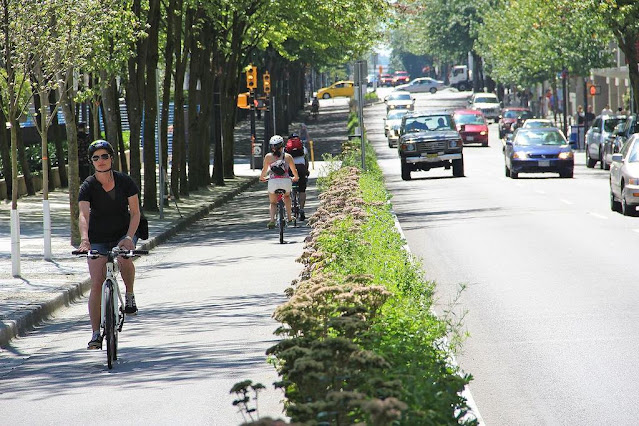
A similar phenomenon is brewing against bike lanes. San Francisco is removing the Valencia Street bike lane 18 months after the city installed it. (To be fair, the lane was supposed to be a 12-month pilot project.) Meanwhile, Ontario’s provincial government is taking actions to remove bike lanes in Toronto. Other jurisdictions are making similar moves or stalling or canceling plans to build new bike infrastructure.
(In a related move, the self-coronated Fake Tan Fūhrer has ordered the end of congestion pricing in my hometown of New York. It’s not clear, however, that he has such authority.)
So why all of the hate for bike lanes? If what I hear in the Big Apple echoes in other ‘burgs, much of the opposition comes from drivers and small businesses owners. The former believe that cyclists are taking “their” lanes and parking spaces, while the latter complain about lost sales.
Shop owners may have a point. Malls (most of which are moribund) and big-box stores are inherently auto-centric. So are the business and commercial districts of most American municipalities: They are designed so that customers can drive into, and park, in them. While that characteristic doesn’t cause Wal-Mart to lose customers—such stores are usually surrounded by large parking lots—the downtown stores and cafes rely, in large part, on curbside access.
As for lost traffic lanes and parking spaces: As I’ve mentioned in earlier posts, studies show that it isn’t the case. Bike lanes don’t “cause” traffic jams: In most cases, the road was already congested. As more than one planner has observed, streets and highways are “build it and they will come” projects.
The real reasons for the backlash against bike infrastructure, as Ron Johnson writes in Momentum, include the following: a.) even in large cities, transportation planning is made in an “imaginary world” in which there are only “suburban drivers “ and its corollary, b.) the lack of a true infrastructure that allows cyclists to pedal safely from Point A to Point B. Too often, the bike lanes are just “tokens,” poorly-conceived, constructed and maintained ribbons that make no one safer.
Two examples are the Grand Concourse lane near my current residence and the Queens Boulevard lane near my former home. Both are center lanes along the divider. One problem is that every few blocks, traffic crosses the lane to enter or leave the service lane. Another is that because those lanes are not physically separated, drivers use them as passing lanes. (Some seem to take out their aggression by passing as close and as fast as they can to cyclists.) Moreover, trucks park or idle in the lanes when drivers deliver to the businesses that line the Concourse and Boulevard. Oh, and I’ve seen cops sipping coffee and munching their donuts (OK, accuse me of stereotyping!) in patrol cars parked in the bike lane.
In other words, such lanes benefit no one. Nobody is safer and, perhaps, shop owners are indeed losing business. A better-planned bike network would take cyclists where they want and need to go and allow traffic to flow more efficiently.
But would it stop the backlash? Well, maybe not. As Johnson points out, it’s one of the “culture wars” in which cyclists and their allies are seen as “woke” granola-crunching gender-variant (whoops, I meant non-male- or -female conforming) “enemies.” In other words, people like me. So the backlash against bike lanes doesn’t surprise me.