23 May 2016

OTEC Will Keep You Going In Circles, But Not In The Way You Expected

Back when I was racing--and even when I wanted to stay in (or pretend that I was) in the same kind of shape I was when I was racing--one of the goals of training could be summed up in three letters:  RPM.

In other words, we believed that spinning at the highest cadences possible would make us go our fastest.  That meant riding, at least at first, in a lower gear and working up to higher gears.  The one who could spin the highest gear would win the race.

Now, of course, nobody is going to turn cranks with a 54X11 gear (which I actually had on my road bike for a time) at the same rate as, say, a 42X15.  But all of the trainers and training manuals told us that it was better to do 120 rpms on the latter (or a higher gear later in the season) than to mash the former.  If nothing else, it gives you a better cardio workout and is easier on your knees.

Apparently, there are some folks who don't agree.  Ever since the invention of the "safety" bicycle (two wheels of more or less equal size driven by sprockets and a chain), someone or another has tried to "improve" on circular pedaling motion.  Examples of such endeavors include the oval and elliptical chainrings that seem to reappear in one form or another every generation or so. Shimano's Biopace is probably the most famous example; currently Osymetric rings have a following among some members of the peloton.  There have been all sorts of other ways to make pedaling more efficient by eliminating the "dead" spots so that power is transferred all through the arc of pedaling.

Just recently, I came across something I saw in the bike magazines some years ago but never actually saw in person.  It seemed like one of the most bizarre, Rube Goldberg-ian contraptions I'd ever seen on a bicycle.  But, apparently, the idea has stuck around:  The organization that patented it in 2007 was founded in 1998.
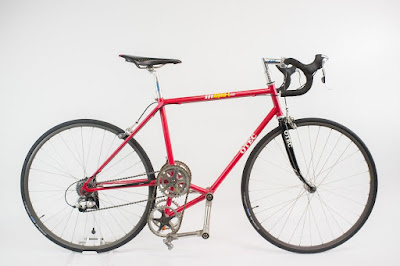


At the risk of offending anyone with any sense of political correctness, I will say that the idea is so high-tech and so complex (complicated?) that it could have come from one of only two countries:  France or Japan.   


If you chose the Land of the Rising Sun, enjoy your sake.  OTEC, the company that patented and produces the SDV system, says "The direction of a motion of a pedal in its power phase is designed to coincide with the direction in which the rider can most easily apply force on the pedal while stretching his or her legs."  The result is that its geometry  "makes riders use larger muscles, resulting in lower cadences than expected".  


That is exactly the opposite of what we were all trying to achieve all of those years!  But, in looking at it in motion, I can see how it would make sense for, say, someone like a climber or, perhaps, an individual time trialist.  It also seems to me that it also might be better suited to a recumbent bike, on which the rider pedals from behind, than on a diamond frame, on which the cyclist pedals from above.


I am curious enough to try an OTEC if given the opportunity.  What differences, if any, would I notice in my pedal stroke or my ride?

22 May 2016

My Real Motivation (!)

You've probably heard, by now, about the "bathroom bill" passed in North Carolina.  In essence, it says that people have to use public bathrooms in accordance with the gender indicated on their birth certificates.

Since this a blog about cycling (well, mostly), I'm not going to get into what the law means for transgenders, or people in general.  I am fortunate, I guess, in that it's been a long time since I've been hassled about being in the "wrong" bathroom.  One thing I wonder, though, is whether or not I need to carry a copy of my birth certificate with me if I ever have to change flights in Charlotte, or go to the Tar Heel State for any other reason. In case you're wondering:  Yes, my birth certificate says I'm female.


Anyway, in fairness, I'll point out that North Carolina isn't the only jurisdiction that has such a regulation, whether in the letter of the law or in effect.  The probable reason why the law has made gotten so much publicity is that the state legislature voted for it, and the governor signed it, the day after the city of Charlotte passed its own law saying that LGBT people would be protected in "public accomodations", including bathrooms. 

Also, this is a Presidential election year and although North Carolina voted for Mitt Romney four years ago and for every Republican candidate since 1980--with one exception--the margins of victory have been slim.  (That exception came in 2008, when Barack Obama took the state from John McCain.)  Also, there are pockets of the state, such as the "Research Triangle" and much of Charlotte, where Democratic support is almost as strong as it is in most Northeastern states and coastal metropoli.


But about the bathrooms:  I hope that no place where I cycle will ever pass its version of a "bathroom bill", and that no ride organizer will institute such a rule.  After all, organized bike rides are among the few arenae in which the lines for the women's rooms are actually shorter than those for the men's rooms.  

Now you know the real reason why I "changed" my gender! ;-)


21 May 2016

The Long And Short Of Women's Bikes: Terry

Smaller and cuter, preferably in pink.

I can remember when that was a pretty fair summation of bicycles and other sports equipment made for women.  It was assumed that girls wouldn't pedal, swim, run, climb or whatever as hard or as long as men did--and, most likely, would do so in the (possibly grudging) company of a husband, boyfriend or other male in her life.   Thus, she wanted to look good, or at least cute, by his side--or so the thinking of manufacturers and marketers seemed to be.  

Most bike manufacturers offered "ladies'" versions of one or two models in their lineups.  At first glance, they seemed the same as their men's counterparts, except for the dropped top tube on the frame.  This makes a "ladies'" bike less stiff and stable than its male peer, though how much less is a matter of debate.

1898 Cygnet "Swan" 

Anyway, some bike makers seemed to use this trait as an excuse for making sluggish machines with imprecise handling.  Granted, a bike with less torsional stiffness will not respond as quickly or efficiently to a rider's pedal strokes.  Still, there have been any number of diamond-frame (a.k.a. "men's") bikes with relatively slack angles and long wheelbases that nonetheless offered a sprightly ride.  So, it seemed disingenous--at least to me--to, in essence, say that someone who buys a women's bike shouldn't expect much.

Mind you, for most of my life I wasn't interested in having a really nice women's bike.  I did own a couple of inexpensive women's bikes that I got for little or nothing and  used as commuters and "beaters".  But on such bikes, which I didn't ride long distances, I wasn't as concerened with performance as I was on my "good" bikes.  If it fit well enough (which wasn't always to say "well"), or could be made to do so for little or no money, I was happy.

Perhaps it was working in bike shops and for American Youth Hostels, and thus having the opportunity to meet discerning female riders and try a number of bikes, that made me aware of what I've described.  Also, even though I was of average height for a male (which makes me taller than 90% of other women), I have a few abnormalities, namely somewhat longer-than-average legs and considerably shorter-than-average arms for a man (or even a woman) of my height.  

So, while I had little trouble finding a bike that was the "right" size (i.e., height or seat tube length) for me, it wasn't until I got a custom frame that I would ride something that truly fit me.  For years, I rode bikes with 55 or 56 cm (depending on whether they were measured center-to-center or center-to-top) seat tubes--and top tubes of the same length, or longer.  That meant riding stems with short extensions--sometimes as little as 8 cm--which made racing bikes handle (at least for me) like shopping carts.


Even though I had a harder time than most other men I knew in obtaining a good fit, I knew the situation was much worse for most women, a few of whom I rode with. For example, Tammy, who was about 8 cm (a little more than three inches) taller than me, had shorter arms and smaller hands than mine!

During the past couple of decades, various bike companies have tried equally varying methods of tailoring their offerings to women, particularly those who are more petite than the likes of Tammy or me.  Some tweak their geometries to make shorter top tubes; others have tried varying the shapes of both traditional diamond as well as mixte and step-through frames to accomodate the proportions of smaller women.  A few have even offered bikes with smaller wheels.  For extremely small women (and men) this could make sense; after all, it's hard to build a bike with 700 C wheels on which someone who's less than five feet tall can clear the frame while standing.

Perhaps one of the most interesting solutions was tried by one of the first bike-makers to really try to re-configure women's bikes.  From about thirty to about twenty years ago, I would see one of those bikes--usually ridden by someone on a club ride--during one of my weekend road rides.    You've probably seen at least one:

Terry road bicycle, circa 1990


From 1985 until 1994, Terry Bicycles offered road bikes with 700C rear and 24 inch front wheels.  Their quality was actually quite good:  During the first few years they were made in Japan.  I am guessing that Panasonic or Bridgestone made them, as their lugwork and finishes, as well as other details, looked much like those of bikes from those companies, or companies (like Schwinn and Bianchi) that had bikes made for them by those companies.  Likewise, the details on later models, which were made in Taiwan, lead me to believe they were made by Giant, who also made bikes for Schwinn and other companies.

I have never tried one of those Terry bikes with the small front wheels.  The accounts I heard about them varied:  Some women said that their Terrys were the first bikes that felt "right" to them, while others thought the bikes' handling was "weird" or unresponsive.  There were claims--which I suspect were exaggerated-- that the front wheel slowed the bike down, as was the inconvenience of having to carry more than one spare inner tube on a ride (or tire on a long tour).

In time, I saw fewer and fewer of those early Terry bikes.  Ironically, one of the last people I saw riding one was a man:  a very short (for a man, anyway) Latino.  These days, those bikes can be found relatively inexpensively on eBay and in other venues.

20 May 2016

Now They'll Know I Rode To Work Today!

Many, many years ago, I attended Catholic school.  Like my classmates, I went to confession every Friday and mass on Sunday. 

You weren't supposed to receive Holy Communion unless you'd confessed your sins.  Of course, that meant just about all of us who went to the Catholic school partook of that most important (by the Church's reckoning, anyway) sacrament. I always wanted to ask how God saw whatever sins you might've committed between the time you went to confession and mass.

Not that I was so worried about receiving communion.  After all, how many kids look forward to having  flat, flavorless wafers put in their mouths and having to kneel, with eyes shut, and pray (or pretend to, anyway) silently as long as those wafers are in their mouths?  Most kids probably wonder--as I did--why the wafer couldn't at least taste like chocolate or something?

Then there was something else we received from the church, if once a year:  ashes.  I know that having charcoal or whatever rubbed on your forehead is supposed to symbolize that to which we return, or some such thing.  On Ash Wednesday, we were all supposed to be so marked.  The nuns treated us juuust a little better (they were nuns, after all!) if we were. 

Some people--usually old (or, at least, they seemed that way to us)--used to walk a little prouder--or, perhaps, just a little more smugly--with the smudges on their foreheads in full view.  It was as if they had to show the world--God?--that they were indeed devout Catholics.  Because they were older, I used to wonder whether that mark would help them if they fell down dead.  Would God recognize them that much sooner and whisk them into their eternal reward?

I got to thinking about this, oddly, because today is Ride Your Bike To Work Day. Now, those of us who normally ride to work don't give it a second thought.  About the only thing I did differently was to stop at the Transportation Alternatives table on the Bronx side of the Willis Avenue Bridge for their free coffee (which was pretty good, actually) and Kind bars. (I like the Blueberry Almond and Honey Oat!)  And, oh yeah, to renew my membership.

Since I normally ride to work and my co-workers and friends know it, I don't feel the need to show it.  But I got to thinking about how I might show off my concern for the environment and all of those other things that commuting by bike are supposed to signify, if I were so inclined.

Here's one way:


19 May 2016

Helene Dutrieu: She Did It Without A Corset!

For better or worse, everyone knows Lance Armstrong's name.  And, for a time, all Americans--whether or not they'd ever even touched a bicycle--knew about Greg LeMond, who won the Tour de France three times in the late 1980s.

And, of course, everyone who has even the slightest familiarity with bicycle racing has heard of a guy named Eddy Mercx.  For that matter, you don't have to be intimately connected to the sport to recognize names like Bernard Hinault, Fausto Coppi and Jacques Anquetil.

The fame of female cyclists, however, tends to be much more fleeting.  Most of what I know about them--including the ones I've written about on this blog--I learned by accident. 

Now I can add Helene Dutrieu to my list. Given her accomplishments, it's almost criminal that she's not better-known. 

She was born on 10 July 1877 in Tournai, Belgium--perhaps not coincidentally, the birthplace of Clovis I.  When she was a young girl, she moved with her family to Lille, in the north of France.  At age 14, she left school to earn a living.

I couldn't find any information about her first job(s).  But, at some point, her older brother Eugene inspired her to follow his career path:  bicycle racing.  In 1893, at age 16, she set the women's world record for distance cycled in one hour.  Three years later, she won the world women's track cycling championship and reprised her title the following year. 

Helene Dutrieu racing for the La Chaine Simpson team.


During that time, she won a twelve-day race in England and raced for the Simpson Lever Chain (La Chaine Simpson) team, immortalized in a Toulouse-Lautrec illustration.   In 1898,  she won the Grand Prix d'Europe.   Belgium's King Leopold II awarded her the le Croix d' St. Andre with diamonds in honor of her exploits as a cyclist.


Toulouse-Lautrec illustration of Constance Huret  in a pursuit race.


Her velocipedic virtuosity was matched by her daring:  She gained, perhaps, as much renown as a stunt cyclist, first on a bicycle and, later, on a motorcycle.  She created a stunt--a jump of about 15 meters on a bicycle--called "La Fleche Humaine" (the Human Arrow), which became her nickname.

In reading about her, I came away with the impression that she was, first and foremost, a performer.  In addition to her feats of athleticism and daring, she also gained renown as an actress, appearing on such stages as the Theatre des Capucines.  During that time--from 1903 to 1909-- she also was a stunt driver, first on motorcycles and, later, in automobiles.

Dutrieu in a Henry Farman-type two-seater, circa 1911.


That the public and press loved her didn't escape the notice of Clement-Bayard de Levallois, the company that sponsored her as a stunt and race car driver.  They were about to introduce their new aeroplane--the Santos-Dumont No. 19 Demoiselle.  Especially with a name like that ("Demoiselle", as you probably know, means "young lady"), who would be a better candidate to be its first pilot than Ms. Dutrieu.

In those days, flying was truly not for the faint of heart--or heavy of body.  Those machines didn't have much power and, thus, couldn't bring much weight aloft.  Naturally petite and trim--and fit from her years of cycling--Helene Dutrieu thus had advantages over nearly every other pilot candidate.  Though her first flight ended in a crash--not unusual in 1908-- she quickly developed a following that grew with the skills she developed as a pilot.  In fact, she was the first woman to fly an aircraft bearing a passenger, and would become the fourth woman (and first Belgian woman) in history to earn a flying license, which she would need to enter competitions.  La Fleche Humaine soon would be known as La Femme Epervier (the Lady Hawk).

One thing to remember was that in those days, in most of the world (including her native Belgium and France), women didn't have the right to vote, or many other rights.  And we were thought biologically incapable of doing many of the things we do today.  So, while the public loved seeing her fly, her sponsor was also capitalizing on a subtext of her exploits:  This plane is so easy to fly that a woman can do it!    


Gender norms in those days were more rigid, both literally and figuratively, in other ways.  So, while people were enthusiastic about Dutrieu's exploits, they expected her--as they would expect any other woman--to adhere to the standards of modesty of the time.  The biggest scandal about her, then, was not a result of  any of her daring feats, but in doing them--as the press discovered accidentally--without a corset! 

(Because she was so thin, I have no idea of how that terrifying fact was discovered!)


But that didn't seem to bother Pierre Lafitte.  He published Femina, one of France's most popular women's magazines.  An early aviation enthusiast, in 1910 he announced a prize for the longest flight--in both distance and time aloft--by a woman in an aeroplane.  Dutrieu flew 167 kilometers in 2.6 hours to win the title, which she defended the following year.  She would fly in the air-show circuit for another two years before retiring in 1913, after France awarded her the Legion d'honneur.

Hélène Dutrieu (Library of Congress

When Dutrieu won the Coup Femina in 1910, a woman named Marie Marvingt finished second, flying 42 kilometers in 53 minutes.  Interestingly, their careers turned in the same direction with the outbreak of World War I:  both became ambulance drivers!

So, like so many pioneers in the worlds of automobiles and aviation--and women's achievement--Helene Dutrieu started her revolution with revolutions--of her pedals.  Her journey ended in Paris on 26 June 1961, at the age of 83.