06 July 2016

LA Bike Share Launches: Will It Save The Metro?

New York, my home town, is known as the City That Never Sleeps.

Los Angeles, on the other hand, has been called The Place Where Nobody Walks.


Like most labels, neither is completely true, though there is at least a kernel of truth to both.  About the Big Apple:  I know that at least one person sleeps because, well, at my age, it's harder to stay up at all hours than it was in my youth.  It's been a while since I've been to the City of Angels, but as I recall, it's not as conducive to pedestrians as, say, Paris. (Then again, how many cities are?)  And I don't recall seeing other cyclists when I rode there.  For that matter, I don't recall seeing anyone else walking on the Walk of Fame when I walked it. (OK, now you know another one of my dim, dark secrets! ;-))


Now, if any of you are reading this blog from Southern California, please don't hate on me.  I'll admit that I preferred San Francisco (and, hey, how can you not prefer the Central Coast to almost any other coastal area?), but I found things to like about the LA area, even though family members I didn't want to see were living there the last time I stayed.


Anyway...Something interesting is happening in one of the first metropolises to be developed for and around the automobile. (According to at least one history I've read, the motel was invented there.)  Could it really be that Angelenos are giving up their automobiles?  Might people go motorless in Santa Monica?


Well, perhaps things won't go that way just yet.  However, an idea that's taken hold in other cities around the world is about to come LA's way.


Tomorrow, the City of Los Angeles and Metro, its mass-transit authority, are launching a bike-share program.  About 1000 bikes will be available in 65 locations around the downtown area, including Union Station, City Hall, the Convention Center, Chinatown, the Arts District, Little Tokyo and the Fashion District. 


 Many of the bike ports will be close to Metro rail and bus stations.  This is not surprising when one considers that in other places, like Manhattan, people ride share bikes to subway and bus stations or from suburban commuter lines.  However, the reason why LA Metro bikes will be so placed is one I have never heard before:  Officials want to use the bike share program to not only reduce the number of automobile trips, but also to increase Metro ridership.


According to at least one report, the number of people who ride the buses (which comprise about 75 percent of the Metro system) and trains has been declining.  A number of factors have been cited, including fare hikes.  Interestingly, one reason given for the decline has been gentrification.  Working-class families are being priced out some neighborhoods that offer convenient mass transportation.  So, they have to move further away from their jobs, often to areas that don't have mass transportation.  They may also have to take on an additional job. Getting to either or both on time via mass transit--even if it is available--is often difficult, if not impossible.  Thus, another car is part of the next jam on the 10 Freeway.


This scenario contrasts with what has happened in other cities, like New York, where gentrification has actually contributed to increases in mass-transit ridership and may have saved previously-moribund lines from shutting down.


If the bike share system actually increases Metro ridership, it will create another contrast between Los Angeles and other cities with bike share programs.  In Washington DC, as an example, commuters are using the bike share program instead of the rail and bus lines.  In one way, that is not necessarily a negative development, as the rail lines are congested and there is neither the space nor the money to build new ones.  But is it a harbinger for what could happen in Los Angeles?

Whatever the case, I am glad that the Los Angeles bike share program is set to launch tomorrow.  If it gets more people on bikes, it's a success.  And if it can get people out of their cars, so much the better.


05 July 2016

The Ice Man Cometh--On A Bike!

Yesterday I managed to slip out for a ride before meeting a friend for dinner and to watch the fireworks.

So what, exactly, did I have to escape from in order to get on my bike?  Well, none other than Max and Marlee.  Who says humans are the only creatures who don't know how to let go?

Anyway, I had no particular destination in mind.  Perhaps the only real intention I had was to avoid beach areas, because I knew that they were crowded.  That turned out to be a good choice:  I had most of the Queens and Brooklyn streets to myself!

I did find myself just up the street (Rockaway Parkway) from the Canarsie Pier. But I didn't go to the pier because it was packed with families and other groups cooking burgers, 'dogs and chicken wings on little grills.  Everything smelled good, even mixed with the aromas of beer and other kinds of alcohol.  

So, I made a U-turn and pedaled through a soundscape of liliting Caribbean music and accents along Canarsie side streets, and along Rockaway Avenue (almost traffic-free) to Brownsville, Ocean Hill and Bedford-Styvesant--areas of Brooklyn hipsters and gentrification still haven't found (though that could change very, very soon!).  Soon, I found myself in the tatoo capital of the Western world--Wilson Avenue in Bushwick.  There, I stopped at a shaved-ice cart, where I asked the man to make me a cone (paper) of ice con citron y cereza--with lemon and cherry syrups.  

I actually wante that cone.  But buying it was also a pretext for talking to the man about his cart.  


He says he made the cart, and attached the bicycle, himself.  It's easier and faster to move that way than it is to push the cart around while on foot.  Also, he doesn't have to worry about parking, as he would if he were driving the cart.

And, yes, that ice hit the spot.

04 July 2016

Happy Fourth Of July. Be Safe!

I am going to share a secret with you:  It's my birthday.  Really!  

Oh, yeah, it's also the birthday of the country in which I was born, raised and have spent most of my life.  Whether or not you celebrate--or whether it's just another day wherever you are, I hope you enjoy it.  And, please, don't try this:


From World of Bikes, Iowa City


I mean, maybe I don't do enough night riding. But don't you think that's going just a bit far to get get a good bicycle lighting system--one that will actually allow you to be seen by drivers?  

03 July 2016

A Great Ride, "In Spite Of"

Sometimes we say that a ride was good or great "in spite of"...the rain...the wind...the cloud cover...the traffic...the flat or mechanical malfunction...the fill-in-the-blank.

Yesterday's ride was one of those rides.   I didn't experience any disasters or mishaps.  And while the temperature reached 28C (82F) in the middle of the afternoon, it never seemed that warm.  Heavy rains the other night dissipated the humidity, and the bright sunshine forecast for the day was muted, at various times, by a scrim--sometimes a curtain--of clouds.  As much as I love sunshine, I appreciate such movements of clouds, especially when they don't bring any threat of rain with them.   After all, one thing cycling--or anything else--will never cure is my, ahem, melanin deficiency!

Image by John Hart.  From the Centre for Sports Engineering Research at Sheffield Hallam University (UK).


Anyway...the one complaint I could have made was the wind.  In that regard, this year has been very strange:  March, supposedly the windiest month, didn't seem particularly so, but every month since then has brought us more steady streams, and even gusts, than the one before.

And so it was yesterday.  I decided to take, intead of an "out and back" ride, one in which the route away from home would be different from the one that brought me back.  It wasn't quite a circular ride:  If anything, if I were to draw it on a map, it would probably be shaped more like an almond or an eye socket.

That was interesting and rewarding.  And, for most of the way out, I pedaled against the wind, sometimes gusting to 50 KPH (30 MPH).  Normally, I don't mind that, for it means--in most circumstances--that I would have the wind at my back on the way home.

Except that it didn't happen that way.  You guessed it:  I spent most of the trip home pedaling into wind just as strong as what I encountered on the way out.  I know that sometimes the wind shifts direction during the course of the day.  I also know that in particular locations, even ones only an hour's bike ride apart, the wind can blow in a different direction.  (Believe it or not, in the NYC Metro area, we have micro-climates, even within Manhattan!)  So, the plan of riding into the wind so you can let it carry you home works, except when it doesn't.

Arielle


But I didn't mind.  All told, I rode about 130 kilometers (80 miles) on Arielle, my Mercian Audax.  With a name like that, you know she rides like the wind!  Now you know why I had a great ride, "in spite of"!

02 July 2016

Elie Wiesel R.I.P.

I took a wonderful bike ride today. But I can't write about it. Instead, I must discuss someone I don't merely admire or idolize.  Instead, he is someone of whom I am completely sure that the world is better--or, at least, not as bad as it could have been--because he was in it. 

Thirty years ago, on the Third of July--the day before US Independence Day--I was in a San Francisco hotel room.  A  Thursday, it was--in essence, if not in fact-- the beginning of a holiday weekend.  It also marked one of the strangest--almost to the point of being surreal--coming-togethers of people who, perhaps, should not have been on the same planet, let alone the same podium.  I watched it on television.

That day, the opening ceremonies of the Statue of Liberty's centenary began.  At the foot of the Statue, President Reagan awarded  something that no one ever received before, or has received since:  the Medal of Liberty.  Twelve naturalized (born in other countries) American citizens received it.  


I must admit that I learned something that day:  Bob Hope, one of the medal's recipients, was born in England.  It wasn't so strange to see him with the President.  It also wasn't so unusual to see another recipient--Henry Kissinger (born in Germany)--on the same stage with them.  I didn't even find it so odd that Irving Berlin (Russia) also received the medal:  As great a songwriter as the man was, his ouevre includes stuff like "God Bless America" and "White Christmas".

Now, when the award went to Itzhak Perlman (Israel), Albert Sabin (Russia) and I.M. Pei (China), I thought it was venturing into another sub-species of the human race.  I admire all of them, and have no quibble with any award they might ever have received.  We've all benefited from Sabin's work; I have listened to Perlman (live as well as on recording) and think that Pei's "Glass Pyramid" actually makes the Louvre courtyard look better. (Yes, I've seen it without.)

When things got really weird, though, was when Elie Wiesel (Romania) got the award.  Again, I have no issue with his receiving it, or anything else he's been awarded in his life.  To merely say that he is a great writer is an insult--almost libel, really--against the man.  His work is nothing like the sort that is celebrated by fashionable people for whom whatever they reading is like one of this season's "must-have" accessories.  People like them don't think you're hip or witty if you quote him at their parties.  (Then again, if you are reading his work, you're probably not going to such parties.)  Reading him also doesn't make you feel better about yourself:  It just makes you more of a human being.

And what did he write about?  Mostly, about people's inhumanity to each other. Perhaps that's not surprising when you realize that at age 15, he and his family ended up in Auschwitz.  Later, he was moved to the Buchenwald concentration camp, from which he was freed.  Of his family, only two of his sisters survived.


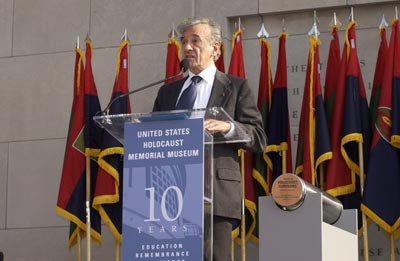
Elie Wiesel became Founding Chairman of the United States Holocaust Memorial Council in 1980. Here, he speaks at a ceremony held during the Tribute to Holocaust Survivors, one of the Museum's tenth anniversary events. Flags of US Army liberating divisions form the backdrop to the ceremony. Washington, DC, November 2003.
Elie Wiesel speaking at a Tribute to Holocaust Survivors in 2003.  From the US Holocaust Memorial Museum.

But his message was not one of depression or despair.  Nor was it a "We Shall Overcome" kind of optimism.  Instead, it was one of simple honesty, about what he experienced as well as his role--and limitations--as a survivor and witness:


"Never shall I forget that night, the first night in camp, which has turned my life into one long night, seven times cursed and seven times sealed. Never shall I forget that smoke. Never shall I forget the little faces of the children, whose bodies I saw turned into wreaths of smoke beneath a silent blue sky. Never shall I forget those flames which consumed my faith forever. Never shall I forget that nocturnal silence which deprived me, for all eternity, of the desire to live. Never shall I forget those moments which murdered my God and my soul and turned my dreams to dust. Never shall I forget these things, even if I am condemned to live as long as God himself. Never."

There is, to my eye, not an iota of self-pity in those words.  Rather, it is a statement of his job, his mission, as it were:  one that he never could have chosen.  And, as I read in some of his other writings, the mission that found him is also gave him an almost overwhelming humility--borne of survivor's guilt, perhaps--about his work.  He said there was no language for the horrors he witnessed, but he did his best to describe them.  And those who perished--whether in the Holocaust or unjustly in any and all kinds of other tragedies--cannot speak for themselves.  He wondered whether he had any right, let alone the language, to give voice (rather than speak for) them, but he had no other choice.

Even though he was given the tablet, the torch or whatever you want to call it, his writings are never preachy, sanctimonious or self-important.  They were, as he said, testimony. Sometimes he called for nothig ore than simple decency from one human being to another. What a concept, eh?

Whatever I drank the night before (I don't remember exactly what, but I drank more than enough) couldn't have induced, in me, a hallucination anywhere near as bizarre as seeing Elie Wiesel on the same stage, getting the same award, as Henry Kissinger.

Then again, it wouldn't be the only time something so strange happened.  Later that year, Wiesel won the Nobel Peace Prize.  Thirteen years earlier, Henry Kissinger--who orchestrated the illegal bombing of Cambodia, the assasination of Salvador Allende and the invasion of Cyprus--also won the Prize.  (To think that Hilary Clinton cited him as her role-model when she was Secretary of State!)  And, of course, Barack Obama--who, barring something miraculous, will become the first US President to lead the country through two terms of continuous war and, by the way, ordered air strikes on Syria--also won the Prize in 2008.

Kissinger, at age 93, is still getting awards and accolades and fat speaking fees.  Barack is, of course, still in office.  But Wiesel died today, at age 87.  I don't know what comes after this life, but it can't be justice if he is going to the same place as Ronald Reagan or wherever Henry Kissinger will end up.


Interesting Fact:  Weisel did all of his writing in French, the language in which he did most of his reading.  After being rescued, he was taken to a French orphanage and attended a French school--where, he said, he received his first secular education.  (Everything he read before his internment, he said, had to do with his religion.)  Some of the English translations were done by his wife.