19 April 2017

Today Is Bicycle Day. And It's A Real Trip

Sometimes people give a knowing (or think-they-know) grin when I tell them I took a trip on a bike.  Yes, even at my age, at this late date. 

I'm sure many people reacted in the same way--or less approvingly--when they saw the title of Tom Cuthbertson's Bike Tripping.  It's one of those primers, if you will, that came out during the '70's North American Bike Boom.  Most of the advice in it is still pretty sound, even if some of what he says about equipment is dated.  And, as with Cuthbertson's other books, it can be enjoyed for its witty tone and those fun illustrations from his friend Rick Morrall.

First of all, the book came out in 1972--one year after Cuthbertson's first classic, Anybody's Bike Book.  Although the calendar may have said the world was in the 1970s, in many ways,  it was still the late '60's, complete with the anti-war and environmental movements.  And hippies. (Cuthbertson's books looked like they were created by hippies.  And he looked like one.) And, of course, drugs.

Among the drugs of that time was Lysergic Acid Diathymalide-25, better known to the world as LSD or simply "acid".  Although it still has a stigma from the overdoses and the people who had terrifying visions while taking it, there are still researchers who are trying to find ways to use it for which it was intended:  medical purposes.

At least, that was the way Albert Hofmann intended it.  He was the Swiss scientist who first synthesized it, in 1938, as   a stimulant for the circulatory and respiratory systems.  He learned of its true power five years later, when he accidentally absorbed some into his fingertips.  The "not unpleasant intoxicated-like condition" he experienced intrigued him enough that he did what any intensely curious researcher would do:  He experimented on himself.

On 19 April 1943, he took what he thought was an appropriate threshold dose:  250 milligrams.  That was a bit too  much; today we know that a standard dose is 200 mg. (I am using the imperial "we":  I have no firsthand experience!)  Within an hour, his perception began to ebb and flow rapidly.  Then he became the first person to "freak out":  He was convinced that his neighbor was a witch, and he was going insane.  He wanted to go home.

In 1943, wartime restrictions were in place, which meant that, like many other people, Hofmann had no access to a car.  So he rode his bicycle.  

Image by jibberjabber


That trip home was a stressful one:  His vision wavered and he felt as though he were motionless.  After he reached the climax of his condition, however, he came back from a "weird, unfamiliar world" to reassuring everyday reality.

Albert Hofmann, therefore, took the world's acid trip.  And he did it on his bike.  That is why 19 April is celebrated as Bicycle Day--though I think Bicycle Trip Day might be more appropriate.

18 April 2017

Does Nobike Fit All?

So why do you have six bikes?

If you have more than one bike, you have heard some variant of this question--from a spouse, lover, other family member, co-worker or friend who doesn't share your enthusiasm for cycling.  That person might see that one of your bikes has drop bars and the other has uprights or flats.  Or he or she might notice that one bike has fatter or skinnier tires, or has only one gear or multiple gears.  On the other hand, that person might see only that your bikes are different colors or have different names on them.

The reason nearly all of us give--if we actually ride the bikes we own (I do) is that they have different ride characteristics.  One bike might be better for long distances, another for speed and yet another for "rough stuff".  One of our steeds might carry our groceries, books r even furniture, while another can and should be ridden only in its most stripped-down form.

Now, if you've gotten this far in answering your incredulous friend or lover, he or she might ask whether there's one bike that can "do it all".  Some bikes are billed, by their makers or marketers, as Swiss Army knives on wheels, if you will.  Swiss Army knives are great (I have a couple.) and they can perform a number of different tasks in a pinch.  But, for most of those tasks, if you had to do them every day, you probably wouldn't want to rely on your Swiss Army knife.

Still, it seems that there's always someone trying to create a bike that can give a satisfying ride in all conditions.  Likewise, it seems that there's always someone or another who's trying to design a bike that will fit everyone.  Nearly every folding bike I've ever seen is touted as a machine that will fit everyone from about 150 to 215 cm (a little less than five feet to a little more than seven feet) tall.

When you've been riding for as long as I've been riding, you become skeptical about either endeavor.  So, it might seem doubly dubious when you hear that someone has designed a bike that not only can be adjusted to a wide range of sizes, but can also be altered to suit different riding styles and conditions.


Well, Dynalab has just designed such a machine. The frame is made from four triangular slabs of aluminum slotted together by three joints with cylinder spacers.


According to the folks at Dynalab, the frame has 80 cm (about 31.5 inches) of vertical adjustability, making it "suitable for men, women adolescents and adults alike".  The aluminum slabs can also be moved horizontally and the angles varied to change the frame's geometry.


The bike actually sounds interesting and I wouldn't mind trying one, if only out of curiosity.  If it works, I could see using it as a travel bike, as it looks as if it could be disassembled rather easily and carried in a relatively small piece of luggage.  And it could be made into whatever kind of bike would suit the conditions you might encounter upon arrival.  

Even if the ride and fit qualities are as good as Dynalab claims, I have to wonder how sturdy those slotted joints are. Just how much assembling, disassembling and moving around could the withstand?  And how much shock and abuse.

Still, even if it is what it's claimed to be, I might have a hard time shelling out my money for something called Nobike.  


17 April 2017

Don't Worry About Me, Mate, I'm Taking Your Bike

Bristol is often cited as one of the UK's--and Europe's--most "green" and "liveable" cities. Given that a relatively large portion of the city's residents are young and environmentally consciousness, it's not surprising that many bicycles are ridden--and parked--on the streets.

The large number of bikes also means that Bristol has a problem that plagues other places like it.  You have probably guessed, by now, what it is. Yes, bike theft. As Louis Emanuel wrote in a Bristol 24/7 article:  "If you live in Bristol it's likely you have had your bike stolen or know someone who has."   At the time he wrote that article--in July 2015--police were conducting raids that targeted bike-theft gangs.   


While those constabulary operations may have reduced, if only slightly, the number of bikes that are "nicked", they have not, by any means, solved the problem.  And it seems that thieves are as brazen as ever.


How bold are they?  Here's one who cut through the lock in broad daylight yesterday--Easter Sunday:


The bike belonged to a 13-year-old boy who'd gone to FOPP, a shop that sells books, films and music, in the center of town.  

After filming, someone confronted the thief, asking him where he got the bike.  "Don't worry about me, mate, worry about yourself!" he said.


16 April 2017

Trek To The Sea

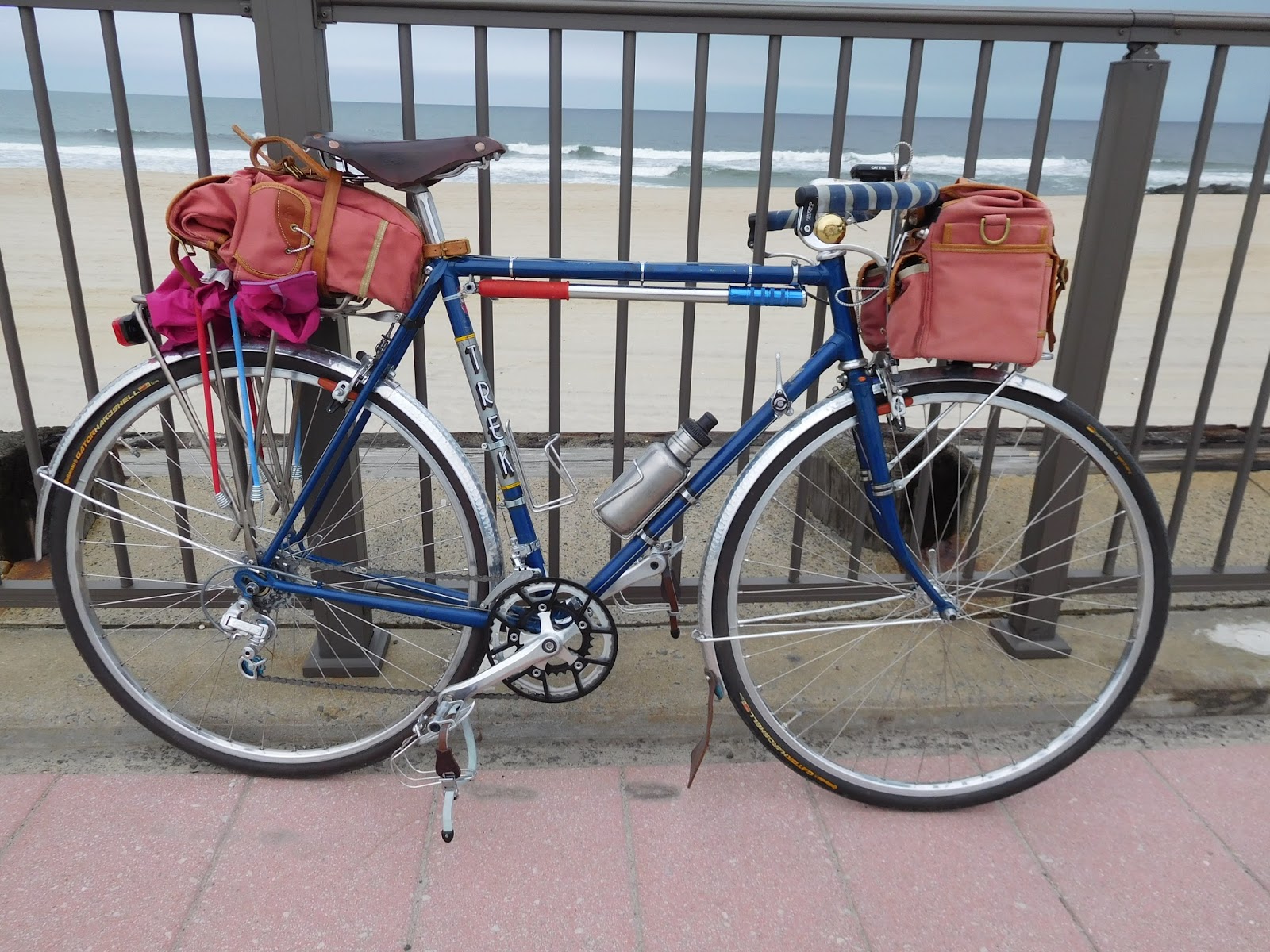
Yesterday the Trek project got another rite of initiation, if you will:  I took it on a ride I have experienced with all of my Mercians--and some of the bikes of my youth.


I pedaled down to Long Branch, NJ.   I am glad I went there yesterday, when it was overcast and windy--and turned chilly.  Today is summer-like and, of course, it is Easter Sunday, so lots of families will be taking their post-church service or pre- (or post-) prandial strolls on the boardwalk.  Some may even venture onto the beach, even though it's still  too cold for just about any land, and even most amphibious, animals to swim.


Vehicular traffic  was pretty light throughout the ride, except in one spot where it's almost always congested:  Just past the Victory Bridge, where US 9 and New Jersey Route 35 converge for a couple of miles--which is near the point where the New Jersey Turnpike (the Jersey stretch of I-95) crosses the Garden State Parkway.  But until that stretch, and after it, I didn't see many cars or trucks, even in Newark.


I rode down to the World Trade Center and descended through three levels of "upscale" (i.e., glossy and overpriced) shopping and "fine" (i.e., see above) "dining" (i.e., eating) "expriences" to the PATH train platform.  If Dante's Inferno had been made of glass, steel and faux marble, and the people spent more money for clothes with names on them but weren't really any better-dressed than I was (if I do say so myself), it would have looked like that place.


And, the train parked itself in Journal Square, about halfway through the trip, for a "schedule adjustment".  Hmm...I'll try that the next time I have a deadline to meet. Anyway, a trip that normally takes about 20 minutes took double that amount of time: longer than it took me to ride from my apartment to the World Trade Center.

Once I got out of Newark Penn Station, which smells as if someone's been brewing the same pot of coffee since the day it opened (It's a WPA building.), I was about to swing my leg over my bike when one of the most charming homeless men I've ever encountered asked me for a dollar to help him buy some fried chicken.  Who doesn't like fried chicken?  How could I deny such a request?  Certainly not I, even if he wasn't telling me the truth!


I think, subconsciously, I chose to ride the Trek today because I knew its colors would mirror, more or less, the sea and sky.  It's almost as if the Trek wanted to be there today.  


The last part of the ride--from the Azzolina Bridge to Long Branch--was the flattest and, paradoxically, the most difficult part of the ride.   It took me longer to cover that distance than to ride nearly double that distance, from the intersections of Route 35 and 36 in Matawan to the bridge.  Once I got off the bridge, I was riding right into the teeth of the wind and the temperature felt as it had dropped about twenty degrees F.  When I finally stopped, at the Long Branch boardwalk, it might been good to be a polar bear.

Speaking of which:


I think it's the first time that place has been painted in about 45 years.  My first reaction was "Uh-oh!  They're turning it into a Cold Stone Creamery clone--with CSC prices.    Turns out, I had nothing to fear.  It's still an old-school Jersey Shore roadside ice cream stand.  You won't find exotic flavors there (unless you consider Yuengling Black and Tan exotic), just the stuff you remember from your childhood.  And it's just as good, maybe better, and reasonably priced.  I ordered a cone with vanilla-chocolate twist ice cream and a cherry topping.  Definitely old-school Jersey shore.  


It was good.  Real good.  So was my ride.  So was the day. 

Jackie Robinson

Yesterday was the 70th anniversary of one of the most important events in US history.  It, and the actor in the drama, if you will, should be commemorated--though not exactly for the reasons that they are.

On 15 April 1947, Jackie Robinson played his first regular-season game for the Brooklyn Dodgers.  It is often said that on that day, he "integrated" the "national pastime."  It is true that he was the first openly, visibly black man to appear in a modern major league baseball game.  That is, if you define "modern major league" as today's National and American Leagues.  Before 1901, though, the American League didn't exist and the National League's chief competition--the other major league, if you will--was the American Association.

The Toledo Blue Stockings joined the Association, as it was called (in contrast to the NL, which was usually referred to as "The League") in 1884.  Prior to that, it had played five years in a minor league.  On its roster was a fellow named Moses Fleetwood Walker.  

He was a slick-fielding, light-hitting catcher who joined the Blue Stockings in 1883 and remained with them when they made the move to the Association the following year.  During that time, "Cap" Anson, player-manager of the Chicago White Stockings (one of the powerhouse teams of that time), refused to let his squad play a rival with a black man on its roster.  Of course, Anson didn't refer to Walker--who was usually known as "Fleetwood"--as a black man.  Rather, he used a word that rhymes with "bigger".

Injuries limited Walker to one season on the 'Stockings.  He extended his playing career in the minor leagues by another five seasons.  By that time, his injuries (In those days, catchers didn't have mitts, or any of the other protective equipment they have now!) and the racism he endured took their toll on him.  During his teams' road trips, he sometimes slept on park benches because no hotel or rooming house would accommodate him, and he endured everything from insults to death threats to having projectiles hurled his way.


Image result for Jackie Robinson bicycle
Jackie Robinson signing autographs on the steps of his Brooklyn home.  His wife, Rachel, is at his side.  Today, at age 94, she is strong and beautiful.

Robinson endured all of those things, too, throughout his career.  Add that to the fact that he made his debut at age 28--five to eight years later than players typically begin their major league careers (Prior to his Dodger debut, Robinson played in the Negro American League and served in World War II.)--and you realize that it's a miracle he lasted ten seasons in the major leagues.  He retired when the Dodgers traded him, saying he didn't want to play as a shadow of what he had been.  But it's hard not to think that, as tough as he was, he'd simply had enough.


So, when I bring up Walker, I mean absolutely no disrespect to Robinson, who remains one of the athletes I admire most.  After Walker retired, Anson--who had a lot of influence among baseball administrators and team owners of the time--got the major leagues to make a "gentleman's agreement" not to hire black players.

And major league baseball teams followed it, until Dodger General Manager Branch Rickey brought Robinson aboard.  At least, they believed they did.  I can't help but to think that other black men played "stealth" on major league rosters before Robinson.

Long before Spike Lee made his claim, rumors abounded that Babe Ruth was black.  Part of the reason for that is that he had some Negroid features. Also, he was born in a section of Baltimore where many African-Americans lived and ended up in an orphanage there.  Beyond that, few details about his childhood exist.  Throughout his life, Ruth had many black friends, was a denizen of Harlem during the "Roaring Twenties", played in--and sometimes organized--exhibition games between white major leaguers and Negro Major League players (something the owners of major league teams as well as the major league baseball commissioner frowned upon), and voiced his wish to see the major leagues integrated.  For all of that, he was taunted and threatened, by fans as well as players like Ty Cobb, who once refused to go on an off-season hunting trip because he didn't want to share a cabin with "no N----".

Whether or not Ruth was in fact black, I can't help but to wonder whether other light-skinned black players donned major league uniforms.  After all, more than a few such people--including the father of a friend of mine--essentially changed their racial status by moving from the South to the North or the West Coast.  My friend's father was born and raised in Virginia which, like other Southern states, had the "one drop" rule. He came to New York, which had no such law and where no one questioned his race.  He married a white woman whose parents, from what my friend tells me, never realized that their daughter married a "black" man!

Now, if he and others changed their race by changing their abode, who is to say that some baseball player or another didn't do it--and make it to the major leagues?  I'm not saying that such a thing indeed happened--I have no evidence for that--I am only raising the possibility that it could have happened.  

Whether or not it did, and whether or not Babe Ruth was black, or whether or not any blacks wore major league uniforms during the six decades between Walker's retirement and Robinson's debut, Jackie Robinson should be honored as a hero.  He was ineffably and openly black at a time when even the Armed Forces (in which he served during World War II) were segregated.  And, even though Major League audiences didn't get to see him during what might have been a couple (or even a few) of his best years, he retired as one of the best second basemen in the history of the game. (Some say he was the best.)  He was a first-ballot Hall of Famer and, in perhaps his greatest baseball honor, in 1997 his number (42) became the only one that, to this day, is "universally" retired by all major league teams.