So, again....Why Rome?
I thought it would have remained a rhetorical question after I missed breakfast at the hotel this morning. It seems that I took in more sun than I'd realized and stayed up later, so I slept until 9:30--something I don't normally do during a trip.
So I went for a walk. I figured that I needed to get beyond the neighborhood where I'm staying, as much as I like it. The hotel is most of the way up a hill, and the Forum, which I visited yesterday morning, is at the bottom of it: about a five-minute walk. And the Colosseum is only about the same distance in another direction. Although I walked a lot yesterday among the ruins (they cover a lot of ground), I hadn't ventured much beyond my "base", if you will.
Today I started by walking in the other direction, past Termini--the main rail and bus station--and kept going. I honestly had no idea of where I was, but I knew I was moving away from the tourists. Finally, after about an hour and a half, I stopped at a cafe for a coffee--an espresso, to be exact.
Then I did something that, I think, took the baristo by surprise: I ordered another. It was that good: Caffeine jitters be damned, I told myself. But I didn't experience them, though I was almost giddy for a moment.

Anyway, I continued to walk, guided by the navigational skills of no less than Signoro Colombo, and climbed the hill to the Villa Medici. It now houses the Academie Francaise of Rome, but the real reason you go that way is for the gardens adjacent to it--and for the views. In particular, it's at the top of the hill you reach when you climb the Spanish Steps--which I descended.

Even though it seems like half of the human race is in La Piazza Spagna on days like this, it's difficult not to like: When a staircase is built with such artistry and function and connects two places with different kinds of beauty, well, it's not difficult to see why it would draw all sorts of people.
By this time, I was feeling better about having come to Rome, but something still felt a bit off. Then I realized I hadn't taken a pill I normally take in the morning. (It's not psychtropic, at least not technically!) So I went back to my hotel room--as it turned out, five stops on the Rome Metro A line--and downed it with a bottle of San Benedetto water.
Actually, that trip back to the hotel room wasn't a diversion. I had scheduled a bike tour for 3 pm, and the shop at which I booked it--one of the three branches of Bici & Baci--is located most of the way down that hill from my hotel to the Forum, near the end of la via Cavour.
Bici & Baci is an interesting place. Although they rent bicycles and conduct bicycle tours, their main focus is on Vespas. In fact, the shop's basement hosts the Vespa Museum. Perhaps if I really wanted to "do as the Romans do", I would ride one. But I wanted to stick to pedals, if for no other reason that I haven't driven any sort of motorized vehicle in a long time.
They couldn't have given me a better guide than Roberto. He asked what I'd already seen. When I told him, he said, "OK, we will not do the 'highlights' tour--unless you want that."

Instead, he offered to show me "Rome as a Roman." Of course! That meant, among other things, this:

Hundreds of fountains like these are located all over the city. The water is indeed potable, and people often fill their bottles under them. But that's something a Roman wouldn't do, Roberto told me. Oddly, most people don't seem to notice the hole at the top of the pipe on all of those fountains: To prove his point, we stopped at three, all of which had that feature.
I wonder whether the Roman water authorities designed them that way and didn't bother to tell the rest of the world. Or, perhaps, that hole serves some other purpose (aeration?) and someone discovered the easy way to drink from them.

Anyway, on our route, I learned entertaining stories like the one about the fountain the Borgheses supposedly built in one night to show that, although they'd fallen on hard time, they had the financial wherewithal for such things. Why? Well, a Borghese daughter wanted to marry the son of the family that owned the land on which the fountain was built--the Matteis, who were rich and influential. But they were reluctant to let him take her hand because they'd heard about their financial straits. According to legend, the next morning, the Mattei patriarch woke and, much to his surprise, saw the fountain on his land, amidst the houses that ringed the palazzo.
Interestingly, although the Matteis were Roman Catholic--as were nearly all members of noble families at their time--they lived right in the middle of the Ghetto (yes, the original one), the traditional Jewish quarter of the city. Literally steps away from that fountain, one can find momentos like these:

Although a higher percentage of the Jewish population survived in Rome and in Italy than in other European cities and countries, many Italian Jews ended up in Auschwitz once Mussolini was deposed and the Nazis invaded. Although the Italian Jewish community is smaller, especially in Rome and the North, than it was before the war, it has had a lot of influence in Italian and the world's culture. And, as Roberto--interestingly--pointed out, much of the Roman kitchen (cuisine) in fact originated with the city's Jews.
Back to the Matteis: They were patrons of the arts. Among the painters they sponsored was the one who gave us this:
It adorns a portico of the Sant'Agostino chruch, the last stop of our tour. Roberto made a point of stopping there because he loves that painting, and Caravaggio generally. So do I.
Finally, in keeping with Roberto's promise to show me what a Roman knows about his city, he took me up the Aventine hill, which has a garden with the most unique view:

You might think it's just another way of seeing the Vatican. But the park and garden were designed so that the closer to the edge of the hill--and to the dome of the Vatican--you walk (You can't ride in the park.), the smaller it seems. That is because the approach brings other tall structures into view, which diminishes the perspective of the dome.
Nearby is another interesting view, which I tried to capture:
This peephole is on the gate of the Villa del Priorato di Malta, which--like the Vatican--has extraterratorial status in Rome. I tried to capture the view of the Vatican which, as Roberto pointed out, makes the gate one of the few places in the world where you can look at three countries (or, at any rate, sovereign territories)--i.e., Italy, Malta and the Vatican--at the same time.
Now tell me: What else could I have asked for on a day in Rome?
Note: As you can probably tell, I am feeling much better about this city and country than I did yesterday. Still, I have one complaint: I am on the slowest internet connection I've experienced in at least 15 years. My photos are taking forever to upload! So, you won't see as many of them in upcoming posts. But I'll share some more, if you'd like, after I return home!
I thought it would have remained a rhetorical question after I missed breakfast at the hotel this morning. It seems that I took in more sun than I'd realized and stayed up later, so I slept until 9:30--something I don't normally do during a trip.
So I went for a walk. I figured that I needed to get beyond the neighborhood where I'm staying, as much as I like it. The hotel is most of the way up a hill, and the Forum, which I visited yesterday morning, is at the bottom of it: about a five-minute walk. And the Colosseum is only about the same distance in another direction. Although I walked a lot yesterday among the ruins (they cover a lot of ground), I hadn't ventured much beyond my "base", if you will.
Today I started by walking in the other direction, past Termini--the main rail and bus station--and kept going. I honestly had no idea of where I was, but I knew I was moving away from the tourists. Finally, after about an hour and a half, I stopped at a cafe for a coffee--an espresso, to be exact.
Then I did something that, I think, took the baristo by surprise: I ordered another. It was that good: Caffeine jitters be damned, I told myself. But I didn't experience them, though I was almost giddy for a moment.

Anyway, I continued to walk, guided by the navigational skills of no less than Signoro Colombo, and climbed the hill to the Villa Medici. It now houses the Academie Francaise of Rome, but the real reason you go that way is for the gardens adjacent to it--and for the views. In particular, it's at the top of the hill you reach when you climb the Spanish Steps--which I descended.

Even though it seems like half of the human race is in La Piazza Spagna on days like this, it's difficult not to like: When a staircase is built with such artistry and function and connects two places with different kinds of beauty, well, it's not difficult to see why it would draw all sorts of people.
By this time, I was feeling better about having come to Rome, but something still felt a bit off. Then I realized I hadn't taken a pill I normally take in the morning. (It's not psychtropic, at least not technically!) So I went back to my hotel room--as it turned out, five stops on the Rome Metro A line--and downed it with a bottle of San Benedetto water.
Actually, that trip back to the hotel room wasn't a diversion. I had scheduled a bike tour for 3 pm, and the shop at which I booked it--one of the three branches of Bici & Baci--is located most of the way down that hill from my hotel to the Forum, near the end of la via Cavour.
Bici & Baci is an interesting place. Although they rent bicycles and conduct bicycle tours, their main focus is on Vespas. In fact, the shop's basement hosts the Vespa Museum. Perhaps if I really wanted to "do as the Romans do", I would ride one. But I wanted to stick to pedals, if for no other reason that I haven't driven any sort of motorized vehicle in a long time.
They couldn't have given me a better guide than Roberto. He asked what I'd already seen. When I told him, he said, "OK, we will not do the 'highlights' tour--unless you want that."

Instead, he offered to show me "Rome as a Roman." Of course! That meant, among other things, this:

Hundreds of fountains like these are located all over the city. The water is indeed potable, and people often fill their bottles under them. But that's something a Roman wouldn't do, Roberto told me. Oddly, most people don't seem to notice the hole at the top of the pipe on all of those fountains: To prove his point, we stopped at three, all of which had that feature.
I wonder whether the Roman water authorities designed them that way and didn't bother to tell the rest of the world. Or, perhaps, that hole serves some other purpose (aeration?) and someone discovered the easy way to drink from them.

Anyway, on our route, I learned entertaining stories like the one about the fountain the Borgheses supposedly built in one night to show that, although they'd fallen on hard time, they had the financial wherewithal for such things. Why? Well, a Borghese daughter wanted to marry the son of the family that owned the land on which the fountain was built--the Matteis, who were rich and influential. But they were reluctant to let him take her hand because they'd heard about their financial straits. According to legend, the next morning, the Mattei patriarch woke and, much to his surprise, saw the fountain on his land, amidst the houses that ringed the palazzo.
Interestingly, although the Matteis were Roman Catholic--as were nearly all members of noble families at their time--they lived right in the middle of the Ghetto (yes, the original one), the traditional Jewish quarter of the city. Literally steps away from that fountain, one can find momentos like these:

Although a higher percentage of the Jewish population survived in Rome and in Italy than in other European cities and countries, many Italian Jews ended up in Auschwitz once Mussolini was deposed and the Nazis invaded. Although the Italian Jewish community is smaller, especially in Rome and the North, than it was before the war, it has had a lot of influence in Italian and the world's culture. And, as Roberto--interestingly--pointed out, much of the Roman kitchen (cuisine) in fact originated with the city's Jews.
Back to the Matteis: They were patrons of the arts. Among the painters they sponsored was the one who gave us this:
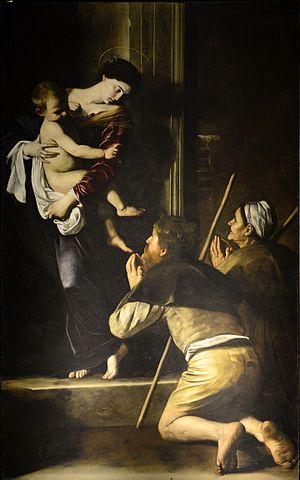 |
| Madonna dei Pellegrini, by Caravaggio |
It adorns a portico of the Sant'Agostino chruch, the last stop of our tour. Roberto made a point of stopping there because he loves that painting, and Caravaggio generally. So do I.
Finally, in keeping with Roberto's promise to show me what a Roman knows about his city, he took me up the Aventine hill, which has a garden with the most unique view:

You might think it's just another way of seeing the Vatican. But the park and garden were designed so that the closer to the edge of the hill--and to the dome of the Vatican--you walk (You can't ride in the park.), the smaller it seems. That is because the approach brings other tall structures into view, which diminishes the perspective of the dome.
Nearby is another interesting view, which I tried to capture:
 |
| I wasn't peeping. I swear! |
This peephole is on the gate of the Villa del Priorato di Malta, which--like the Vatican--has extraterratorial status in Rome. I tried to capture the view of the Vatican which, as Roberto pointed out, makes the gate one of the few places in the world where you can look at three countries (or, at any rate, sovereign territories)--i.e., Italy, Malta and the Vatican--at the same time.
Now tell me: What else could I have asked for on a day in Rome?
Note: As you can probably tell, I am feeling much better about this city and country than I did yesterday. Still, I have one complaint: I am on the slowest internet connection I've experienced in at least 15 years. My photos are taking forever to upload! So, you won't see as many of them in upcoming posts. But I'll share some more, if you'd like, after I return home!


