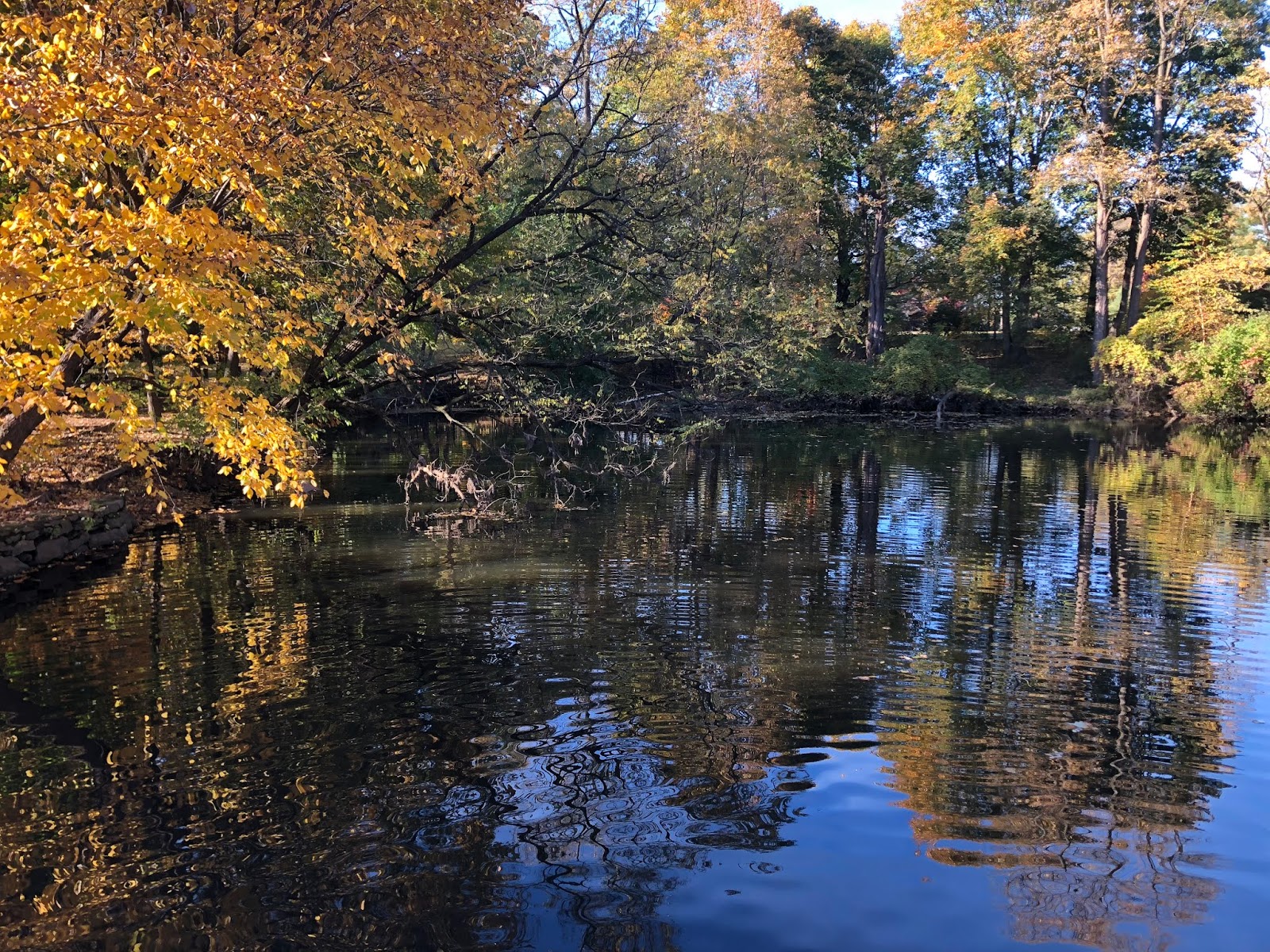
Last week, I said this year's foliage seemed less colorful than that of previous years. Well, it seems that I picked the wrong week to complain. I saw some more color during a ride I took--to Connecticut--on Thursday, and even more about 50 kilometers north of the city.
Bill and I rode along the South County Trail, which begins in Van Cortlandt Park, near the Bronx-Westchester border, and continues parallel to the Hudson River. Parts of it follow the Saw Mill River. In some places, it looks more like a drainage canal than a river; in other spots, it's a turbid pool. But, believe it or not, there are rapids and falls--and, even better, scenes like thesw.
Most of the trail is paved or hard-packed dirt. But the part in Van Cortlandt seems to have been mud since the beginning of time. There was a time when I would have said that getting myself muddied up, or sweaty, made me "deserving" of the beauty I saw around me. But, the other day, the mud was simply another part of the picture, if you will.
Because of the marathon, we started later than we'd planned: So many streets were closed that we had trouble navigating our way to our meeting point. The part of Queens where I live was effectively cut off from Brooklyn, and the bridges and streets where people were allowed to circulate freely were full.
Not only did we start late, we had less daylight to work with because Daylight Savings Time ended. The day ended early, but at least, in Sleepy Hollow (a.k.a. Tarrytown), we saw this:
When I was a literature student, I learned about something called the "closet drama".
Now, dear reader, could you forgive me for believing, at first, that it was a play written by someone who hadn't admitted his or her "love that dare not speak its name." Of course, I was in a closet myself--one from which I wouldn't emerge for a few more decades--and doing everything I could to convince myself that it was really my home.
Anyway, a "closet drama" is something its writer does not intend for performance. Perhaps it seems silly to write a play that you don't want produced--why not write a novel instead?, you might ask. Well, as I understand it, the play allows for certain kinds of plot and character development that are difficult, if not impossible, in other genres of writing. I say "as I understand it" because I've never tried to write a play.
I would later learn about architects' "closet plans". A number of renowned architects designed edifices they never intended to be built. There are, I learned, even architects who've designed dozens, even hundreds, of buildings without having a single one built. Most such architects, not surprisingly, are professors: They design such buildings for instructional purposes or as academic exercises.
Such an architect might be behind this bicycle:
Of course, it began its life as a bicycle--a Pashley, the "Princess" model, to be exact. But the Arcade Bicycle Basin not intended for you to ride to school or the park or simply to be seen looking fashionable while riding a bike--even though it retains everything the Princess normally comes with, save for the Brooks saddle, if you buy it in your local shop.
Instead of the seat, the designers installed a shelf, which mounts to the wall and supports a vitreous china washbasin. Interestingly, the bike retains the wicker basket that's normally supplied with it. Not surprisingly, it comes in handy for hand towels and the like.
I guess I can understand integrating a bicycle into one's daily ablutions. I wonder, though, whether anyone has tried to turn a washroom unit into a rideable bicycle.
One thing I know: That basin wouldn't be nearly as comfortable as a broken-in Brooks saddle. Not for me, anyway!
What's even more interesting than what people transport on bicycles--whether of the pedal- or pedal-assisted variety--is how those things are transported on two wheels.
What's just as interesting is how passengers are transported on bikes built for one.
I won't ask what she was doing there!
Henry Ford was a bicycle mechanic. His first car was basically two bicycles connected to a carriage and a motor. But, even though he made four-wheeled motorized vehicles available to the masses, Ford never abandoned his pedaled two-wheeled. Even after he became one of the world's wealthiest individuals, he took a three-mile spin every day after supper. Time magazine showed him on one of those rides, which he took on his 77th birthday.
Around the time Ford was fixing bikes, two brothers in Detroit were doing the same. They would patent a dust-repellent hub and bottom bracket and found a company that manufactured some of Detroit's earliest bicycles. Later, they would enter the same line of business that would make Ford--and Detroit--famous.
The siblings in question are John and Horace Dodge.
Then there was a bike mechanic and racer from France who, like Ford and the Dodges, would turn his energies from two wheels to four and add a motor. He achieved renown as one of the early auto racers and, like Henry, John and Horace, would start his own auto-making company.
I am referring to Louis Chevrolet.
Of course, if you have too much time on your hands and idle brain capacity, you can speculate about what bikes might be like if the companies Ford, the Dodge brothers and Chevrolet made them.
Actually, we might get an idea of what Chevrolet Cycles might be by looking at what's on offer for 2019. Chevrolet, of course, became one of the most iconic marques of General Motors.
Yes, GM is going to make and market two models of bicycle for the coming year. But they won't be like the offerings of Shinola or the Detroit Bike. Instead, the company's two-wheelers will be pedal-assisted e-bikes. General Motors CEO Mary Barra said, in a press conference, that the new e-bikes would be "designed to help people stay mobile in an increasingly difficult-to-navigate urban landscape."
There is a kind of irony or poetic justice in all of this: GM, Ford, Chrysler and other auto companies helped to make the "increasingly difficult-to-navigate urban landscape."
Some motorists see us as invaders, or as over-indulged, when we "take" "their" roadway and parking spaces simply by exercising the rights we have--let alone when bike lanes are built.
Others, though, simply are baffled by us. They are unaccustomed to seeing us, mainly because few, if any, Americans living today can recall a time when bicycles and cyclists were major presences in their cities or towns. They certainly can't recall a time when bicycles were important parts of their community's culture and economy.
In some places, such a time really wasn't so long ago. Detroit, Boston, New York and a few other cities had vibrant, if small, cycling communities during the "Dark Ages" of US bicycling: roughly the two decades or so following World War II. Also, a few colleges and universities, including Princeton and the US Military Academy (West Point) had very competitive cycling teams.
There are, however, a few more communities in which bicycles as well as bicycling were an important part of the history and culture, and even the economy. One such place was Shelby, Ohio. So was a much larger city about 500 kilometers west: Chicago.
Mention the "Windy City" and, in regards to cycling, a certain name enters people's minds. Hint: It starts with an "S". If you grew up in the US, there's a good chance you rode--or had--one of their bikes. And, if you became an active rider or simply an enthusiast, you might have bought one of their top-of-the line bikes.
I'm talking, of course, about Schwinn, which manufactured bikes on the city's West Side for nearly a century. But in 1900, it was just one of 30 bicycle manufacturers making its wares along Lake Street! Perhaps not surprisingly, the "Second City" was also home to one of the most intense racing scenes, and vibrant cycle cultures, to be found anywhere in the US, or even the world.
While much of the current bicycle culture in American cities began with young, educated and affluent people--and is frankly consumeristic--Chicago's cycling culture thrived, then survived to the degree that it did, largely because of its industrial, working-class roots and immigrant (particularly German) communities. This story is one that the Chicago Design Museum tells with "Keep Moving: Designing Chicago's Bicycle Culture," an exhibit it recently opened.
The Museum places a Divvy (from the city's bike-share program) alongside a Schwinn Manta-Ray and an 1891 Featherstone-- believed to be the first US bike offered with pneumatic tires--and other bikes that were made, or had some other significant connection to, Chicago. There is also memorabilia related to the bikes, including material from Carter Harrison's successful campaign to become the city's mayor.
So why is Carter Harrison's important in the story of cycling in Chicago? Well, to demonstrate his athletic bona fides, he wore his Century pin--signifying that he'd done a 100-mile bike ride--on his chest while riding his single-speed bike.
And to think that a certain presidential candidate ridiculed a Secretary of State for falling off his bicycle! Hmm...Would El Cheeto Grande have won Harrison's election?