15 September 2020

Cranking Up A Classic Marque

A little over a year ago, I recounted discovering--along with other novice American cyclists in the 1970s--bicycle and component marques known to generations of riders in other parts of the world.  

What I didn't realize was that some actually were, or would soon be, on the brink of extinction or being changed beyond recognition.  I am thinking of bikes like Falcon, Gitane and  Legnano, who made all sorts of machines from Tour de France winners to urban delivery conveyances--and companies like Nervar, Weinmann, Huret, Stronglight Simplex, Mafac and SunTour, who made the components for those bikes, and others.

Those manufacturers are gone now. (Weinmann-branded rims are made in China and the SunTour name lives on in SR-SunTour forks, which bear no relation, other than the name, to the revered maker of derailleurs and freewheels.)  So was Chater-Lea, a British company that made bicycles and even, for a couple of decades, cars and motorcycles.  But C-L is best known for what the English call "fittings":  parts like pedals, headsets and bottom brackets. They even made frame tubing and lugs.

Chater-Lea's quality was, in its heyday, second to none.  Custom frame builders specified C-L's parts; so did larger manufacturers for their best models.  I never owned or used any of their stuff, but I encountered some when I first worked in a bike shop.  A couple of my early riding companions--who pedaled through the "Dark Ages" when few American adults cycled--rode bikes equipped with C-L.

Those bikes were older than I was.  They sported those pencil-thin steel cottered cranksets (which may have been made by Chater-Lea) you see on old-time racing bikes and that fell out of favor once good-quality mid-priced cotterless cranks became available.  To my knowledge, C-L made bottom brackets only for cottered cranksets, and their pedals were of the traditional "rat trap" variety.  

So, while the stuff was of high quality, its designs were dated or even obsolete. (Clipless pedals all but killed the market for high-quality traditional pedals.)  That is why I was, if unknowingly, witnessing the "last gasp" of a once-revered name in the cycling world:  In 1987, they would cease after nearly a century of making bike parts.

Last year, Andy Richman, a British cycling enthusiast who lives in the US, decided to revive the brand with a ne plus ultra pedal that echoes the company's old designs but employs the highest-grade materials and finished flawlessly.  He said, at the time, that "if jobs are going to come back to the UK, it's got to be for making this kind of stuff."  In other words, "high end, beautiful, artisanal" items.
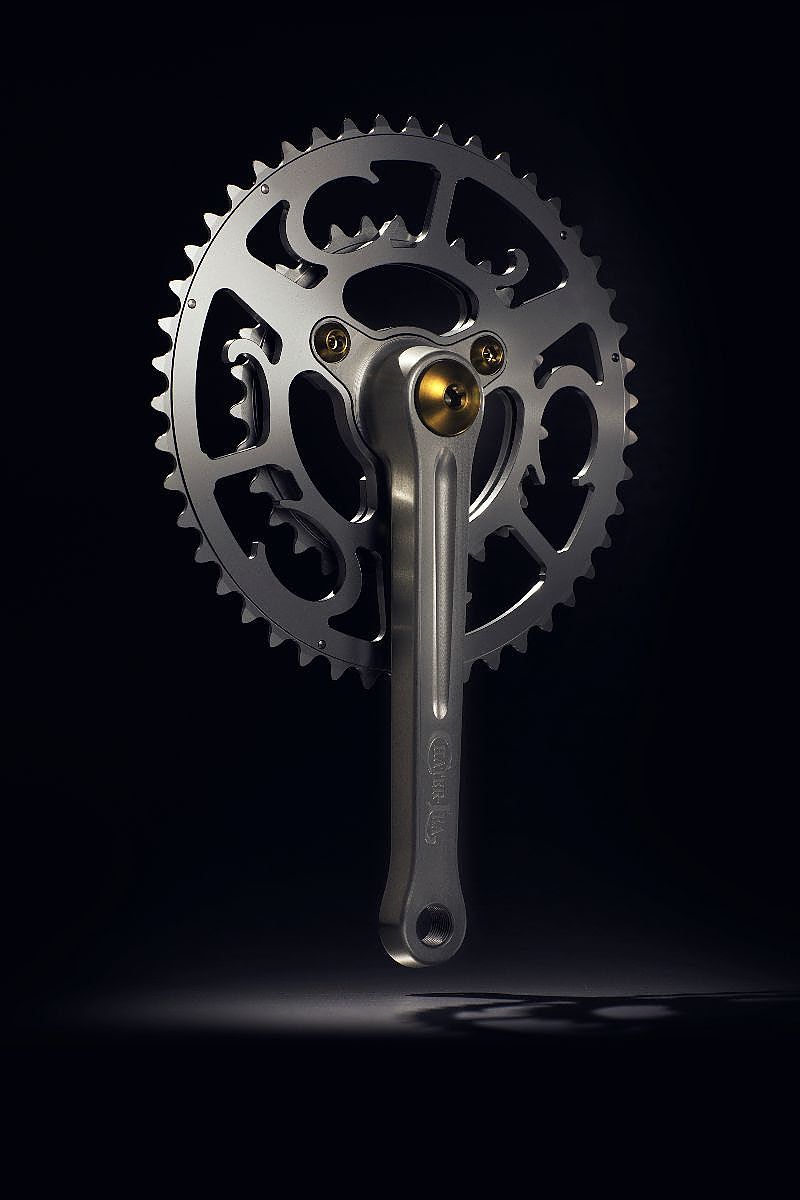
The new Chater-Lea crank comes in single or double chainring variations.


Now he is introducing a second Chater-Lea item.  Appropriately enough, it's a crankset.  But it's as much a departure from C-L's cottered sets as the pedals are a refinement of a traditional design:  The Grand Tour is a "sub-compact" crankset with 46/30 chainrings (a classic Randonneur/Gran Fondo configuration) designed to fit on JIS square taper axles and work with up to 11 speeds.

If you want to equip your bike with these items, save up your pounds:  You'll need 595 of them (about $775 at current exchange rates) to buy the cranks, and 250 ($325) for the pedals.  

Does Richman plan a complete Chater-Lea bike?


14 September 2020

On Your Mount, In The Saddle

Sometimes we are redundant. We repeat ourselves.  We say something we've said before.  And sometimes it's OK.  Someone, I forget whom, told me that when you use different words to say the same thing, it shows only that you're trying really, really hard not to repeat yourself.  Or that you have access to a thesaurus.

I am guilty of this literary tic.  How many times have I referred to my bicycle as my "mount" or "steed"?

Of course, I am not the only person to use equine-related terminology for bicycles and bicycling. (Why do we call bicycle seats "saddles?")  Moreover, more than a few have folks have used horse-related metaphors and imagery to portray human-powered two-wheeled ambulation.  Hey, the owners of North Division Bicycle, a well-regarded shop in Spokane, Washington.

North Division Bicycle Home Page


I've never been to The Evergreen State's "Second City."  The first syllable of its name is pronounced "Spoke."  If that doesn't suggest cycling, I don't know what does.

(Who would be the Four Cyclists of the Apocalypse?)

13 September 2020

What Kind Of Protection Do You Want?

I've seen bike helmets that don't have vents.  I simply can't imagine riding one:  Even with my latticework casque, I sweat when the temperature or humidity rises.

On the other hand, those vents let in the cold and rain.  The former isn't such a problem as long as you can fit a balaclava, beanie or some other form-fitting form of insulation under your helmet.

The rain is another story.  I've worn shower caps or even plastic bags under my helmets.  They're fine for keeping your head dry, but not very comfortable when it's warm and raining.

And, even if you keep your head dry, there's still the rest of you.  Do you wear a full rain suit?  A poncho?  Or do you need only to cover your shoulders and upper torso?


Hmm...Maybe this headgear could be made to ANSI specifications.

Could it also be made with a COVID mask--or even one of the face shields I've seen on a few people?

12 September 2020

Shelby Cycle Museum

More than two years ago, I wrote about a municipality that was best known for its epomymous bicycle company.

From 1925 until 1953, Shelby Bicycles were manufactured in the Ohio city for which they were named.  While most of their wares were sold under other names, such as Goodyear, Firestone and AMF, others bore the company's name and are prized by collectors for their stylishness.  One was even ridden to a transcontinental record.

While some manufacturers, such as Schwinn, Raleigh and Peugeot, were major employers, it can be argued that none was as integral to its community as the Shelby Cycle Company was to its town.

Restored 1938 Shelby. Photo by Aaron W. Legand


At the time I wrote my earlier post, the Shelby Cycle Historical Society, a tax-exempt organization, was forming and seeking members.  On Tuesday (perhaps appropriately, the day after Labor Day), it received a grant to create the Shelby Bicycle Museum on the grounds of the original Shelby Cycle factory.

I can't help but to wonder how many other bicycle "company towns" existed late in the 19th, and early in the 20th, Centuries. In those days, bike manufacturers were smaller and their markets were mainly local: No giant (with a capital or small "g") manufacturer or conglomerate dominated the industry.

11 September 2020

Dreams And A Memorial

Lately, I've had some very strange and vivid dreams.  Perhaps it has something to do with my crash. Or the pandemic might've brought them on:  I've heard other people say they've been having "weird dreams" and "nightmares" since COVID-19 ravaged cities and countries.

There are two other times when I can recall such deep, detailed night voyages, if you will:  During the weeks and months after my gender reassignment surgery and in the aftermath of the attacks on the World Trade Center and Pentagon.

My post-surgery dreams--some of which were beautiful--may have had something to do with the anesthetics and other drugs.  On the other hand, what I experienced in late 2001 and through much of 2002 (and on a few later occasions)  may have been a reaction to the pain and grief I experienced around me.  Other people, I learned, also had odd and terrifying dreams during that time, so in that sense our psyches (and, in some cases, our bodies) were responding to the attacks in the same way many of us would process the current pandemic.

Some of my dreams involved bicycling to places that weren't physical locations as much as they were rapidly-changing series of images.  In others, I would retrieve a bicycle--which I may or may not have ridden or owned in my waking life--in places I'd never anticipate, like the house of someone I knew in the dream, or some place that looked like a bunker or butcher shop.  Or I was trying to retrieve something--or even a person--while riding my bike.

I rarely talk about my dreams with anyone, though a few have figured, one way or another, into my writing.  I am mentioning them now because 19 years ago, the last event (before the current pandemic) that "changed everything" took place.  I am talking, of course, about the attacks on the World Trade Center and Pentagon.  Although I did not know anyone who died, or was even injured in them, it was impossible to escape the grief and sadness if you were here in New York.  Someone I'd never seen before, and haven't seen since, cried on my shoulder.  Someone else--an old riding buddy--rode to the site and stayed for three weeks afterward, helping in any way he could. (He was a welder and metalworker.)  One night, he called me, in tears.  I told him he'd done more than anyone had a right to expect of him, and he should go home and spend time with his girlfriend.

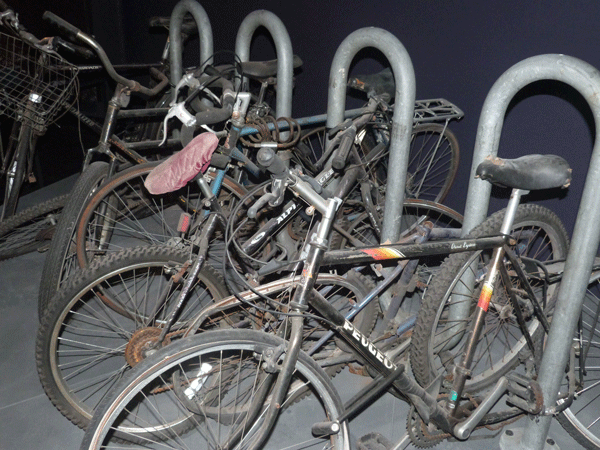
He did. Others didn't, though.  Some of them--messengers, food deliverers or others who would now be called "essential workers"--locked their bikes to a rack by the Towers.  A year later, only one of those bikes was retrieved. 

At last, the public gets to visit the 9/11 Museum - amNewYork
Bike rack at 9/11 Memorial

Perhaps I was trying to retrieve one of them in the dreams I've mentioned.  Or, perhaps, one of them was me.