20 November 2021

How I Could Have Become One Of The Remembered


Today is Transgender Day of Remembrance. All over the world, people will read the names of trans people who have been murdered during the previous year.  Such observances began on this date in 1999, one year after trans woman Rita Hester was found barely alive in her apartment.  She had been stabbed 20 times and died upon arrival at the hospital.

As brutal as her murder was,  it wasn't unusual for trans or non-binary people.  It seems that haters have a particular penchant for spewing their bile on those of us who don't, in one way or another, conform to the norms of whichever sex we were assigned at birth.  And living as the people we are seems to bring out the lawlessness of too many law enforcement officials.

I could have been one of their victims--and, possibly, one of the names read at the commemorations.  One hot day early in my gender-affirmation process, I was riding my Dahon Vitesse home work.  I didn't like the bike much but its flat-black finish garnered a lot of compliments.  One of them came through the window of a van whose rear windows were blacked out.  "Nice bike," the passenger commented.  I nodded in thanks.

The driver slowed that van down.  I rode past and thought nothing of it until it pulled up alongside me again and the same passenger yelled, "Nice legs, honey."  I was wearing a skirt that day and my legs are often complimented, or at least noticed.  So I thought nothing of it until the guy repeated himself, louder, "Nice legs!"  I paid no mind.  Then the guy bellowed, "Stop!"

Of course, I didn't.  But, as it turned out, it was a situation of "damned if I do, damned if I don't."  Again, the van slowed down, let me pull ahead, then caught up to me.  The passenger side flung open.  "When we say STOP, you STOP!"

"Why?"

"We're cops!"

"Show me your badges."

"Shut up!," the driver yelled.  "Shut up and do what we tell you!"

"But if you're a cop, you have to have reason to stop me."

"What were you doing in the projects?"

"First of all, I wasn't there.  I wasn't anywhere near there." That was true which, I think, pissed off those cops even more. "Just shut up and do what we tell you."

At that moment, I was picturing myself in the back of that van and ending up in the river that night.  So, when the passenger demanded to see my ID, I opened my bag. Fortunately for me, the ID I carried had an old address:  I had moved recently and was waiting for my updated state ID card.  

"Where are you going?"

"Home."

"Where's that?"

"The address on the card"--which was a few blocks away.

"OK," hissed the driver. "Just remember--when a cop tells you to do something, you do it," the passenger bellowed.

"You can go now," said the driver.

As it was early in my gender affirmation process, I couldn't help but to think those cops--if they were indeed cops--were "curious" about me.  Or perhaps they were looking for a victim "nobody will miss." 

That incident went down not long after I had gone through a process of wondering whether my cycling would survive my gender affirmation process.  I had made up my mind to continue riding, but I have to admit that I wondered about my decision.

Fortunately, there are more transgender or gender non-conforming cyclists than there were back then, in 2005.  Or, at least, more of us are "out."  I've met a few and have made contact with others, including Molly Cameron and the wonderful Coline in Scotland.  And, of course, there is another Scot:   the incomparable Philippa York, nee Robert Millar, the first anglophone rider to win the polka dot jersey (for the best climber) in the Tour de France.

While cycling has become more inclusive--when I first started became a dedicated rider, nearly half a century ago, almost everyone who rode more than a few kilometers was male--we still need to work toward greater inclusion and safety, of, for and in our own selves.  That is our real journey, however and wherever we ride.


19 November 2021

We May Not Be Able To Follow The Dutch, But We Can Get To Where They Are (More Or Less)

A few days ago, Mark Wagenbuur re-posted an early post on his excellent blog, Bicycle Dutch.  In it, he outlines the developments that led to the Netherlands' much-lauded bicycle infrastructure and culture.  


Utrecht city center in 1929...


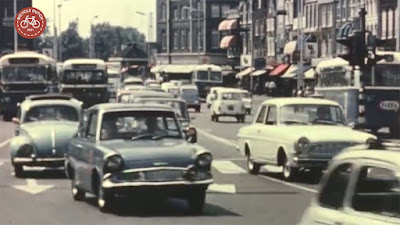
Perhaps most important, he shows that his country wasn't always the cyclists' paradise one encounters today.  Before World War II, bicycles were the main mode of transportation for many Dutch people.  Photos show streets relatively free of cars and cyclists riding among, but not competing with, trams.  After World War II, however, increasing affluence led people to foresake two wheels for four.  Another photo from 1968 shows a street as clogged with motor traffic as any in an American city (though, it's hard not to notice, the vehicles are smaller).  It was during the 1970s, he says, that the movements that led to today's system of bike lanes and other facilities began.


..

...and in 1968


Activists and planners of that time also advocated for changes in city planning to encourage motor-free transportation and recreation.  He shows motor vehicle-free central business districts, some in centuries-old areas of cities.  As he points out--in contrast to the arguments of their American counterparts--business owners report increased business because a cyclist or pedestrian is more likely to stop by whereas a driver might pass by if they can't find a parking space.

But his post also points to another parallel with the US that might help to explain why such developments are slower in coming to America. For one, he mentions that in recent years, the amount of cycling in the Netherlands has stabilized--which isn't surprising when you realize that bicycles have outnumbered people for some time. (They do in my apartment, too!)  Those statistics, though, have layers, and if you peel off one of them, you find that cycling has increased in urban areas but decreased in the countryside has decreased.  I don't know what the numbers are for the US, but I suspect that there is a similar situation at work--or that, at any rate, most of the increase in American cycling has come in or near urban areas.

For another, he talks about the resistance to making city centers more auto-friendly. (One of the images is a rendition of a proposed highway that looks alarmingly like the ones in areas like Southern California and other auto-centric areas. Thankfully, it was never built.)  While cycling declined for a couple of decades after World War II, remaining cyclists fought to make their country safer for riding.  Also, making some city centers more auto-friendly meant, not only removing bike lanes or streets that were safe for cycling, but also some beloved buildings, some of them centuries old. When some of those structures were lost, people thought that perhaps the price of "progress" wasn't worth it.

While there is some interest in preserving historic structures in some American cities, on the whole the environment in the US is more amenable to large-scale development.  Some of that has to do with citizens who still see building bigger buildings as "progress," but I suspect that it has at least as much to do with the fact that mega-developers have more influence on politics and the media, at the local as well as the national level, in the US.  

Also, business and commercial districts in some American cities, especially the newer ones in the South and West, are auto-centric by design.  In contrast, the older Dutch (and other European) city centers, with their narrower streets and smaller plazas, were created long before automobiles came along.  So, I would suspect, making them more bicycle- and pedestrian-friendly would mean, at least to some degree, returning them to their original state.  Or, at least, making them bicycle- and pedestrian- friendly doesn't require as much of a radical redesign as would be required in most American cities.

Finally, there is the matter of geography.  The Netherlands is a much smaller country, and places are closer together.  So people need less convincing to see that bicycling is a practical way to get to where they need to go--and that riding is simply fun.  If someone lives 100 kilometers away from work, as many Americans do, no bike lane is going to convince them not to drive.  At best, such a commuter might be enticed to ride his or her bike to a train or bus station--if indeed there are safe and secure parking facilities at the station. Or if there is a train or bus line at all.  That is another area in which Dutch and other European people are better-served than Americans.


So, Mark Wagenbuur has done a service by showing that his country wasn't always the cycling Nirvana we see today.  More important, he shows that it was once before a country of cyclists, but planners and ordinary citizens learned from their mistakes in emulating American transportation and city planning.  Perhaps we can learn from our own mistakes and, although we can't go about it in the same way as the Dutch (or Danes or other Europeans), we can make this country more amenable for cyclists and pedestrians.  It's one of the steps we need to take in order to keep from cooking ourselves (and most other life) on this planet!


18 November 2021

A Race You Really Can't Win Without Trying

I'm riding the Lento.

Most things sound better in Italian. (One of the few exceptions is the mushroom, fungo in la bella lingua.)  And if I didn't know any better, I'd sign up for it.

But those of you who know the language--or music terminology--know that "lento" means "slow."  Believe it or not, there's actually an event in which people try to go slowly--something that comes naturally to me at my age!

What's really wild, though, is a barrier the riders were trying to break.  Just as running a mile in four minutes or less seemed impossible until Roger Bannister did it in 1954, one wonders how someone who isn't completely immobile can ride less than a kilometer (about .625 mile) in an hour.  That was the goal of Davide Formolo and Maria Vittoria Sperotto at the Velodromo Rino Mercante del Bassano di Grappa, in the Veneto region.  They were trying to "better" the old mark of 1070 meters set by Bruno Zanoni in the same event two years ago.

Formolo and Speretto shattered that record by riding 918 meters.

Now, if you think you can out-do them simply by stopping for a latte every 30 seconds, think again.  The cyclists in the Lento are every bit as fit as the riders you'd see in any race:  Formolo, in fact, has competed in, and finished, all of the Big Three races and placed as high as ninth in the Vuelta. But they're not trying to showcase their power or speed, as someone trying to break (in the sense we'd normally think of) a distance or speed record.  What the Lento rewards, instead, are skill and patience.  

The rules of the race are that riders must always ride forward at the slowest possible speed without coming to a complete stop, and they must do so on a geared bike without brakes.  


In a way, the event reminds me of something theater and film directors have long said:  People can't play themselves.  Likewise, you can't win an event like the Lento if your normal speed is slow:  You have to be strong, fast and skilled enough to control yourself at the slowest possible speed.    

17 November 2021

A Path For Stolen Bikes

Between 2005 and 2010, a number of European cities, mainly in the north and west, initiated bike-share programs.  Paris and Rome were among them.  Both ran into similar problems, among them vandalism and theft.  In both the City of Light and the Eternal City, bikes ended up at the bottom of bodies of water:  the Canal Saint Martin in Paris and the Tiber in Rome.  Also, a number of bikes went to--and a few were recovered in North Africa and Eastern Europe, particularly Romania.

The fact that so many bikes were not returned led Rome to pull the plug on its program, and for two companies to abandon the city.  The Velib program nearly met the same fate before a Spanish company, Smovengo, took it over and rebranded it as Velib Metropole in 2018.

Over the years, I have heard from friends and acquaintances in France and elsewhere that Romania is a common destination for goods, including everything from watches and designer clothing to priceless artwork, stolen in other parts of Europe. The reasons I've heard and read include everything from the relative poverty of the country to the corruption or inefficacy of police and government officials.  

Whatever the reasons, it seems that high-profile sports teams--including those in cycling--are not immune to the problem.  About a month ago, the Italian national team competed--and won seven medals--in this year's World track championships, held in Roubaix, Belgium (the end-point of the Paris-Roubaix race, a.k.a. "L'enfer du nord.).  The team stayed in a hotel just over the border in Lille, France that was selected specifically for its safety.

Well, we all know that stuff happens even in the safest places and structures.  The team was getting ready for its return home when 22 of its Pinarellos--including four with a distinctive gold--were stolen from a team van.  In total, those bikes were valued at around 400,000 Euros (about 451,790 USD).


Italian team members Simone Consonni, Filippo Ganna, Francesco Lamon and Jonathan Milan on the track bikes that were stolen.


The good news is that police recovered the bikes after they caught some criminals in the act of trying to sell  them.  Searches also turned up--surprise, surprise--other stolen goods, including eight televisions, ten mobile phones and drugs, in addition to 2800 Euros in cash.  

On Monday, team mechanics travelled to Romania to pick up the bikes and bring them back in Italy. 

16 November 2021

A Perfect Storm Of Hate

I am a transgender woman and a cyclist.  That means I belong to two groups of people for whom it means that becoming more visible means having a target pinned on your back.

That's how it seems, anyway.  On some jobs, when I've done anything that draws positive attention--whether it's an excellent review, volunteering for a committee or, sometimes, even outside activities, like my writing--some co-workers, including those of higher rank than mine, become Captain Ahabs to my Moby Dick.  Until that happens, they congratulate themselves for "tolerating" me.  But when I accomplish something through my creativity and hard work, they seem to think that someone like me (or unlike them) isn't supposed to do such things.  

Likewise, as cycling for transportation as well as recreation becomes more mainstream, it stokes whatever hatreds and resentments some folks have toward us--or, at least, whatever notions, however unfounded, they have about us. We are seen as taking something--"their" streets or, perhaps, some notion of what it means to live a meaningful and productive life.  We are also accused of "not paying taxes" when, in fact, as I pointed out to one driver,  we pay more taxes for things we don't use, such as gasoline and highways.  

An unfortunate corollary to the things I've described can be seen in the aftermath of recent protests against the ways police, in too many places, treat Black*, Hispanic and Native American people.  It seems that, like trans and non-binary folks and cyclists, racial and ethnic minorities--especially Blacks and, in some parts of the country, Native Americans--have similarly been targeted for harassment and violence. Unfortunately, it's no surprise when you realize that the Ku Klux Klan became a force in the wake of Reconstruction, and lynchings and other kinds of violence against Black people surged in the years just after World War I, when large numbers of Black soldiers returned home, and during and after the Civil Rights protests of the 1950s and 1960s.

One parallel between what I've experienced, if less intensely, as a cyclist and trans woman and what Blacks too often endure is that we and they are too often targeted for doing or accomplishing things, or being in a place we're "not supposed to." And, being a member of one of the groups I've mentioned can compound the harassment you might experience as a member of one of the other groups.  As an example, one hot day early in my gender-affirmation process (I was on hormones for about two years and had begun living and working as female), a couple of cops pulled me over on some made-up charge while I was riding home. Their interrogation was punctuated by comments like, "I like your bike" and "You have nice legs." 

Elliot Reed also experienced an unfortunate confluence of bigotry while he was out for his morning ride two weeks ago.  The 50-year-old Texan is not only a cyclist in a car-centric, red-meat state; he is also--you guessed it--Black.  

When he stopped at an intersection, 25-year-old Collin Joseph Fries (great name for someone in a red-meat state, isn't it?)  drove up along side him.  "He was just looking at me at the stop sign," Reed recalls.  "He said, 'You need to get out of this neighborhood because you're making a lot of people nervous."  

Then Fries upped the ante:  "You don't live here, and if I catch you, I'm gonna do something to you."

Reed says he tried to get away and  get neighbors to confirm that he indeed lives in the neighborhood.  Then he pulled out his cell phone to record the incident.  At that point, he recalls, Fries got out of his car and used the N-word.  Things went downhill, very quickly, from there. 


Several witnesses have confirmed everything I've described so far, and what I'm about to relate.  Fries chased Reed, caught him and punched him so hard and so often that he lost consciousness. Those same witnesses reported that Fries continued to punch him even after he lost consciousness.

The attack left Reed with cuts requiring numerous stitches on his face, a broken tooth, fractured cheek bone and a burst blood vessel in his eye.


From Black Enterprise


Now, you might expect that, with all of those witnesses giving essentially the same account, Fries would be facing some serious charges.  For the moment, though, he's only been charged with a misdemeanor for aggravated assault.  (Is that a Harris County thing?  If something is "assault" and it's "aggravated," how can it be called a "misdemeanor?")  The District Attorney's office, however, says the investigation is "ongoing" and that it's awaiting medical records of the injuries and other evidence from the investigating officers.

At the very least, I think, Fries should be charged with something more serious related to Reed's injuries--and a hate crime.  For that matter, anyone who is attacked because of his or her identity--yes, I include motorists who did what Fries did or pedestrians who push people off their bicycles because their victims are cyclists--should be so charged, and sentenced.

*  I am using the term "Black" because I want to include immigrants and descendants from the Caribbean and Africa, as well those who were born here. They, too often, experience the same sort of hostility and violence as African Americans.