18 January 2022

Food, Fashion And...Bike Lanes?

This post will be a tale of two cities--without the capital letters. 

They have roughly the same population.  One is the capital of its nation; the other is, at least in some senses, in its country.  They could be said to be rivals because they are renowned for many of the same things:  food, fashion, finance, the arts, education and technology.

Now one of those cities is not only wants to emulate something the other has been doing; it plans to do even more of it.

I am talking about urban bike lane networks.  While Copenhagen and Amsterdam are seen, perhaps rightly, as the most bike-friendly capitals in Europe, Paris is leading the way in creating new bike infrastructure.  It plans to have 680 kilometers (423 miles) of bike lanes in the City of Light and its surrounding areas.  


Rental Bikes by the Duomo Cathedral, Milan.  Photo by Alessia Pierdomenico for Bloomberg


Well, in the city's chief rival for food and fashion--Milan--the City Council has approved a plan that will include 750 kilometers (466 miles) of lanes that will connect not only major areas of the immediate city, but also its suburbs and some rural areas.  The goal of the Cambio Biciplan is to make bicycling the "first and easiest" way of getting around Metropolitan Milan.

One of the motivations for this plan is a problem the city is trying to tackle.  Among Italian cities, only Turin has worse air pollution; both have some of the worst air quality in Europe.  The factors contributing to that toxicity are similar in both cities: population density, industrial activity and automobile density.  That pollution intensifies in winter, when temperature inversions trap pollutants in the lower atmosphere, leaving a toxic blanket of smog.  Also, I suspect that each of those cities shares a problem with Denver: the mountains that surround (Turin) or abut (Milan) those cities also trap some of the pollutants. (Denver consistently has some of the worst air quality in the US.)

So, in the near future, bike advocacy groups may well emulate fashion and culinary institutions in seeing their "capitals" as New York, Paris and Milan!

17 January 2022

What Would Dr. King Think Of Cheap Bikes Or Rich Riders?

Last week, I wrote two posts that might indicate a future direction for this blog.  (Don't worry, I'll still write about my rides, bikes and all things related to them!) One post, about a German study, discussed who is becoming a new cyclist, and why.  The other discussed a mechanics' petition calling for repairable bicycles:  Turns out, most of the new cheap bikes, which are usually the ones bought by people with limited funds, have faultily-designed frames made from shoddy materials and are equipped with proprietary parts that break easily or wear out quickly.  

In brief, those new cyclists on nice new bikes bought in Cannondale, Giant, Specialized or Trek showrooms are mainly people with advanced educations who live in fashionable or gentrifying urban areas.  They might be riding to work or school, or simply for exercise and, as often as not, they are signaling that they care about their health and/or the environment. In other words, they are cycling by choice.

On the other hand, folks buying the cheap bikes, if they're not cycling for the first time in decades and therefore don't want to spend a lot of money,  are buying that big-box special in a big box because they can't afford anything else, including a bus or train pass--if indeed there is a bus or train that will get them from wherever they sleep to wherever they work.

One of the sad ironies--following the logic of the German study--is that we see a kind of social, economic, racial and gender segregation that would have astounded or appalled the man who is being commemorated today in the US:  Martin Luther King Jr.


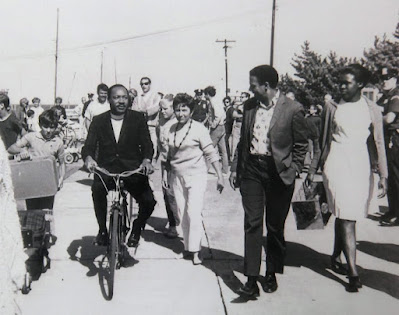
Now, I don't think King would have denounced cycling or cyclists per se:  He was often seen riding, which he probably saw as a way of bringing him closer to some of the people he was trying to help.  And, because he was turning more of his attention to economic justice issues in his last days, I can somehow see him advising bike share organizations on ways to bridge the cultural divides and media representations that cause some people to believe they can't ride because they're not white and don't look good in lycra--or those who harass cyclists because they see us as entitled jerks (the educated riders of the German study) or the scum of the earth (cf. police who are trained to automatically assume that any cyclist in a low-income neighborhood is a criminal).

So...while I wasn't thinking specifically of King, or any activist in particular, when I was writing the posts I've linked in this post, thinking about King today is causing me to realize that my almost half a century of cycling--and nearly two decades of living as a woman--makes it all but impossible not to connect my experiences and even the things I most love (bicycling, reading, writing, food, travel, animals) to questions of justice.   In other words, the work of Martin Luther King Jr is one of the major byways, if you will, of my journey.

16 January 2022

Spinning A Good Ride

When I first got serious about cycling, nearly half a century ago(!), the question was:  Reynolds 531 or Columbus SL?  Sometimes Vitus 971 was included, and within a few years,Tange and Ishiwata (The latter was seriously underrated, in my opinion!) would become part of the discussion.

Later, cyclists argued about whether to ride frames made of aluminum, titanium, carbon fiber--or steel. When serious cyclists said "steel," of course, they didn't mean the gaspipe-grade stuff used on bikes sold in big-box stores:  They were referring to Reynolds, Columbus and Tange (though in new configurations), Dedaccai and other makers.

Today, I am going to settle the question about frame materials, for once and for all.  Or, to be exact, someone more famous (and therefore more of an expert) than me--will give us the answer we've all been waiting for:


By Mike Joos


15 January 2022

It's The Stories That Matter

During the past couple of days, it's been colder (in NYC) than it's been in, probably, a few years. Today is definitely a tomato-soup-and-grilled-cheese-sandwich kind of day. Now, to all of you dear readers in Minnesota and North Dakota, this might be a beach day (on Lake Superior?  the Red River?).  But you have to remember that those of us in the Big Apple, everything is bigger, brighter, dirtier, hotter, colder, and generally more intense, and everybody is tougher, stronger and smarter, than in any other place in the universe.

Of couse, I jested (Is that a real word?), but only somewhat, with my previous sentence.  But like any true New Yorker, that's what I tell myself.  And the tourist bureau wants you to believe stuff like that so you'll tell yourself that you'll never, ever come here--until you do.  And you meet someone like yours truly.  And someone else like me. (Yes, believe it or not, there such people.)  And another.  And another.  Then you go home and tell your friends that everything in New York is bigger, brighter, dirtier, louder, more intense--and more expensive--but, you know, those New Yorkers are rude and gruff but they have hearts of gold.

My late uncle Joe was that kind of person.  He was born and lived in Brooklyn until he was about 60, when he and my aunt moved upstate. He never lost his straight-out-of-Red Hook  (I bawt a boddle uv alluv earl in da staw on toity-toid and toid*) accent--or his sense of humor and generous spirit.  

I am thinking of him now because of a feature article in a local newspaper of a place I've never seen. Uncle Joe was an avid motorcyclist until he couldn't ride anymore.  I don't recall him riding a bicycle but he talked fondly of the one he rode as an adolescent in the 1950s:  a Schwinn Phantom, in black.  He said the bike always "felt right:"  in spite of its weight, "it moved."  And somehow, he said, the gearing felt just right:  "I felt I could pedal into anything!"

Now, perhaps that last exclamation had more to do with his youthful energy than the bike, or anything else--though, I must say, if his bike was anything like the two black Phantoms I've seen, he probably felt like a real badass when he rode it.  I know, I probably would have, too.


Howard F. Gordon of Lower Burrell, Pennsylvania has one of those bikes.  And, I would guess, another, perhaps in another color.  And other bikes from that period, and earlier--over 100 of them!

From what I read in the article and saw in the accompanying photos, all or most of those bikes are of the balloon-tired "cruiser" variety made by Schwinn, Columbia and many other American companies until the 1960s.  He calls his 1951 Monark "the Cadillac of bikes.


Even though he admits he has "too many" bikes, he's always on the lookout for new treasures, at garage and estate sales.  "There are so many bicycles in garages and attics that are worth money," he explains. Whenever he buys a bike, he disassembles it and cleans every part before reassembling and restoring the bike to something like its original condition.


One of his more interesting observations regards the condition of the bikes he finds.  Generally, he says, girls' bikes are in better condition because they were better cared-for. Boys, he observed, usually rode their bikes into the ground.

That observation is part of what keeps him interested in vintage bikes:  the stories, known or imagined, by them.  "Every one of those bikes had a rider who can tell you something about the adventures they took on it," he explains.  "A bike is a kid's first feeling of freedom."  Sometimes kids pedaled their bikes to places their parents never knew they went. (Can you see me and Uncle Joe winking to each other?)  

In case you were wondering, Gordon rides.  "My wife and I go on riding dates," he relates.  "We stop for ice cream.  We enjoy the nice weather.  It's great exercise."

That sounds like a story behind at least one of his bikes! 

*--Translation: I bought a bottle of olive oil in the store on Thirty-third and Third.

Photos by Louis B. Ruediger, for the Tribune-Review

14 January 2022

Egyptian Art Deco Catholic In Jackson Heights

 Jackson Heights is five to six kilometers from my apartment.  I have ridden through it, many times, along various routes.  Still, a ride can lead me to some interesting corner or structure I’d never seen or noticed before.


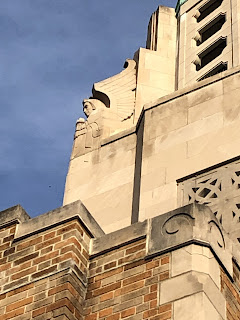
This is one such building.  At first glance, it doesn’t seem out of place: Like most of what is now in the neighborhood, it was built during the late 1920s:  around the same time as the Empire State and Chrysler Buildings. Also, many palatial movie theatres were constructed during that time, just when movies were becoming the most popular form of popular entertainment.  So it would be easy to take this building for a Loews or RKO cinema, especially when you look up.


Those “movie houses” often combined the line structures and geometric shapes of Art Deco with Egyptian motifs. They sound like an odd pairing until you look at them—and you realize that Howard Carter discovered King Tutankhamen’s tomb in the early 1920s, setting off a fad for all things Egyptian just as Art Deco was becoming the most influential style in architecture and design.


That is why this building doesn’t look out of place in Jackson Heights and would look right in parts of the Bronx or Miami Beach, which were also developed around the same time.

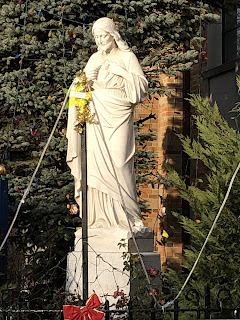
What makes this building so unusual, is this:


I grew up Catholic and have entered all sorts of church buildings and cathedrals here, in Europe and Asia.  I can’t say, however, that I’ve seen any other Catholic Church building—or, for that matter, any other house of worship—that looks quite like this one. 

And to think:  I came across it just because I decided to make a turn, and ride down a street, I hadn’t before.  That is one of the joys of cycling!