Showing posts with label Gloria Steinem. Show all posts

15 September 2026

Midlife Changes


As I mentioned yesterday, Bruce Gerencser’s blog has been one of my regular reads for nearly a decade. For one thing, I enjoy his writing style, which I cannot emulate. For another, I admire his learnedness and sheer integrity. He was part of Evangelical churches almost from birth through the next fifty years 

and was a pastor for twenty-five of them. Like many clergy and lay members of such churches, he was a conservative Republican though, he says, that slowly changed. So did the way he defined and preached his Christianity.

The latter had much to do with his study of the Bible—about 20,000 hours’ worth, by his own reckoning. Finally, he left Christianity and faith altogether. As you can imagine, he has received many dismissive and even threatening letters and e-mails from self-professed Christians. Some say he was studying the wrong way. Others  say that it was a “midlife crisis” and he should get over it. Still others accuse him of becoming an atheist and humanist for personal glory or  monetary reasons.

From what I know of him, through reading his blog and corresponding with him, none of those charges make any sense. First of all, what is the “right” way to read or study the Bible, or to worship? As for fame and glory: Although the United States is nominally a secular country, religion, and Christianity in particular, is central to many of our institutions and people’s lives. So I don’t think becoming an atheist improved anyone’s social or economic standing. 

So, was he having a “midlife crisis?” Perhaps. If he was, so were many other people who changed their opinions or way of life based on what they’ve learned.  An example is how Gloria Steinem viewed transgender people. Like other second-wave feminists during the 1970s and 1980s, she was critical of us and said some of us chose gender reassignment surgery because of rigid gender roles imposed by patriarchy. Later, however, she publicly changed her stance, recognizing that transgenders and feminists share many of the same goals, including bodily autonomy and dismantling the very gender norms she previously believed to be the reason why we underwent surgery and other changes. 

People who changed their opinions are often accused of being weak “flip-floppers” or, worse, opportunists. If anything, I respect them for having the courage to continue learning and evolving, even doing so may result in a great personal cost. (I think also of how his pilgrimage to Mecca changed the way Malcolm X saw his faith, causing him to leave the Nation of Islam. Some say it led to his assassination.) They are nothing like those who abandon principles or, worse, betray those who loved and  trusted them only for personal gain. That is the opposite of integrity.

In brief, I have the utmost respect for people who are willing to learn and, if need be, change their behavior, beliefs or ways of life in the middle of their lives. There are many such people whose names I will never know. But I am glad that others, like Malcolm, Gloria—and Bruce—have given us, in one form or another, accounts of their journeys.

Perhaps they did, after all, have a “midlife crisis.” But sometimes a “crisis” is exactly what we need to become better, or at least more authentic, versions of ourselves.

03 September 2026

Gloria Steinem Dies In The Middle Of Her Life, At 92

A woman without a man is like a fish without a bicycle.

She admits that she didn’t coin the phrase.  But she probably did more to popularize it (and its paraphrase, “A woman needs a man like a fish needs a bicycle.”)

I am talking, of course, about the one and only Gloria Steinem.  Please indulge me that one cliche: She was not only one-of-a-kind; I truly believe that it’s simply not possible for this world, let alone the human race, to produce anyone else like her.

Yesterday she passed away, age 92.


I remember my disbelief when hearing that she was 80 years old. She seemed to be as much in the middle of her life as she was decades earlier. Perhaps it came from living and working for the causes she championed  with the knowledge that even when a policy changed, a new law passed or people (some, anyway) changed the way they thought, her work would never end. She clearly never forgot the struggles she faced while growing up (her father died when she was 11) or as a young woman trying to make her way in male-dominated spheres.

Her body has ceased to function. But her legacy hasn’t, in spite of Trump’s (and his allies’) attempts to destroy it. That is why she will always be in the middle of her life: the only possible, let alone proper, way to remember her.

16 February 2014

Riding To End The World As They Knew It

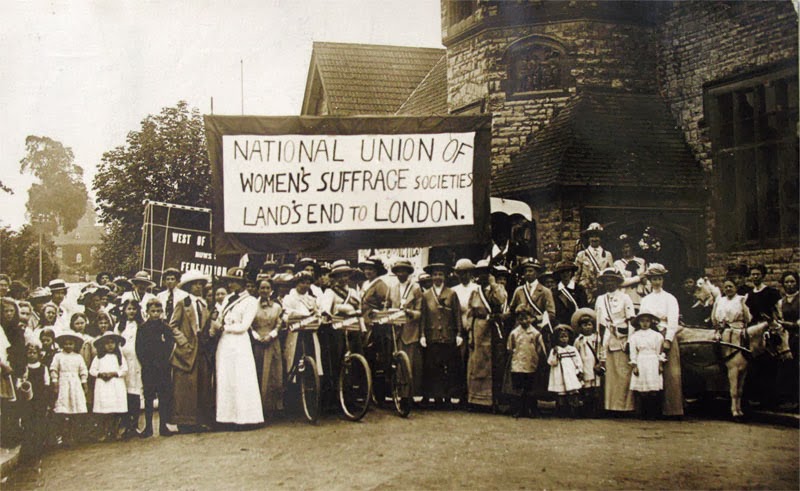
In an earlier post, I wrote about a remark Susan B. Anthony made:

"Let me tell you what I think of bicycling. It has done more to emancipate women than anything else in the world.  It gives women a feeling of freedom and self-reliance."

Historians, professional and amateur, are taking notice of something that has been neglected, or simply overlooked, for a century:  the relationship between cycling and women's liberation.


It's more than interesting to note that the heydays first modern feminist movement and the first "bike boom" almost exactly coincided during the last decade of the 19th Century and the first decade of the 20th. As I and others have noted, the bicycle gave women, for the first time, an independent means of transportation and led to the design of clothing that was less restrictive than the hoopskirts and corsets "proper" ladies wore until that time.

Of course, those were the very reasons why some--almost all of them men--thought that in seeing their mothers, sisters, wives and daughters astride two wheels, they were witnessing the decline and fall of civilization.   To wit;

 Cycling tends to destroy the sweet simplicity of her girlish nature; besides how dreadful it would be if, by some accident, she were to fall into the arms of a strange man.” 

As "Sam B.", the author of the blog Fit, Feminist and (Almost) Fifty wryly notes, "I can't imagine falling off a bike into someone's arms (that would take rather a lot of coordination)".  As for me, no one ever said that anything destroyed the sweet simplicity of my girlish nature.  For that matter, no one has ever imputed sweet simplicity to me. At least, I'm not aware of anyone who's done such a thing.

But I digress.  The irrational fear expressed in the minister's quote about how cycling makes good girls go bad was, unfortunately,  shared by some doctorsWorse, those male medical professionals amplified such nonsense with "scientific studies" claiming that cycling also made women infertile. 

(Ironically, every fifteen years or so some doctor or another claims that cycling causes infertility in menHmm...I guess all of those Tour de France winners who had children are the exception.)

Anyway, those fears were not expressed during the second bike boom and modern feminist movement--which, like their earlier counterparts, coincided.  The difference is, of course, that Betty Freidan, Gloria Steinem and the other "Women's Libbers" of the 1970's did not see the bicycle as a vehicle for female independence.  In fact, they seemed not to think about bicycles at all:  I don't recall them mentioning pedaled two-wheeled vehicles in any way.  

Perhaps one could argue that the bicycle had already done its job in liberating women.  But there was another striking paralell between the two convergences of feminism and cycling:  At the beginning of each, racing and long-distance cycling were almost entirely male preserves. If anything, more than a few women, especially the young, were discouraged from becoming serious cyclists for that very reason.  Rather than predict the moral decay that would ensue from women mounting steel steeds, many male cyclists instead made--sometimes unwittingly--rides and clubs less than hospitable to women.

These days, I see a lot more women on bikes than I did in my youth or even just a few years ago. In yet another interesting reflection of an earlier time, many of the women I see on bikes are riding independently, or with other women.  In other words, they're not trying to become members of a "boy's club": Instead, we are making ourselves more independent, like the women of whom Ms. Anthony spoke more than a century ago.