22 March 2014

Where Did I Leave It?

New York City is one of the few places in this country where large numbers of people don't own, or even drive, cars.  I am among them.

It's pretty easy to tell those who drive from those who do: The latter complain about the lack of parking.  Someone with whom I used to work said that in his vision of Hell, he is doomed to forever roam the streets of Brooklyn in search of a legal parking space.

(Hmm...Would Dante have included that if he were writing The Inferno today?  If so, which circle of Hell would it be?)

That got me to wondering whether cyclists have the same problem in places where almost everybody rides.  After all, I have had to park my wheels a block or even more from my destination because there wasn't an unoccupied sign post or parking meter--let alone a bike station--where I could lock up my machine.

What do they do in Amsterdam?

From Danasaurus

Hmm...Now where did I park?

21 March 2014

From Pedals To Motors And Back In Detroit

Today everyone thinks of Portland as the cycling capital of the United States.  That is, everyone except us New Yorkers because, well, we know that the Big Apple is the capital of everything.

Anyway, we may have the nation's oldest bike lane in continuous use (the one in Brooklyn that runs along Ocean Parkway from Prospect Park Southwest to the ocean) and Portland can lay claim to the world's first handknitted granola guard that is compatible with Shimano, SRAM and Campagnolo.  However, the American city with the richest cycling tradition may be the one people least expect.

Shinola is now crafting some beautiful and useful two-wheelers.  However, contrary to what some people believe, they are not the first bicycle manufacturer in Detroit.  They are at least 130 years too late to make such a claim (which, to be fair, they never did):  John Shire was listed as a bicycle maker--Detroit's first--in the city's 1878 business directory.  The previous year, he was listed as a carriage-maker; the following year, he would patent his improvements on the velocipede designed to make it more comfortable on the city's brick-paved streets.

From Hometown History Tours

 Shire's trajectory mirrored Detroit's industrial history:  Before it became the nation's (and the world's) motor mecca, "the D" was the North American center of carriage making, and would become one of the major hubs of the nascent bicycle industry.  In fact, some of the early automakers--including Henry Ford himself--started off by building or fixing bikes.

Henry Ford


In the 1890's and the early part of the 2Oth Century, the city on the banks of the Detroit River (the city's name is the French word for "strait")  was a port of call, if you will, for racers and other cyclists from all over the world.  It was estimated that 80 percent of the city's population rode the heavy but delicate two-wheeled vehicles, some of which snapped in half on the brick-paved streets and potholed lanes.  

There are several reasons why cycling of all kinds was so popular. One is that, in part because of its location, it attracted people from many different places--including cities and countries that had cycling traditions.  Another is that Detroit is one of the flattest major cities in America.  And, finally, even though it had become the fourth-largest city in the US by 1900, it was still pretty compact, much like downtown Manhattan or many European capitals.  So, most people didn't have to ride very far to get to work or school, or simply to get out.

What makes the history of cycling in Detroit so interesting,though, is how vigorous the city's two-wheeled scene remained even as the people (except for children) in the rest of the United Stats largely abandoned bikes in favor of the automobiles that were being produced, ironically, in Detroit.  Through most of the 20th Century--even during the "Dark Ages" of the 1950's--the Detroit News carried announcements of the Wolverine Wheelmen's rides.  Until World War II, the only American six-day race more popular than the one held in New York (at Madison Square Garden) was Detroit's. Even after it--and most other competitive cycling in the US--disappeared during World War II, criteriums and track races maintained active participation and loyal followings.  

Among those active in the Detroit cycling scene was Gene Porteusi, who opened the Cycle Sport shop on Michigan Avenue near Livernois.  At the time, it was one of the few stores anywhere in the US that carried the best racing bikes and components, most of which were imported from Europe.   His Cyclo-Pedia was also one of the first, if not the first, mail-order catalogue devoted to such goods.

But Detroit's greatest contributions to the history of American cycling may have come during the 1970's:  in another irony, during the auto industry's last "golden age" in that city.  In a previous post, I mentioned Nancy Burghart, who utterly dominated women's racing during the 1960's.  As great as she was, it took the exploits of two other racers, both from the Detroit area, to bring women's cycling (and women's sports generally) to prominence--and to establish American women as the best in that field.

In the mid- and late- 1970's, one of the most interesting rivalries developed between Sue Novara and Sheila Young.  Both were track racers and both, interestingly, came into the sport after distinguishing themselves as speed skaters. (Young won Olympic gold for the 500 meter race in the 1976 Innsbruck games.) And, as it happened, both called the Detroit area home.

Sue Novara in 1976


Cycling helped to make Detroit one of the world's great industrial centers and maintain the fabric of its life through many decades.  Perhaps people pedaling two wheels can help to bring about a renaissance of the city David Byrne counts as one of his favorites for a bike ride.


20 March 2014

Commuting On The First Day Of Spring

Many people ride their bicycles to work for the first time on the first day of Spring--or, at least, the first day with Spring-like weather.

Somehow, though, I don't think the ride Marc Boudreau filmed today was his first bike commute.


The twelve-minute spin takes him from his home to his office in Victoria, British Colombia (Canada).

19 March 2014

Carrying, Not Riding, Gaspipes

Some would argue that one can tell what kind of a cyclist someone is by what he or she carries while riding.  

That was certainly true for me during my days as a messenger.  It's also been true at other times in my cycling life.  Hey, I've even moved myself from one living quarter to another on my bike.

But at no time could I ever have held a candle to this man:


Chris Jones of Weymouth, Dorset (UK) started carrying his plumbing equipment because, he said, construction that preceded the 2012 Olympics blocked traffic.  Some of the sailing events took place in his town.

He said his service to his customers actually improved.  "On the  bike, I can tell the customers that I will be there at a certain time and know I will be there," he explained.  He knows he won't be "sitting in a traffic queue for half an hour" and therefore won't be late.

I tried to find out whether he still goes to his jobs on his bike. Somehow I imagine he does, as his bike is purpose-built.

18 March 2014

A Day Begins With A Setting Cloud

Yesterday's post ended with a pot of gold over the rainbow.  Well, sort of.

Today's post begins--as my day did--with a cloud moving across the cityscape. 


From its path between these buldings, it "sets":


Then it recedes, eventually disappearing behind one of the buildings:


17 March 2014

One Of Our Patron Saints

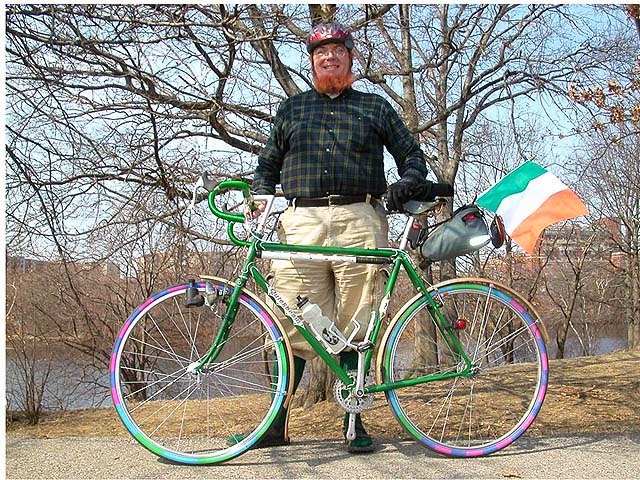
Happy St. Patrick's Day!

As I am not Irish, others can--and did-- convey the spirit of this day much better than I ever could.

Here's one of them:


He is, of course, Sheldon Brown--one of the patron saints of the cycling world.  


I can't believe he's been gone for six years already.  I hope that, wherever he's gone, he's found this:


 No doubt he's sharing a ride, a story and a Guinness Stout or two with this fellow:


16 March 2014

A Door To A Season

Perhaps it's strange to talk about a "typical March day" in this part of the world, as this month's weather is the least predictable of all.  On any of the 31 days between February and April, we can have (and have had) everything from summer-like heat waves to the most intense blizzards.  

But somehow today seems like it could only be of this month: chilly winds are blowing under clear skies streaked by the faintest wisps of cumulus clouds.

It feels, to me, like the door to a new season.  I can see what's inside even if I can't enter yet.

Somehow this photo seems apt:

From Pinterest
 

15 March 2014

The End Of A Short Journey On This Trek

You probably saw this coming.

In an earlier post, I mentioned the Trek 720 hybrid frame that came my way. 


Well, I put it together with some parts I had lying around and others I scrounged from bike shops where I do business.  And what little riding I've done during the past few weeks (We've had lots of ice on the streets, bridges and bike lanes!) has been done on that bike.  I didn't feel like getting road salt and sand all over my Mercians.

Now someone else has that bike.  A young female grad student I know needed some basic transportation.   

What did she give me in return?  Gratitude.  You see, I took off the seat (Brooks B 17) and pedals (MKS Lambda, a.k.a. Grip King) and let her take the rest of the bike.  

I look at it this way:  I didn't spend any money on the bike and I rode it for a couple of months.    All right, so I spent some time--but not much--putting it together.  I guess I can call that service.

14 March 2014

The Real Way To Find The Right Bike For You


I found this neat graphic on the Osprey Packs blog

You've gotta love some of the questions on it: "Ever worked as a bike messenger or dreamed of it?" "What's your favorite kind of equestrian event?" "Which are you more likely to consume while riding?"

 But my favorite question is the one at the top of the "chain": "Are you wearing a top hat?" Honestly, I am not, and never have.

 I've worn all sorts of things--and very little of anything at all--while riding my bike. And, before I started wearing helmet, I sported all manner of headgear, from bonnets to berets--and, yes, cycling caps. But no top hat. Or spats.

13 March 2014

Before Portland, There Was Portland

Mention "the history of cycling"--or, in particular, "the history of road (or track) racing", and chances are people would think of Europe--perhaps specifically of France or Italy.

However, in spite of the "Dark Ages" in the post-World War II years, the United States has its own history of bicycle racing.  Most of it is still unwritten and exists--to the extent that it does--in photographs that are fading and becoming brittle as leaves in October.

I have alluded to a few episodes of that history in earlier posts about Nancy Burghart and the Six Day Races, and others in which I mention the annual Tour of Somerville (NJ) and the 1951 tandem race in New Brunswick, NJ.

Now I've come across another interesting piece of that history:  the 1967 National Road Championships in Portland, OR.

American Cycling:  October 1967 issue featuring National Championships held in Portland, OR


Yes, in Portland.  Believe it or not, people cycled there before the first hipsters moved in.  (To be fair, a lot of the newcomers were trying to live the kinds of lives they hoped to live--and couldn't afford--in San Francisco and Seattle.)  Before there were commuters and nude races there were, well, races.

Actually, it's not so surprising when you consider that most of the cycling scene of that time was concentrated on the West Coast and in parts of New England and, inerestingly, the Detroit area.  In 1967, the American racing scene was taking its first pedal strokes on its return to a place among the cycling superpowers.  Tim Mountford, Jackie Simes, Skip Cutting and John Howard--and, of course, Nancy Burghart-- were the stars in that still-limited but growing firmament of American bicycle racing.

Given that Stars and Stripes cycling was drawing the first breaths of its resuscitation, Pete Hoffman's account of the Portland championships makes for a remarkably good read.  And, of course, the photos are not to be missed.