13 June 2015

Being Prepared, Before Uber


As a teenager, I learned bike repair and basic first aid because I wanted to be self-sufficient on the road. 


As a Scout (We were still “Boy Scouts” in those days!), I had to learn first aid to advance from one rank to another, if I recall correctly.  Also, I learned some first aid techniques and lore—some of which contradicted what Scout leaders taught us—in one of my high school Health/Phys Ed classes. 


On the other hand, when it came to bike repair, my education was home-made.  Most of what I learned came from the first edition of the late Tom Cuthbertson’s wonderful Anybody’s Bike BookIf the “For Dummies” series of books existed in those days, ABB could have been part of it:  It began with the assumption that, before you opened the book, you didn’t know the difference between a flat-bladed and Philips screwdriver, let alone a Schraeder and Presta valve.  But Cuthbertson would not have allowed his book to be called Bike Repair For Dummies; he had too much respect for his readers to do that.


Anyway, I wanted to learn bike repair and first aid, among other things, because I wanted to get on my bike one day and pedal some place far away, never to be seen or heard from again by anyone who knew me.  That fantasy came, in part, from being an adolescent and taking some things I read—from The Adventures of Huckleberry Finn to A Doll’s Houseas well as movies like Butch Cassidy and the Sundance Kid--perhaps a bit too literally.  To be fair, I must say that I wasn’t suffering the fate of some Dickensian character.  Though I butted heads with my parents, teachers and other authority figures in my life, none were abusive.  However, I also knew that I couldn’t live any of the lives my parents and teachers, or any other adults in my life, envisioned for me, even if I didn’t quite know what sort of life I actually wanted to live.


You might say I wanted to run away.  I suppose I could have done that by joining the circus or the French Foreign Legion.  Believe it or not, I actually thought about giving myself over to the Legion one day when I passed by their recruitment office.  But getting on my bike and riding into the sunset, the fog or whatever else was on the horizon was more appealing. 


Even though I wanted to disappear, I didn’t want to get stranded someplace.  I wanted the power to move out, move away, move forward, move on — all on my own terms, in my own way.  I didn’t want to put myself at the mercy of anyone or anything else in an emergency.


That would mean, of course, having certain skills and tools when I was on my bike.  It would also mean carrying dimes (and, later, quarters, or whatever the local coinage was) for pay telephones—at least, for those places where there was a pay telephone!  By the time I took my first long bike tour, I had those things and some textbook knowledge of Spanish and French—and perhaps even less knowledge than I thought I had about a lot of other things!  But that is the topic of another blog post, perhaps another blog.


I am thinking about all of that now, after the bike ride I took today.  Every inch or centimeter of the route on this day’s ride was one I’d ridden numerous times before; my intent was simply to ride vigorously and enjoy myself on a gorgeous day.  And, yes, I planned on getting home:  After all, I have cats (and myself!) to feed.


I was descending the ramp of the Cross Bay-Veterans MemorialBridge (“the bridge to the Rockaways”) on the Beach Channel side.  I’d pedaled about 80 kilometers (50 miles) and had about another 25 (15) ahead of me. The wind blew at my back, so I expected to be home shortly.


There is a fairly sharp turn in the ramp on the Beach Channel side.  I have long since learned not to yield to the temptation of descending faster than Lindsey Vonn on the Super G at Val d’Isere; there isn’t much room if you have to dodge another cyclist—or, worse, a group of riders—coming in the opposite direction. Even a pedestrian, skater or dogwalker who’s “in the zone” and not paying attention to surroundings can lead to your being entangled. 


However, someone else hadn’t learned those lessons.  Or she simply lost control of her bike; from what I could see, she’d probably never before ridden so fast—or much at all.  When I saw her, she was flat on her back, crying in pain. 


Her boyfriend confirmed my suspicions.  He said she “couldn’t steer out” of the path of the retaining wall she crashed into.  She gasped, “It hurts to breathe”. I immediately suspected a fractured rib—or, judging from the scrapes and bruises on and around her left shoulder, a broken collarbone.  I also feared a possible concussion:  Neither she nor her boyfriend was wearing a helmet.  However, she said she didn’t feel dizzy and, after a few minutes, was able to stand up.  And, from what her boyfriend said, her shoulder, but not her head, hit that wall.

This is not the accident about which I've written today. 


I offered to help:  Call an ambulance, get ice from the bagel shop at the foot of the bridge, whatever else they needed.  “We’re OK,” he said.  I offered her my water bottle, which was about half full.  She drank from it. 

I then glanced at her bike.  The front wheel was a “pretzel”, but there didn’t appear to be any damage to the rest of the bike.  I opened up the front V-brake, which made it possible to move the bike, albeit with some difficulty.  I then apologized for not having a spoke wrench:  Although the wheel couldn’t be salvaged, I explained, at least it would make it easier to push the bike.    I also apologized for not having a wound dressing or other things the bagel shop probably wouldn’t have.  “Oh, don’t worry,” he said.  “We’re glad you stopped”.


They live about halfway between that bridge and my place. I asked if they had a way of getting home.  “We called a friend but he wasn’t home,” he explained.  “But don’t worry—we’ll just call Uber.”


Uber.  Nobody had even thought of such a service back when I was plotting my Great Bike Escape.  The only time I had seen the word “uber” was in one of those books I didn’t understand as well as I thought I did—or, more precisely, understood in the way only an adolescent, with no guidance, can understand it.  For all I know, that just might have been the way Nietzsche wanted it to be understood.


But I digress again.  I told the young man to be sure to remind the Uber-man (or woman) that he and his girlfriend have bikes.  Turns out, the Uber person was driving an SUV.  But he had no idea of where we were; he claimed his GPS couldn’t find it.


If he couldn’t find that, I don’t think any Uber driver—had such a person existed in my youth—could have found the places I thought I might ride to when I left home, my head full of the stuff I’d been taught and the bike repairs I’d learned on my own.  And, even if the driver could find them, he (who almost surely would have been male in those days) would not have wanted to go there, any more than many New York taxi drivers would want to take a big black man who wanted to go to Brownsville.


Finally, the young man called a local car service the girl at the bagel shop counter knew about.  They indeed had a van and said it would be “no problem” to go to the young couple’s apartment.


In some of the places where I’ve ridden, there aren’t car services.  Or bagel shops.  Or, for that matter, bike shops.  Perhaps I wasn’t as ready for them as I thought it was. But I survived and had fun, and I had a great bike ride today.

12 June 2015

Not Lost, Only Moved

In previous posts, I've said that I've never regretted going on a bike ride.  I've also said that I never felt worse after a ride than I did when I started it.  Oh, I've felt tired, in pain and had other physical maladies. But they all healed, probably because riding my bike relieves me, at least for a time, of mental and emotional stresses.

Although I've never wished I hadn't gone on a ride or felt less happy than I was before I took the ride, that's not to say that I don't experience things that make me sad.  I've gone to favorite cafes, bookstores and even bike shops, only to find they'd closed. I've also ridden to some place or another only to find that a lovely, or simply tranquil, piece of land has been turned into a shopping mall or tract housing, or that some other place has been changed beyond recognition.

Of course, some changes--like the closure of a deli or restaurant--are inevitable.  Actually, in the grand scheme of things, change is the only thing you can count on.  As Lao Tsu wrote, "Life is a series of natural and spontaneous changes.  Don't resist them; that only creates sorrow."

Well, while riding late this afternoon, I saw a change that I simply can't resist.  It's something that's been done, and there's no turning back.  So, according to Lao, I won't create sorrow.  But I'm feeling some now.

That change involves something that was as important to my childhood as the places in which we lived.  I was pedaling up and down residential streets in Queens and Brooklyn, in and out of neighborhoods where hipsters and Hasidim and Hispanics--and people with all sorts of other identities--live.  I skirted the edges of the neighborhoods--Borough Park and Bensonhurst--in which I grew up.  I found myself on Ditmas Avenue, at East Fourth Street, where I saw this:


If you've been in that part of Brooklyn, you might think it looks like any number of catering or event halls.  As a matter of fact, that's what that building was--before I entered it.  Long before I entered it, in fact.  

By the time my family moved to Dahill Road, about half a dozen blocks away, that building had become a place where I would spend almost as much time as I spent in the house or in school.  In fact, during the summer, I would spend hours there that, during the rest of the year, I would have passed in school.

It was the Kensington Branch of the Brooklyn Public Library.  Everyone knew how much I loved to read, but in my family (immediate and extended) there weren't many books nor much money for them.  (Also, I think that the strains of blue-collar jobs and child-rearing didn't leave my parents, or other adults in our circle, with much energy for reading, to themselves or with kids.)  But that library, it seemed, had an endless supply.  And the librarians were happy to see a kid whose reading didn't consist only of school assignments.

Plus, going to the library was one thing neither my mother nor anyone else questioned.  If I wanted to go anywhere else, I had to say what I planned to do there, who would be there and who would go with me.  When I went to the library, she said only, "Just be home for supper."

Usually, I would take a few books--story or poetry collections, histories or books about exotic and faraway places--and browse them at one of the tables.  Most days, I succeeded in getting a seat at the table by the center window:


Now, from that window, one could see only up and down Ditmas Avenue, East Fourth Street and a few nearby streets--and over the rows of houses.  But I could see far enough that all of those things eventually faded into a scrim of cirrus clouds, a wall of rain or a vista of twilight.  The world opened out in front of that window, just as world opened with the books I took from the shelves of the Kensington Branch.

Seeing it closed, I feared the worst, since the library budget seems not to have increased since the days when I was using that branch.  But, in riding along, I found out that the Kensington Branch had merely moved to another location, about the same distance--though in another direction--from the house in which I lived.  In other words, I could have walked there just as easily.  And my mother probably would have told me just to remember to be home in time for supper.

11 June 2015

Why Most Americans Don't--Or Can't--Pedal, Walk Or Take The Train To Work

Ever since I took my first bike tour in Europe, I've dreamt of the day when Americans had the sort of freedom of choice in transportation that many Europeans have.

(Of course, I was dreaming, at least for a time, of living in Europe for the rest of my life.  Sometimes I still have that dream.)

Is the United States any closer to being a country where you can decide whether you want to drive, take a train or bus, pedal or walk to work, school or shop than it was in 1980?  I'd say that in most of the country, that answer is "no".

I'm well aware that the number of bicycle commuters has increased exponentially over the past decade or so in my home town, New York City.  Such a scenario has also unfolded in a few other large American cities, such as Boston, San Francisco, Philadelphia, Washington DC and, from what I hear, Chicago.  Perhaps even more to the point, in those cities, and perhaps a few other places in the States, there are more than a few people who ride to the office or classroom or store by choice, not because they can't afford a car.

However, in large swaths of this nation, cycling and walking--or even mass transit--is less feasible than driving for most people.  That is the situation even in some of our largest cities, such as Los Angeles, Denver, Phoenix and pretty much any major metro area in Florida or Texas.  And, for a variety of reasons, it doesn't seem that things will change much in the near future.

What I've said in the previous two paragraphs basically sums up a recent post in a blog I've just discovered:  Rebuilding Place in the Urban SpaceThe blog's author, Richard Layman, is "an urban/commercial district revitalization and transportation/mobility advocate" based in Washington DC.  He's also a principal in BicyclePASS, a bicycle facilities integration firm.

Mr. Layman succinctly gives the most basic reason why getting to work in any way besides a car isn't really an option for most Americans:  Patterns of development outside the older cities made the private automobile the fastest and most efficient way of getting around.  And, where anything resembling a mass transit system was developed, it wasn't made to facilitate everyday life.  An example of too many transit systems' lack of efficacy can be seen in that in places like the Tampa Bay area, even pro-transit public officials don't use the local bus system

Even in the cities where, as I've mentioned, the number of commuters who pedal, walk or take the train or bus is growing, there are still many who choose to drive.  Some simply enjoy driving or don't want to give up the sense of privacy they have in their cars.  And, to be fair, some people--such as self-employed contractors--have to haul around lots of equipment or have to travel between work sites that aren't close to mass transit lines.  But there are still many people who would simply prefer not to give up the freedom or privacy they believe they have in their own automobiles.  Also there are still people in New York and other cities who believe that bicycles and mass transit are "for other people".

Corner of Delancey and Essex Streets, Lower East Side, New York


Cities like New York, Boston, Chicago and San Francisco all have transportation infrastructures--and even a few bike lanes--that have survived, mostly intact, the century or so of the automotive age.  (The San Francisco Bay Area's BART system was built in the 1970's, but San Francisco, at least, had a decent transit system and something like a bicycling infrastructure before that.)  They also have business and residential areas that are close to each other.  In contrast, places like Tampa Bay, much of which was undeveloped during the time the older cities were building their transit systems, developed in a more horizontal way than the older cities and didn't build mass transit systems or even facilities amenable to cyclists or pedestrians.

There are some other older cities, like Detroit, Pittsburgh, St. Louis and Cleveland, had decent transit systems--or at least,  housing and employment centers relatively close to each other.  But, according to Layman, they "lost their ability to support sustainable transportation" as "metropolitan areas sprawled and businesses left the city", trends accelerated by de-industrialization.

I am not familiar with the transportation systems of those cities. But, if they're anything like the ones I've used in the US, they are designed to get people in and out of a central business area of the city--or, at least, some place that was a central business area at the time the system was built.  Such systems aren't made to get people between destinations in the outer boroughs or suburbs. 

(Given these facts, it will be interesting to see how cities like Portland, Seattle and Los Angeles-- all of which are more spread-out than New York, Boston or San Francisco--re-develop their transit systems.)

In suburban and exurban areas, it's considered a "given" that people will have cars.  In fact, we now have at least a generation of people who know, basically, no other means of transportation:  They have no experience with mass transit and the bicycle--if it's ridden in adulthood--is seen as a recreational, rather than a transportation, vehicle.  Moreover, homeowners don't want sidewalks built across their front lawns.

From the ranks of such people come many elected representatives, who don't see the need for mass transportation or amenities that would facilitate and encourage cycling and walking.  Thus, they don't vote to fund such things or even Amtrak. 


Seeing the things I've described, Layman says--and he makes a lot of sense to me--it's unlikely that most transportation systems will be repatterned to make walking, cycling or public transportation practical alternatives for getting to work or wherever else people need to be.  At least, it doesn't seem likely for a few more decades. 


10 June 2015

A Summer Afternoon After The Storm, Fire And Crash

People fantasize about the sort of summer afternoon we had today.  There was lots of sunshine, very little humidity and practically no clouds as the temperature rose to 30C (86F).


So, of course, I went for a ride.  After crossing the bridge into Rockaway Beach, I turned right and rode along rows of serene-looking homes that masked the tragedies the Queens coastal communities of Rockaway Park and  Belle Harbor have experienced.  Of course, they bore the brunt of Superstorm Sandy, but perhaps survived it a bit better than some other areas.  

Eleven years earlier, Flight 587--which had taken off from JFK Airport only two and a half minutes earlier, bound for the Dominican Republic--crashed into the ocean and sent its debris flying into those homes.  Although it is the second-deadliest air crash in US history, it has been forgotten, probably because it happened only a few weeks after 11 September.

To see the neighborhood today, one would hardly know--save for a monument on 116th Street--that it had experienced something so horrific. I could say the same for Breezy Point, about four miles to the west on the Rockaway Peninsula.  Few areas were more devastated by the storm:  In addition to the destruction wrought by the wind, rain and tides, 100 houses burned to the ground in a fire sparked when a storm surge inundated power lines.


Homes, stores and other buildings have been restored and rebuilt.  Still , it all looked rather forlorn. Perhaps it had to do with the fact that  almost nobody was out and about in spite of the weather.


At least it was all there and I could ride it.  And I did--over the bridge to Brooklyn, to Floyd Bennett and Brighton Beach and Coney Island.  At least it looked like a summer day at Coney Island, with people swimming and fishing the water, walking, riding and lounging on the boardwalk and eating all of those unhealthy foods sold in boardwalk stands. 


Then I rode home, along the promenade that passes along the Verrazano Bridge and up Hipster Hook to my place.  I was grateful for another good ride, even if it wasn't long or challenging. 

09 June 2015

Bicycle Paisley?

Although the paisley pattern is named for a town in Scotland, it is thought to have originated in India or Persia (present-day Iran).  Some have said the kidney-ish shapes found in paisleys were inspired by mangoes.  Others have attributed their origins to pears or other fruits.  Also, paisley's swirls and  botanical motifs are said to have been inspired by palm trees (The French often refer to paisley as "palme".) or by pine or cypress trees. 

Whatever you believe, a pattern that has printed on, or woven into, everything from Hermes silk scarves and ties to hippies' T-shirts and headbands originated many centuries ago, long before the first bicycle was built.  What might paisley look like if its creator(s) got around on pedaled two-wheeled vehicles?

All right...So you never asked yourself that question.  I confess: I never did, either.  Somehow, though, I think I found an answer to it here:

From Bike Art:  Bicycles In Art Around The World


It's one of my favorite pieces of bicycle art I've seen in a while.  Now I'll admit that I rarely see an image or representation of a bicycle that I dislike, even if it's of a bike I'd never ride or buy: bikes and cycling make me happy.  Still, I realize that not all drawings, paintings or other objets that include or represent bicycles are art.

So what makes something art? (You weren't expecting to see a question like that on this blog, were you?)  Well, as I understand it, art gets at the essence of something.  A painter or sculptor will make a work about some particular person or subjects and render it from whatever materials he or she chooses or has available. But those people, subjects and materials are really just vehicles for expression of the forms--whether of light, texture, shape, sound or energy--within those subjects.


That is why something like the bull's head Picasso made from a bicycle saddle and pair of handlebars is, if not "high" art, then at least something more than mere amusement.  To me, it represents the energy of moving forward on a bicycle and of the singular determination it sometimes takes to keep on riding, especially in adverse conditions.

So...Is the bike "paisley" a work of art?  Maybe.  Whatever it is, I think it went beyond--if only somewhat--typical stylized representations of bicycles.  That's more than enough to make me happy.

08 June 2015

The Money Cycling Saves

I'm no expert on public policy and budgets.  Of course, that's not going to stop me from saying what I'm about to say.

People are always saying "I can't afford X". Public officials and voters are always saying "We can't afford Y."  "X" and "Y" can be any number of things:  X might be a seemingly-expensive purchase (like a quality bicycle), "Y" might be an infrastructure expense such as public transportation or some other pubic expenditure such as a raise in teachers' salaries.

Yet money is spent on all sorts of other things that make me wonder what people are thinking.  Someone can't afford to buy vegetables and fruit yet can afford a two-pack-a day (here in NYC, about $30) cigarette habit.  A city might not be able to find the money in its budget to keep its streetlights on but can build a sports arena for some team owner who can easily afford to pay for it himself.

And, in study after study, it's shown that spending on things like transportation, education and even providing meals for needy families creates more jobs and other economic activity, per amount of money spent, than a stadium, megamall or weapons system.

I got to thinking about that after overhearing a conversation between two old-time Queens residents.  One is one of the few remaining US-born Caucasian taxi drivers left in this city; the other is the widow of a blue-collar worker.  They are both warm, generous people (I have been witness and recipient to their acts of kindness) who would never dream of voting for any Republican and who believe that we are all accountable to God (as they perceive him--and both perceive him as male) but will enter a church only under great duress.  Obviously, they are not part of the class of people who got theirs, or are trying to get theirs, and don't care about anybody else.

Their conversation took a bunch of twists and turns, as any really good conversation does.  Somehow they got onto the topic of bike lanes.  Both decried them, and both offered the same rationales--one of them being the cost of constructing them and of putting cops on the street to enforce safety.

Now, I didn't mention that I'm not in favor of creating separate bike lanes, especially given how poorly-conceived and constructed too many lanes I've seen are.  However, those two folks--one a good friend, the other a friendly acquaintance--talked about "priorites".  One of them complained, "How can they spend money on bike lanes when there are so many other pressing issues, like police and firefighters?"

Back in the Reagan years, people--perhaps not those two--would have wondered the same thing about "the arts" or, more specifically, the National Endowment for the Arts.  And I would give the same answer I gave to those two people who decried bike lanes:  They're such a small part of the budget.  If they were eliminated, it wouldn't save enough money to keep even one branch of the library open for longer hours. (In the NEA argument, I'd say something like "one Air Force bomber" or something like that.) Besides, all kinds of other money is wasted on truly useless projects or lost to graft and corruption.   

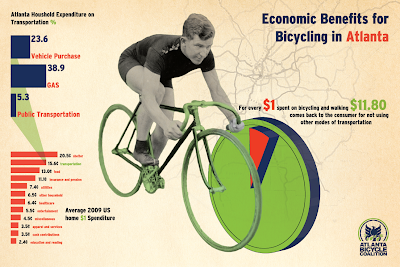
What I didn't mention is that just as spending on the arts generates economic activity in other areas, so does bicycling.  In fact, the "return" in both cases is much greater than the expenditure, whether at the household or national level.

I couldn't have cited any figures off the top of my head.  But I would've loved to have the following graphic on hand.  Even though the numbers were compiled for Atlanta, I think they could be scaled to New York and other cities.

https://blogger.googleusercontent.com/img/b/R29vZ2xl/AVvXsEjaBqKYQa3mtNASg1TrgRJ54W4tSFgKzGdNeEV0FWrLoqiAoQGho3ApgUYC-E0JkFsFIQLYmqA8AuZN1METwHMeFmbQWY4rMFeoip7O-MdEJGWb4KRpTDWaxI1fYdTz73w7PNaQ422lBCNC/s9000/Atlanta+Bicycle+2.6-01.png
From The Atlanta Bicycle Coalitiom

07 June 2015

I Thought I'd Caught Her Flip-Flopping

Today was an absolutely glorious day, weather-wise, and I didn't have to worry about spectacles of animal exploitation clogging area roadways.  In fact, given that it was Sunday, there was scarcely a cloud in the sky and little humidity, and the temperature reached 24C (75F), I was surprised to see as little traffic as I did anywhere I rode.

Even the beach areas were pretty quiet.  I rode down to the Rockaways, flipped a quarter and continued to Point Lookout. Some people were walking about on the beach and the boardwalks in the Rockaways and Atlantic Beach.  But they didn't seem to linger, surprisingly enough. The water is still a bit cooler than some people like for swimming.  That might be a reason why there weren't as many people as I expected.  Also, there didn't seem to be many events as there were last weekend or the weekend before, which included Memorial Day.

Of course I didn't mind.  I just rode and took a couple of self-indulgent shots of Tosca, my fixed-gear Mercian:


Actually, I took the photos because in the light of that beach, and the angle from which I was looking when I sat down, I could see the "flip-flop" quality of the finish:  It actually looked purple and green at the same time.  I don't think it came through in these photos.  Oh well.

I had a great ride with Tosca.  That's what matters.

06 June 2015

What I Did To Avoid A Race Today

Yesterday I said I love sports.  Let me qualify that:  I love most sports.  Among the exceptions is horse racing.  Fortunately, I never had to write about it. 

I also have never been keen on dog racing.  In fact, I don't care much for anything that involves training animals to put themselves at risk to entertain humans.  Making animals fight each other simply disgusts me:  I fail to see what is entertaining or even thrilling about bullfighting, cockfighting, dog fighting or camel wrestling. 

Believe it or not, that last abomination exists:  I saw a match when I was in Turkey.  During camel mating season, males are tied up and left in a dark room.  Then, just before they're walked out into the ring, they're adorned with embroidered capes and such.  By the time they get into the ring, at least one of them is foaming at the mouth.  If I were an animal-rights activist rather than the mere animal-lover that I am, I probably would have been foaming at the mouth, too.

Seeing that camel wrestling match was the only thing I hated in Turkey.  I don't get quite that worked up over horse racing; I simply don't care for it.  And, if you are here in the US, you probably know that the Belmont Stakes was run today.  There was a lot of buzz about it because of American Pharaoh, who had the opportunity to become the first horse in thirty-seven years to win the Triple Crown.  He did not disappoint those who bet on him.

What that means is crowds and lots of traffic on the roads leading to the Belmont Park race track, which is 25 to 30 kilometers from my apartment, depending on which route I were to take.  Once I rode in the direction of the track on the day of the Belmont Stakes, and even the side roads and some residential streets were clogged with SUVs piloted by testy, impatient drivers.

So, of course, I made it a point of avoiding all of that today.  Instead of a horse race, I saw another kind of sport:


No, it's not baseball.  It's one of its forerunners:  cricket.  I wish I could have gotten a bit closer, or that I had my camera with me.  I was relegated to taking that photo with my cell phone.  I also had to push my limited skills to the limit to capture this image:


OK.  So now you're thinking, "She went all the way to England to get away from a horse race?"  If only...

Actually, I rode in the opposite direction of the race track and found myself riding through the Bronx and Westchester County.  Believe it or not, both of those photos were taken in the Bronx.

Van Cortlandt Park is the second-largest park in the Bronx and the fourth-largest in New York City.  Its northern boundary is the city line with Westchester County.  To its south and east are longtime Irish enclaves  Norwood and Bedford Park.  That is where the players in the photo live, or have lived.

On a nearby field, there was another game of cricket in progress:


Adjoining Norwood and Bedford Park is one of the city's largest enclaves of immigrants from the Anglophone West Indies, centered along Gun Hill Road.  The players in this photo probably live there, or possibly in one of the West Indian neighborhoods of Brooklyn.  Although there is no Jim Crow policy in place in Van Cortlandt (or anyplace else in New York) and, from what I understand, the players were not segregating themselves by race (they were merely playing with friends and family), it was still a bit jarring to see white players on one field and blacks on another.


The house in the photo is in a nearby neighborhood almost no one would associate with the Bronx.  The street on which I found the house is private, as are the streets surrounding it.  A couple of blocks away is the Fieldston School, where the tuition is higher than the salary I earned in any of the first twenty or so years I worked. 

Anyway...I saw the cricket games on my way up to Westchester County and the house on my way back.  In Westchester, I rode as close as I could to the Hudson River and was treated to a vista of the Palisades:


What most people don't realize about the Hudson is that south of the Tappan Zee, it's not really a river:  It's actually a tidal basin.  And I could tell, by the way the water was churning, that the tide was coming in. It turns brownish-green then and looks more like a river when the tide is out.

I pedaled against the wind going upriver, so the wind blew me back into the Bronx and to my place.  And I avoided the throngs of gas-guzzlers people drove to watch little men drive horses in the service of bettors.
 

05 June 2015

Why Should Cyclists Care About The FIFA Scandal?


In a previous post, I mentioned that the worlds of cycling and what most of the world calls “football” (but most Americans call “soccer”) are so close but never quite meet.  Some of the world’s most cycling-intensive nations also happen to be football powerhouses and some countries in the Americas are emerging in both.  (The US has elite athletes and teams in both sports but, on the whole, isn’t quite on the level of, say, Belgium, Italy, Spain, France or England in either one.)  I got to thinking about the relationship between the two sports again in light of FIFA’s current troubles.

Although I'm not as avid about them as I once was, I still love sports.  I have competed in three (wrestling, soccer and, of course, cycling) and have been a cyclist in one form or another for most of my life.  I even wrote about sports for a small local newspaper.  To this day, some of the things of which I’m most proud are things I’ve done in athletic pursuits. 

I must also point out that I have never participated in any athletic endeavor for money.  That doesn’t make me more virtuous or prove my love of sports or much of anything else.  However, I also realize that having always been an amateur—and having participated in sports that, at the times I was involved with them, offered few opportunities for scholarships, let alone professional careers—I never had an incentive to cheat.  Nor did most of those I competed with and against.  Likewise, my coaches and others involved in officiating contests or administering programs in which I was involved were not tempted by the prospect of payoffs or bribes of one kind or another.

That perspective—and my experience writing about sports—helped me to understand that when money, especially large sums of it, are involved, the attitude of everyone involved with sport changes.  It’s almost trite to say that money corrupts, and large sums corrupt in major ways.  To be more exact, the prospect of a large payoff exposes avarice that might lay dormant in the absence of lucre.

What I find ironic is that nearly every fan of any professional sport acknowledges that corruption exists, at whatever level, but he or she is almost invariably shocked when that corruption is exposed.  For all the whispers that Lance Armstrong, the Festina team and any number of other riders and teams were doping, when that doping was exposed or confessed, fans expressed a sense of betrayal.  Likewise, nearly every soccer/football fan believes that the sport’s officials and governing bodies are corrupt. (Most people also have the same sense about Olympic organizations.)  But some still said the equivalent of “no…really” when Sepp Blatter and others were implicated in various kinds of graft related to the awarding of the World Cup to the countries that hosted the tournament.


 Cycleball

One interesting difference I’ve noticed between cycling and football/soccer is that in cycling, the investigations, accusations and crackdowns have focused on individual cyclists and teams, while in football, prosecutors’ sights have been set on the governing bodies and top-level officials.  Of course, one reason for that is that the scandals in cycling have had mainly to do with doping, or allegations thereof, while those in football have had to do with kickbacks and awarding tournaments to countries. 

Why has relatively little attention been paid to cycling’s governing bodies?  Surely, their officials must have known about doping, or the rumors of it.  It’s also hard not to imagine that in the administration of cycling, there are money scandals and nepotism similar to what is found in FIFA and football’s governing bodies in individual countries.  I mean, if corrupt officials can take bribes to allow Russia or Qatar or some other country to host the World Cup, it’s hard not to believe that similar (though smaller-scale) deals are made so that cities can host stages of multi-day races or for facilities to be built for cycling.  Likewise, if cyclists are doping and their teams and sponsors are pressuring them to do so, who’s to say that something similar isn’t happening in football?  After all, as in cycling, the world’s best athletes are competing in it, and the difference between victory or relegation could be laid to something as seemingly trivial as whether a key performer drank one glass too many or too few of water on the day of the competition.

And, as I have mentioned, there is a lot of money riding on the siting as well as the outcomes of competitions in both sports.  The incentives exist for cheating and corruption, and are so similar in so many ways in cycling and football.  But, in that regard, as in so many other aspects, the worlds of the two sports are so close but somehow manage not to meet.