In the middle of the journey of my life, I am--as always--a woman on a bike. Although I do not know where this road will lead, the way is not lost, for I have arrived here. And I am on my bicycle, again.
I am Justine Valinotti.
17 October 2020
From Watts To Lumens...To Lux
16 October 2020
More Riders+ Not Enough Bikes=Theft
For as long as there have been bicycles, there have been bike thieves. That's my guess, anyway.
I also reckon that bicycle thefts increase along with the popularity of cycling. As I've mentioned in other posts, I became a dedicated cyclist as a teenager, late in the North American Bike Boom of the 1970s. Until that time, there didn't seem to be much bike theft and the loss of a bicycle was seen like losing a toy, mainly because almost all bikes at that time were ridden by kids.
During the "boom", for the first time in about half a century, significant numbers of American adults were riding bicycles. While most pedaled for recreation or fitness, a few rode to work. That, I believe, the reason why bike theft was taken more seriously.
That is, by everyone except the police. If you were to report your stolen bike, you'd be told, explicitly or implicitly, that you wouldn't see it again. They had bigger fish to fry; never mind that the person might have been using the bike to put food on his or her table.
History repeats itself, plus ca change, or whatever how you want to say it. Bike sales have surged. So have bike thefts. Worse, methods that haven't been seen since the "bad old days" of high crime have made a comeback. There are reports of bikes lifted, along with the railings to which they were locked, from the insides of buildings. And, in the Bronx, eight men attacked a 15-year-old boy and took the bike he was riding.
Stealing the bike may not have been the ultimate goal in that attack, though the bike was a worthwhile "haul" for the perps. Some of the other thefts may have been "fenced" for quick cash. But, according to reports, some of bikes may have been stolen because of the current shortage, caused by a spike in demand combined with a disruption of supply chains.
15 October 2020
Lighting--And Measuring--The Way
Soubitez and Huret.
What do they have in common? Well, for one thing, they're both French. For another, they made parts and accessories found on constructeur bikes as well as basic ten-speeds from the 1970s Bike Boom.
Huret was best-known for its derailleurs, though it made other parts. Soubitez, on the other hand, was renowned for its bicycle lights, most of which were dynamo-powered.
So, other than being French and found on many of the same bikes, Soubitez and Huret wouldn't seem to have much in common--or much reason to collaborate. Or would they?
In addition to derailleurs, shifters and frame fittings (such as dropouts), Huret also made some cycling accessories. Perhaps its most famous was its Multito cyclometer, which ran quieter and registered more accurately than other bicycle odometers because it used belt-driven pulleys rather than the wheel-and-striker system of more traditional devices like the Lucas.
Before the Multito was introduced, in the late 1970s, Huret made speedometer/odometers that attached to the handlebars and emulated similar devices found on motorcycles and in cars. Huret sold it under its own marque, but bike makers like Schwinn rebranded it, which is how it ended up on countless kids' "muscle" bikes of that time.
Schwinn and other companies also rebadged Soubitez lights and dynamos, including the extremely popular "bloc" dynamo-light combo that attached to the front fork. (I had one on my Continental.)
Even with the seeming ubiquity of Soubitez lights and Huret speedometers and odometers, I don't think it ever occurred to me (or anyone I knew) to combine a light with a speedometer or odometer. Apparently, though, it was done.
I tried to find more information about the Soubitez 941 K N. It may well have been exported to the US and I missed it, but I don't recall seeing it anywhere back when so many of us rode with Soubitez blocs and Huret speedometers (and derailleurs: the one on my Continental was a re-branded Huret Allvit). The 941 K N seems to have been supplied with a Huret speedometer cable and driver. They may well have been the power source for the light. Or, judging by the shape of the light, it may have housed dry-cell batteries.
If that driver and cable were indeed the light's power source, it's not hard to imagine that the Soubitez 941 K N may well have influenced modern bike computers. Otherwise, it's an interesting curiosity.
14 October 2020
Workers On A Late-Day Ride
Three weeks after the autumnal equinox, days grow noticeably shorter. That, I feel, makes late-afternoon rides even sweeter: Sunlight simmers into shades of sand, stone and rust just before the sun begins to set.
And, it seems, I notice things anew, or for the first time, along familiar routes. Today, I pedaled a loop that skirted the edge of LaGuardia Airport and wiggled through an industrial waterfront area. I had one ulterior motive: to climb the local version of Mount Ventoux. It's nowhere near as high as that iconic French peak that has served as a "statement" climb for Tour de France winners and leaders, but the hill erupts, seemingly out of nowhere, from the cauldron of Berrian Boulevard and up 41st Street.
After my second climb, I coasted back to Berrian, where a building I'd passed a number of times before caught my eye:
It's a waste water treatment plant, which is why it's surrounded by a chain-link fence. The ship portal-style holes are telltale signs of an Art Deco-influenced Works Progress Administration building. Other similarly-styled and -detailed buildings stand in other parts of this city. This one, though, must have the least conspicuous location as well as purpose of such buildings.
WPA public works buildings like this one often feature some interesting bas-reliefs, often depicting scenes of workers, if in stylized or romanticized ways. Ironically, works like these were made at about the same time "social realism"--which also featured stylized and romanticized scenes of workers--was taking shape in the former Soviet Union.
The late day light and air would have been enough of a reward from my late-day ride. But they highlighted something I noticed, for the first time, along a familiar route.
13 October 2020
Moving Forward: Cultural Unity--Or Clash?
In case you were wondering how I resolved the Columbus Day/Indigenous Peoples' Day dilemma: I cooked both spaghettti and spaghetti squash. Well, sort of: I cooked pasta, but it wasn't spaghetti: Instead, I made penne with a medley of vegetables in olive oil, swirled with some mozzarella cheese. And I baked a spaghetti squash. Ironically, it does look like translucent spaghetti when you scoop it out of its husk. Even though it is native to the Americas, I doubt that the indigenous people called it "spaghetti squash," because they never saw spaghetti. Ironically, I topped it off with tomato sauce and rationalized it with the knowledge that tomatoes are also native to the Americas. (Europeans didn't have tomatoes--or potatoes--before they exploited the Americas!)
Anyway, I enjoyed both, and ate leftovers from both, today. I'm happy. Now I need to get on my bike. I'm not complaining!
On something entirely unrelated: Accompanying the umpteenth "Will the pandemic bike boom last when the pandemic ends?" I've seen was this illustration:
I don't know why it was chosen, but I like it!
12 October 2020
What Day Is This?
Today is the holiday commonly celebrated as "Columbus Day." Recently, it's also come to be known as "Indigenous Peoples' Day."
As someone of mostly Italian-American heritage, I am conflicted. I mean, for years I like many others of my background, thought of this day as "our" day, when we celebrated our pride in our heritage. There are parades, parties and lots of eating and drinking.
I enjoyed those things, even though I knew Columbus didn't "discover" America (people were already living here) and doubted that he was the first person to arrive here after crossing the Atlantic. Plus, he didn't even get here on purpose.
Our culture has turned out Michelangelo, Galileo, Leonardo da Vinci, Dante, Verdi, Sophia Loren and Tullio Campagnolo--and we celebrate a guy who got lost? That never made any sense to me.
Now, calling this "Indigenous Peoples' Day," I can understand. Of course, I have no business being any part of a celebration, as I have no Native American blood in me. I do, however, have respect and empathy for the way they've endured, so maybe that's something to celebrate.
Those of us who have Italian heritage just need to get another holiday!
So...What will I do today? Well, after doing some work and taking a ride (if the downpours we're experiencing taper off), I'm going to make--spaghetti or spaghetti squash? I guess I could make both!
11 October 2020
Look At What Landed On My Bike
After that debacle involving the president who wants to hold onto power even more than he wants to win the election and the fellow who's trying to replace him, the event involving Mike Pence and Kamala Harris seemed like an Oxford-style intellectual exchange by comparison. Although they were more civilized, and Harris displayed more intelligence than the other candidates combined, I wouldn't call either event a debate.
10 October 2020
We're Riding. How Many Of Us Will Keep It Up?
The pandemic is changing that picture, however slowly. Even the Times is taking note, but what I've heard from Transportation Alternatives and WE Bike--two organizations of which I'm a member--corroborates my observation.
09 October 2020
Remembering Him As He Remembered His Bicycle
As a kid I had a dream: I wanted my own bicycle. When I got the bike, I must have been the happiest boy in (his hometown), maybe the world. I lived for that bike. Most kids left their bike in the backyard at night. Not me. I insisted on taking mine indoors and the first night I even kept it in my bed.
I omitted the name of this person's hometown because I didn't want to give away his identity just yet. I'll give you a related clue: The international airport of his hometown is named after him.
Oh, and he would have been 80 years old today.
He is, of course, John Lennon. It's hard to believe he's been gone for almost as long as he was alive: He was murdred on 8 December 1980, two months after turning 40.
That he was shot to death by someone who claimed to be inspired by Catcher In The Rye is a tragic irony on several levels. For one, Lennon preached peace in his songs and his everyday life. For another, Catcher is as much about youthful alienation as anything else. (Not for nothing was Mark David Chapman not the first, nor the last, killer to claim the novel as his muse, as it were.) While some of John's, and the Beatle's, songs expressed anger or sadness, they were never disengaged from the lives of the speakers, or the writers or performers, of those songs.
I mean, how alienated can someone be if, late in an all-too-brief life in which he accomplished so much, he could count getting a bicycle as a child as one of his happiest and most important memories.
Happy birthday and R.I.P., John!
(The airport is officially known as Liverpool-John Lennon International Airport, International Air Transport Association Code LPL.)
08 October 2020
A Wrong Turn And A Good Man
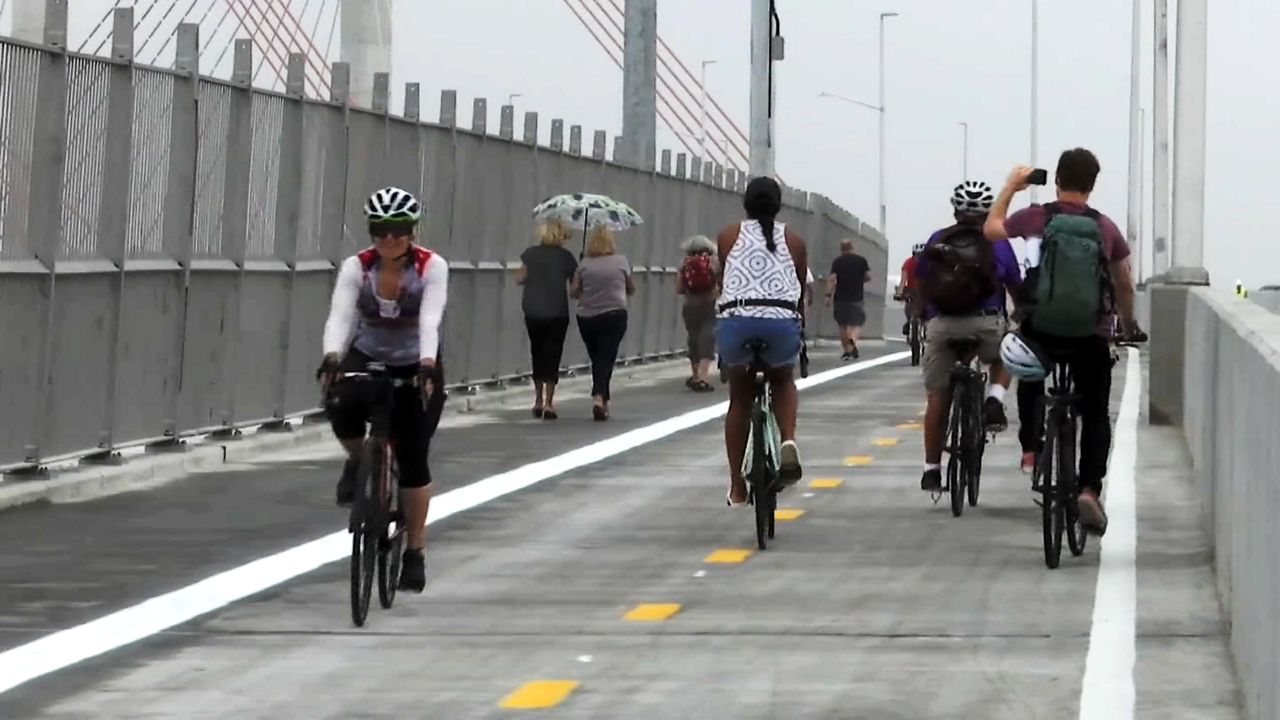
I've cycled under, around and by the new Kosciuszko Bridge any number of times. I've admired its light show, through all of the colors of the rainbow. But I hadn't actually crossed the bridge's walkway/pedestrian path.
Until last night. Actually, I pedaled about half of it. I followed 43rd Street and made what I thought was the turn onto the path.
Instead, I found myself on the shoulder of the roadway. That might not have been so bad if the speed limit were less than the posted 45 MPH: the same limit posted for the rest of the Brooklyn-Queens Expressway, a.k.a. Interstate 278.
No drivers pulled over to the shoulder. But I could see that it ended with the first exit, where a steep off-ramp snakes its way down to Meeker Avenue in Brooklyn. For once, I actually hoped a cop would stop me. Even if I got a ticket, I figured, at least I'd be riding in a patrol car down to the street or the precinct.
That wasn't an appealing prospect. So I stopped about halfway across the bridge and started to hoist my bike over the four foot-high concrete barrier that separates the shoulder from the path. An Indian man was walking in the opposite direction, with his wife. He grabbed the right fork and seat stay, boosted my bike and set it down on the path. Then he reached for my hand, but I was able to climb over.
I thanked the man. "No problem, ma'am. Be safe." His wife smiled.