24 December 2021

Pedaling Big Macs Into Phone Juice

In the past 30-something years, I've entered a McDonald's maybe a dozen times:  to use the free Internet or the bathroom.  All right, I actually had an ice cream cone at a McDonald's in Turkey:  My host and guide on the Aegean coast thought he was doing something nice for me, an American.  And I actually went to chez Ronald just off the Rue de Rivoli because of its colorful display of macarons like the ones you see in Parisian patisseries.  They were actually better than I expected, though no rivals for the ones from Fauchon.

Never, though, have I ever been under any illusion of improving my health when walking under the "Golden Arches."

That means I'm not part of the target market for a Shanghai, China branch of the chain I regarded as "the Evil Empire" until Starbucks.  (Then came Amazon.)  You see, I would never, ever believe that such a global monolith would install stationary bikes so its customers could burn off the Big Macs, fries and shakes they're consuming.  

OK, so that makes me a cynic (or, perhaps, just a New Yorker).  But I'm not smart enough to figure out, on my own, just why the company that all but singlehandedly introduced the Standard American Diet (SAD) to a people that had subsisted, for milennia, on rice, vegetables and whatever fish or fowl they caught that day.

So what are those faux-Peloton devices doing in a branch of Mickey Dee's?

Well, you see, since Chinese are smart (or at least skeptical) enough to doubt that the top brass of what Ray Kroc wrought are trying to promote fitness, the next logical step was to "greenwash" at least one of their franchises.  If you want people to think you care about their well-being and their kids' future, you do something that helps the environment--or at least seems to.

So, that Shanghai branch installed those stationary bikes to generate power.

That sounds, if not noble, than at least wise and conscious. But customers burning off their burgers aren't generating electricity for the lights or fryers.  Rather, the "juice" is used to charge customers' phones and other portable devices.


I have to wonder, then, whether it actually helps to generate sales:  After all, wouldn't some customers buy more of what McDonald's sells if they're burning at least some of it off?

Funny how China, ostensibly a Communist country, has learned how to use capitalism in ways that we in America haven't even imagined.

23 December 2021

A Happy Holiday For Juan

We've all heard the expression, "The early bird gets the worm!"

Well, like so many oft-repeated bromides, it's true until, well, it isn't.

Case in point:  I followed my doctor's advice and got the first COVID vaccine available to me.  Of course, I followed it up a month later with the second dose and, last month, a booster.  

Well, if I'd waited, I'd be $200 richer.  Not long after I got my second dose, New York, where I live, was offering $100 people to get the vaccine.  Now it's offering that same amount to folks who get their booster jabs.

Even though I would've liked getting that money, I am of course glad I followed my doctor's advice.  Had I waited--who knows what could have happened?

Still, I have to wonder about, basically, bribing people to do what's best for themselves and the people around them.  I mean, we usually bribe kids to do what they don't want to do.  

So, while much of the world--I'm thinking in particular of Africa-- doesn't have any COVID vaccines to give its people, we in this country have to offer that spoon full of sugar to help the medicine go down.  Does that make the United States look like a nation full of sulking, petulant children?

All right. I shouldn't speak so badly of children, I know.  I don't have kids myself, but I've been around enough to know that while they have their moods and outbursts, most have a basic sense of right and wrong and really want to help, or at least please, people.  That they're sometimes rewarded for it is, la cerise sur le gateau.  

So it was for a 10-year-old boy named Juan.  He lives in Port Isabel, in the southernmost part of Texas.  Last Saturday, police temporarily lost sight of a male suspect they were pursuing.  Juan was riding his brother's bicycle and guided the officers in the direction of the suspect, whom they arrested.


From the Valley Central News


Juan was riding his brother's bike because he didn't have one of his own.  So, to thank him for his help, the Port Isabel police surprised him a new bike.  Needless to say, this is a happy holiday season for him.


22 December 2021

Another Reason Why Bike Lanes Aren't Safer Than The Streets

As I've mentioned in earlier posts, I generally avoid the bike lanes here in New York City.  Most of them are poorly conceived, designed and constructed.  Moreover, I see more motorized bikes and scooters than pedaled bicycles on them.  Those vehicles--and the folks who operate them--are, in my experience, far more dangerous than motorcycle, auto or truck traffic.  For one thing, you can't hear the scooters or Vespa-style bikes until they're practically at your elbow.  And the people who drive them tend to be more reckless than anyone else.

But lately I've encountered other reasons not to ride on the marked lanes--even the ones separated from motor traffic by physical barriers. Lately, I've been seeing more broken glass an other debris in them.  Worse still is that the lanes seem to have become magnets for all sorts of haters and their bad behavior.

To wit:  Late yesterday, I rode two blocks down the Crescent Street lane in Astoria.  Along the way, I saw two dude-bros weaving in and out of it.  I don't know whether they were drinking, but even if their motor coordination were somewhat impaired, they could have easily walked along the sidewalk:  Few other people were using it, and there wasn't any construction or other obstructions.  But they chose to weave in and out of the bike lane, playing "chicken" with and shouting obscenities at anyone who happened to be riding by.

About three or four meters ahead of me, a young woman on a Citibike--a tourist, I'm guessing--just barely missed being entangled with them.  "F---in' bike bitch," one of them yelled.  She, and I, managed to dodge them and a delivery worker riding a motorized bike in the opposite direction.  A little further on, she stopped.  I pulled up alongside her.  She told me she was OK and thanked me. 

But I was furious. I turned around, saw the dude-bros doing their pedestrian slalom and rode right into their faces.  "Who are you callin' bike bitch?" I bellowed.

One of them tried to put on his "fight" face.  But he, his buddy and I knew he was bluffing.  "Oh, no.  We were just talking about our friend Mike Rich," the other one claimed.  

I stared at them and intoned, "OK.  Have a nice holiday."

"You do the same."

(Hmm...I guess it might've damaged their sense of themselves to get their asses kicked by a trans woman of a certain age!)

Although the exchange didn't lead to a physical confrontation or worse, I was still upset and worried:  I am seeing, and hearing about more and more aggression against cyclists, especially in bike lanes, and not only from motorists who think we've taken "their" traffic lanes and parking spaces, in this city and elsewhere.  I fear that one of us could ride into something like the attack a 46-year-old Texas cyclist suffered at the hands of a shirtless, pipe-wielding guy:


The cyclist was "shaken" but not seriously injured. Understandably, he doesn't want to ride that lane again.  Even before the attack, he had a "weird feeling" about the path, he said. "[I]t's right next to houses and there's probably a lot of NIMBYs out there."

The attacker might well have been a disgruntled homeowner. But, on seeing him, I thought of the rioters at the US Capitol on 6 January.  Looking  at the comments on the YouTube video of the attack gave me a clue as to why:  Some of those comments compared us, cyclists, to all of the folks Trumpsters love to hate:  the Bidens, Democrats in general and so on. While I'd bet that most of us voted for Biden in the last election, it hardly makes us the threat to their way of life they fancy us to be.  

Oh, I also couldn't help but to notice that one commenter said that we, and all the others they love to hate, "love protecting your pedos."  How is it that all of their fantasies about us seem to lead to pedophilia?  The bike paths in this city should have such clear destinations!

21 December 2021

Turn The Lights On!

 Today the Winter Solistice arrives at 10:59 am local (US Eastern Standard) time.  

Given that there will be less daylight today than on any other day this year, this image seemed appropriate:


It was taken during the "Glow Ride," an annual London Cycle Link event held in October.  The ride, they say, is about visibility, specifically, to "raise awareness that you can cycle in London," according to Mateus Butterwick, LCL's program coordinator.

Those riders will have even more opportunities to use their lights today than I will:  There will be even less daylight in London than we'll have here in New York.


20 December 2021

A Ride From Art To Marlee

 I've ridden to museums, galleries, plays, poetry readings, concerts and other cultural events.  It's one of my favorite ways to spend a day: I get to combine some of the things I love most.  

The problem, though is parking. I know, I sound like a motorist when I say that.  But only in a few venues can one bring in a bicycle. The Metropolitan Museum has bike racks in its parking garage and valet bicycle parking during certain hours.  But at most other events and venues, you take your chances with parking on the street.

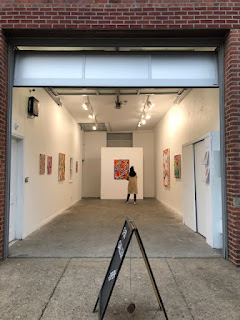
A couple of days ago, during a late-day ride, I came across a solution to the problem:


The 5-50 Gallery is located, as the name indicates, at 5-50 51st Avenue in Long Island City.  More specifically, it occupies a garage--from what I can tell, a commercial one.  Converting industrial and retail spaces to use for art and performance is not new, but this gallery's space is uniquely accessible. 


No, that isn't a portait of Marlee on mushrooms.  It's one work by Kyle Gallagher, the artist featured when I stopped by. 


The paintings have a grab-you-by-the-collar quality, full of  colors that flash with, at once, the energy of street festivals and the urgency of flashing ambulance lights.  And the way cats and other living beings are rendered makes comics seem like a kind of mythology of the subconscious,  spun from threads of graffiti, street portraiture and abstraction.


All right, I know, you didn't come to this blog for two-bit art commentary. But there was something oddly appropriate, almost synchronistic, about encountering those paintings on a bike ride through an industrial-turned-trendy neighborhood.

When I got home, Marlee didn't care. She just wanted to know, "what's for dinner?"  


19 December 2021

Ornament?

 Can you imagine hanging this on your tree?


Age Is Just A Number. So Is Speed.

The title of this blog is "Midlife Cycling."  Even though I've been writing it for 11 1/2 years, I'm still in the middle of my life.  Really, I am.  I may have slowed down a bit since my youth, but I'm not old.


I'm still in the middle of my life.  And riding my bike.  

18 December 2021

A "Walk Audit" In Tulsa

Yesterday I decried, as I often do, the sorry state of bike lanes here in New York City and much of the US.  It seems that bike and pedestrian lanes are, too often, conceived and designed by people who never have actually set foot, let alone walked or ridden a bike, where the lanes are built.  The result is lanes that actually put bicyclists and pedestrians in more danger than they'd experience without it and that don't offer safe and practical routes to and from wherever people live, work, go to school or shop.

Well, it seems that some folks in Tulsa, Oklahoma are reading this blog--or they have great minds that think like mine. ;=)  They are doing at least part of what I think anyone planning a bike or pedestrian lane should  do.  What's more, they plan to continue the practice for at least a year.

The other day, some of the city's business owners, neighborhood association members, city councilors and other citizens took the first "walk audit" of an area with crash areas. More such "walk audits" will be conducted through the coming year.  The purpose is to determine what needs to be changed in order to make those areas safer for walking, cycling and using public transportation.


Photo by Josh New, for Oklahoma Magazine


It sounds like a good idea, although I'd also like to see "bike audits":  Much, but not all, of what will make walking safer will also help cyclists.  As an example, the audit identified a lack of sidewalks in one area which, of course, forces pedestrians to walk in the street.  While I certainly favor installing a sidewalk, it generates this question:  Will cyclists and other wheeled (but non-motorized) vehicles be permitted on it?  In some places, like some areas of Florida I've ridden, bike lanes double as sidewalks (or vice versa, depending on your point of view).  That works out as long as there isn't a high volume of pedestrian or bicycle traffic, which seems to go against the purpose of having safe bike and pedestrian routes.

So, I think the good folks of Tulsa have begun to move in the right direction.  Now I'd like to see whether they expand their efforts, and whether they can export them--or whether they will be imported by--cities like the one in which I live.


17 December 2021

Bike Lane Mayhem: Just Don't Yell At The Cops.

I ride the bike lane on Crescent Street in Astoria only because it passes directly in front of my apartment--and I use it only to get home or to a street that will take me wherever I'm going.  

In that sense, the Crescent Street lane is actually better than some:  It not only takes me to my apartment; it also provides a direct connection between two major bridges with bike lanes: the Triborough/RFK and Queensborough/59th Street.  

For a while, I was crossing the Triborough almost every day to work, and often use it for rides to points north, including Connecticut.  But I take the Queensborough/59th Street only if I'm going to someplace within a few blocks of the Manhattan side.  If I'm going to Midtown or downtown Manhattan, I prefer to pedal into Brooklyn and cross the Williamsburg or Manhattan Bridges.  

The reason I like those bridges better is that the bike lanes are relatively wide and accessible.  The Queensborough/59th Street Bridge, on the other hand, is--like the Crescent Street lane--narrow.  How narrow?  Well, I've come within a chain link width of brushing, or being brushed by, cyclists traveling in the opposite direction.  

That problem has been exacerbated by motorized bikes and scooters.  I was under the impression that they're supposed to be limited to a maximum speed of 40 kph (about 25 mph).  But I've seen more than a few that were traveling well above that speed.  And I have seen many more of them than cyclists run red lights, make careless turns and sideswipe cyclists and pedestrians.  

Photo by Scott Gries--Getty Images


I know I'm not the only one who's noticed.  Christopher Ketcham said as much yesterday, in a New York Daily News guest editorial.  He also points out something I've mentioned:  It's illegal to operate those motorized vehicles in bike lanes.  People do it; they endanger others; cops see it and do nothing.

Ketcham described such a scenario of which he had to be a part.  Someone riding a motorized bike nearly knocked him off his bike on the Manhattan Bridge Lane.  When he stopped to complain to the cops sitting on the complain to two cops stationed on the Manhattan side, one of them said, "We're here for the bikes."

So that officer admitted what many of us know:  the police come after us because we're easy prey--and because, as former Transportation Alternatives head Charlie Komanoff said, "Cycling is everything cops are acculturated to despise:  urban, improvisatory and joyous rather than suburban, rulebook and buttoned-up."  I have noticed the hostility he and Ketcham describe even in cops who patrol on bicycles: I suspect that none of them ride when they're off the clock.

Some might say that Ketcham, Komanoff and I are paranoid or "not seeing the whole picture."  Well, if we can't see from the proverbial 30,000 feet, we certainly can look through the wide-angle lens of statistics:  In 2019, the NYPD handed cyclists 35,000 tickets for all sorts of infractions, from not having bells (more about that in a moment) to running red lights (even when, as I have described, crossing at the red light is safer for the cyclist and drivers). Truck drivers received 400 fewer tickets, although there are ten times as many trucks as bicycles on New York City streets.

When Ketcham complained to the cops at the foot of the Manhattan Bridge, they gave him a $98 ticket--for not having a bell and, allegedly, for yelling at the officers, according to the "Description/Narrative" portion of the ticket.  

I wonder how many folks driving motorized bikes were ticketed for riding illegally in bike lanes (or on sidewalks), sideswiping cyclists and pedestrians--or yelling at police officers.


16 December 2021

If You Like This Blog, Thank bell hooks

If you've been following this blog for a while, you may have noticed that every once in a while I invoke what I'll call herein the Howard Cosell Rule. I am so naming it for the sportscaster who interrupted his play-by-play and commentary of an NFL game to announce the murder of John Lennon.  About a dozen years earlier, he deviated from the format of his radio program to talk about the assassinations of Robert F. Kennedy and Martin Luther King Jr.

He received a lot of hate mail--which included slurs against his Jewishness and questioning of his manhood--for reminding viewers that, indeed, some things are more important than what your favorite football or baseball team is doing on the field.  That, of course, is what some fans didn't want to hear:  When it wasn't impugning his heritage, actual or perceived sexual orientation or political leanings, the angry responses said, in essence, that he should stick to sports because that's what they tuned in to hear.

Of course, these days, you'd have to be comatose to think that politics, economics, history, gender identity and expression and sexual orientation can be separated from games, matches or tournaments. (Simone Biles and Colin Kaepernick, anyone?) And I am always conscious of the fact that I started this blog because I am a middle-aged (depending on your definition of it!) transgender woman who has cycling in one form or another for longer than she’s been living as the person she is.

That said, I am writing today about someone who, to my knowledge, didn't do much cycling. And I have not previously mentioned her on this blog.  But she has as much to do with the person I am, and why I have continued to ride, as anyone has.


bell hooks, from the bell hooks institute


Yesterday Gloria Jean Watkins--better known as bell hooks*--died at age 69 from renal failure.  As I understand, she'd been in failing health for some time.  Physically, that is. I can't get inside her mind, any more than anyone else can, but I feel confident in saying that until her last moment, it worked better than that of most people (including me) at their cognitive best.

So what does she have to do with me, or this blog? Well, first of all, any transgender person owes at least something to her.  Laverne Cox said as much.  hooks, a black feminist scholar who described her sexuality as "queer-pas-gay,"  sowed the seeds of what Kimberle Crenshaw would later call "intersectionality" in feminism and the studies of race, class and culture.  For those of you who didn't take a graduate seminar in gender studies (no shame there, really!), intersectionality explores, as its name implies, the connections between social categories such as race, gender and class--though hooks (and Crenshaw) were careful to point out that while sexism, racism, class bias and homo- and trans-phobia are related, they are not identical.  Thus, while hooks took pains to respect the differences between, say, a white cisgender woman from an upper middle class background trying to break the "glass ceiling" of an organization or profession and an Afro-Latina transgender trying to get medical treatment, she could also see the parallels between, and empathise with, their struggles.

Most important, she challenged her readers to empathise, and to embrace, the ways in which their identities, whatever they are, express themselves.  That is not to say she believed that "anything goes:" her critique of Beyonce says as much.  Rather, she wanted people to free themselves from the mostly-unspoken dictates (many of which she identified as patriarchical) about gender and race into which people are immersed from an early age.

So how did that lead to this blog?  Well, when I was starting my gender affirmation process, I struggled with the question of what, exactly, it would mean to live as a woman.  It changed, it seemed, almost from one day to the next.  In part, that had to do with the time in which I started my process:  In 2003, books like Jennifer Boylan's She's Not There had just come out.  In a recent interview, Boylan said that in re-reading it, she realizes that much of it had an apologetic tone.  She, who started her process about a decade before mine, was trying to conform to some of the very same notions I was--and which bell hooks didn't denounce as much as she said were outmoded and, in some cases, crippling.  

I think that most people who experience gender identity as I have, until recently, realized that they weren't the sex by which they were identified from birth before they understood what living by the gender by which they identify themselves would mean.  That meant, for some of us, things that we look back on with embarrassment: I realize now that, at times, I was performing an exaggerated version of femininity.  Young trans and queer people have the advantage, in part because of people like bell hooks, of realizing that they don't have to accept those notions of gender (I include the ones to which some trans men conform) that were formed by notions of the superiority of a particular gender, race, class or religious group.

For me, figuring out what kind of woman I would be included answering the question of whether I would continue cycling.  At the time I started my affirmation process, I didn't see many female cyclists. I take that back:  I didn't see many who rode as much, as long, as hard, as I was riding in those days.  So I wondered just how much (if any) cycling I could do and still be the woman I was envisioning at the time. 

Then, I realized that I had bought into a frankly hyper-masculine idea about cycling, modeled after the wannabe Eddy Mercxes, Bernard Hinaults and Russian sprinters I saw and sometimes rode with. Over time, my ideas about cycling--and womanhood--changed.  

These days, I am a woman who rides because I love being a woman and I love riding.  The forms each take have changed, and will change, in part because age inevitably changes our minds as well as our bodies.  It took time, but I think I've come to a place where I live and ride as I see fit, whether or not it fits into someone else's ideas about what a woman, a person in mid-life, or a cyclist should be.  For that, I have bell hooks, among others to thank.  She is as good a reason as any for me to invoke the Howard Cosell rule today. 

*--bell hooks always spelled her nom de plume with lower case letters. It's her grandmother's name, which she took in honor of her fighting spirit.  But bell hooks wouldn't capitalize the first letters of her name, she said, because she didn't want to draw attention to herself at the expense of her works.  I hope I don't seem cynical when I say someone as intelligent and perceptive as she was must have known that, for some people, it's exactly what drew attention to her.  I confess:  I am one of them.  I knew nothing about her when I first saw her name and started reading her works out of curiosity because of how she spelled her name.