02 March 2022

The Law, In All Of Its Majestic Equality

In Le Lys Rouge (The Red Lily), Anatole France wrote, "La loi, dans un grand souci d'egalite, interdit aux riches comme aux pauvres de coucher sous les ponts, de mendier dans les rues et de voler du pain."  The law, he says, in all of its majestic equality, forbids the rich as well as the poor from sleeping under bridges, begging on the streets and stealing bread.

Inspector Javert, who pursues Jean Valjean in Victor Hugo's Les Miserables, could have uttered that--without irony or sarcasm.  France, though, meant it as an indictment of folks like Javert and what they represent:  They might pursue justice "blindly," but the wrath of it falls more on the poor and otherwise vulnerable and marginalized:  Not only are we less able to defend ourselves if we're stopped, arrested or charged; we are more likely to be arrested and charged--or simply stopped and questioned--whether or not we committed any offense.

(Trust me, I know from whence I speak.*)

Moreover, those stops and arrests do little to nothing to enhance public safety and do little to nothing besides undermining people's trust in the police and the criminal justice system.  

The previous paragraph isn't my opinion, or that of a public defender or judge in the Bronx.  Rather, it's a paraphrase of the rationale a State Attorney in Hillsborough County--at the western end of Florida's I-4 corridor, politically one of this country's quintessential "swing" areas--gave for a new policy.

Six weeks ago, Andrew Warren issued a memo sent a memo saying that it's no longer appropriate to prosecute someone stopped on a bike if their only offense is that they resisted an officer without violence.  In that memo, he noted that while Black defendants make up a third of misdemeanor cases in the county, which includes Tampa, they represent 49 percent of all "resisting without violence" arrests.  And more than 70 percent of such cases that resulted from a bike or pedestrian stop had Black defendants--even though roughly one in five county residents is Black.


These findings did not surprise Black residents of the area, especially in light of a 2015 report documenting that Tampa police stopped disproportionate numbers of cyclists, 80 percent of whom were Black.  Those numbers were so egregious they drew the ire of the Department of Justice and helped to popularize the lament, "Bicycling While Black."

Warren's memo became the basis for his declaration that it is no longer appropriate to prosecute those stopped on bikes if their only charge is resisting an officer without violence, and as long as the "stop" is not related to some other, more serious, offense. While the number of affected cases, he admits, is small (about 40 or so per year), it will not tie up police time and other resources that could be deployed against crimes that are true threats to pubic safety, but also make, if in a small way, the criminal justice system fairer by not burdening poor and Black cyclists, most of whom are young, with criminal records for minor offenses.   

After all, the law, in all of its majestic equality, not only allows the poor as well as the rich, Black as well as White, and female as well as male (or genderqueer) to cycle or simply go about their business.  At least, it should. 

*--More than once, I have been stopped by police officers who had absolutely no reason to do so.  Once, in Lido Beach, Nassau County, the officer claimed I was "riding between cars'--where in the books such a law is embedded, I don't know--when, in fact, I was riding on the shoulder of the road, to the right of the two lanes of traffic.


01 March 2022

Just Another Road Obstacle

In my decades of cycling, I've toured, commuted, road raced, ridden off road and done just about anything else one can do on a bike besides BMX or Polo.  And, on the roads and trails, I've encountered all manner of obstacles. They include include debris blown or thrown into bike lanes, mounds of snow, motor vehicles parked or idled and animals ranging from a chipmunk (I never would run over anything so cute!)  to a pack of  macaques and, of course, the random cat, dog or deer.  

(I have never had to stop for an elephant, but I did see one from about five meters away on a ride in Cambodia.)

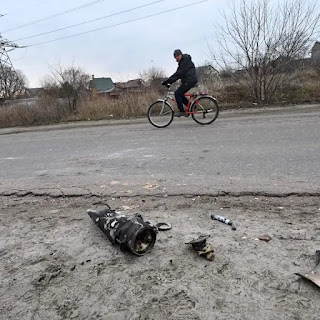
Of all the living beings and inanimate objects that have found their way into my line of riding, I must say that I have never encountered any like this:


Now, tell me: What do you do when a tank is blocking your trading ride?  Do you turn around or ride around it?  If you choose the latter, do you curse at the driver or remind him/her/them to give you three feet (actually, a meter, since the cyclist is in Kyiv) of space?  Does a three-foot/one meter rule exist there? If it does, would a Russian tank operator adhere to it?


28 February 2022

How Should The Cycling Community Respond To The Ukraine Invasion?

 In response to the Soviet invasion of Afghanistan, the United States and several other countries (including, ironically, the then-new enemy of the US, the Ayatollah Khomieni-led Iran) boycotted the 1980 Summer Olympics, which were held in Moscow.

Some  hailed the boycott as a strong statement of principle.  Others thought they unfairly penalized athletes, particularly those in sports for which the Games are the most prominent stage—and the end-point of athletes’ careers, especially in sports as diverse as gymnastics, wrestling and, yes, bicycle racing (at least for countries like the US that didn’t have professional racing circuits).

That last point makes an article in Velo News all the more interesting and relevant. “Where does the line end and begin between sports and politics?” Andrew Hood wonders.

Specifically, he relates that question to Putain’s, I mean Puto’s, I mean Putain’s, invasion of Ukraine.  Very astutely, he points out that while the Union Cyclisme Internationale’s  condemnation is laudable, it actually won’t do much to pressure the Russian sports establishment or government, let alone Putin himself.


While there are a number of world-class Russian cyclists—in particular, sprinters—there aren’t any major UCI-sanctioned road races—which, let’s face it, are the most-followed events in the sport—in Russia.  Moreover, there aren’t any major bike brands with a sizable market outside the country.

In brief, a full-on boycott by the UCI or any other cycling body will do more to hurt individual Russian racers, just as the 1980 Olympic boycott penalized individual athletes—and, arguably, accomplished nothing beyond a retaliatory boycott of the 1984 Los Angeles Olympics.

27 February 2022

Is This What They Mean By "Going Green?"

 In my half-century of dedicated cycling, I've noticed that, when it comes to food, there are two extreme types of cyclists.  One fuels up on pepperoni pizza washed down with Coke or Pepsi and eats steaks or cheeseburgers and ice cream after the ride.  The other wants the packaging to be as organic as the food in it.

Most cyclists, of course, fall somewhere in between. I admit that I eat and drink stuff that isn't found on most training tables, but I cringe at Twinkies, Jell-O and the like.  I eat less meat in all forms than I did in my youth--and I not only eat more vegetables, but more of them are fresh rather than processed.

Like many other Americans, during the past decade or so, I have discovered the joys of one vegetable in particular:


26 February 2022

On The Bridge Too Far

 Bells clang.  Lights flash.  A gate drops.

You have to stop for: a.) a railroad crossing or b.) a drawbridge.

I admit that on more than one occasion, upon hearing the bells, my legs pumped out a momentary burst of speed that would have impressed a Russian sprinter. OK, I'm exaggerating---only slightly! 😉 But I did manage to cross tracks before trains plowed through, or bridges before they opened.

It's been a while since I pulled such stunts.  These days, I envision the fate of a cyclist in this video:


He hung onto the North Palm Beach, Florida span as it opened.  According to a news report, the witness who took the video saw the cyclist on the bridge as it began to lift and, believing the cyclist would ride down, started to take the video.

When the witnessed noticed the cyclist was in trouble, he stopped taking the video and "rushed to help him down  off the bridge," according to police.

The bike was damaged but the cyclist suffered only "pain and discomfort" in his left shoulder from holding himself up on the bridge and a slight burn in his right inner bicep from sliding on the railing. 

He declined EMS help at the scene but went to the hospital on his own.  

The bridge tender claims she didn't see anyone crossing the bridge.

25 February 2022

The Weather Outside Is Ice-ful


This morning, anything that can fall from the sky has been falling.

All right, that was a terrible description to use on Day 2 or 3 (depending on what you consider “zero hour”) of Putain’s, I mean Putin’s, invasion.  Actually, it would be a frightening description any day, given my proximity to an airport.  So let me be more specific:  Anything that can naturally fall from the Earth’s atmosphere—snow, rain, sleet and freezing rain is falling. That combination, according to my, shall we say, layperson’s understanding of meteorology, can happen only in the conditions we have now: the air is saturated and the temperature is yo-yoing a degree or two above and below the freezing point.


The weather is indeed frightful.  But some of the resulting scenes are, if not delightful, at least interesting. 


24 February 2022

Paint Is Not Infrastructure

 I don't know whether Robert "Bicycle Bob" Silverman, about whom I wrote yesterday, uttered the title of this post.  It's not hard to imagine that he did--le peinture n'est pas une infrastructure--when he was campaigning for the safe, practical lanes Montreal's cyclists enjoy.

Someone who did say that--in English--was a fellow identified only as "John" in Hertfordshire.  He documented a "near miss" in which a driver squeezed him over to the curb.  


"John" blames, in part the driver:  "Whilst this was telegraphed right from the point when the van signals to turn right, there was a weary inevitability of at least one of the drivers not being able to see beyond the end of their bonnet and creating an easily preventable situation"  

While the carelessness or cluelessness of drivers is not news to cyclists in the UK or US, "John" also blames what an editor of road.cc sarcastically calls "a great piece of cycle superhighway."  His all-too-close encounter, he says, "demonstrates that poor cycle infrastructure, in this case a narrow lane that disappears just when you need it, can cause more problems than it solves."


He said what I've said--and, what I don't doubt "Bicycle Bob" said:  Poorly-conceived, -constructed and -maintained bicycle infrastructure is not only less convenient, but more dangerous, for cyclists and motorists alike, than no infrastructure at all.  I have seen too many examples of that here in New York, but too many planners persist in believing that simply painting a few lines on a street will lead to a safer co-existence, or at least a truce, between cyclists and motorists.

23 February 2022

Robert Silverman: A Prophet Of Bicycle-Friendly Cities

 A few years ago, I spent an extremely pleasant long weekend in Montréal . What's not to like about a beautiful, diverse  city with good food and art where French is spoken?  

What made all of that even better?  Cycling.  La ville aux cent clochers is, simply, one of the best cities for cycling I've encountered.  The bike lanes aren't just lines of paint in a street:  They're physically separated from the rest of the traffic (although a couple I rode seemed a bit narrow for two-way bicycle traffic) and there seems to be more respect, or at least a better detente , between cyclists and drivers than I've seen in any US locale.

Moreover, the lanes I encountered weren't just paths that suddenly began in one place and just as suddenly ended somewhere else, far from any place else.  (Perhaps if I'd spent more time in the city, I might have found such useless paths.) Instead, there are at least a couple of lanes on which you can cross the city, and other lanes are actually useful in getting to and from anywhere you might be or want or need to go. You can even ride a lane to the Jacques Cartier Bridge or other crossings to or from the city, which is on an island.

What I didn't realize was that much of that pleasant, stress-free riding was a result, directly or indirectly, of "Bicycle Bob" Silverman.  


In 1975, he co-founded Le Monde à Bicyclette, or Citizens on Bicycles.  His choice of the French name was important because he knew that if he were to realize his dream of starting a "velorution " to break the "auto-cracy," he would need to reach beyond his mainly-anglophone circle.  Also, he said, the main cycling organization in his province--la Fédération quebecoise de cylotourisme , now known as Vélo-Québec, was focused mainly on recreational cycling. 

In the previous paragraph, you might've noticed that Silverman had a penchant for appropriating the rhetoric of political upheval.  That was no accident:  He identified as a Trotskyite and, in his twenties, lived in Cuba, where he met Che Guevara, before he was deported for distributing anti-Soviet literature.  After that, he lived and worked on an Israeli kibutz before 
"bouncing around Europe" and falling in love with cycling while riding in France (of course!). 

His vocabulary also reflected his flair for the dramatic. Le Monde à Bicyclette staged "die-ins" to protest cyclist deaths--which have since decreased significantly--in the city and province.  Silverman and his organization argued that the reason was not, as some claimed, that cyclists were careless or they shouldn't have been cycling in the city in the first place.  Rather, he argued that there were too many cars and that their number wouldn't stop growing as long as the city's and province's infrastructure is built around moving them rather than on human interactions and sustainable transportation--and that the bicycle is as viable a mode of transport as any other.

He also led other kinds of demonstrations, like the time he dressed up as Moses* and pretended to part the waters of the St. Lawrence River to lead cyclists across. (Hmm...Maybe this is why he was called a "prophet" of the bicycle-friendly, sustainable city.) Another time, he rolled out a carpet on Boulevard Maisonneuve to press for the group's demand for an east-west cycle route (which now exists) across the city.   In yet another action--which got Silverman three days in prison--he and a group of fellow cyclists painted clandestine cycle lanes in the dark of night.

Save for his time in Cuba, Israel and Europe, and the past few years in the Laurentians, Bob Silverman was a lifelong Montreal resident born and raised in the city.  His work was therefore not only abstract ideas about sustainability (before that became a widely-used term) or even cycling itself; it was his way of trying to achieve the kind of city he wanted.  That, according to Michael Fish, the architect who founded Save Montréal at around the same time Silverman and his friends started Le Monde à Bicyclette. "Nothing since the multiple achievements of Robert Silverman  for the rights of cyclists has so affected positively the environment of the region, at almost no public cost," he explained.

He and others want to memorialize Robert Silverman, who passed away at age 87 on Sunday.

Whatever the city does, the next time you ride there (or if you ever get to ride there), thank him.


*—I tried to find a photo of “Bicycle Bob” in Old Testament prophet mode. To this day, my mental image of Moses is Charlton Heston:  a result, most likely, of seeing “The Ten Commandments “ every year, on the night before Easter, during my childhood.


22 February 2022

What Leads A Charge Away From Red Bull? Greenbacks.

 This year's Winter Olympics have just ended.  I have to admit that I didn't pay as much attention to them as I've paid to Olympiads past, though I haven't been living under a big enough rock to not know about the saga of Kamila Valieva.  Whether or not she intentionally took a banned substance, the way her teammates and coach and the Russian sports establishment have treated her is child abuse, pure and simple.  That the International Olympic Committee did nothing to prevent her situation from snowballing--and, if they do anything, they're more likely to discipline her than her team, coaches or the relevant Russian organizations--confirms something that I've long known:  The IOC is, purely and simply, one of the most corrupt organizations in the world. Even if Valieva's tale of woe hadn't unfolded as it did, the fact that this year's games were awarded to Beijing is, for all sorts of reasons, evidence of how avaricious the IOC is.

(As Harry Shearer reminds us, the Olympics are a movement, and we need one--every day!)

As bad as the IOC is, it has at least one other rival for unscrupulousness in the sports world:  the Union Cycliste Internationale (UCI). (I'd also put FIFA in the same league, if you will.)  The travesty of Lance Armstrong's carrer is, alone, evidence of that.  UCI officials seem to react to doping in one of two ways:  They look the other way until they can't (that's how they acted in the L.A. farce) or they talk about how they're going to do whatever they keep riders from using banned substances and severely discipline those who did, while making some deal or another that sends the exact opposite message.

Red Bull, to my knowledge, isn't banned by any major sports organization.  I've never drunk it myself, but from what I've heard, it gives one of the quickest, most intense, legal bursts of energy.  That is probably the reason why it's so often associated, whether through sponsorship or in other ways, with high-intensity sporting events.


Evie Richards at the UCI Mountain Bike World Cup in Alberstadt, 2021


Such was the case with the Mountain Bike World Cup, the sport's premier UCI event.  Sponsors are selected by the UCI, as they are at other events under the organization's umbrella.  Red Bull is sponsoring this year's edition, as it's sponsored the past ten.  I can't help but to see some UCI official winking while making the deal.

Well, this will be the last time for Red Bull.  For next year's event,  Discovery Sports will be the sponsor.  They're part of the Discovery broadcast network, which broadcasts a wide variety of sporting events.  I don't fault their work, but, given UCI's history, it's hard not to think that the money involved swayed them--and will give the UCI even less incentive than it (or the IOC or FIFA) to act on its stated commitment to fight doping and other forms of corruption in the sporting events they sanction.

21 February 2022

He Didn’t Wear Lycra


 Here in the United States, today is Presidents’ Day.

When I was a kid (really, I was!), two separate holidays were celebrated:  the 12th for Abraham Lincoln’s Birthday and the 22nd for George Washington.  That meant two days off from school unless, of course, the holiday fell on a weekend.  In the 1970s, those fetes were eliminated in favor of a Monday holiday in February.

The resulting long weekend gave stores (and, now, Internet retailers) a day to mark down prices on stuff they couldn’t sell for Christmas or other holidays—and customers an excuse to shop.

As I wrote a few years ago, during the 1890s-early 1900s Bike Boom, Washington’s Birthday was Bicycle Day. Bicycle makers debuted new models in splashy shows, and with sales, in much the same way the day would become the occasion to introduce new car models. 

From what I’ve read, that day was chosen because, at this time of year, people sense that Spring was around the corner—and, in the warmer parts of the country, it had all but arrived.  In those balmier locales (and some less temperate), the day also began the riding or racing season.

Our current President, Joe Biden, has been spotted riding with his wife, Jill, on more than one occasion.  His predecessor who shall not be named did everything he could to denigrate bicycles and cyclists.  But Obama, Clinton and both Bushes were at least occasional cyclists. So was Jimmy Carter, until recently.

I don’t think Ronald Reagan ever mounted two wheels while he was in office, though he was known to ride in his younger days.  And another president I shouldn’t name—let’s call him Tricky Dick—is probably the last person in the world I would expect to see on a bike. (Peter Sagal quipped that in San Clemente, he was seen surfing in his dress shoes.  So it’s not surprising to see him cycling in, shall we say, non-cycling attire.

From The Bicycle Story