21 March 2022

Spring Back?

 The Spring Equinox came yesterday.  It certainly felt that way when I set out on Zebbie, my 1984 King of Mercia, for Point Lookout.  I chose to ride her, in part, because she has full fenders and yesterday’s rain turned some residual road salt and sand into nasty muck.

Anyway, my ride started under clear skies with a temperature of about 15C (60F) with a breeze blowing toward me.  If not perfect, conditions were nice and certainly felt like the first day of Spring. 

But I think I entered some sort of time machine as I pedaled down the Broad Channel bike lane and across the Veterans’ Memorial Bridge to the Rockaways. Clouds gathered and blanketed the sky, though they brought no threat of rain.  The breeze stiffened into a real, full-on March wind.  And the temperature dropped, or so it seemed, to a level that would have been right a few weeks ago.


The boardwalks of the Rockaways, Atlantic Beach and Long Beach hosted more cyclists and strollers, including families, than I’ve seen in a while.  They, no doubt, wanted to take in the light and air, but were bundled in parkas and scarves.

The reason for the seeming reversal of the seasons is the ocean: At this time of year, the water temperature is still only about 4 or 5C (38-40F). And the wind blew from those waters to the boardwalks, streets and land.

On the ride back, I felt the air grow warmer, gradually, as I pedaled away from the ocean..This morning, though, it seems that a touch of winter has returned—if only for a little while,

20 March 2022

Power--Or Peril?

Do you hope the kid who rode the bike wasn't hurt--or wonder how powerful a rider he or she will be all grown up?


I mean, if a toddler could ride hard or fast enough to knock that thing--a surveillance camera, I think--imagine him or her in the peloton at age 27.

Just hope that kid was wearing a helmet.

The bike doesn't look any the worse for the crash, though!


19 March 2022

St. Patrick's Day Sandwich

I had a St. Patrick's Day sandwich.

No, I'm not talking about corned beef and cabbage.  Rather, two fabulous cycling days sandwiched St. Pat's holiday, which featured rain, drizzle and more rain.  Wednesday was sunny and clear, if a bit nippy, but yesterday was more like a day in the middle of May:  sunny, with a slight breeze and temperatures that reached 22C (72F).


So, yesterday, I took advantage of the weather--and the extra hour of daylight at the end of the afternoon, thanks to Daylight Savings Time--and pedaled up to Greenwich, Connecticut and back.  


Of course, being so early in the Spring (or not officially Spring, if you look at the calendar), some plant life isn't quite ready to express the weather.  I didn't mind, though:  the tree in that photo is still beautiful, I believe, in a New England sort of way.  


I must say, though, it's odd to see bare trees as folks strolled along the common in T-shirts, tank tops, shorts or light, flowy skirts.  Then again, I was wearing my lightweight knee-length "knickers" and a long-sleeved T-shirt--and fingerless gloves.

On Wednesday afternoon, after riding to the World Trade Center and taking the PATH train to Journal Square, Jersey City, I pedaled along Kennedy Boulevard down to Bayonne, where a park entrance enticed me to take a detour. 


That park, the Richard A. Rutkowski Park, which includes the Hackensack Riverwalk, abuts Newark Bay, which forms part of the boundary between New Jersey and Staten Island.  Now, this park isn't Big Sur or Acadia, but it has its own charm.  For one thing, it's nicely landscaped and the paths are well-constructed.  For another, it has something of the aesthetic of a post-industrial park like the Cement Plant Park in the Bronx but the waterfront in Rutkowski is still active:  Ships come and go, and the docks and factories still hum with activity.  Somehow all of that makes the sensation of riding by the water all the more calming, especially late in the day, at least for me.


From there, I pedaled down to the Bayonne Bridge for the first time in a few years.  It had been closed so that the span could be reconfigured to allow larger ships to pass.  I am happy to report that the reconstruction includes a bike and pedestrian lane that's better than the old one.  For one thing, it's wider and better-maintained.  For another, it is on the east side of the span, which offers better views than the old one on the west side. Best of all, it lets you off at Trantor Place, where directions to the Ferry (to Manhattan), Stadium and Snug Harbor Cultural Center are clearly marked.  

My only criticism of the new lane is that it's a bit difficult to access from the Bayonne (New Jersey) side.  The entrance ramp rises from Kennedy Boulevard between 7th and 6th Streets.  It's set back and not clearly marked, and because Kennedy is interrupted by a highway entrance and takes a turn on the other side of it, it's easy to lose your way. (If you continue to go straight, you'll end up on a different street altogether.

From the bridge, I rode Richmond Terrace, which winds along the North Shore of the Island and passes Snug Harbor.  The main problem with the Terrace, for cycling, is that it's narrow and almost everyone drives well over the speed limit.  There's been talk of constructing a cycle lane alongside it, or on parallel roads, to allow a safe cycle route from the Bridge to the Ferry.  

So my St. Patrick's Day "sandwich" included enough riding, I think, to burn off the calories I consumed on the day itself--all of them from Irish (or Irish-American) delicacies!

18 March 2022

Bikes Not Going Their Way


For the past two years, you may have had difficulty in buying a bike—the one you want, anyway. If you managed to find your machine of choice, you probably had to pay more for it than you would have in 2019.

You may have had a similar experience in procuring parts to repair, refurbish or update your favorite ride—or even if you were looking for accessories like water bottle cages or a pair or riding glasses or gloves.

The reason for the situation I’ve described is the COVID-19 pandemic. It disrupted supply chains and even closed production facilities at the very moment when folks took up cycling as a way to avoid buses and trains or to get exercise or mental cleansing in a way that allows for social distancing.

But at least you could get something you could ride, whether or not it was your first choice, as long as you were willing to pay and could wait. 

The folks in Russia aren’t so lucky. (Ok, the Ukrainians have it worse, but bear with me!) The way things are going, they won’t be able to get bikes, parts, accessories, apparel—or much of anything—at all.

A number of bicycle and bike-related companies have suspended their operations in the country. The list includes SRAM, Trek, Specialized, Tern and Quality Bicycle Products (QBP). Also, leading bicycle tire manufacturers Continental, Michelin, Pirelli and Bridgestone have joined their ranks.  

Those companies, no doubt, were motivated by the difficulty of doing business in Russia due to banking sanctions and that some shipping companies, including Fed Ex and UPS, have stopped delivering to the country.  But one representative also says “there’s a social aspect too” in the companies’ actions.


17 March 2022

A Joycean Parade of Cyclists

 Today is, of course, St. Patrick’s Day.

Since I am not Irish (at least, not to my knowledge!), I will not tell you whether or how to celebrate this day.  I will say, however, that so much of what we’ll see today is what I’ll call Celtic Kitsch. (Confession:  I was in college before I knew that the “C” at the beginning of “Celtic” is pronounced like a “k.”  Until then, I’d been pronouncing the word as “sell-tick,” like the basketball team in Boston.) The truth is, few can agree on what is “authentically” Irish. Although schools teach the Gaelic language, nearly everyone speaks (beautifully) the language of their colonizers.  And, apart from Roman Catholicism with a strong monastic tradition—which the young are largely abandoning—we actually know little about pre-Anglo Irish culture and history.

James Joyce understood as much.  Although all of his writing is set in his native country—which he lived away from for most of his adult life—he is not part of a “Celtic revival.” Instead, he used Ireland—Dublin, mainly—as a lens through which he could explore how people move through life, and how it moves through them—and, perhaps most important, our minds re-assemble it all, whether in images or language—or simply deal live with it as the chaos it is.  

Some have said that Joyce’s works—specifically Dubliners and Ulysses—are therefore to literature what Picasso’s Cubist paintings are to art.  Others have called him the first “cinematic” writer.  I agree with both, and would add that his narrative style is like a bicycle ride:  Whenever I take a ride, even one I’ve done hundreds of times, I see not only people and things I haven’t seen before, but a building, a city block, a tree or a seashore from an angle or in a different kind of light (or darkness) from what I saw on that same ride on a different day.

Martina Devlin, Darina Gallagher and Donna Cooney seem to understand as much.  On Sunday, they participated in a Dublin St. Patrick’s Day parade that includes a procession of 100 cyclists dressed in Ulysses-themed Edwardian clothes. They took spectators on a journey through places in the book.


Martina Devlin, Darina Gallagher and Donna Cooney (Photo by Norma Burke)


Cooney, the artistic director of the Dublin Cycling Campaign (now there’s a job I wouldn’t mind having!) said this year’s bicycle procession and St.Patrick’s Day parade are particularly special because February was the 100-year anniversary of Ulysses’ publication.  But the essence of the event might have been best summed up by Devlin, a writer whose speech included an excerpt from the novel and began with this:  “One of the landmark days in my life was when I learned how to ride a bike.”

“I felt as if I were on the road to somewhere.”

As were the cyclists and marchers in the Dublin parade, 100 years after Ulysses came into the world.

16 March 2022

Agonizingly Rewarding

I've cycled in the Green Mountains, Adirondacks, Catskills, Sierra Nevada, Pyrenees, Alpes Maritimes and the Alps of France, Italy and Switzerland.  I've also done some challenging climbs in places like the Greek island of Milos, where the road up the mountain, I think, was first built long, long before I was born and simply paved over.  

I don't know whether that climb was tough (but rewarding) because of the less-advanced state of engineering at the time it was first carved out, the hot weather or my age.  But it felt nearly as arduous, at times, as one stretch of the Col de Portillon, on the Spanish border.  I climbed it--and was both terrified and exhilarated by the views from the guardrail-less virages--on a bike loaded with full panniers.  I don't know whether that stretch--about a kilometer of a 10 kilometer climb --was steeper than the most vertical stretches of the Alpe d'Huez or Col d'Agnel (a.k.a. Colle d'Agnello: It's on the Italian-French border) but I remember a group of people applauding me when I made it to the top. 

Well, there is one climb that claims to put those, and all others, to shame.  Every year, the Mount Washington Auto Road Bicycle Hillclimb takes cyclists to the top of the highest peak in the Northeastern United States. The route can lay claim to one of the world's steepest climbs:  The average grade is 12 percent; extended sections rise at 18 percent and for one part near the end, cyclists have to pump their way up a 22 percent climb.  

When bumper stickers proclaim, "This car climbed Mount Washington," you know it has to be quite ride for cyclists. (The road is closed to auto traffic on the day of the ride.)  What makes the ascent all the more laborious is the weather, some of the most severe and changeable in the world. For years, the race was held in September, but cold, wind, rain and snow caused organizers to move it to August--where there is still a chance of starting off in typically summer-like conditions but pedaling through cold, wind and freezing rain before reaching the top.


At the start of the 2017 ride. Photo by Joe Viger


Mark Greenleaf would know.  He plans to participate for the 35th time when this year's edition is held on 20 August.  

In 1983, he was living in Providence, Rhode Island when, one day, he grabbed the mail before going out to dinner with friends.  Among that day's delivery was a copy of Bicycling! magazine, in which he noticed an article about the ride.  "After a couple of beers, we dared each other to do it," he said of his friends at that fateful dinner.  The following year, he did it for the first time.

After each climb--which he completed--he always felt it was "agonizingly rewarding."  I could say the same for the climbs I've made.

15 March 2022

An Early Sign?

Under a canopy of wizened limbs


They rise from catacombs of winter horizons

Fit For An Emperor Or Empress’


 Beware the ides of March.

Those words are, of course, Shakespeare’s:  A soothsayer emerges from a crowd to warn Julius Caesar in the Bard’s eponymous play.

In much of the Northern Hemisphere, Spring is about to arrive.  It is a time of change:  Many of us look forward to longer periods of daylight and, yes, warmer weather.  But it’s also a time other changes, some of which are already underway. 

Anyway, I typed “ides of March bicycle” into a Google search window just to see what would come up.


This Ides of March bicycle chain bracelet is fit for an emperor or empress*—or, at least, the King of the Mountains.


*—What is a gender-neutral term for emperor or empress?  

Who but I—or a transgender or non-binary historian—would ask such a question?

14 March 2022

A Messenger For Equality

March is Women's History Month.  As I've mentioned in other posts, the bicycle--as Susan B. Anthony herself said--has played an important role in liberating women. It led to a revolution in the way we dress--freeing women from corsets, hoopskirts and bustles--which, in turn, gave us more independence and mobility, not only into the physical places where we could go, but also in what we could do for paid work (or whether or not we could do paid work at all!) as well as in our free time.

It also took us on our path toward something that, in the US, only men were allowed to do from 1776 until 1920--and a right given only to white men until 1865. I am talking, of course, about voting.  Almost nobody would dispute that when women were able to partake of the other liberties I've described, it made it possible for even the most conservative men to realize that we have the powers of discernment derived from life experience that give us at least the same ability to decide what is best for our selves, families, communities and nation as the other 49 percent of the population.  

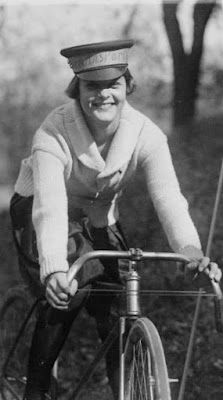
What can't be overlooked, however, are the mundane tasks women performed as part of the project of achieving the right to vote.  Here is a bike messenger--in bloomers, one of the sartorial innovations wrought by women on bicycles--at work for the National Women's Party headquarters:


From the National Women's History Museum

Okay, I'll admit that today's post is, at least in part, an excuse to post that image!  She looks about as happy as anyone I've seen in doing her work.  And well she should have been.

13 March 2022

Sunday funnies, funny bicycle images, folding bicycles

 I have ridden several folding bikes but have owned two. One was  a Dahon Vitesse 5 on which I commuted for about a year and a half. The other was a 1970s Chiorda I found in the trash on a Jackson Heights curbside. I rode the bike a couple of times before I gave it to a local mechanic who gave it to his girlfriend.

Neither of those bikes bore any resemblance to this one: