21 July 2023

A Ride From Astoria To Denmark, Via Atlanta

I have a confession:  I rode a bike-share bike the other night.

No, I wasn't in some faraway place without one of my bikes.  I was in my home city--New York, where I live with almost as many bikes (and Marlee) as I lived with family members when I was growing up.

So what was I doing on a CitiBike?

Well, I went to some place where I wasn't sure I could park any of my bikes safely.  A phone call confirmed that there is no on-premises bike parking. And, while there are on-street bike racks-- in addition to sign posts, railings and such--I didn't want to lock up my bike for the three hours or more I expected to be at my destination.

This image will give you an idea of what the neighborhood is like:
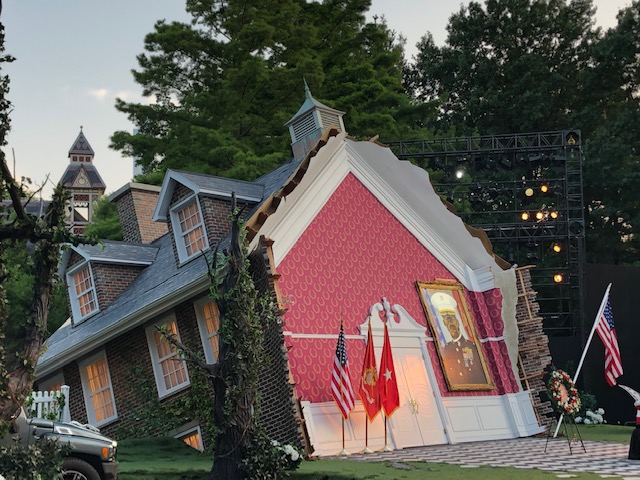


All right, the whole neighborhood isn't like that.  It's actually one of the more affluent areas of the city.  The crime rate is lower than in most other neighborhoods but, as in similar neighborhoods, a fair amount of that crime consists of bike theft.

That semi-submerged house is, as you may have surmised, a prop on a stage--specifically, in the Delacorte Theatre, the home of Shakespeare In The Park.

There I saw a very interesting production of Hamlet.  All of the major soliloquies (speeches), and most of the original language, was intact. But it was set in suburban Atlanta, and some liberties were taken with the chronology.  

Whenever I've assigned the play, I've told students that there are really two Hamlets in the play. The one who delivers "To be or not to be" and those other immortal lines is really Hamlet Jr. or Hamlet II, and he is brooding the death of his father--Hamlet Sr, if you will.  In this production, he becomes the patriarch of a mixed-race family. The play opens with his funeral, which includes soul and gospel songs and dance. 

For me, the cast (Ato Blankson-Wood is one of my favorite Hamlets!) helped me to see something that has been in the play all along but what is seldom emphasized:  what we now call "intergenerational trauma."  It also conveys the effect of murder and other kinds of violence on families and communities.  And some of the "tweaks" to the original dialogue--such as "Denmark's a prison" becoming "this country is a prison" (so powerfully delivered by Blankson-Wood)--makes the play almost scarily relevant.

Those who insist traditional, period-correct productions may not like this one.  And I'll admit that some attempts to transpose a contemporary Black/mixed-race American milieu with medieval Denmark don't always work.  But this production "hit" far more often than it "missed" for me, and I recommend it. Oh, and if you need an excuse to ride a Citibike even if you have a few bikes of your own, here it is.

It's All Your Fault (If You Voted A Certain Way)

A proprietor loses his businesses.  He points his finger. "It's all your fault!" he bellows.

In this case, though, he wasn't pointing to an executive, employee, family member or incompetent (or crooked) lawyer, accountant or bookkeeper.  Rather, he aimed his accusation at 25 million or so people.

What did they have to do with the demise of his enterprise?  (That rhyme was unintentional. Really!)  They all voted for what, according to the proprietor, was the slit to the throat of his company.

Hint:  They voted seven years ago, in the UK.

I am referring, of course to "Brexit:"  the decision to take the country out of the European Union (formerly called the "Common Market).  That meant the re-imposition of tariffs that membership eliminated on goods from most continental European countries.  Perhaps more to the point, it meant reels and reels of "red tape" that tied up shipments in ports and terminals or made it all but impossible to pass through.  It even made Brooks saddles unavailable England, where they have been made for more than a century and a half:  For about two decades, an Italian company has owned Brooks, so the company's saddles are shipped from a distribution center Italy, an EU country.

And many bike brands sold in the UK are based in European countries, even if the bikes or parts are made in Asia or other parts of the world.  One of those bike brands is Austrian KTM, distributed by Huddersfield-based FLi Distributors for the past eleven years.  They have just ceased trading. In announcing their demise, owner Colin Williams said, "If you voted for Brexit, realise (British spelling) this is 90 percent because of your decision back in 2016."


FLi is not the only bicycle-related company to close its doors since Brexit-related regulations took effect at the beginning of 2021--just as the worst of COVID-19 related shutdowns were choking supply chains.  I would bet that the owners and employees of those companies and Williams--along with many others in the bike business, cyclists and other citizens--are not the only ones regretting the Brexit vote.

20 July 2023

More Choppers!

 Even with all of my cycling experiences, there is one that I don’t share with some other members of my generation.  I never had one of those bikes that was styled so that kids could pretend they were riding motorcycles.  You know the kind I mean:  the ones with “banana” seats, “ape-hanger” handlebars and “stick” shifters strategically located (on the top tube) to, it seemed, reduce our generation’s fertility rate.

Such bikes included the spectrum Schwinn’s Sting-Ray bicycles (the original S-R and the Lemon Peeler, Pea Picker, the Orange and Apple Krates and the long-rumored Grape Krate) and their imitators from other American bike manufacturers.

That genre also included the Raleigh Chopper. Like the Sting-Ray, they have a loyal following among those who rode them in their childhood and, apparently, some who use them as compact or travel bikes—sort of like a Raleigh Twenty that doesn’t fold.

Last month, Raleigh released a near-as-possible reproduction run that sold out in days.  Now another run—based on the MK2 model—is set to be released next Tuesday, the 25th.  After that, Raleigh says, there will be no more.

Some of the parts used on the 1970s Choppers (and Sting-Rays) are long out of production and the companies that made them have gone out of business (or simply the bike business) or been absorbed into other companies.  Among those companies is Sturmey-Archer, which went into receivership in 2000 and was purchased by the Taiwanese company SunRace.  S-A made the three-speed hub found on the Chopper MK II (and those classic English three-speed bikes)—and the “stick” shifter. Raleigh had to work with S-A (SunRace kept the brand alive) to replicate a hub that looks like the original—and the “sterilization” shifter!