22 April 2015

When The Sun Was Rising On The Bike Boom

Yesterday I talked about something people younger than "a certain age" probably wouldn't have known:  Cannondale's pre-bikemaking history (1971-1982).

Now I'm going to mention something else us oldsters (some of whom ride roadsters) will remember:  a time when Japanese goods were considered inferior to everything else on the market.  Bike parts, particularly derailleurs, from the Land of the Rising Sun were starting to gain respectability right around the time the 1970s North American Bike Boom was exploding; the bikes would soon follow.

I'm giving you this capsule history because I recently acquired a new-old-stock part from that period.  Although there's nothing exceptional about it, it's interesting and, I believe, good.

I knew I'd had one of an "endangered species" when I saw the packaging:  It looked as if no one had touched it in forty years.  More to the point, it bore signs of an earlier time:


In the days before Shimano came out with its Crane derailleurs and the Dura-Ace gruppo of which it would become a part, nearly all of its parts bore the "wings" "lifting" the "333" logo.  After Dura-Ace and Titlist (the forerunner of 600 and Ultegra) came to market, only Shimano's internally-geared three-speed hubs bore that emblem.  On that basis alone, one could date this hub from 1973 or earlier.


I have tried to show the logo engraved in the hub body and what appears to be a date code:


The letters are "R" and "U".  In every explanation of Shimano's code I've seen, the first letter is the month and the second letter is the year.  The month code goes from "A" to "L", with "A" being January and "L" being December.  The year code starts with "A" in 1976, goes through "Z" (2001) and begins again with "A" in 2002.  

One site suggests that Shimano was using this sequence before 1976 or, at least, that "Y" could be 1974 and "Z", 1975.  If that is the case, the "U" on my hub might mean that it was made in 1970.  But what about the "R"?  Could there have been another code in use for the month?  

Or might those letters mean something else--or nothing at all?

Whatever the case, it's pretty reasonable, I believe, to assume this hub was made before 1973, perhaps even during the late 1960s.  Here's another piece of evidence--which you may have noticed in another photo--that, I believe, supports my hypothesis.

I


21 April 2015

Before They Made Bikes: Cannondale

There are a few bike brands that even non-cyclists can name.  Here in the US, Schwinn is one of them.  Others include Raleigh, Peugeot, Motobecane and Fuji.  

Cannondale might also be included in that list.  I think they gained notice with the general public because when their bicycles were first introduced in 1983, they looked very different from the others.  While Klein may have been the first to make aluminum frames from large-diameter tubing, Cannondale made them a mass-market (relatively speaking, anyway) item.  To this day, those frames are the first thing most people associate with the name "Cannondale".


What most people, especially those younger than--ahem--a certain age, don't realize is that Cannondale was in business for more than a decade before they built their first bicycle.  Furthermore, even though the first product they ever made was bicycle-related, their early reputation was established as much on non-bike equipment as on accessories for two-wheelers.


In the late 1960's, Joe Montgomery was a self-described "grunt" on Wall Street.  The experience, he later related, taught him how businesses work.  Always an avid outdoorsman, he saw a growing enthusiasm for hiking, camping and related activities--and foresaw the North American Bike Boom.  He knew he wanted to build bikes but didn't have the necessary capital.  So, when he started Cannondale (and named it, as nearly everyone knows by now, after a Connecticut train station) in 1971, he knew he had to develop and market a product that would distinguish his new enterprise as well as help him raise the money he'd need to build bikes.


Thus was the world's first bicycle-towed trailer--the Bugger--born.  One funny thing about it was that it predated, if unwittingly, the luggage that people roll through airport lobbies all over the world.  That's because the Bugger was, in essence, a big backpack on wheels.  Since it was mounted on an angle, it transferred all of the weight carried in it to its tires and didn't add to the weight of the bicycle.  I never owned one, but had opportunities to ride with one.  While it increased the turning radius, it didn't affect other aspects of the ride nearly as much as I expected.


The original Cannondale Bugger, 1972.


Sales took off and in spite (or, perhaps, because) of the connotations of its name, it sold well in the UK.  That allowed the new company to create other products for which they would be known.  They included panniers and handlebar bags with innovative designs and sturdy construction.  


Within a couple of years, Cannondale was also making backpacks, sleeping bags, parkas, and other items for camping, hiking, snowshoeing and other outdoor sports.  LL Bean sold them through their catalogue; one was as likely to find Cannondale products in ski shops as in bike shops. 


The "Trackwalker" is on the left.  Mine was black, with tan leather and red tabs.


During that time, I used several Cannondale products, in part because the shops in which I worked (as well as American Youth Hostels, where I also worked) carried them.  For at least a decade, my "Trackwalker" backpack was my go-to bag when I was off the bike--and sometimes on it.  With its black body, tan leather bottom and red "spider" zipper tabs, it had a very distinctive look.  Also, I wore one of their parkas through a number of seasons.  They, like their bike bags (I used one of their handlebar bags and seat bags on my first few bike tours) were well-constructed and practical.  


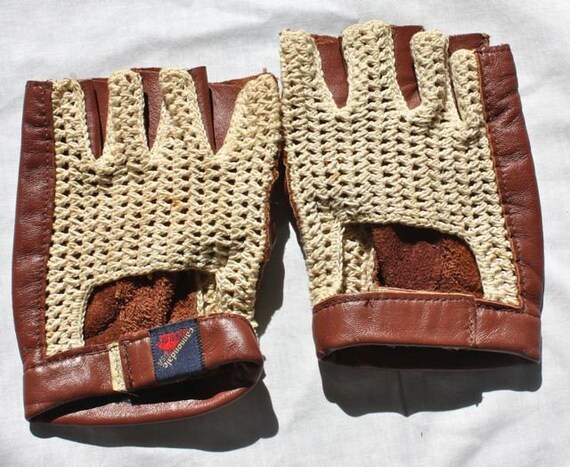
But my favorite Cannondale product of all time (Remember, I owned and rode two of their bicycles) was the glove they made--by hand, in Pennsylvania--during the 1980's.  I don't think I've come across another sport glove--or, for that matter, any glove--made from such high-quality materials and with such good workmanship.  It was like a Brooks saddle:  stiff at first, but once broken in, a perfect fit that would last for many years.  I wore mine until the crochet backings deteriorated--a long, long time after I first started wearing the gloves.


The best glove ever made--by far!


I wish I could find a pair of them--or something as good--now.  Back then, a pair of those gloves retailed for $25-30, which, it seems,  is what a "good" pair of gloves costs now. 

 I'm guessing that Cannondale couldn't continue to make them in Pennsylvania--or anywhere in the US--without raising the price significantly.  So production of those gloves was sent overseas.  Later, that of their bike apparel and accessories and, finally, their bikes followed.  Around the time Cannondale introduced their bicycles, they stopped making and selling backpacks, parkas and other non-bike-related gear.


(If you want to learn more about what Cannondale was doing before they started building bikes, check out this site.)

20 April 2015

Suspension Of DIsbelief

About fifteen years ago, I saw a classic Cinelli track bike with a floral basket attached to the handlebars.  I'd never seen such an arrangement before, and I complemented its rider, a young woman with hair in hues that weren't offered even in DuPont Imron.  She grinned, as if I'd gotten some sort of joke.

Now I see all like manner of baskets--including porteur-styled ones--as well as racks and bags on fixed gear bikes.  Granted, those bikes aren't classic Cinellis or classic anything else.  But they are fixed-gear bikes nonetheless, even if they'll never get near a velodrome.  So it's still a little odd, at least for me, to see them so rigged up.

This one, though, takes the genre of the fixed-gear city transporter to new heights:


Or, more precisely, it takes rear baskets to new heights, literally.  Perhaps it redefines "suspension" on a bicycle.


19 April 2015

Same Ride, Different Day--By Choice


Have you ever done the same ride two days in a row?


Back in my racing days, I sometimes did.  Ditto for the early part of my post-racing life, when I was still pretty young and training for…what, I didn’t know.  But, most of the time, I managed to find a different route every day for the hour or two or three I’d ride before or after work.


It’s rare, though, that I’ll follow the same itinerary two days in a row when I’m riding simply for pleasure.  Today was one of those unusual occasions:  I rode to Point Lookout again.


The sun shone as brightly as it did yesterday.  However, the wind blew harder and the temperature barely made it to 15C (60F) in my neighborhood, in contrast to yesterday’s 27C (80F).  That meant that though the temperature dropped considerably as I rode over the Cross Bay Bridge to the Rockaways, the contrast wasn’t as extreme as it was yesterday.


In addition to being stiffer, the wind blew almost directly from the south-south-east.  Yesterday, it came more directly from the southeast.  So, while I had headwinds, then sidewinds followed by more headwinds on yesterday’s ride, I pedaled into headwinds all the way from my apartment to Point Lookout.  On the other hand, I had a nearly perfect tailwind all the way home.  


One other difference: I rode Arielle, my Mercian Audax, for the first time this year.  I don’t know whether it was because I was so happy to ride her again, but the ride felt even smoother than I recall from earlier seasons.  Best of all, my ride out was faster than I thought it would be and I felt as if I were flying home.


Plus, if I do say so myself, she’s never been prettier.  Arielle always gets compliments; they seemed more common today.  Interestingly, of all of my bikes, it seems that Arielle and Vera (my green Miss Mercian mixte) get the most compliments for their looks.


Another reason why I was happy to be riding Arielle is that the gears sure came in handy when I was pedaling into that wind.  On my way home, I never shifted to anything larger than my third-smallest rear cog (on a nine-speed cassette) and I stayed in my large chainring throughout the ride.

So…I did 100K rides on consecutive days.  I guess that’s not bad considering how little riding I during the past winter, which seemed to end only when I went to Florida the week before last.

18 April 2015

Bryter: Ryde Now, Not Layter (Apologies to Nick Drake)


Some things felt right again after I rode to St. Augustine and Daytona Beach from my parents’ house.  The cobwebs fell off, so to speak, after days without riding and sunlight.

Today was even better:  I did my first long (100K plus) ride on my home turf, if you will.  And I did it on Tosca, my fixed gear bike, no less.  Because she’s so responsive, about the only thing that hindered me was the wind.  But at least I had it with me on most of my way back after pedaling into it on my way out.


It was all but impossible for me not to ride today.  Not that I would have tried not to:  The sky was brighter than it’s been in a long, long time up this way.  Now, some days this winter were clearer—or, at least, some things could be seen more clearly, including the sorts of reflections and images that come to some of us from within.  


If you live in a place where winters are long and full of short days, you might know what I mean.  Some things are never more striking—or, at least, stark—than they are against an alabaster landscape, bare branches and an ashen sky.  It’s sort of like a photographic negative of a chiaroscuro painting.  


But today was all light and color.  I might be the “extroverted introvert” that someone called me, but even at my most introspective, I can stand a dark night (Is there any other kind?) of the soul for only so long.  


Even against the blue, sunny skies, and among the budding flowers and trees, there are still signs of the old season.


And there are signs of other seasons further past:  to be more precise, the one of Superstorm Sandy.  Dunes are being fortified along the Rockaway shore; there’s even been talk about building a sea wall.  I wonder if this is the scaffolding for it.


If it is, it’s certainly wasn’t necessary today.   The tide was out everywhere I rode all the way to Point Lookout.


Also, although the air temperature reached 27C (80F) in my neighborhood, it was—or at least felt—about 10C cooler along the shoreline.  That’s because the ocean temperature is still only about 7C (45F).  It will warm up fairly rapidly during the next two months.  But for now, I think there’s more danger of freezing than drowning from that water.


Tomorrow—or, perhaps, later tonight—I will see the effects of the sun and wind on my skin.  One good thing about having ridden in Florida the week before last is that, as a result, I remembered to use sunscreen today.  Often, I forget it on my first warm-day ride and feel the burning and fatigue the following day, if not that night.
But all in all, this ride lifted my spirits.  That’s all I ever wanted, really.