17 March 2016

St. Patrick's Day. What Do You Wear? What Do You Ride? What Do You Drink?

This has been one of the warmest winters on record.  (It seems that we've been hearing that every other year for the past twenty or so!)  So, not surprisingly, we're having a warm St. Patrick's Day.  The last time I checked, the temperature had risen to 13C (65F) and was predicted to go higher. 

There is a "possibility" of rain, according to the forecast.  Still, I think I'm going for a ride, however brief, after work.

What does one wear on a St. Patrick's Day ride?  This, perhaps?:


You can get that jersey from AeroTech Designs.   Maybe you'll wear it on next year's St. Patrick's Day ride, along with this cap:


Then again, if you're like me, you don't buy cycling-specific clothing.  Maybe you'll get decked out like one of these folks:


Since the weather is warm (at least in this part of the world), perhaps something like this is in order:


From Eleanor's


or if you are in one of those places where this day's weather reminds you that Spring hasn't officially arrived yet, you might think of this:


From Eleanor's


or this:


From LJ World


Maybe you like to ride in tweed, or something that looks like it:


From Meetzorp


Then there is the question of what to ride.  This certainly is lovely:
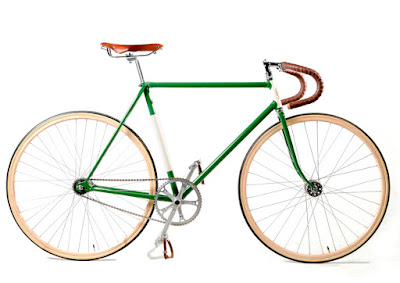

 
Freddie Grubb track bike.  Photos from Megadeluxe
 

and, really, no less practical than this:

1953 Schwinn Debutante.  Photo from Meetzorp


As for me, I'll probably do my St. Patrick's Day ride on this:


All right. So the bike is English.  So are most of the bikes that have ever been ridden in Ireland.  So, for that matter was St. Paddy himself.

And how many of you are drinking Bass ale* today?

*=I'm not referring to Budweiser beer sold under the Bass name.

16 March 2016

Do You Fix It, Or Keep On Riding?

If you've commuted by bike for any amount of time, you've no doubt had at least one flat.

It's one thing for your tire to get punctured and go flat immediately.  Then all you can do is to fix it and, if you're running late, call into the office (or wherever you work). Or, if you're in a place that has mass transit, you can use that.

On the other hand, a gradual leak presents another situation.  How far do you have to go to get to work?  How much time do you have?  You have to answer those questions in deciding whether to fix your flat or to continue riding.

This morning, about halfway to work, I noticed that my steering was a bit balkier.  Then, when I hit a bump, I noticed that the tire was soft, though not completely flat.  At that point, I was on Randall's Island--no subway nearby, and the one bus line that goes through the island doesn't allow bikes on board. 

From Tales and Fables
 

So, my choices were:

  • Fix the flat.
  • Lock the bike up and take the bus to the subway.
  • Keep on riding with crossed fingers.

I had ridden about twenty minutes and would need about another fifteen to get to work. My first class would start in about forty-five minutes.  I probably could have fixed the flat, but I really didn't want to be pressed for time.  If I were to lock the bike on the island, it would probably be bit safer there than in most other parts of the city.  But getting back could be a hassle.  And, really, I didn't know how much longer I could ride on my deflating front tire.

Still, I chose the last option.  Even though I could feel, with every turn, the bike losing whatever handling abilities it had, I figured that I had a chance of getting to work before my inner tube completely lost air.  Also, I reckoned that if I couldn't make it the rest of the way to work, I'd at least be able to cross the bridge into the Bronx, where I could catch the subway (which I'd have to take for only two stops).

I managed to pedal to work.  For the last couple of blocks, my tire and tube felt like a half-melted marshmallow between my rim and the street.  But at least I still had some time to spare when I got to my job.

Now I'm about to go home--but I have to fix the flat first.  Oh well. 

When you realize you are riding on a slow leak, how do you decide whether to fix it, keep on riding or bail out?

15 March 2016

The Journey--And Destination--Of My Rides

When I first became a dedicated cyclist--during the '70's Bike Boom--a lot of new adult cyclists were folks who were, had been or did not want to stop being hippies.  In retrospect, it makes perfect sense:  cyclists of the previous generation, who kept the flame lit during the Dark Ages following World War II, were countercultural in their own way.  

During the '50's, much of the American landscape and culture were being carved up to better accommodate the automobile.  Developing an economy and society ever-more dependent on the internal combustion engine was seen as a sign of progress, much as many immigrants and their children saw acquiring an automobile as a sign of economic progress away from bicycling, walking or taking public transportation to work out of necessity.

Continuing to ride a bike--let alone taking up cycling as an adult--was almost a revolutionary act under such conditions.  That, I believe, is the reason why the hippies who rode bikes in the days and years after Woodstock are logical descendants of those who rode in the Dark Ages.    Ironically, it is also the reason, I think, why the new cyclists of the Bike Boom actually had very little truck with those who kept the fire burning during the decade or two before them:  by the '70's, adults on bikes who could afford to travel by other means were becoming a more common sight.  So, riding a bike--especially for a hippie--wasn't such an act of rebellion anymore. If anything, it was one of the more socially acceptable things a guy with long hair and wearing torn jeans could do.

Still, for many, riding a bike--especially taking bike tours or camping trips--was seen as a way of "getting away" or simply not joining the ranks of those who made payments on cars and houses.  On the other hand, those earlier cyclists, who were bucking cultural and economic trends to an even greater degree than Bike Boom riders were, didn't seem to ride out of any sense of rebellion.  Most of them had regular jobs or owned businesses; most were also not adverse to the acquisition of property and wealth.

I have long valued older, more experienced cyclists for their wisdom as well as their insights, and even for their sense of humor.  And, let's face it, they show us that we (most of us, anyway) have to get jobs or negotiate the capitalist system in some way or another, and then find time and ways to ride our bikes in the midst of the chaos.  But I realize, as I get older, that it's really the hippie in me that keeps me cycling:  I ride in order to be free (at least for as long as possible) and that I need my freedom in order to ride.  

So, if you've gotten this far, you might be wondering what prompted this rumination.  Well, I stumbled across a blog by someone who "some would describe... as the old hippy who doesn't know the war is over".    Fred Bailey, the "old hippy" in question, lives aboard the Seafire, a boat he is refitting for voyages far and wide.

Actually, I didn't stumble across the blog itself.  Rather, I found, by chance, a photograph included in Fred's latest post.  In that post, he talks about his annual "pilgrimage" to the Fisher Poet's Gathering in Astoria(!), Oregon.   It sounds like a wonderful event:  Maybe the next gathering will give me reason to visit an Astoria that, I am sure, is different from the one in which I live.  

He took the photograph--of "the most westerly bike rack in the USA"--during that trip:


Photo by Fred Bailey, from Seafireblog.


I don't think anyone could create a better visualization of my cycling spirit, if you will.  The colors, the sights and the overall mood are my destination, whatever my cycling journey happens to be.

14 March 2016

One Way Of Entering The Bronx

As I mentioned in a previous post, a bicycle/pedestrian connection between Randall's Island and the Bronx has opened.  It's actually very good:  It's well-constructed and makes a smooth transition to the pathways on the island.  Also, it's wide and closed off to motorized traffic, though there is a rail crossing--albeit one that doesn't seem to be used very often.  My only real complaint about it is that it's that most people would have a difficult time finding it from the Bronx side.

Still, I sometimes choose to ride up the walkway on the Bronx spur of the RFK Memorial/Triborough Bridge.  One reason is that it has a fairly steep incline, which adds a small challenge to my daily commute.  Also, while the new connector makes for an easy entrance into the Bronx, the old RFK walkway makes the entrance, shall we say, a bit more grand


and perhaps a bit more dramatic, even a bit Gothic, on an overcast day.   It's not exactly noir--more like gris, perhaps.  Plus,  you have to admit, there's something imposing about seeing a cross--or something that looks like a cross, anyway--as you are riding up to an arch.

Don't get me wrong:  I'm enjoying my new job, and the commute to it.  Truth be told, the part of the Bronx where I now work is more interesting than the part of Queens where I had been working.  And, oddly enough, even though I don't see a lot of people in the neighborhood riding bikes (a few of colleagues in my department and elsewhere in the college ride in), somehow I don't feel as conspicuous as I did at my old job, where practically nobody rode.  And I couldn't make the kind of entrance I make when I pedal up that ramp into the Bronx!

13 March 2016

The Racer's Edge: Dick Power

I am told very good tacos are made in this place:


I plan to return one day and find out.  

Recently I learned about something else that was made in this building, next door:


At first glance, it looks like just another storefront building on a block that gentrification hasn't yet found.   Its owners told me that sofas were once made within its walls.  However, they were unaware that something meant for a decidedly un-sedentary pursuit was also made inside its confines:


Dick Power track bike, 1963


About ten kilometers from my apartment is the hipster haven of Williamsburg, Brooklyn, where there seems to be a bike boutique (next to a bar that serves only craft beers, or course!) on every block.  I can recall a time when the area more closely resembled the environs of the taco restaurant and its neighbor:  a place full of blue-collar residents and immigrants, where few, if any, adults ride bicycles. 

 The neighborhood around Santa Fe Taco---Sunnyside, Queens--might well be on its way to becoming like Williamsburg.  Only four kilometers, in another direction, from my apartment, it was long known, along with neighboring Woodside, for the Irish bars and German saloons that served the blue-collar immigrants and first-generation Irish- and German-Americans who lived in the area.   (Both neighborhoods still have large Irish populations but also have perhaps the greatest concentration of Filipinos east of California.)  Sunnyside and Woodside did not suffer the devastation other blue-collar neighborhoods (like Williamsburg) endured, but nevertheless have experienced changes that threaten to erase some of their heritage.

A part of that heritage that is unknown to almost everyone who lives in the neighborhood involves the bikes that were made and sold in that unprepossessing building next to a Taco restaurant.  


Dick Power in front of his shop--in the building next to the taco restaurant!--in 1939.


During the "Dark Ages" of cycling--roughly the two decades or so following World War II--there existed in a few American locales, including New York City, a small but tight-knit community of racers and other adult cyclists.  Shops such as Thomas Avenia's in East Harlem and Kopp's in Princeton catered to them.  And there was a small but dedicated group of framebuilders, some of whom also owned and operated retail shops, who catered to those riders.  

Dick Power was one of them.  From his shop and frameworks at 4710 47th Avenue in Sunnyside, he turned out some beautifully-crafted frames that are prized by riders as well as collectors.  Power, who died in 1973, plied his trade and served as a coach and trainer from the 1930s through the 1960s.  However, the loss of his son--executed for his role in a robbery gone wrong that resulted in the death of a police officer--propelled him onto a mission to recruit and mentor young people into cycling.  


Among those he encouraged, and for whom he built bikes, were several female cyclists.  In the 1950s, the world of cycling, including racing, was even more of a male preserve than it is now.  Power's mentorship of those young women was seen as radical in his time.

I must say, though, that it must have been interesting, to say the least, for a young woman to be coached by a man with a name like "Dick Power".  Than again, those times were more innocent, I imagine!