20 July 2018

To The Temple Of Women

Nobody here should be impressed with me. (Actually, I don't think anybody should be impressed with me.)  But the people I've talked to all seem to look up to me, and not because I'm taller than they are.  

Sometimes it's because I'm a professor (university lecturer, actually), as educators and, more important, education are revered here because so many can't get it, or get enough.  A couple of people were in awe when I did something a lady isn't supposed to do:  reveal my age.  One woman--about whom I'll say more later--said her mother is ten years younger and "looks older."  Days spent in hard, repetitive tasks in the sun, heat and humidity will do that to you. And then there are those who think I'm other-worldly because I live in New York City.


Sokhana (sp?), who works at Green Park Village, the hotel where I'm staying, was simply astounded that I rode a bike about 85 kilometers.  She simply had to tell her co-workers, the manager and everyone about it.  If you've been reading this blog, you know that I've done much longer rides than that.  If anything, if they want to admire me, it should be for going that distance (about 53 miles) on the bike I borrowed from the hotel.  Yes, that one. And, perhaps, that someone from a temperate climate pedaled through the heat, humidity and rain (late in the afternoon).


I could have taken the tuk-tuk.  I'm sure the driver would have known how to get to the Banteay Srei temple.  But I simply felt like riding.


The town and district are named for Banteay Srei, hence the name of the Butterfly Centre I mentioned in yesterday's post.  My ride took me into the countryside, much like the PURE bicycle tour I took.  A curious visitor ambled up to the side of the road:


Just meters away, a farmer waded through a rice paddy, barefoot.  His manner of growing the grain, and the ways in which he tended the cow (if indeed the cow was his) probably don't differ much from those of farmers at the time the Banteay Srei temple was built, in the 10th Century CE.


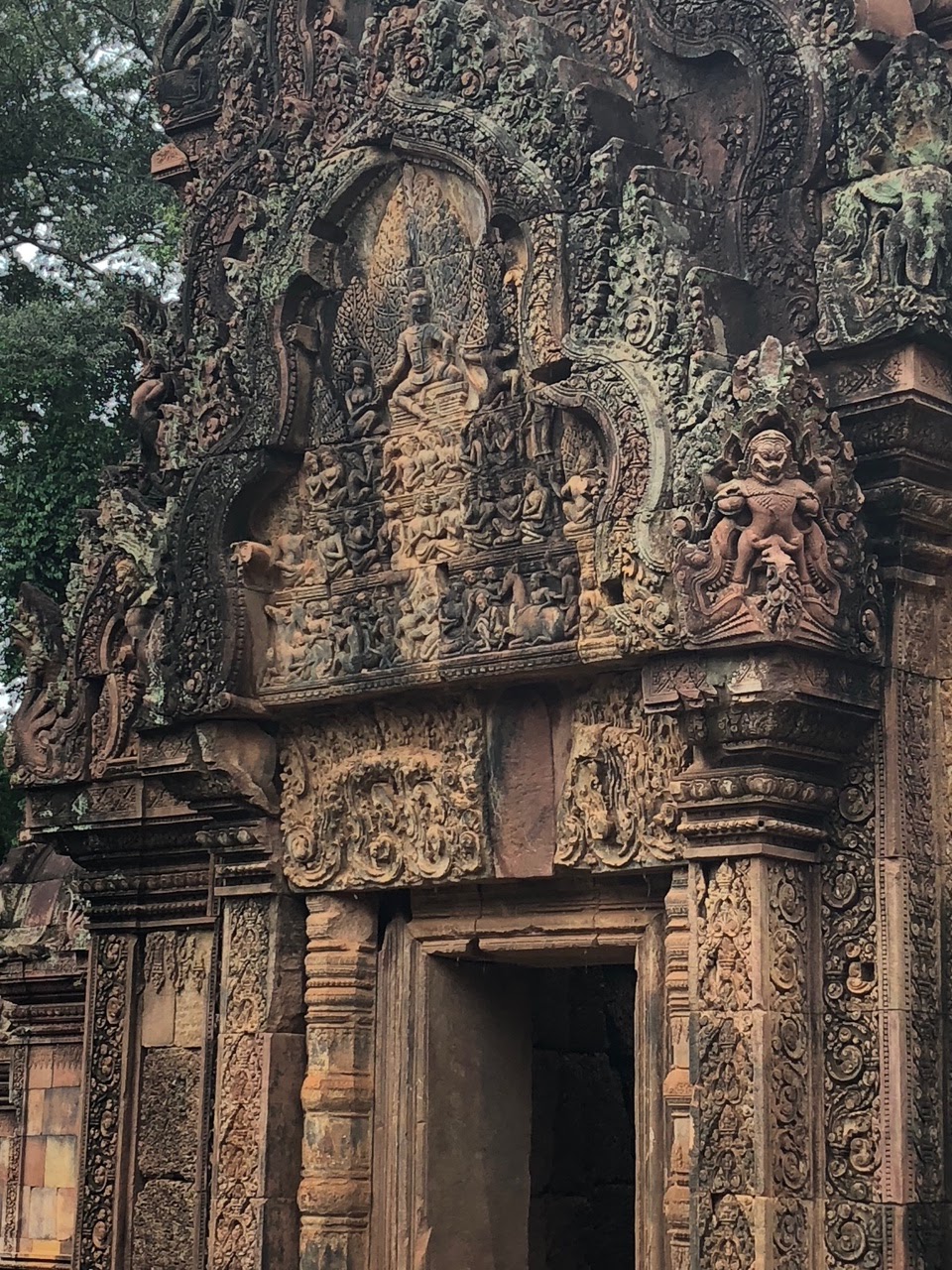
The temple is known as the "Citadel of Women."  There are indeed many carvings of female figures, but they are mainly divine nymphs or celestial dancing girls knows as aspara or minor female deities, shown standing and called devata. 


The real reason why it's known as "The Citadel of Women," though, would not pass today's standards of political correctness:  It's because of the temple's small size, at least compared to Angkor Wat or Bayon, and the intricacy of its carvings, which have survived remarkably well.  

That detail was possible, in part, because most of the temple was built from red sandstone, which lends itself to such work and at times looks like wood. So, although it is relatively small, the reddish color and those details, visible from a pretty fair distance, give Banteay Srei a striking, unique experience.  You might say that if Angkor Wat is the virtuoso and Bayon is the show-stopper, then Banteay Srei is the crowd-pleaser.

And, yes, you can enter it with a valid Angkor Wat pass. 

On my way back, I passed the Butterfly Center and stopped at the Landmine Museum, but not to look at the exhibits.  The young woman at the admission desk remembered me and allowed me in when I asked to see another young woman who works in the gift shop.  An Youn and I had a very friendly talk when I first visited, and she really liked the pendant I was wearing.  This time, I gave it to her.  Rarely has anyone been so happy for such a small favor from me.

Of course, I didn't tell her the real reason I gave it to her:  I was trying to lighten up the load for the rest of my ride back to the hotel! ;-)


19 July 2018

A Rainy Day Of Contrasts

The rain started some time before I woke up. I think the young woman at the hotel's front desk knew it would rain throughout the day, and called a tuk-tuk driver for me.

That was a really good call.  The rain came and went until about two this afternoon.  Then it washed down in a torrent through the rest of the day and well into the evening.

I first saw Apocalypse Now on a cold, rainy day (Christmas Eve, no less) the year that it was released.  So I guess it makes sense that on a rainy day here I would go to--wait for it--the Landmine Museum.


Yes, such a thing actually exists. (I wasn't so surprised:  After all, I went to a Mushroom Museum and Mustard Museum in--where else?--France!)  But you don't have to be a military buff to appreciate it.  In fact, the aim of Aki Ra, its founder, is not to glorify war or fetishize weapons.  Rather, he wants to alert people to the fact that there are so many landmines and the harm they cause. And he has a goal of de-mining Cambodia by 2025.


U


In spite of his Japanese-sounding name, he's actually Cambodian.  He chose that name for himself after a Japanese journalist gave it to him.  Before that, he had a number of different names, not because he was trying to evade debt collectors, but because he was essentially "adopted" so many times.


Except that his "adoptors" weren't well-heeled go-gooder Western families.  Rather, as he says, he doesn't know exactly when he was born, but he believes it was in 1970.  Orphaned early, he was conscripted as a child soldier, first by the Khmer Rouge and, later, by the Vietnamese army after that country invaded.  As he recalls, he was taught how to use a rifle that was bigger than he was, and he preferred using rocket launchers because, at least, he could lie down while aiming them.

His training also included the installation of land mines.  He became such an expert with them that he was called on not only to install them, but to find them.  That also gave him the expertise to find other kinds of munitions  on the ground.

After the fighting ceased, he used his expertise to de-mine.  He's not the first to undertake such a task:  Many a Khmer peasant has dug up, or simply stumbled upon, these explosives.  To give you an idea of just how poor they are, they disassembled them to sell the scrap metal.  Some didn't live to tell about it; many others lost limbs, eyes, ears and other body parts.  I have seen a few such unfortunates in my travels here.

Sun Ra himself admits that, even with his expertise, he is very lucky to be unscathed--at least physically--from the thousands of mines and other munitions he found.  They became the basis of the collection in the museum he started, which is run by an NGO he helped to found.  Today, that organization works to detect and extract land mines, not only in Cambodia, but in the Middle East, Europe and even the Americas.  

As the museum's commentary reminds visitors, once placed, landmines can cause damage indefinitely.  In 1965, an explosion in Alabama resulted from mines placed a century earlier, during the US Civil War.  And, less than a year ago, 70,000 people were evacuated in Frankfurt, Germany when a British bomb from World War II was found.

The NGO Aki Ra helped to start is staffed entirely by Cambodians and, it says, pays "liveable wages".  It also runs a school adjacent to the museum, but not accessible to visitors.  Many Cambodian kids never attend school for a variety of reasons--mainly, because their families need their help on the farms or other enterprises, or because they can't afford the fees.  The stories of some of those students are posted in one of the museum's exhibits.

So, on a rainy day, what did I do after spending a couple of hours among munitions from the US, China, the USSR and other countries, as well as art and other works related to them?  I went to another museum--a preserve, actually, about two kilometers down the road.

So what was preserved there?  Not dragonfruits or lychee nuts or pineapples.  The things "preserved" there were living and not meant to be consumed, at least not on the grounds of the preserve. I'm sure, though, that someone has eaten them:  They sound tasty, at least in the English word for them.


I'm talking about butterflies.  More species have been identified in Cambodia, and in Southeast Asia, than in any other part of the world.  But, even though this area isn't as developed as the US, Europe or Japan, some of those species are, if not endangered, then declining in numbers.  As the exhibit reminds visitors, butterflies are a good "barometer" of ecological health:  Where they can't live and thrive, there are other problems.  I couldn't help but to think about how, last year, I didn't see the flocks of migrating Monarchs I had seen in earlier years on Point Lookout, Long Island.


Like the Landmine Museum, the Banteay Srey Butterfly Centre is run by an NGO that employs Cambodians, from farmers who collect butterfly eggs to the tourguides and the folks who raise the butterflies through all of their stages of life.  Some of the butterflies--which, of course, I'd never seen before coming here--look more like other kinds of insects, or even birds or bats, than what we normally think of as butterflies.  Others look like the ones most of us in the developed world have seen, only in different colors and patterns.


Admission is five dollars (two for kids).  For another four dollars, you can have lunch in the center's cafe.  I had something a staff member recommended:  a Khmer curry with chicken, pumpkin and other vegetables.  Frankly, I would have gladly eaten it no matter where it was offered, and at a higher price!


I can't help but to wonder whether there's some "product placement" going on here:  a butterfly center with a sumptuous lunch just down the road from a landmine museum.  It's sort of like watching Breaking Away after you've seen Apocalypse Now.

18 July 2018

Waves Rise, Empires Fall, Temples Remain

Some do it because they must; others do it because they can.  Sometimes it's easy to tell who fits into each category.  Other times, not so much.

I'm thinking now about the folks who live on Tonle Sap, often called Cambodia's "Great Lake".  Like the Great Lakes of North America, it has its own climates and ecosystems.  It also has its own distinct human communities which, for all I know, Ontario, Erie, Huron, Superior and Michigan may also have.  


I took a tuk-tuk to the shore of Tonle Sac, about an hour from my hotel.  The ride took us from an industrial area on the edge of town into expanses of rice paddies and forests.  At times, the pavement on Highway 6 gave way to dirt, which turned to mud when it began to rain.


The road also narrowed, which meant that my tuk-tuk driver had to follow the unwritten, unspoken rule of the road in this country:  You move over for anything that's bigger than what you're driving (or pedaling).  That, at times, meant swerves through potholes of some liquid about the same color as an iced blonde macchiato at Starbuck's.


(Why am I mentioning the Evil Empire of coffee when writing about Cambodia?)


Oh, and all manner of living things cross the road--including oxen and cattle.  One of them might've impaled me on his horns had my driver's reflexes been any slower. 


But he got me to the shore.  I didn't uncross my fingers, though: It seemed that we'd been riding in and out of downpours.  


That tuk-tuk ride was a harbinger of things to come. Or maybe I hadn't "seen nothin' yet".  For all I knew, Tonle Sac might be like an inland sea, with all of its caprices in currents, tides and the like.  


Turns out, I knew more than I realized.  The boat I took could've been built by a Khmer farmer a century or two before any Europeans showed up.  The only difference was that it had an engine.  


The driver of the boat took us through a community of floating houses, which includes the school he attends.  He is 16, he told me, and had been driving the boats since he was 13.  He enjoys it, he said, but he wants to continue his schooling to so he can "help out" his family.


Would "helping them out" mean getting them out of that floating community--or simply finding a way to live better in it?  


One thing I must say for him is this: He isn't stupid.  I asked him to take us out into the open lake, where no land was visible.  There, choppy waves turned into walls of tide that bounced us like a beach ball off the nose of a circus seal.  He told me he could continue if I wanted to, but I could tell that he would have preferred not to.  And I didn't blame him, so we didn't.


But I did get to see fisherman unfurling, fixing and casting their nets; women cooking and cleaning. (On most of those houses, at least two sides are open.


Out in the open lake, all four sides are open--to the wind and storms as well as the decisions made by young captains and their passengers! 


Once back on shore, my tuk-tuk driver suggested two temples about a third of the way back to Siem Reap: Bakong and Preah Ko.  


Bakong, one of the oldest temples, has been called the "Khmer Pyramid" due to its shape.  It also has, perhaps, the steepest stairs to climb.  Like Angkor Wat, it was originally built as a Hindu shrine; other temples constructed for Buddhists tend not to have such steep stairs.  My theory is that Buddism stresses the importance of learning and--in some branches, anyway--an ordinary person is capable of becoming a Buddha, or enlightened one.  Hinduism, as I understand it, is like other theistic religions in that it says people have a long, steep climb to reach the Gods.


Preah Ko was built a bit later than Bakong, but is still one of the oldest Khmer temples.  King Indravarman built it late in the 9th Century CE to honor members of the king's family, whom it relates to the Hindu god Shiva.  Interestingly, it was built from bricks on a sandstone base, in contrast to later temples made from sandstone and lava.


(Note:  Both of these temples are accessible with an Angkor Wat pass.)

Temples And Bikes

Another temple, another bike.

No, I didn't buy another bike--or a temple. (If I could afford to buy a temple, I probably wouldn't have flown economy class!)  I did, however, managed to ride third different bike in as many days.  After mounting the machines provided by the organizers of the rides I took the previous two days, I did some exploring on this machine.


Here in Siem Reap, as in much of Cambodia, hotels and guest houses have bikes for their guests to use.  They are the sorts of bikes ridden by people who live here:  heavy and completely utilitarian.  Then again, most places charge only a dollar or two a day.  The hotel in which I'm staying provided the one in the photo for free.


You can tell this bike was not maintained in any systematic way.  Fragments of brackets for parts and accessories long gone are still clamped to the bike in various places. Did the bracket on the front hold a basket?  A light?  And the old shifter pod on the handlebar:  Was it for a three-speed?


The hotel desk manager actually knew enough to fill the tires before letting me ride it.  He even helped me to adjust the saddle. And the chain was surprisingly well-oiled.  But, as I found out when I dodged a tuk-tuk, a dog and a motorbike at the same time, about a kilometer from the hotel, the brakes weren't.


Fortunately, I found a hardware stall in a market strip.  The gentleman tried three different wrenches, all brand-new, before finding the 10mm open- and box-end wrench that fit the front brake's cable fixing bolt.  When I asked his price, he waved his hand.  So, I insisted on buying the wrench.  His price?  2000 rials, or 50 cents.  For good measure, I noticed he had a cooler full of cold beverages for sale.  I took a small can of lychee nut juice, which made for a grand total of one dollar.


(Most day-to-day transactions in Cambodia are done in dollars.  Rials are used only for amounts less than a dollar.  So, for example, if you buy something for $7.50 and pay with a $10 bill, you will probably get two dollars and two thousand rials in paper notes for your change.  Coins seem not to be in circulation in either currency.)


After adjusting the front--a simple side pull--I went for the rear and found what appeared to be a kind of disc brake in which the pad rubs the outer rim of the disc rather than the sides.  I didn't need the wrench to adjust it: I simply turned the cable barrel.


Then I was on my way.  First up:  the Ta Prohm temple.  I had already visited it with Vichea and Stuart, but it was along the route I happened to ride.  I certainly didn't mind seeing it again and, because I have a seven-day pass, I didn't have to worry about paying to get in.


Note:  The admission prices for what is known collectively as the "Angkor Wat complex" seems high:  $25 for one day, $54 for three and $72 for seven.  But those passes allow admission to the Angkor Thom temples (which include Ta Prohm) as well as others nearby.  Also, the seven-day pass is for seven days of visits, and can be spaced out over a month.  I figured that if I spent three days in any of the temples--which I have--I will have gotten my money's worth.


Anyway, there was no sign of Lara Croft, so the temple had to make do with me.  All of the temples are interesting in their own ways, but this one has what might be the most maze-like internal structure.  And, of course there are those trees that twine themselves around and under walls and other structures.  While all of the temples had things growing on them and creatures (and, probably, people) living in them when the Europeans found them, they didn't look like Ta Prohm.  Even there, some of the trees were cut away.  The ones that remain couldn't be cut or removed without damaging or destroying the structure.  A debate lingers as to whether the trees should be removed if a way can be found to extricate them without sending the walls tumbling down.


From Ta Prohm, I rode along varying combinations of pavement, dirt, ruts and rocks to Banetay Kdei.  Whatever its architecture or other attributes, it makes sense as a Buddhist temple for its peace and quiet alone.  It lacked the crowds of Angkor Wat and Angkor Thom.  It's so quiet, in fact, that you can hear the chirps, caw-caws, moans and other sounds of the surrounding jungle!


It was built in the late 12th and 13th Centuries CE  by Khmer King Jayavarman VII, who also built Angkor Thom and completed Angkor Wat.   So, not surprisingly, some features of Banetay Kdei, including the gopuras, or face towers at the gate, echo those of Angkor Thom.  Some go as far as to say that Banetay Kdei is a sort of Angkor Thom in miniature.


From there, I got some guidance for the rest of my ride--and day.


Somehow they managed to steer me back to Angkor Wat.  I didn't mind:  I mean, it really is one of those places worth returning to, crowds be damned.  Also, seeing it again helped me further appreciate the other temples I'd seen, which in turn helped me to further appreciate the Angkor Wat.

As for the creatures:  They're not as nice as they are cute.  (I've dated a few people like that.)  A few hang around Angkor Wat.  As I was leaving, one jumped on a tourist.  One of her traveling companions swatted at it, but it finally let go when another companion tossed a pineapple chunk onto the ground.  Good thing that monkey was hungry! 


17 July 2018

You Weren't Expecting Angelina Jolie, Now, Were You?

In The Love Song of J.Alfred Prufrock, T.S. Eliot's eponymous speaker laments, "I have measured out my life with coffee spoons."

Most of us, I believe, have measured out something or another in our lives in ways that have nothing to do with the metric or Imperial systems.  Me, I've gone on bike rides that I didn't measure in miles, kilometers, minutes, hours, days, pedal strokes or calories.  


As for the latter, I have followed the example of an old riding buddy and measured out my rides in bananas, water bottle refills, "gorp" or trail mix packets, dark chocolate squares, pizza slices or other foods consumed during the ride--or what was consumed afterward. 


I have also measured rides in the number of climbs or amount of climbing, temperature changes or the number of chateaux I visited. 


You know which country I was touring when I was counting chateaux.  Although the country where I've ridden the last few days was a French colony for a bit less than a century, that method wouldn't work very well. But there is a parallel method of measuring a ride in the vicinity of Siam Reap, Cambodia, where I am now.  


To wit:  I have been able to gauge my rides, more or less, by the temple ruins I've visited en route.  Only one of my rides so far have included none at all, though that one--the PURE countryside tour--took me to a currently-operating temple and monastery.  My other two rides both included the "big one": Angkor Wat.


As I mentioned in yesterday's post, my ride with Grasshopper Adventure Day Tours began with sunrise at Angkor Wat. (Interesting fact:  Angkor Wat is really a nickname. It means "city of temples".  Its original name, in Sanskrit, was Parama Visnuloka.)  Stuart and I, led by Vichea, rode a series of trails that Vichea knows about because he rides and races in this area.  Those trails took us to other temples that have at least some relation to Angkor Wat.  


They were actually part of a complex called Angkor Thom.  If Angkor Wat is the "Temple City", then Angkor Thom is the "Big City"--literally.  It's Angkor Wat on steroids--and at least one other mind-altering drug (at least according to my amateur knowledge of psychopharmacology).  It covers 9 square kilometers, or 3.5 square miles: roughly the size of Manhattan below 14th Street. 


Since it was designed as a city, it has  ports, if you will:  gates leading to  bridges lined with carved images.  All of those bridges and gates have more or  less the same architecture and carvings, which depict the deities involved in the Hindu creation myth.  


Once inside the gates and cross one of the bridges--we came in through the North side--possibly the most striking monument is Bayon, which is full of ecstatic depictions of Hindu deities.  The style of the place is often described as "baroque", in contrast to the "classical" Angkor Wat.  The latter has a symmetry that Bayon lacks, but it's hard to imagine Bayon built, or its carvings rendered, in a more restrained way.


Then there is a temple you might have seen even if you've never gone anywhere near Angkor Wat.  At least, you might have seen it on a screen much bigger than the one you're using to read this post.  Now, though, you get to see it with me in it.  Who needs Angelina Jolie, right?


I'm talking about Ta Prohm, more commonly known as the "Tomb Raider" temple.  Aside from its intricate structure, it's known for the trees whose roots ravel themselves around and under various walls and other parts of the temple.  Next to one of those trees, Jolie's Lara Croft character picks a jasmine flower and tumbles through the earth into....Pinewood Studios.  Hmm...I don't recall seeing that in Dante's Inferno.


I saw other temple ruins with Vachea and Stuart.  But Angkor Wat, Bayon and Ta Prohm were enough to make the ride a monumental one, however many kilometers we pedaled, tree roots we rumbled across and mud we flung from our tires.  Oh, and just as nature re-conquered the Ta Prohm site once dominated by Khmer kings, at least one creature showed us who really has the run of this country, however slick we were at riding the trails and roads!


Give me a home where the (water) buffalo roam!