08 February 2019

20 Million Hacks

Mumbai has two and a half times as many people as my hometown of New York.  Its population is also about half that of Canada, and a third of the UK or France.


It's been said that there are 8 million stories--the same as the number of people--in the Five Boroughs.  Well, one might say that there are 20 million ways of using a bicycle--one for every resident--in the City of Seven Islands.


At least, that was the impression I got from yesterday's post on HackadayIn the Gateway to India, it seems that bicycles are used, not only for transporting one's self, but also for moving other people, cargo that seems better suited for ship containers, hay, livestock and even gas cylinders--12 to 16 at a time!-- that weigh 15 kilos empty and 30 when full. 


I don't know which would scare me more:  the potentially-explosive cargo, or that those bikes, with 300-kilo loads, have the same brakes found on typical roadsters.  Come to think of it, I shudder thinking about maneuvering such rigs through winding, narrow, crowded streets that make Broadway in lower Manhattan seem like a Dutch bike lane.

07 February 2019

They Aren't Blamed. So Why Are We?

In each of the past five years, more Americans have died from opioid drug overdoses than from car crashes or gun violence.

One reason for this, of course, is improvements in automotive safety.  Another is the campaigns to reduce gun violence, which have succeeded in a number of cities.

But no one would suggest that we should celebrate those developments when people are dying because they were prescribed drugs that they, and possibly their doctors, didn't realize were so addictive.  If anything, people from medical experts to the loved ones of those who've died will say that everything from the pharmaceutical and insurance companies' roles in creating and fueling the epidemic of addiction, to the ways in which the drugs act in the body, needs to be investigated.

And one rarely, if ever, hears anyone blaming the overdose victims themselves for dying in greater numbers than people involved in car crashes or shootings.  Thankfully, most Americans now understand that addiction is a health problem, not a moral failing, and that addicts need help in overcoming the ways in which the drugs overtook their bodies and minds rather than condemnation for "letting themselves" become addicted.

Would that such understanding were extended to cyclists and pedestrians.


In 2017, 27 cyclists and pedestrians were killed in San Jose, California.  An equal number of people were homicide victims.  

As in other large urban areas, the homicide rate in the San Francisco Bay Area, which includes San Jose, has been falling for a number of years.  I don't think anyone is unhappy about that, and don't believe they should be.  It shouldn't, however, be used to trivialize the number of cyclists and pedestrians who are killed.  While not many people are doing that, they are engaging in a kind of victim-blaming they would never direct at someone who dies from an overdose.  Such people believe that cyclists and pedestrians are "over-entitled" for having the right of way, or for having lanes dedicated to them.  

I won't deny that there are careless pedestrians and cyclists.  I would submit, however, that there are far more motorists who are reading or sending text messages, talking on their cell phones, or doing any number of other things that distract them from their surroundings. But it's odd that they are seldom blamed when they crash into other vehicles, let alone pedestrians or cyclists.

So, yes, we should be happy that fewer people are being shot, stabbed or beaten to death.  But we mustn't lose sight of the fact that increasing numbers of people are meeting premature demises while walking or pedaling to school or work, or for exercise.  In other words, a cyclist or pedestrian who is run down by a motorist is as likely as not to be an experienced, responsible cyclist or pedestrian who follows the rules of the road and takes all of the necessary precautions.

Opioid addicts, homicide victims and other people who die from causes not of their making are not blamed for their own deaths.  Why should it be any different for cyclists and pedestrians?


06 February 2019

She Wants Girls To Have Fun

It's hard for us to believe, perhaps, that in the early days of cycling, a woman astride two wheels was seen as provocative or even transgressive almost everywhere.

These days, it's hard to picture any major European city, and even a few American cities, without women pedaling to work, to school, or even for fun--sometimes alone, other times in the company of friends and, often, with a baby or toddler in a rear seat or trailer.


In much of the world, however, the situation for women and bicycles isn't much different from how it was in the western world in the 19th Century.  If anything, in some places, the sight of a woman on a bike can incite outrage, revulsion or even violence.


Pakistan is one of those places.  It's one of the more conservative Muslim countries, where women aren't even welcome to sit at tea stalls, congregate in parks or ride a bike for fun.  In fact, a woman in a public space without a purpose--like going to the market or school--is viewed as a threat to public morality.  It's uncommon even to see a woman riding a bike for a purpose, as straddling a seat is seen as a vulgar and sexlike act.


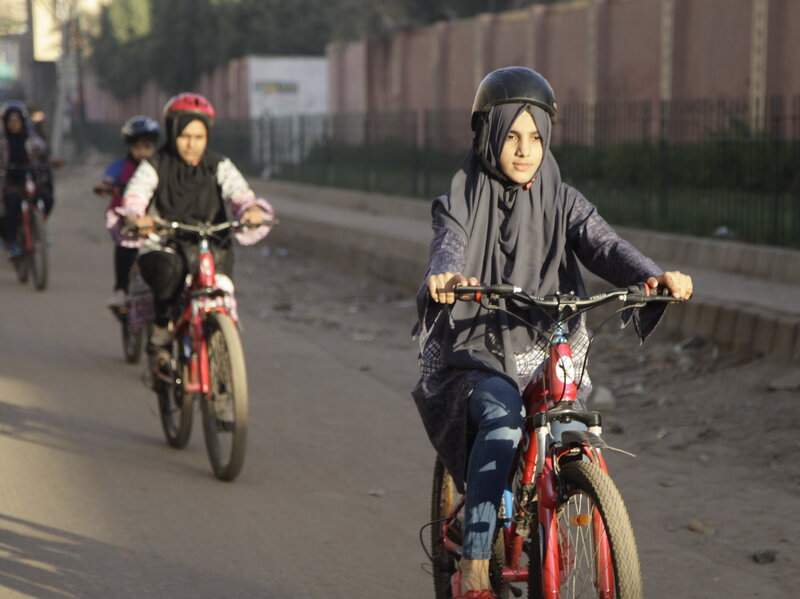
One woman who dares to challenge this social taboo is Zulekha Dawood.  The 26-year-old activities organizer at a community center organizes and leads rides through the streets and alleys of Karachi.  A year ago, when the weekly rides began, only a few young women participate; now as many as 30 women and girls join Dawood.


Zulekha Dawood leading a ride in Karachi.


What makes her efforts all the more remarkable is the part of the city in which the center is located, and where most of the rides go.  It's not a leafy enclave of professionals who were educated in London or New York or Toronto; rather, it's Lyari, a gritty working-class area in the southern part of Karachi.  


This illustrates a criticism that's been made of women's equality movements in Pakistan and elsewhere:  They're usually led by affluent or upper middle-class women, who have access to the education and networks that make it more possible for them to bring their visions into reality. On the other hand, the girls and women who participate in Dawood's rides face more opprobrium because their poorer and less-educated families tend to be more religiously and socially conservative.  


And, to be fair, many such families see marriage as the best hope for their daughters.   They believe that a woman who isn't "modest", or is simply "too independent", will make her less desirable to the "good" families of young men who could provide for her.


Although Dawood's rides are for the sake of riding, she understands that for participants--some of whom she herself has taught how to ride--riding a bicycle is mobility, pure and simple.  If a girl or a woman can ride just because she wants to, she is also more likely to ride to the school or job that will allow her to live a more independent life.  


Surely she understands something my favorite Woodhaven native sang in her best Queens English:  Girls just wanna have fun.  And her critics are upset that she and those who join her rides are doing just that.


05 February 2019

The Shadow I Saw

Last week, I wrote about the coldest cycle-commute I've pedaled in many years.  The temperature rose gradually during the week, reaching the freezing mark on Friday and the 10-15C (50-60F) yesterday and today.

We didn't get much snow during the cold spell--the squall we experienced brought more wind than anything else--but the fallen flakes stayed on the ground and froze until the thaw.

The result has been mud everywhere.


Neither Punxsutawney Phil nor Staten Island Chuck  saw his shadow.  According to legend, that means Spring will soon arrive.  But I still anticipate more cold weather before the thaw becomes permanent (at least until next winter):  After all I saw this shadow


of a bare tree.  

04 February 2019

The Morning After--A Game And A Guy Losing His Shirt

While out riding yesterday, I stopped in Recycle-a-Bicycle's Brooklyn shop.  I left a few things with them that I know I'll never use but they might need some time.  They were happy for it.

Then I told them the real reason why I stopped there:  I figured it's one place where I might find people who care less about the Super Bowl than I do.

Turns out, I was right. Two of the fellows working there didn't even know which teams were playing.  And I was so proud of myself for knowing only that the game pitted the New England Patriots--who, it seems, everyone outside of New England hates--and the Los Angeles Rams, who used to play in St. Louis and before that in Los Angeles.


Today I'm hearing about how "boring" the game was and that some guy took off his shirt during the halftime--and why it was or wasn't OK for him to do that fifteen years after Janet Jackson's "wardrobe malfunction".  Interestingly, I've heard nothing about the advertisements during halftime, which are usually among the most creative, or simply oddest, to be seen on TV.

Bicycle commuting


Me?  I didn't watch, didn't listen. And I rode to work this morning, refreshed, on my bike.  I hope not sound smug, but I thought it ironic that I was getting healthy exercise on my way to the college on the morning after a game when a few dozen guys pounded at each other's bodies for millions of spectators who ate and drank the most unhealthy things imaginable.