19 September 2021

If You're Gonna Steal...Don't Learn From These Guys

Normally, bike theft is not a laughing matter.  But I am relaying this story as a "Sunday funny" because of the thief's ineptitude.

In New Hampshire, a couple of guys cased out a bike shop.  At least, that much can be surmised as they bypassed the cheap bikes and took three with a combined retail value of $16,000.  

In the wee hours of morning, before the shop opened, the perps backed a van into the shop's front door.  They tossed two of the bikes into the back of the van and the other on the roof.

But they forgot to shut the rear door of the van.  And the bike on the roof fell off as they drove away.

Bob Beal, the shop's owner, said it took a year to get those bikes and will probably take at least another to replace them.  But, as the crooks' bungling was recorded, and the fire department later responded to a call for a burning van--which the thieves abandoned and apparently torched--I suspect the criminals will be caught sooner rather than later. 

I would imagine that Mr. Beal will be compensated for his losses.  But I am sure he and his customers would rather have those bikes.


18 September 2021

Note To North Country: Don't Repeat NYC Bike Policy Mistake

Yesterday I wrote about an example of bicycle infrastructure and policy crafted, so it seems, by non-cyclists.  The new Brooklyn Bridge bike lane seems to combine every bad decision made by this city's planners when it comes to cycling.  What's worse, or at least as bad, as the lane itself is that motorized bicycles and scooters are allowed to share it with completely human-powered bikes.


Photo by Jay Petrequin for 


Now the folks in Warren County--part of my home state's "North Country"--are contemplating that same policy mistake on a popular bike lane.  The Warren County Bikeway winds its way through the woods from the village of Lake George through the city of Glens Falls, and connects cyclists with Adirondack Park and other parts of the North Country.  The county administrators are debating whether to allow electric bikes on the lane.

Now, I am not against electric bikes in principle:  They keep people on two wheels after their bodies have been decimated by injuries, disease or simply old age.  And, they are quieter and less polluting--at least in their normal state--than the motorized bikes--which, in my opinion, are just scaled-down motorcycles-- commonly used by delivery workers. 

E-bikes differ from their motorized counterparts in several ways.  First, of course, is their power source.  But more to the point, the motor in an e-bike is not made to power the bike by itself.  Rather, it's there to augment the rider's leg juice on a hill, against the wind or simply when the rider tires out.  

Within the category of e-bikes, there are three basic types: 

Type 1 is designed to assist the rider in getting the bike to speeds up to 20 MPH.  At higher speeds, the motor cuts off until the bike slows down.

Type 2 is like Type 1, with a throttle added.  This feature can be used to cross an intersection, make a right turn or in any other situation in which quick acceleration is helpful.

Type 3 is the same as Type 2, but with the ability to reach 28 MPH.

If the bike lane is wide enough and secluded from traffic, I have no problem with Type 1, or even Type 2.  The problem is that the latter is often modified into a Type 3, and Type 3s are made to go even faster.  Also, Type 3 riders tend to ride more than they pedal. 

I think making clear distinctions about what is and isn't allowed, and enforcing such regulations, would make it safe and practical for Type 1 and even Type 2 riders to share a lane with those of us who ride completely human-powered bikes.  Such an arrangement would make particular sense on the Warren County bike lane, as many riders are vacationers who bring their bikes on RVs or trailers to Lake George or some other North Country destination.  And many of those arriving in RVs are retirees who might not otherwise cycle if there wasn't a "boost."


17 September 2021

This Bridge Should Be Seen And Not Crossed

Photo by Jake Offenhartz, for the Gothamist

 The new Brooklyn Bridge bike lane opened on Tuesday. However, I probably won’t be using it any time soon.

The old joke about compromises is that they make no-one happy.  The thing about jokes is, of course, that they convey truths.  Such is the case for the new lane.

Mayor de Blasio was opposed to any lane on the bridge.  Advocates wanted a single lane in each direction.  The new lane is two-way, on the Manhattan-bound part of the bridge.  While it is separated from traffic by concrete barriers connected with chicken wire, cyclists who’ve used it report feeling nervous about traffic so close by.

What would concern me more , though, is some of the traffic allowed in the lane: motorized bikes and scooters, including those making deliveries for Doordash and other services. Anyone who’s used the Queensborough/59th Street Bridge lane can recount all-too-close encounters with them.  Well, the new Brooklyn Bridge lane is even narrower: six feet for two-wheeled traffic in both directions.

Such claustrophobic conditions pose another hazard:  If a cyclist has a flat or other issues, there is no room to pull over, let alone fix the problem.

So, while cyclists will no longer have to dodge selfie-taking and otherwise bike-oblivious pedestrians on the wooden upper deck, I don’t see how the new lane makes cycling safer, let alone more pleasurable, on the Brooklyn Bridge.  For now, I will stick to my tried-and-true New York wisdom that the Brooklyn Bridge should be seen and not crossed!


16 September 2021

A Monument Befitting A Giant


 Yesterday I mentioned a monument to a pioneer of his sport and the struggle for civil rights.  Today I came across a story about a new monument to Robinson’s sporting and historical grandfather, if you will.

As readers of this blog—and those with even a cursory knowledge of cycling history—know, Marshall Walter “Major” Taylor was not only the first Black World Champion cyclist; he was also the first African-American champion in any sport. 

(George Dixon, the African Canadian who won the bantamweight boxing title in 1892, was the first Black champion of any sport. Interestingly, Taylor first won his title in Montréal.)

While Major Taylor is most often associated with Worcester, Massachusetts, where he lived much of his adult life, and New York, Paris and other places where he achieved his victories, he was born and raised In Indianapolis—where, I suspect, few people have been aware of him.

Until now, that is.  As part of the city’s bicentennial celebration, its Arts Council commissioned a “Bicentennial Legends” mural series. (If you’re a regular reader of this blog, you know that I love murals!) The latest is a five-story homage to Major Taylor.

His great-granddaughter Karen Brown Donovan attended the ribbon-cutting ceremony last week, along with 1984 Olympic sprint medalist Nelson Vails, pro cyclists Justin Williams and Rashaan Bahati, and mural artist Shawn Michael Warren.


15 September 2021

Jackie In The Jersey Theater

Today I took a ride into New Jersey for the first time, I think, since the pandemic began.  I know, that sounds odd, considering how often I’ve pedaled to Connecticut. But I finally got up the courage to board the ferry—which, much to my surprise, was nearly empty—to Jersey City.

I’d forgotten just how odd and interesting parts of the city are.  In Journal Square stands this monument to one of the icons, not only of sports, but also of racial equality and human rights:


Jackie Robinson is one athlete I wish I could have seen in his prime.  What I learned from looking at this sculpture, though, is the emotions he tried not to show, and the ones that he couldn’t help but to reveal.


Sporting events at their best are theater, or at least dramatic. So, perhaps, it’s not surprising to see this theatre across Kennedy Boulevard:


It’s long fascinated me that during the 1920s, when movies first reached mass audiences and studios built towering, cavernous shrines to them, Art Deco and a fascination for all things Egyptian defined the visual style of the time just as jazz was its soundtrack.  Looking at buildings like the Loew’s Jersey, though, shows me how congruent those things were: the lines and shapes of Art Deco building details and Egyptian carvings mirror each other as much as they echo the tempo changes of the era’s best music.


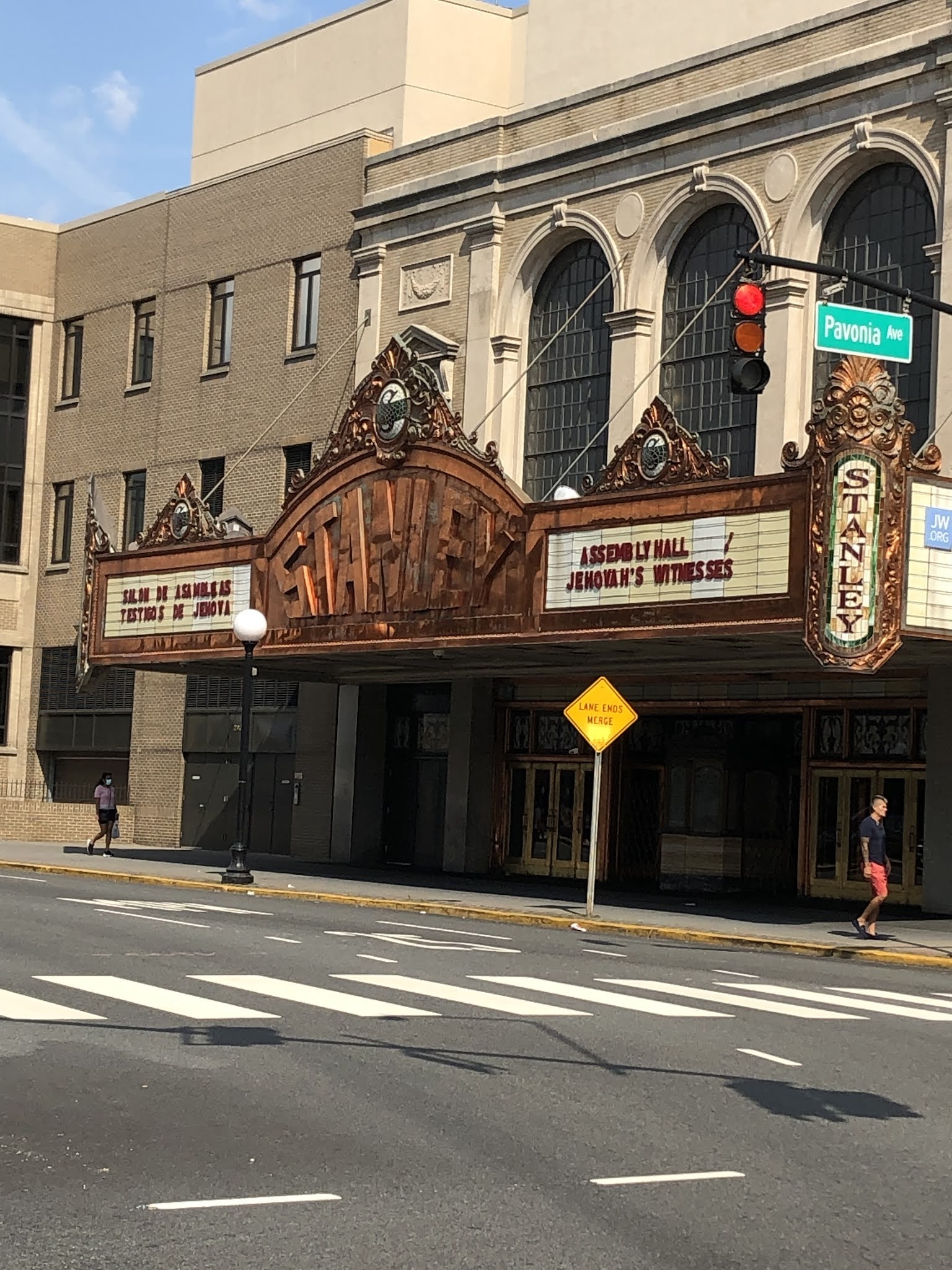
So a theater stands across from a monument to a man who played out one of this country’s real-life dramas.  To his right, across Pavonia Avenue, stands another former movie theater:


Like many other former cinematic cathedrals, it’s become a house of worship. That makes sense, as the interior dimensions of those old movie houses closely resemble theaters.  And when you come down to it, a mass or service is a kind of theatrical performance—just like a ball game or bike race.

And I got to see the theater of the street from my bike.