26 October 2021

Tout A Velo In Paris

 As I said on Saturday, and in earlier posts, if any municipality is serious about getting people to ride bikes rather than drive to work or school, or for fun, building bike lanes is just one step.

And it’s a legitimate step if and only if (See what I learned in my formal logic class?) those lanes are well-designed, -constructed and -maintained—and practical.  

On that last condition:  Building bike lanes that begin  and end in seemingly-arbitrary locations, without any markers or any other indicators, serves no one.  People will give up four wheels for two if, among other things, bike lanes actually connect places people ride to and from, safely.  Of course, I don’t mean that people should have lanes directly from their front doors to their desks or work stations. But bike and pedestrian paths should make it possible to go from, say, a central point in a residential neighborhood to a business or cultural district in the way of good mass transit systems—like, say, the one in Paris.
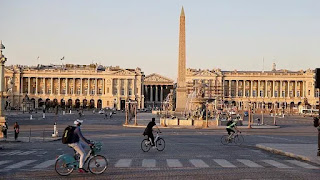
Photo by Ludivic Marin, for Agence France Presse


Apparently, the City of Light’s Mayor, Anne Hidalgo, has such a vision.  She won a second term last June on a platform that included making Paris a city “tout รก velo”—totally cycleable—by 2026. To that end, the French capital is investing 250 million Euros to improve its cycling infrastructure.  

Among other things, 52 km (about 32 miles) of “coronapistes”—temporary lanes created during the pandemic—will be upgraded and made permanent. To that, another 130 km will be added to the existing 100 km.  These additions and upgrades will make it possible to cycle from one end to another, and to and from key locations, within the city as well as in the adjacent suburbs.Even more important, those lanes will be planned to make it safer for cyclists to cross intersections, thus addressing another concern of people who say they’d consider cycle commuting but worry about safety.

Hidalgo’s plan will also address another concern—bike theft—by adding 100,000 new secure parking spaces, including 1000 for cargo bikes.


25 October 2021

Budding Fall At The Harbor

Yesterday I started riding to Connecticut.  But in Mamaroneck, a bit more than halfway up, I detoured into a couple of cute downtowns and onto lanes that wind by mansions, country clubs and horse trotting courses, and through tax-shelter farms.

When I ended up back on Boston Post Road in Mamaroneck, I stopped to eat the bagel and small wedge of cheese I packed in the bag of Zebbie, my Mercian King of Mercia with the striped seat tube.  

Honestly, I rode her for one reason:  She looks autumnal.  So did the scene at Mamaroneck harbor, at least somewhat.


If you look closely or enlarge the image, you can see budding Fall foliage on the right.  Actually, it looks (to me, anyway) like someone lightly brushed red and orange across a cluster of leaves.  


24 October 2021

He Lost His Key, Not His BIke

The pandemic has brought both out the altruism and avariciousness of people.  It's also revealed their creativity and hideboundedness, as well as their brilliance and sheer stupidity.

Examples of the latter include the woman who got busted for using a fake vaccine card.  Her forgery was detected because the name of the vaccine she didn't receive was spelled "Maderna."

As if there isn't enough boneheadedness to go around, a probably-soon-to-be-former San Jose Sharks forward Evander Kane got himself suspended for a quarter of the season because he violated the National Hockey League's COVID-19 protocol.  His offense?  He submitted a fake vaccine card.

And, to prove that idiocy knows no boundaries, there's Singapore Police Station inspector Ong Chee Seng.  On 26 May, the 50-year-old rode his foldable bicycle to a shopping mall so he could buy lunch. When he returned to his bike, he couldn't find his key.  He tried to borrow a cutter from the mall's security personnel, but they wouldn't help him because they couldn't verify that the bike was his.

Later that day, he sent a message on his WhatsApp group chat, asking whether he could borrow a cutter.  One friend jokingly suggested that he call the police and claim he'd found his stolen bicycle.  The constables, this friend jested, could then perform a "free service" for him.

The rest of this story illustrates something else we've learned during this pandemic:  There's no counsel so bad that nobody will follow it. (Think of the folks who followed Trump's advice and injected themselves with cleaning products.) So, Ong called the Punggol Neighborhood Police Center and told the officer who answered, "I found my stolen bicycle here at the bicycle bay of Waterway Point.  I need police assistance."


Google Street View image


He led officers dispatched to the scene to another nearby location, claiming it was stolen when he locked it there.  When one of the officers said he'd check the CCTV cameras, Ong confessed to his lie. He was then charged with providing false information to police that led to an investigation.

On 3 September, he was suspended from the Singapore Police Force and the other day, he was fined $3000.  The SPF has also initiated "internal action" against him. If stupidity were a crime, his sentence surely would have been greater.

23 October 2021

Real Cities Have....

 Earlier this week, New York City Mayoral candidates Eric Adams and Curtis Sliwa debated.  The latter, best known as the founder of the Guardian Angels, expressed one position I wholeheartedly agree with:  his stance on animal welfare.  He said that, if elected, all of the city's animal shelters would become "no kill" shelters.  He deemed it "barbaric" that there are still horse-drawn carriages on city streets.

The only purpose those animals and carts serve is the amusement of tourists around Central Park. Thus, his wish to ban them is, I believe, well-founded.  The same cannot be said for his stance on bike lanes and traffic.  He believes there's a "war on cars" on this city, and has vowed to remove bike lanes in neighborhoods where they're less-used.

I think, like any good politician--which is what Sliwa has always been--Sliwa is echoing his supporters, many of whom believe that "their" streets and parking spaces are being stolen, "invasion of the body snatchers-style" by terrible, evil cyclists.  

Apparently, that sentiment echoes in other cities:

  You can't even go to South Water Street in Providence anymore, at least not without wearing a bulletproof vest and duct taping AirPods to your ears.  Nothing screams "thug" like a skinny person in bicycle shorts.

Dan McGowan obviously doesn't think that way.  He followed that paragraph in his Boston Globe editorial with this:  Said absolutely no one ever.  He used his platform to praise outgoing Providence Mayor Jorge Elorza for building bike lanes and in general planning with the recognition that the future of his city, and others, cannot be car-centric.  Those efforts, and similar work by other officials, led McGowan to this conclusion:  Real Cities Have Bike Lanes.


Bike lane on South Water Street in Providence.  Photo by Barry Chin, for the Boston Globe.


He is partially right.  Bike lanes can be an integral part of a city's infrastructure and thus encourage cycling if those lanes are well-conceived, -designed and -constructed.  They need to make cycling safer by taking into account the actual experience of cycling on urban streets or county roads. (As an example, the lane has to be built and traffic signals coordinated so that cyclists can proceed through an intersection, or make a left turn, ahead of right-turning motorists.)  And those lanes should be practical:  They should enable cyclists to pedal from their homes to schools, workplaces, shopping areas and other common destinations.  I've seen too many bike lanes that begin in seemingly arbitrarily locations and end abruptly.  

So, I would amend Dan McGowan's conclusion with one word:  Real cities have practical bike lanes.

22 October 2021

All Aboard The Bike Train--To School

Some people can be enticed into bicycle commuting if it's practical, safe and convenient.  Bike lanes that connect--or at least facilitate connections--between cyclists and everyday destinations like schools and workplaces are one "carrot," if you will.  Another is safe bicycle parking facilities, not only at said schools and workplaces, but also at transportation hubs.  After all, if someone's job is a 45 minute train or bus ride away, he or she isn't likely to pedal all the way.  But that commuter could be persuaded into riding instead of driving to the train or bus station. 

Now, here's something that is rarely, if ever, addressed in planning bicycle (or other transportation) policy and infrastructure:  getting more kids to ride in school.  In some rural areas, where the bus ride might be even longer than it is for a suburban resident's commute to the city office, that might not be practical.  But it could make sense in urban and suburban areas, or even in some small towns, where the trip to school might be a ten-minute bus ride--or a half-hour walk.

The biggest hurdle to getting kids to ride to work, though, might not be convincing the kids themselves.  Rather, it's allaying parents' not-unjustifiable fears for their kids' safety.  But a solution is one that's been in use for some time, though not for bicycling.

On any school day, you might find yourself stopping at an intersection--or somewhere along the path in your local park--by a "train."  I'm not talking about the ones that run on steel rails.  Rather, I am talking about a line of kids who might be latching onto a rope or other line, and supervised by their teacher or aide.  Well, some folks in East Lansing, Michigan are guiding kids to school in the same way:  The kids ride in a line, accompanied by a chaperone who picks each one up along the way.


Photo by Margaret Cahill, from Fox47 News


This "bike train" was organized by Jeff Potter, an aide and substitute teacher at Red Cedar Elementary School who also just happens to be a cyclist.  While he admits that keeping the kids together is "like herding cats," he thinks the "train" is a "community builder."  The kids have a chance to interact with each other on the way to school.  This, he believes, has "improved school behavior and their awareness of the neighborhood." 

Principal Rinard Pugh agrees and adds there is another benefit.  "There's fewer kids in cars," he explains.  That "helps to improve health and fitness" which, he explains, "is really important with our kids coming off COVID."  In addition to getting kids to exercise and interact, it also gets them outside which, Pugh explains, is especially important during the pandemic.

So, bicycle trains not only help to accomplish, for kids, one goal of good bicycle policy:  making bicycling safe and convenient.  In addition, it helps in dealing with the pandemic.  Perhaps more people and communities will get "aboard" with this idea.