05 December 2021

"Like Herding Cats"

 You've heard the expression that something is "like herding cats."

Well, have you ever tried to teach a cat to ride a bike?

You'd think that with all of my experience as a cyclist, teacher and professor, I could teach anyone anything when it comes to cycling.  Well, some things tax even my wealth of experience!

I'm going to try visualization.  Maybe if she sees enough images like this one, she'll accompany me on a ride:


There's still time!


04 December 2021

A Bike Lane Or A Parking Spot

 If you’ve been reading this blog for a while, you know that one of my pet peeves is bike lanes that put cyclists in more danger than they’d experience in riding on the streets.

Bike lanes can be hazardous in all sorts of ways:  They can be poorly constructed or maintained.  They can be poorly conceived and designed. (How many lanes begin or end “out of the blue” or lead cyclists straight into the path of trucks or buses turning right in intersections?) Or they can be marked (or not) in ways that confuse motorists and pedestrians as well as cyclists.


The latter situation confronts drivers and cyclists along Lake Avenue on Cleveland’s West Side. Recently, the city installed a bike lane there.  What they neglected to do, however, was to remove 30- and 60-minute parking signs.  

Not only is it inconvenient for cyclists when motor vehicles pull in and out, or park in bike lanes: it’s also hazardous. “It creates a situation where motorists don’t expect cyclists to veer out into the roadway because there is a bike lane,” explained Jacob VanSickle of Bike Cleveland.

He says BC has contacted the city about removing the signs.  The city said it’s the duty of a contractor for the Ohio Department of Transportation to remove the signs.  According to Isaac Hunt, the lane is expected to be completed by mid-December and the signs will be gone “in a few weeks.”

“Those are bike lanes now,” Hunt says and cars are therefore not permitted to park in them. But, many drivers are understandably confused by the signs: perhaps they don’t see the bike lane markings or realize they aren’t supposed to park in a bike lane.  

Then, of course, there are motorists who resent having “their” road space taken from them, or just don’t care about rules. For them, the rules have to be enforced.  For everyone else, those rules—and the very existence of the bike lane—need to be clarified.

03 December 2021

Where Are The Bikes—And Docks?

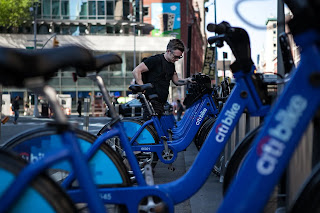
 I’ve ridden Citibikes a few times, always for the same reasons:  I could ride there, but not back (like the time I pedaled to a procedure that involved anaesthesia) or I went to pick up one of my own bikes.


Photo by Christopher Lee for the New York Times


On the whole, it’s a good system, given its inherent limitations.  The main non-inherent limitation is that it still isn’t available to about half of this city’s residents:  Nearly all of the bikes and docks are in Manhattan or nearby neighborhoods (like mine) in western Queens and northern Brooklyn. 

Of the inherent limitations, perhaps the most significant is the mismatch between the availability of bikes and ports at any given moment.  As an example, on one of my trips, I had to go to three different docking station before I found an empty port where I could leave the bike.  That left me about half a kilometer from my destination.  The nearest docking station was only a block from where I needed to go.

Sometimes people encounter the opposite problem:  no bikes at the docking station. This typically happens at times and in areas where many people are leaving, or leaving for, their jobs or schools.

As much as I liked Curtis Sliwa’s position on animal rights, I voted for Eric Adams to become our next mayor because of just about everything else—including his mention of expanding Citibike to areas not yet served by it—and, too often, un- and under-served in so many other ways.

02 December 2021

How Not To Sell A Stolen Bike

When I wrote for a newspaper, I talked with a man who was (or at least claimed to have been) a "professional thief."  In other words, he said, stealing--jewels, mainly-- was his metier. And, as such, he and others like him had a set of guidelines--a code of professional conduct, if you will.  They included such gems as "Never kill unless there is no other alternative" and "Never steal from anyone poorer than yourself."

One thing that separates professionals, like the one he claimed to be, and others is that he stole strictly to "get paid," he said.  "You steal, you sell, you spend," he explained, unlike amateurs who might, say, steal out of poverty and desperation or to support a drug habit.

By implication, that meant "you shouldn't steal to support your stealing"  and "you shouldn't use something stolen to steal." In other words, a professional thief never  should do what two men in Oregon seem to have done.

A bicycle was stolen in Eugene, the state's capital.  The victim found it for sale on Facebook Marketplace and arranged to meet the sellers at the Walmart in nearby Springfield.  He apprised the cops of what he was doing.


Just before the gendarmes arrived, one of the sellers, who drove the car used to transport the bike, went into the store.  The officers, seeing the bike in the back seat, took the passenger--35-year-old Guy Devault--into custody on a warrant.  Shortly afterward, they caught the driver--Juan Sanchez, also 35 years old--in the store.

An investigation concluded that Devault was responsible for the stolen bike. But, as it turned out, the car was also stolen.  So, in addition to his outstanding warrant on for kidnapping, Sanchez now also faces a charge of being in possession of a stolen vehicle:  the car used to transport the bike.

The fellow I talked to when I was writing for a newspaper would have known better than that.


01 December 2021

Unparliamentary?

 Virtue signaling has been around forever.   Corporations and other major institutions, as well as mainstream politicians and celebrities, have long tried to show one audience or another that they are in agreement on some issue. A current example might be companies that make their products in overseas sweatshops running commercials in which models wear T-shirts or accessories emblazoned with a Black Lives Matter logo.

There is a subgenre of this called greenwashing.  In it, some organization or person tries to convince people that it really, really cares about climate change and other environmental issues by offering "green" versions of its products.  As often as not, the item doesn't actually cause less environmental impact than its "dirty" counterpart, just as so-called "healthy" snacks are sometimes just as hazardous to our waistlines as what they're supposed to replace.  

Now, it seems that some folks are being accused of a sub-subgenre of greenwashing. I'll call it "bikewashing."  Some accused Pete Buttigeg of it when he rode a bike.  Granted, he didn't look like he had much practice, but reliable sources say that he didn't get out of his car and ride a few feet to show the world that the new Transportation Secretary indeed cares about alternatives to fossil-fueled vehicles.

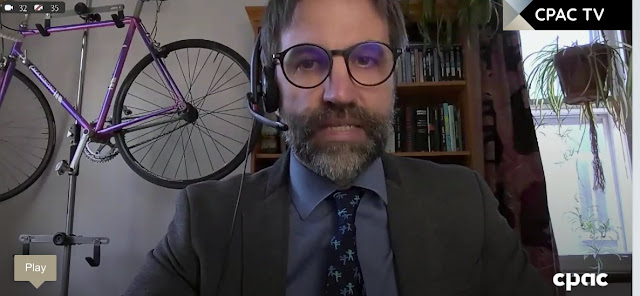
Now a Conservative member of the Canadian parliament has accused the country's Minister of the Environment of using a bike as an "unparliamentary prop" in a Zoom call.  First of all, calling a bike an "unparliamentary prop" is as ignorant as you-know-who taunting John Kerry for breaking his leg in a "bike race."

Can someone tell me what, exactly, is "unparliamentary" about a bicycle?  I like it myself, not in the least a purple Marioni.  My only quibble is that it seems to have a single gear but a pair of downtube shifters.  I guess someone was in the middle of converting it from a derailleur-equipped to a fixed-gear or single-freewheel bike.


To be fair, whether or not Steven Guilbeault actually rides the bike, that it's there is understandable:  He probably was in his home and the bike happens to be wherever his computer or other device was set up.  Nobody has complained about seeing my bikes--or, for that matter, Marlee-- during Zoom meetings.  

If anything, the bike makes me think of the bike that was always hanging in Seinfeld's apartment. (Trivia question: What kind of bike was it?) Did he, or anyone actually ride it?

And Ed Fast's reaction to seeing a bike behind Guilbeault makes me wonder whether members of parliament, conservative or otherwise, have other things to think about--you know, like the latest variant of COVID-19.