23 January 2022

It's All On My Head

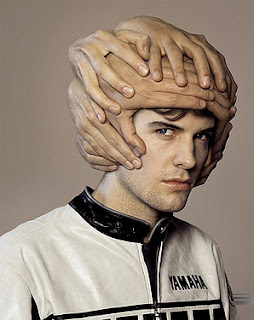
If you are my age or older, you may have ridden with a "leather hairnet."  Similar to the headgear worn by US football players until the 1950s, they were a lattice of foam-filled straps that might have prevented a scrape or two in a minor crash but probably were useless in a headlong fall or impact with a motor vehicle.


I had one such helmet in my youth. (Yes, believe it or not, I had one of those.) But I never wore it because it was too cumbersome and hot.  I had those same complaints when I first started wearing a hardhat--  a later-version Bell "turtle shell" nearly four decades ago--but have covered my head while riding ever since.


My "hairnet" disappeared into the mists of history. Actually, I think I lost it during a move.  I got to thinking about it when I came across this:


22 January 2022

Why Does One Steal For Three?

 I've been told, by people who have worked in it, that the art business can be as shady as any other.  Perhaps I shouldn't be surprised:  It's a world of secrecy with very little regulation.  And, as with real estate, stocks or anything else that's bought and sold, paintings, sculptures and other created objects sell for, essentially, whatever people are willing to pay for them, which leads to all sorts of unethical behavior.

Still, I have trouble imaging that anyone has ever said, with a straight face, "Psst!  Wanna buy a Monet?"  I don't know whether I'd laugh or call the police if I were to hear that.

That is the reason why I don't understand art theft--or theft of anything but basic necessities, and then only by desperate, destitute people. (Mind you, I don't condone any sort of pilferage:  I simply can better understand the motives of a person who's simply trying to survive or feed his or her family.)  After all, what do you do with Rembrandt's Storm on the Sea of GalileeOr Van Gogh's Poppy Flowers? Or Cezanne's Boy In A Red VestHang them on your wall and invite your friends over for dinner?  I mean, if you were to try to sell those paintings to anyone who recognized them, they'd know that it was fake or stolen.  You can't make it "go stealth" the way you can with, say, a contraband high-end watch.

So it is with unusual bicycles.  Most bike thieves want to sell the bikes or their parts, so they steal stuff that's valuable but common. (That makes even more sense when you realize that for several years running, the most-stolen car was the Toyota Camry.)  I would think that it's more difficult to unload a tandem, especially a high-end one.  And I would expect that a bicycle built for three (which was misidentified as a tandem in the article in which I learned about its theft) would be even trickier to sell, "chop shop" or simply disappear. How many triplet fames have you seen?


The Rumseys.  Courtesy: Salt Lake City Police Department


Fortunately for the Rumsey family of Houston, it didn't take long for their three-seater to be recovered after it was stolen in Salt Lake City.  They commissioned the bike 18 years old, not only so Dave and Merle could pedal with Ford, their 36-year-old son with Down's Syndrome, but also so it could travel with them.  The bike can be disassembled to fit into a suitcase and has therefore accompanied the family on every trip they've taken.

So, as you can imagine, the bike entwines all sorts of memories with its usefulness to the family.  That is the reason why they were so glad it was returned to them.  And perhaps it was a good thing that the bike is unlike almost any other.  The Salt Lake Police didn't say whether they'd caught the thief. If they hadn't, perhaps he realized it would be too difficult to sell or otherwise unload and abandoned it. What would he have done with a Picasso or a Caravaggio?


21 January 2022

What If He'd Stayed?

Yesterday, I wrote about an effort to make Austin, Texas more bike- and pedestrian-friendly. I haven't been there, but if it's anything like the parts of the Lone Star State I've seen, the complaints of its cyclists and pedestrians don't surprise me:  Even Houston, its biggest city (and the fourth-largest in the US) can seem like an expanse of auto-centric suburban sprawl, especially if you're accustomed to a city like mine (New York), Boston, San Francisco or most major European burgs, bourgs or bergs.

Then again, I have to admit I was a little bit surprised that, from what I was reading, bike lanes and sidewalks are so poorly conceived, designed or maintained--or nonexistent outside central parts of the city.  After all, during the past three decades, many young, educated people--the ones who, during the same period, were most likely to become recreational or commuting cyclists--moved to the Lone Star Capital.  And it has a major university, which usually is enough to ensure a significant number of cyclists.

Today I was reminded of another reason why one might expect Austin to be a better place for cyclists.  Now, I know that almost anything that happened more than two years ago seems as distant as the Mesopotamian civilization but, believe it or not, three decades ago isn't so long in, as Doctor King said, the long arc of history.  

Just as there was indeed a time before COVID-19, there was also a time when Lance Armstrong was a kind of "golden boy."  He had just won the World Championship and was seen as an heir apparent to Greg LeMond and the generation of American riders who put their country on the sport's map for the first time in decades.

Well, back then, Lance lived in Austin. Professional cyclists are like other professional athletes in that they aren't "working" only when involved in a race, game or match.  Having been a racer for very brief time in my life, I know that in order to be competitive, you have to pedal for a few hours every day.  It's really as much of a commitment as going to the office, factory, school or wherever you make your living or forge your identity.  In addition, most cyclists, as well as other athletes, spend considerable amounts of time in other kinds of conditioning, such as running or weight-lifting.


Photo by Jeff Wilson for Texas Monthly


But one would think that with all of the cycling Lance--and, most likely, others--were doing, the city would have been more conscious of their needs.  You see, not only was he seen as a "rising star;" he had yet to be tainted by accusations of drug use.  In fact, he may not have been using any banned substances (at least, not in detectable quantities) in those days, before his cancer diagnosis. If you look at pre-illness photos of him and compare them to images of him after he returned to the sport, it's not difficult to believe as much.

Anyway, I couldn't help but to wonder whether Lance, had he retained his status, could have made a difference in hometown's cycle and pedestrian infrastructure.  Maybe he could have.  Then again, maybe he couldn't have:  After all, aside from people who bought Trek bicycles in the US Postal Service Team colors, I'm not sure he influenced much else

Still, it makes me feel old to think there was a time before COVID-19--and when Lance was revered.  

20 January 2022

Mapping What’s Missing


From the City of Austin 


My first time in Paris, so many things impressed me.  Among them were, of course, the food and the architecture—and that an entire street—l’Avenue de la Grande Armeé —was lined with boutiques of every major French bike maker and a couple of étrangers like Raleigh.  

And the city’s Métro system seemed like a fleet of high-tech yachts compared to the only such system—New York’s—I knew at the time. The feature that seemed most other-worldly, though, was the interactive route maps in the major stations like Châtelet-Les Halles.  Three decades before GPS, it was about as high-tech as urban subterranean navigation got: You pointed your finger to the name of a street or landmark and a string of lights marked the route and transfer (correspondance) points.

Now the city of Austin, Texas has something that reminds me of that old Paris map. The city’s Public Works and Transportation Departments have collaborated to create the ATX Walk Bike Roll to solicit ideas for improvements to the Lone Star capital’s bike and pedestrian infrastructure. To that end, they’ve designed an interactive map where residents can drop a “pin” wherever they find, say,  “hilariously narrow “ or non-existent sidewalks or bike lanes that are more like “obstacle courses.”

If we had such a map here in New York, I—or any regular cyclist—alone could fill it.  And to think this city is better than others in the US—including, possibly, Austin—for pedestrians and cyclists!


19 January 2022

Extending The Day, And The Season

 Yesterday I went for a late afternoon ride and noticed that, among other things, late afternoon is stretching later into the day.  I shouldn’t have been surprised:  Almost a month has passed since the Winter Solstice.

Something else I noticed also shouldn’t have surprised me, but did: It seems that Christmas decorations have remained on homes and businesses, and in public places, for longer than in any other year I can recall.  I’m sure it has to do with the fact that nearly two years have passed since the COVID-19 pandemic arrived here.  Some people, like health care workers, are tired in body; many more, I am sure, are fatigued in spirit.  Perhaps putting up those decorations, or simply trying to muster up some cheer, sapped them. 

Or they may simply want to cling to whatever flickerings of joy that are illuminating days that, while lengthening, are still followed by long nights.

I suspect that such is the story of the Toufous family, who gives our neighborhood one of the best and most extravagant holiday displays I’ve ever seen:


They’ve put on a great show for years,  But I think they outdid themselves to honor the memory of a family member.


They, like so many people, have endured so much during the past year.  If they want to leave that display up all year, even if only to make themselves feel better, I’m all for it!