06 July 2012

Why Aren't You Riding In The Bike Lane?


The other day, I was riding along 21st Avenue in East Elmhurst.  A driver made a careless turn in front of me.  I yelled a few things not allowed in PG-rated movies and flashed the one-fingered peace sign.


The driver--a woman a few years younger than me--rolled down her window.  "You shouldn't be riding here," she yelled.  "You should be on the bike lane."


"There's none here," I shouted.

"Well, there's one on 20th Avenue."


"But it won't take me to where I'm going."


"You still should use it."


"Would you drive along a street that doesn't take you where you want to go?"


She then started to lecture me about how riding on a bike lane is safer than riding on a street.  Mustering all of the patience I could gather within myself, I explained that bike lanes can be more dangerous than the streets for cyclists.   "Some drivers seem to think the bike lanes are for passing or double-parking."  


Her eyes widened.  "I don't do those things!"


"I wasn't accusing you. I said some drivers do them. "  I was about to tell her that I have been "doored" twice, and on both occasions I was riding in a bike lane.  But she had to go somewhere, so that debate didn't come to pass.


Afterward, it occured to me that her misconceptions about bicycle safety are considered "common knowledge" and guide the decisions of too many urban planners.  That is the reason why so many bike lanes are poorly-conceived and -constructed, and people like the driver I confronted simply cannot understand why we don' t use them. 

05 July 2012

A Softshot Slingride

Today I saw someone riding a bike I hadn't seen in a long time.  Unfortunately, I didn't have my camera with me and I couldn't get my cell phone out of my bag quickly enough.  Fortunately, it was easy enough to find a photo of it on the web:


Production of Softride bicycles seems to have begun during the late 1980's.  Apparently, they're still being made.  Although I haven't seen one on the road recently, I understand they're still popular with triathaloners. 


Softride bicycles appeared around the same time that Rock Shox forks first came onto the market, and other then-radical bicycle designs were being developed. 


Nearly all other bikes with suspension are designed to suspend the bike.  This makes sense when you realize that modern suspension systems were first developed mainly for mountain bikes.  Someone who's hopping over creeks or "jumping" from a rock face doesn't expect to be comfortable upon landing.  However, he or she wants the bike to remain as stable as possible, as this is the best way to keep the bike moving forward and prevent an accident.  


At least, I came to that conclusion from my own experiences of off-road riding. 


On the other hand, according to the designers of Softride, their stated goal was to "suspend the rider, not the bike."  Now, I'll admit that my time on a Softride was very limited and I thought it was uncomfortably bouncy.  However, other riders seemed to master it, or simply became accustomed to the sensation.  If they did, I can see why some liked it:  The shocks incurred on the road aren't nearly as great as one experiences in the woods and mountains.  Plus, road riders tend to spend more time and ride longer distances on their bikes.  So some might like a cushier bike. And, I suppose triathaloners might like the comfort of such a bike because they have to switch, sometimes abruptly, from the swimming or running segment to the cycling part of the race.


Around the same time Softride bikes made their appearance, an old riding buddy took to both the roads on a bike like this one:


This was yet another approach to suspension.  My old riding buddy, an engineering school dropout, once explained the principle behind it for me. I've since forgotten how it's supposed to work--or maybe I never understood it in the first place.  But he swore by Slingshots:  He had a mountain as well as a road version. 


I rode his bikes a few times.  While I wasn't entirely convinced by them, they made more sense to me than Softrides ever did.  


It's been at least a dozen years since I've ridden a Slingshot (or, for that matter, a Softride).  So, please forgive me if my memory is faulty and my description of the ride is less-than-detailed.  

People who have driven the Citroen GS or its descendants remark upon the fluid tautness of its suspension.  I have only ridden in such a car, but I could feel the difference between it and the "springier" suspension of American cars. The Slingshot's suspension felt something like the hydropneumatic system of a Citroen, on steroids.  


I might actually buy a Slingshot if I were going to have a barn full of bikes. (They're still being made, as they were back in the '90's, in Grand Rapids, Michigan.) But being limited to four bikes (still more than most people have, I know!), I am leery about paying full price for such a radical bike.


If I were a collector, I'd probably have at least one Slingshot and a Softride.  What I'd really like, though, is for Slingshot and Softride to collaborate on a mixte frame!


04 July 2012

Six Days Of American Ascendancy

When people think of "American" sports, baseball, basketball and what we call "football" usually come to mind.  


The Six Day Bicycle Race (1935) by William L'Engle


On the other hand, very few people would think of bicycle racing, in spite of wins by American riders over the past quarter-century.  One reason why so few people still think of bicycle racing as an American sport is that no living person can recall the time when the US was one of the dominant cycling nations.  Also, there's almost nobody alive who can remember when one of the dominant forms of racing was the one that was most associated with riders who carried the Stars and Stripes.


Six Day Bike Race (1924) by Alexander Calder


I'm talking about the six-day race.  Although it began in England, it really became one of the prominent forms, if not the most dominant type, of cycle-racing after Madison Square Garden began to host them in 1891.  Those races did much to make cycle racing one of the most popular sports among spectators for four decades afterward.  Well into the 1930's, the only American professional athletes who made more money were the best baseball players.  Nearly all cities had velodromes; in fact, bicycle-racing tracks outnumbered all other kinds of athletic arenae with the possible exception of baseball fields.


Start of Six-Day Race In Madison Square Garden, 1936.  Note Jimmy Durante at far left.   From Reminisce.


As important as they were, six-day races--and bicycle racing in general--were all but forgotten in the US for a generation or so after World War II.  Interest in the sport wasn't rekindled until the 1980's, when American riders became competitive with the best of Europe and other parts of the world.  


Major Taylor (center) and other prominent Six-Day Racers.  Photo montage by  Michael Neubert.


Perhaps some future historian will write about the significant role bicycle racing--and the six-day variety in particular--played in a country that was in the process of becoming the world's dominant economic, political and cultural force.

03 July 2012

A Breeze, Gunz 'N' Rizers And Il Postino

Maybe it had to do with the full moon we had last night.  On  my ride today, I saw some interesting and unusual bikes.


This one was parked not too far from my apartment.  From its joints and the style of the head badge, I am guessing that it's a Schwinn "Breeze" from the 1960's or early 1970's.  The "Breeze" was one of Schwinn's "lightweights" and was equipped with a single-speed coaster brake rear wheel.


This chainguard is really interesting:  Some older Schwinns had "textured" guards rather than the flat ones found on later models.  


Take a look at the "barbershop pole" stripe on the rear fender:


I like what the person(s) who repainted the bike did to the front fender, too.  However, I'm not sure that the front fender is the original, as I don't think the "Breeze" (or any other Schwinn, for that matter) ever came with a ribbed fender.  This one looks like it came from an old Raleigh (or other English) three-speed.


Contrast the Schwinn with this bike I saw parked along Kent Avenue, near the old Domino Sugar refinery,  in Williamsburg:


By now, you've probably seen similar "funny bikes," with one frame stacked on top of the other.  I couldn't help but to notice the relatively thin chain and lock used to secure the bike:


At first, I thought that perhaps the bike isn't such a target for thieves.  After all, most bike-nappers probably wouldn't know how to ride it and would therefore not get very far.  Back in the day, that was also the reason why you could leave a fixed-gear bike unlocked, at least for a short period of time:  A would-be thief was likely to break his legs when he tried to coast or slow down.

But I digress.  I think I saw the real reason why nobody would steal this bike:


I did see one more interesting feature:


I guess it's a handle.  Unless you're as tall as the buildings on the other side of the East River, you couldn't "walk" or carry the bike by grasping the handlebars and saddle.


On the other hand, this bike is all about carrying things:


According to Liz of Bike Works NYC, it's a bike used by the Italian Post Office.  I don't know whether the bike was called "Il Postino," but I couldn't resist referring to it that way.  I mean, it's not hard to imagine the mail carrier in the eponymous film bringing letters from publishers and Nobel Prize committees to Pablo Neruda.  


I'll tell you more about Liz (on left), her friend, Bike Works NYC and what I was doing there in a near-future post.

02 July 2012

A Climb

If you've ever thought there were no hills in New York City, take a look at this:


At the bottom of these stairs  is the Morris Heights section of the Bronx.  Climb them and you're in the aptly-named University Heights neighborhood.  The latter was home to a New York University campus until the early 1970's.  Now that campus is occupied by the Bronx Community College.

I rode up that way this morning.  And, yes, I ascended those stairs on Tosca, my fixie. All right, I climbed with Tosca on my shoulder.

01 July 2012

Purple To Green And Back

In case you were wondering what makes Mercian flip-flop (#57 on their color chart) so unique, take a look:


 Here you can see it turning from purple to green.


Then it reverted to purple.


30 June 2012

The Wisdom of Our Elders

As I'm sure you've heard by now, most of the US is having hot weather. 

This part of the country has not been spared.  On my ride today, I stopped in Isham Park, near the northern tip of Manhattan.  Given its location, it's quite bucolic; on a hot summer day it's not surprising to see elderly people and couples with young children whiling the afternoon away in the shade.


The man in this photo may have had the best idea of all for coping with the heat:


He must have had an influence on me:  I fell asleep, for about an hour, on a bench near the one where he was dozing.

When I woke up, he was still in dreamland.  Actually, I think he would have been in dreamland had he awakened:  The ambient light of such a hot, hazy day spreads across trees, rocks and benches like a linen gauze.  

Maybe I'm closer to that man's age than I want to admit!

29 June 2012

Remembrance Of Jerseys Past

Now I'm going to make a confession:  I used to ride in "bike clothes."  In fact, I used to have a full wardrobe of jerseys.  However, only once or twice did I ever buy matching shorts:  I usually stuck with basic black.  Then again, when I started buying bike clothes, matching shorts and jerseys weren't available, and nearly all shorts were black.

I don't plan on buying any team jerseys this year, or for the rest of my life.  However, I'll admit I did see a couple I liked:


 What's interesting about this jersey from the Basque team Euskatel is that it's not as loud as you'd expect it to be, given its combination of yellow and orange.  That, to me, shows some excellent design sense.  But even if the jersey were louder, people would like it because of all of the talented riders--some of whom have a chance to win stages of the major tours--on that team.


We all knew it was just a matter of time before argyle started to appear on team kit.  (Hipster uber alles?)  At least it was done--at least to my eye--in a very appealing way here, with an eye-pleasing color scheme.


If you like that, how can you not like the Sky team's kit?:


Team kit hasn't gotten much more fashionable than that.  The only problem I can see with it is having to wear it when making a climb on a 100 degree day.


Now I'll show you some jerseys I actually owned and rode:


 All right.  You can forgive me this one, can't you?  First of all, all you have to do is take a look at my bikes (and this blog) to know what some of my favorite colors are.  Plus, I did my young-adult riding during the '80's.  Actually, for a jersey of that era, this one is pretty tame, wouldn't you say?


Speaking of the '80's, here's another popular jersey from that time, which I owned and rode:


The Vetements Z team featured Greg LeMond, the first American to win the Tour de France.  So did this team:


 Bernard Hinault, the last Frenchman to win the Tour de France, also rode for the team La Vie Claire, a French chain of health-food stores.  This is my favorite jersey of all time, if for no other reason that it's the best use anyone ever made of Piet Mondrian's work.

Here's another version of that jersey:


Speaking of French riders and teams:  They didn't win the Tour in the '90's: Miguel Indurain, like Eddy Mercx in the '70's, was simply unbeatable.  However, French riders (e.g., Laurent Jalabert and Richard Virenque) and teams managed to finish second and third in more style than any other athletes in history:


There are other examples, but I always liked this Credit Agricole jersey a lot (enough that I actually paid for one!).  It's colorful, but not over-the-top, and has a rather clean, streamlined design.


I also liked this jersey, though I never bought it:


 Cofidis is the team that dumped Lance Armstrong when his cancer was revealed.  Also, they never escaped from the shadows of doping accusations and other scandals.  Still, I thought they had a pretty cool jersey.

But for sheer style, it's hard to beat those all-wool jerseys from the '60's and earlier. Too bad I never got to wear them:


Finally, no discussion of team kit would be complete without one of the most iconic examples of the genre:


I mean, who hasn't seen the Peugeot checkered flag? In their long history (which has included many different co-sponsors), the team has had some of the sport's most famous riders ride for them, including some guy from Belgium who would win five Tours de France.  Yep, Eddy Mercx began his professional career in this jersey.  And BP wasn't yet associated with an oil spill in the Gulf.

28 June 2012

Product Review: Bike Burrito


You may have noticed something different about Arielle and Tosca, my road and fixed-gear Mercians.


Lately, I've been riding them without the Carradice Barley bags I'd attached to them.  I decided that, especially in the warmer weather, I don't need a bag of that size for rides of a few hours or less. 


When I first started this blog, I'd been alternating those  bags with Bike Burritos.  You might recall that I had pink Burritos on Arielle and Tosca.


Jayme Bassett makes Bike Burritos in three sizes--Tamale, Regular and Grande--in Long Beach, California.  On her website, she offers some Burritos she's already made.  The "wet" ones are made from cordura, the others from duck cloth.  She offers a variety of patterns and colors.  If you don't see one you like (or that matches the color scheme of your bike), you can tell Jayme what you'd like or send her a photo of your bike.  She'll tell you what patterns and colors she has on hand, or can get.  


Every Burrito has two layers of fabric.  On the inside are a series of pockets.  On the Regular and Grande, one is about twice as wide as the others, which allows you to carry an inner tube.  The bags  fold over on themselves, much like the Mexican food for which they're named.


Folding over section containing inner tube and blinky.
Folding over section containing patch kit and tools.
Pulling it together.

Would you like rice and beans with this?


The pink Burritos you see in my early posts were the Regular size, made from duck cloth.  I'd taken one of them off the bike, set it down somewhere and never saw it again. The other was spending time inside my Barley bag.  Since getting the new Burritos (with the print pattern), I've been using the pink one in my handbag or backpack for pencils, pens, lipliners and other things I want to separate from the rest of the bag's contents.


I decided to buy Grandes this time.  They give more capacity:  I can carry my rear "blinky" and front "frog" light easily.  Plus, because they're longer,they can be attached in an interesting way to a B-17 saddle:


If you look in some old catalogues or British or French bike magazines, you can see tool rolls or raingear attached in a similar way.  It can also be attached to the rings on the outside of the Barley's flap. Most people attach their Burritos on the underside of the saddle rails, like a sew-up tire bag or the round TA-style underseat bag.


However you attach or use it, the Bike Burrito is a functional, stylish (or funky, depending on your point of view) accessory that looks right on a classic, modern or anywhere-in-between bike.  Jayme does a great job of making them, and she's very nice to deal with.  For those reasons, I highly recommend Bike Burritos.

27 June 2012

The Point Lookout Orca: Such A Privilege To See It

I've done this ride at least a hundred times before.  Still, every time I do it, I never know what I'll find:


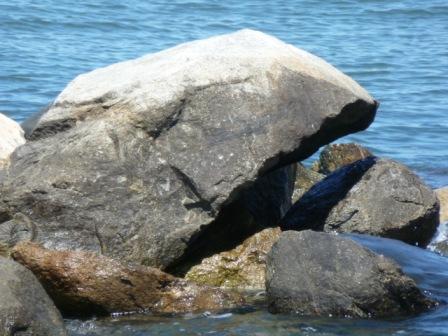
Could this be the Point Lookout Orca?  Or is this proof that Pac-Man evolved from some sea creature that waded onto land--or beached itself?  Hmm...Maybe there's even more to Darwin's theories (or Genesis, for that matter) than we thought!


Some of you might see it as a claw.  That would make sense, given what I saw on the path leading to it:


All of those black dots or specks or smudges you see are crab legs, or fragments of them.  Among them were also some empty mollusk shells.  The birds of Point Lookout don't realize how good they have it:  Meals like these would easily cost $30, or more, in my neighborhood--and even more in Manhattan!


Then again, I wonder whether the people who live there know how good they have it.  I know how good things are for me when I can ride there on an absolutely perfect day


and I have Arielle to take me there.


26 June 2012

Electric Bikes


Not so long ago, if you ordered General Tso's Chicken, Curry Shrimp, a container of hot and sour soup and wontons for you and your loved one, it would be delivered on a beat-up mountain bike or a bike-boom era ten-speed.


That bike was, more than likely, rescued from trash that was set out by the curb.  Or it was purchased for a few dollars from any number of corners where thieves sold their booty.  (Pre-gentrification St. Mark's Place used to be the epicenter of this trade.)  


Now the men (All that I've seen are men) who deliver your favorite Chinese foods are likely to go to a showrooms to buy their delivery vehicles.  Most of those put-put palaces are out of the public's (and, ahem, law enforcement's) view, although a few operate openly.  The vehicles they buy now are shiny and new and those men have had to save their money for months--or borrow it--in order to buy one of these vehicles.


I'm talking, of course, about electric bikes.  The delivery men love them because they're faster (about 20mph) than most bikes and are almost as easy as bicycles to maneuver in traffic.  Best of all, from their standpoint, those "bikes" don't have to be pedaled.  And now when restaurants hire delivery personnel, they give preference to those who have those low-voltage velos. 


There are just two problems with this scenario.  First of all, electric bikes are illegal in this city.  But, as more than one police officer has admitted, the ban is not enforced because "we have more pressing issues."  There isn't any public demand to raid and close down the shops that sell electric bikes, as there is for, say, "drug dens" or houses of prostitution in residential neighborhoods.  


The second problem is that it's, quite frankly, all but impossible to penalize careless electric bike operators--ironically, because of their illegality.  Because those bikes are illegal, there is no licensing requirement for them.  So, most of their operators don't carry--or even have--driver's licenses.  In fact, one of the few operators who's been arrested--for getting into a fight with a pedestrian--admitted that he and many other delivery men don't read or write English well enough to pass the written part of the exam for a driver's license.  The lack of a license makes it more difficult to keep any kind of record of violations.


As a matter of fact, as that same operator admitted, some delivery men don't have documentation of any kind.  Now, I'm not a lawyer, but I feel pretty confident in saying that there's not much you can do with an undocumented scofflaw but to detain and deport him or her.  Most local law enforcement officials don't want to get involved with the latter (which would involve dealing with Federal agencies, which nearly all of them are loath to do), and feel there are more pressing needs for their jail space.


To be fair to delivery people, though, they are simply people who are trying to make a living the best way they know how.  Worse than them are some of the teenagers I sometimes see riding electric bikes on bike/pedestrian lanes, especially the ones that line the bridges.  The bridge lanes are almost invariably narrow and shared with runners, people pushing baby strollers and such. You know how young people (especially men) who just got their drivers' licences drive their cars. Well, they operate motor bikes with even more reckless abandon.  I am not the only cyclist who has been grazed (or nearly so) by one of them, and I am not the only female cyclist who has had to deal with a young man on an electric bike riding as close as he can, then taking off.


Since banning electric bikes has done nothing to keep them off the streets and paths, I think they should be legalized--and that anyone who wants to use one should be required to get a permit.  To get that permit, of course, they would have to take safety classes.  And, I think, electric bikes need to be governed by a different set of regulations from those for bicycles, motorcycles or automobiles.  Perhaps there could be a "points" system, as there is for automobiles, and anyone who accumulates too many would lose his permit--and his ability to get a license to drive a motorcycle, car or larger vehicle.

What do you think?  Have you seen many of these electric bikes in your community?  If so, what's your experience with them?  Do you think they should be regulated--or allowed at all?


25 June 2012

The Meeting

The scholar and critic Cleanth Brooks probably did more than anyone else to champion a generation of Southern writers that included John Crowe Ransom, Allen Tate, Robert Penn Warren and, especially, William Faulkner.


In spite of their correspondence, which spanned more than half a century,Brooks and Faulkner supposedly met only once.  That meeting lasted several hours.  It is said that they did not talk about literature, or even anything else related to the arts, culture or history.  Instead, being true Southern men of their generation, they talked about fishing and 'coon hunting.


So why, you're probably asking yourself, am I mentioning these things on this blog?


Well, I found myself thinking about the story of the Brooks/Faulkner "summit" after meeting "Velouria", the author of the Lovely Bicycle! blog, during the weekend of the New Amsterdam Bike Show.


I discovered her blog--which, at the time, had been running for a few months--when I was recuperating from my surgery nearly three years ago.  I left comments on some of her posts.  An exchange of e-mails ensued and, within a year, with her encouragement, I started this blog.  (Now you know who to blame!;-))


Most of the e-mails we exchanged, interestingly enough, had little or nothing to do with cycling.  Although her upbringing, and much of her early adult life, could hardly have been more different from mine (or so it seemed), we both have had unusual (in different ways) circumstances that, I believe, have led us to see many things in ways that are very different from that of most of our peers. 


When she came to New York, we rode, albeit briefly.  And, of course, she was here for the show.  So it was natural that we talked, at least a little, about bikes and bicycling.  However, I would not say that it dominated the weekend.  Over dinner at Uncle George's and over coffee, we talked about, it seemed, everything but bikes.  I won't get into specifics, but I will say that I found the discussions stimulating because she seems able to get past the hyperbole and cant that too often passes for informed opinion, even among so-called intellectuals.  (Trust me:  I have lots of experience with them!)


You might say that my meeting with Velouria was an inverse of the one between Brooks and Faulkner:  Two men who knew each other via intellectual circles talked about sport, while two women who met via sport talked about culture--both the upper- and lower- case "C" varieties.

24 June 2012

WE Bike And Me


What's gotten into me? 

I mean, what's this with me and volunteering?

It's not as if I haven't volunteered before.  But within the past two weeks, I've begun volunteering with two cycling organizations.  And--quelle coincidence--it turns out that they're going to be working with each other.

I've mentioned my recent experiences with Recycle-A-Bicycle.  I intend to continue working with them as my schedule allows.  It looks like I'll be doing the same--and perhaps more--with a new organization called WE Bike.

I learned of them at the New Amsterdam Bicycle Show, where they had a booth.  Liz, a bike mechanic and youth educator who started the organization only a couple of months ago was at the booth.  And she was under the arches of Grand Army Plaza yesterday, where WE Bike was holding a repair workshop.  

She immediately recognized me.  I didn't think I was so memorable.  Even more interestingly, she mentioned my blog and my Mercians.  Hmm...It's not often that my reputation precedes me.  Is that a good thing?

Anyway, I got there a bit late.  But I went to work right away, showing a woman from the Caribbean island of Dominique how to fix a flat.  She had just purchased her first bicycle, not long after learning how to ride a bicycle as an adult.  

Yesterday, I thought she was mastering what I believe to be the first thing every cyclist should learn to do.  But she apologized.  For what?, I asked.  Then I realized she was doing something I've seen many other women do--and which I've caught myself doing since I started to live as a woman:  apologizing for no particular reason.

"You are officially in a guilt-free zone," I declared. "This circle around me"--I stretched my arms--"is off-limits for gratuitous guilt."  At first, she didn't know what to make of what I said--or, I imagine, me. But then she giggled.  "Don't worry," I said, "You'll be fine."

I was thinking about her as Liz and I talked after the workshop.  We agreed that getting more women to ride, with other women, and learning how to fix their bikes from other women, could help some--especially the young--build their confidence.  Plus, I added, it would help them become more independent. 

Then I thought about my own experiences of working in bike shops.  I don't recall seeing a female mechanic and, in those days, it seemed a lot of shops--including two in which I worked--had a "shop girl" who usually was a salesperson/cashier/hostess/Gal Friday. (I hope I don't seem sexist in using those terms:  I can't think of any others that would accurately describe those roles.)  In other shops--including one in which I worked-- such jobs, along with record-keeping and such, were done by the proprietor's wife.

In recounting those experiences for Liz, I fancied myself, for a moment, as a kind of Prometheus.  Please indulge me if it seems a bit grandiose, but I realized that when I was showing two women how to remove bottom brackets and headsets, and how to true wheels, at Recycle-A-Bicycle, I was passing along knowledge that, in my day, was possessed almost entirely by males.  And I probably wouldn't have learned those skills had I not spent the first four decades of my life as a male.

Or, perhaps--here comes the baggage of my Catholic education!--I am doing penance for all of those times I was one of those awful men who spoke condescendingly to female customers and who was less than helpful with girlfriends who actually wanted to ride bikes with me.  If the work I am doing, and expect to do, is a penance, I suppose I'm lucky:  There are definitely worse and more painful kinds of atonement!

Anyway...I have a feeling that interesting times are ahead for me.