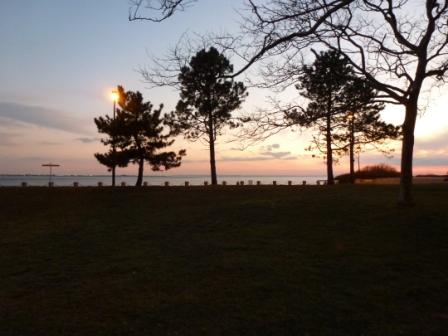
One of the most parodied (and most eminently parodyable) poems in the English language is Joyce Kilmer's "Trees."
Hmm...Even though I know it wouldn't have fit the meter or rhythm of the poem, it might've been better if he'd written, "I think that I shall never see/A bikestand as good as a tree."
Certainly a parking meter isn't quite as nice a stand--although it's a lot easier to loop a chain around it:
The paint job tells me someone was trying to make that bike unattractive to thieves. However, if that was the owner's/rider's intention, something else on the bike counters it:
Now, if you're going to so much trouble to make the bike unappealing, why would you announce, in screaming red letters, that it's a Colnago?
Of course, the bike is not a Colnago. (I know; I owned and raced on one and have seen many others.) Could it be that it's some kind of post-modern irony (translation: a joke)? Could this cyclist be saying, "Ha, ha, it's not a Colnago?"
Who'd've thunk it--putting the Colnago name on a bike would make it less valuable? What if people put Mercedes-Benz stars, or blue-and-white BMW shields, on their 10-year-old Hyundais? Would that make them less of a target for car thieves?
Actually, the basket almost made me wish it was a Colnago. It reminded me of the bike someone I met once in Williamsburg (where else?) about ten years ago: a vintage Cinelli track bike (not the ones sold today with the Cinelli label), with equally vintage Campagnolo Pista components and Mavic SSC rims--and a flowered basket strapped to the handlebars.
None of those bikes, though, will ever have a stand as good as that tree on which I leaned Tosca today.
In the middle of the journey of my life, I am--as always--a woman on a bike. Although I do not know where this road will lead, the way is not lost, for I have arrived here. And I am on my bicycle, again.
I am Justine Valinotti.
28 January 2012
27 January 2012
When Hipsters And Hasidim Use The Same Adjective
![]() |
| From Indigo Jo Blogs |
When people on opposing sides of the same issue are using "stupid" as a prefix for the same word, the thing they're talking about can't be good. Right?
I'm thinking now of bike lanes. Both cyclists and the people who hate us, or merely find us a nuisance, use that same adjective in reference to the lanes.
I was reminded of this when I stumbled over a site called "Stupid Bike Lanes" and read articles like this, and the comments on them.
Of course, the velophobes--who include all sorts of (but not all) people whose way of life or business is auto-based--think we're getting in their way of getting to wherever they have to go and believe we're getting "special privileges."
As any number of other bloggers (including yours truly) and commentators have pointed out, the antipathy toward cyclists, particularly in urban areas, is often generational and based on socio-economic or ethnic issues. Here in New York, non-cyclists hold contradictory views of cyclists: the messenger, the hipster, the Whole Foods customer and the simply rich. What reinforces these stereotypes is that those who most vociferously oppose the bike lanes tend to come from what remains of the blue-collar class and groups like the Hasidic and Orthodox Jews who have large families that they transport in vans. So, they are always driving, it seems, from one available parking spot to the next and, as they see it, the bike lanes take away those spots.
The bike lane-haters who are actual cyclists don't dispute those objections, and in fact cite one basic flaw of most urban bike lanes: They run alongside parking lanes and, therefore, directly in the path of opening drivers' side doors. I've been "doored" a few times: on all except one of those occasions, I was riding in a bike lane.
Some bike lanes are badly designed in other ways. The most obvious flaw, aside from the one I just mentioned, is that many of them go nowhere, end abruptly or in the middle of busy intersections, or are so poorly marked so that only those who already know where they are can find them.
All of the problems I've mentioned actually make cycling less safe than it is in the traffic lanes of most streets. And they indicate that those who design them know as little about cycling as transportation, in an urban area, as those who hate cyclists.
26 January 2012
Reconciliation
One of the nice things about being my age is that, if you're lucky, you can start to reconcile all kinds of things that seemed irreconcilable. If you're not lucky, they reconcile themselves, though perhaps not in the ways you'd intended--or one might destroy the other.
Where am I going with this? Well, it's about cycling, but it also has to do with stuff you'd find on my other blog, if you read it. So consider yourself forewarned.
You see, from the time I found out about John Rakowski, I wanted to do something like what he did. He cycled around the world, turning his pedals on every continent except Antarctica. (What would penguins think of some guy with a bike laden with full front and rear panniers, camping equipment and bottles of water anyplace they'd fit on the bike?) He recounted his adventures in Bicycling! magazine during my teen years.
Rakowski was in his early 50's when he undertook his journey, which lasted three years, if I recall correctly. As it turned out, he was living not far from where I lived, in New Jersey, at the time. And, yes I met him, and he signed my magazines.
Well, the fact that he lived nearby and did what he did would have been reason enough for me to take him as an inspiration, if not a role model. But there was another reason--apart from the "local boy" and "cycling" aspects of the story--that meant so much to me at that time in my life.
However, as important as his feat was to me, I never talked about it with anybody. For one thing, no one else in my family, or even in my circle of peers or the neighborhood in which I was living, shared my passion for cycling. It was as if the so-called "bike boom" had passed them all by. Everybody predicted that I would "grow out of" my obsession with cycling as soon as I got my driver's licence. Then again, people said I would "grow out of" all sorts of other things, as if they were tops and shoes.
You may have figured out where this is going: something else I didn't "grow out of." I'm talking, of course, about my wish to be able to wear bike jerseys and shorts with cleated shoes (in that place and time, almost no one had ever seen them), or skirts and blouses with heels, as a way of life.
The reason, of course, I didn't "grow out of" those desires is that there was more to them--which, of course, I didn't talk about with anybody. Wearing the clothes wasn't the point for me; I wanted to be the person who was expected to wear them--or, at least, a person who wouldn't face opprobrium for doing so.
That John Rakowski was a man, and most cyclists were men, was problematic. How could I want to ride around the world and win the Tour de France and be a woman at the same time?
Today, of course, there are more female cyclists than there were in those days, and women's racing enjoyed a heyday during the late '80's and the '90's. I could not understand why only men should race, tour or participate in most other sports. Title IX had been enacted around that time; however, it would take time for women's sports to gain any momentum because the sorts of sports programs, like Little League and Pop Warner football, that existed for boys didn't exist for girls.
It was a time when many people--including many women--thought sports were "unfeminine." I recall one girl in my high school who was as an even better athlete than most of the boys. Her family, which included three brothers who were athletes, was supportive of her interests. However, some of the teachers and other adults tried to discourage her, saying that no man would want to marry her. I couldn't understand that: She was a very attractive girl who had no difficulty getting dates.
Fortunately for her, she was able to play basketball and a couple of other sports in college. Of course, I would have wanted to be like her. Perhaps I could have been: I played soccer in high school. However, my real passion always lay with cycling, and only a few colleges had teams or even clubs for cycling. To my knowledge, none were for women.
Although I repressed my desire to be a woman then, and for most of the next three decades, I always felt, deep down, that there was no contradiction between wanting to ride the world, and to race, on my bike--and being a woman. What has always drawn me to cycling is the freedom I feel when I ride. I feel as if my spirit is unchained, that--if you'll indulge me a cliche--I felt as free as the wind and as open as the air.
And that, naturally, was what the woman in me wanted. She wanted to be free from what I now realize were the same boundaries that seemed to contain me when I was off my bike. When I say what I'm about to say, I don't mean to aggrandize myself: To be a long-distance cyclist at an age after you were supposed to have a drivers license and a car, you had to be an independent spirit. And, of course, it's impossible to be anything else if you want to live by the imperatives of your spirit rather than the dictates of your school, community and society. That's doubly true if your subconscious or unconscious gender--the one you are when you're by yourself--is different from the one on your birth certificate, and for which you are being trained by your school, church and other institutions.
I wanted to be free--to be Justine, on a bike. At least I lived long enough to know that those things weren't contradictory, and to meet people who understand that. And, just as important,from my point of view, is that I've begun to develop a language to explain my complications, contradictions and complexities. It makes sense to me, which means that I can also make it make sense to others--well, some other people anyway. If they don't understand, or don't accept it, that is all right.
I am Justine, and ride wherever and whenever my time and resources allow. Hopefully, some day, I'll have more of both. For now, living my life and riding my bikes are inseparable, and offer me so much.
25 January 2012
Riding Off Into The Sunset Out Your Window
Yes, I've hit Lotto. Just to prove it, here are photos from my exotic midwinter cycling vacation.
Or see the blue of the sky consumed into the blaze of orange and red and purple, and spreading in waves of deepening blue?
If any of you have not yet entered the workforce, you can look forward to long meetings and workshops. It's not a sign of a character flaw if your mind wanders during them. In fact, I'd argue that if you see what I saw out the window, and you pay more attention to it than to what's going on in the room, it's a sign that you're spiritually healthy.
Just don't tell that to the people who were running the workshop.
In what exotic locale was I?, you ask. Would you believe Kingsborough Community College, at the southern edge of Brooklyn. I took the long way back, so in all I still managed to ride about 40 miles yesterday. And I didn't even have to leave home. Well, not really, anyway!
23 January 2012
Disraeli Gears
"Campagnolo trying to do mass-market derailleurs was a bit like the British Royal Family trying to do marital fidelity--it was never going to work because, although they knew they should do it, they considered the whole idea inherently beneath them."
So begins Michael Sweatman's page about the Campagnolo Nuovo Valentino extra derailleur on his site Disraeli Gears. He says it's about half-complete; I almost don't want him to finish it because so many of his entries leave me in eager anticipation of more.
His pages include his own wry commentaries, as well as photos and technical information, about derailleurs that have been made during the past 80 years or so. Disraeli Gears is arranged by models, brands, countries and decades, as well as by several of his own themes, such as the ever-popular "A Riot of Colour."
Now I'm going to answer the question some of you are asking: Yes, Disraeli Gears is named for the Cream album released in November 1967. According to Ginger Baker, the album got its name when Eric Clapton talked about getting a racing bicycle and Mick Turner said, "Oh yeah--Disraeli Gears."
My guess is that Turner was high when he made that remark. (For that matter, Clapton and Baker probably were, too.) I won't speculate on whether or not Sweatman was high when he wrote any of his entries (or whether he ever was). However, he does reveal one of his food vices in this entry.
Even if all you know about derailleurs is whether or not your bike has one, Disraeli Gears makes for a lot of interesting and entertaining reading.
22 January 2012
"D" For "Dahon"; "F" For "Folding Bike"
Some days, the gray cloudy sky spreads like a shawl over buildings and trees. But today, it's like the proverbial wet blanket.
So, I thought this might be a good day to talk about a bike I owned and didn't care for very much. In fact, it's part of a genre of bikes I'm not really crazy about, but not because I have anything against the genre. Rather, I find the bikes within them are all wanting.
That genre is folding bikes. I've often felt I'd like to have one, even though I'm not travelling more than a couple of times a year. Once, I did give into my curiosity and bought one: the Dahon Vitesse D5.
Part of my rationale for buying it was that I could fold it and bring it into the office I shared at the time. I was indeed able to do that, and folding the bike was easier than I expected. However, the bike was heavier than I thought it would be (I had to climb two flights of stairs to get to that office, and my classes.) though, to be fair, it may have been because of some of the things I added to it.
The bike came in a matte-black finish. It's not exactly my taste, but I think it was the only color choice available. Soon after I bought the bike, I swapped out the stock saddle for a Brooks B72 I picked up on Craig's List. That gave the bike, to which I also added a rear rack, a surprising elegance.
You've heard the term "flexible flyer." That's what some of us called certain bikes like the Peugeot PX-10E (which I'll write about in another post). Well, the Dahon was like a Broken Flyer: When it rolled, it gave a surprisingly nimble ride, albeit on what felt like a broken frame. Again, in all fairness, every folding bike I've tried--even the Brompton--felt like it was pulled apart in the middle. I suppose that if I weren't accustomed to high-quality conventional frame, I might be able to accept that quality. But, after about a year and a half of commuting and running errands on the Dahon, I was still distracted by it.
Another problem I had with the bike was its transmission. The Sturmey-Archer 5-speed hub that came with the bike was one of the most unreliable pieces of bike equipment I've ever had. I never could keep it adjusted; nor could the mechanics at the shop where I bought the bike. Someone suggested that the problem may have had to do with the fact that when the bike was folded, the shifter cable was pulled and twisted. I'm sure that was a contributing factor, but I noticed that even after adjusting the gears when the bike was unfolded, I experienced "ghost" gear changes while I was pedaling. Even changing the shifter from the twist-grip style that came with the bike to a more traditional "trigger" mechanism didn't make the shifts more accurate or smoother.
But the fact that the frame folded wasn't the only thing that made it an unsuitable ride for me. One one of the last commutes home I took on the Dahon, a small pothole I would just barely have noticed had I been riding one of my larger-wheeled bikes swallowed the front wheel and threw me off the bike--in traffic. Neither the bike nor I was damaged, and I sold the former soon afterward.
Perhaps one day I'll get another collapsible bike. But, for now, if I can't take one of my own bikes on a trip (or if doing so is overly expensive or cumbersome), I'll borrow or rent. Then I'll appreciate riding my own bikes all the more when I get home!
So, I thought this might be a good day to talk about a bike I owned and didn't care for very much. In fact, it's part of a genre of bikes I'm not really crazy about, but not because I have anything against the genre. Rather, I find the bikes within them are all wanting.
That genre is folding bikes. I've often felt I'd like to have one, even though I'm not travelling more than a couple of times a year. Once, I did give into my curiosity and bought one: the Dahon Vitesse D5.
Part of my rationale for buying it was that I could fold it and bring it into the office I shared at the time. I was indeed able to do that, and folding the bike was easier than I expected. However, the bike was heavier than I thought it would be (I had to climb two flights of stairs to get to that office, and my classes.) though, to be fair, it may have been because of some of the things I added to it.
The bike came in a matte-black finish. It's not exactly my taste, but I think it was the only color choice available. Soon after I bought the bike, I swapped out the stock saddle for a Brooks B72 I picked up on Craig's List. That gave the bike, to which I also added a rear rack, a surprising elegance.
You've heard the term "flexible flyer." That's what some of us called certain bikes like the Peugeot PX-10E (which I'll write about in another post). Well, the Dahon was like a Broken Flyer: When it rolled, it gave a surprisingly nimble ride, albeit on what felt like a broken frame. Again, in all fairness, every folding bike I've tried--even the Brompton--felt like it was pulled apart in the middle. I suppose that if I weren't accustomed to high-quality conventional frame, I might be able to accept that quality. But, after about a year and a half of commuting and running errands on the Dahon, I was still distracted by it.
Another problem I had with the bike was its transmission. The Sturmey-Archer 5-speed hub that came with the bike was one of the most unreliable pieces of bike equipment I've ever had. I never could keep it adjusted; nor could the mechanics at the shop where I bought the bike. Someone suggested that the problem may have had to do with the fact that when the bike was folded, the shifter cable was pulled and twisted. I'm sure that was a contributing factor, but I noticed that even after adjusting the gears when the bike was unfolded, I experienced "ghost" gear changes while I was pedaling. Even changing the shifter from the twist-grip style that came with the bike to a more traditional "trigger" mechanism didn't make the shifts more accurate or smoother.
But the fact that the frame folded wasn't the only thing that made it an unsuitable ride for me. One one of the last commutes home I took on the Dahon, a small pothole I would just barely have noticed had I been riding one of my larger-wheeled bikes swallowed the front wheel and threw me off the bike--in traffic. Neither the bike nor I was damaged, and I sold the former soon afterward.
Perhaps one day I'll get another collapsible bike. But, for now, if I can't take one of my own bikes on a trip (or if doing so is overly expensive or cumbersome), I'll borrow or rent. Then I'll appreciate riding my own bikes all the more when I get home!
21 January 2012
For Someone Who Has To Ride In The Snow
Today the temperature hovered a few degrees below freezing. But snow fell; about four inches stuck to the sidewalks and streets. Even after the snow stopped, the dampness in the air seeped through everything, it seemed, and made it seem even colder.
I didn't ride today because when I did my laundry and some grocery shopping, I noticed a lot of "black ice." I don't have a pair of studded tires, and I'm not even sure that they would have helped. Plus, Max, my surviving cat, wanted to spend some quality time with me. (Yes, he reads all of the self-help and pop-psychology books.;-))
Plus,I didn't see anyone cycling today, and I didn't see any bikes that looked particularly forlorn, pristine or striking in any other way when parked in the snow. I'd have liked to get a shot of one of the restaurant delivery guys who was carrying General Tso's Chicken and Hot and Sour soup in bags that dangled from the bars of a '90's mountain bike--a Trek, I think--cobbled together with parts from other bikes and stuff that was never meant for bikes.
I couldn't help but to think of my own days as a messenger. I didn't have any cats back then; in fact, I didn't have a regular address: I was living in sublets. I'll bet that delivery guy is living in a similar way. Or, perhaps, he's living in a room with four or five other guys. They might all be making deliveries, too, for other Chinese restaurants, pizzerias, diners and any other kind of place that sells food for people who can't or don't want to prepare it themselves.
I once delivered pizza when I was a messenger. Two slices with sausage, pepperoni, peppers and onions to an office on the 89th floor of One World Trade Center (the NorthTower). Those two slices cost 3.50; the guy who ordered them (or, more precisely, his office) paid six dollars to the company I worked for. I got about half of that as my commission, and the guy gave me a five-dollar tip. In those days, that got me a couple of drinks or smokes. And the man was clearly happy to get his pizza within five minutes of ordering it; the pizzeria's delivery system would have taken at least half an hour. Plus, I think those two slices weren't enough to make the minimum for a delivery order.
The guy I saw today had to have been delivering an order of at least ten dollars. That's the minimum at the restaurant for which he works: Fatima's Halal Kitchen, a Chinese restaurant in my neighborhood. Their food is excellent; you just won't find ribs or pork there. (Here's a slogan for them: Making Hungry Muslims Happy.) On the other hand, they make some really good vegetarian dishes.
Anyway, he has to ride over slush and black ice, which is even more dangerous than rain, snow, sleet or hail. I wonder whether he'll recall or relive days like this. Or maybe he'll forget them altogether. If he does, he probably won't be riding a bike, either.
20 January 2012
Vera's Changes
After losing her saddle and seatpost last month, Vera's had a few changes.
Don't worry: I didn't give her a "fade" paint job or outfit her with carbon components. However, I made a few more subtle alterations to her.
The most obvious, of course, is the Brooks B-67 saddle. I chose it because of another switch I made, which I'll describe. The seatpost is a Kalloy that looks like the Laprade post that was ubiquitous during the 1970's and 1980's. It seems decent enough. However, the main reason I bought it is that, I discovered, Vera takes a 27.0 seatpost. That was the standard diameter for Mercian and most other English bikes until the late '90's or thereabouts. Around that time, Mercian and other makers switched to the 27.2 size Arielle, Tosca and Helene--as well as most other current road bikes--use.
I decided to install the B-67 because, as you may have noticed. i"m riding a more upright bar/stem combination. The flipped-over North Road-style bars (from Velo Orange) I had looked cute on the bike, but I felt cramped on them. The bent-over position felt neither as comfortable nor as efficient as riding on the "hooks" or "drops" of my road handlebars. Plus, I was using it with a Nitto Technomic, which made for one of the flexiest bar/stem combinations I've ridden in a while. That surprised me, as other Nitto stems I've ridden were stiff, and the Velo Orange Porteur bar I've been riding on Helene seems more than stiff enough.
The new bars are Nitto Jitensha, which offer a good upright position for riding in traffic that still has the somewhat-leaning-forward attitude afforded by the bars that used to come on many French mixte bikes during the '70's and '80's.
I paired the bars with a Velo Orange "constructeur-style" steel stem. It's much stiffer than the Technomic it replaced. And I couldn't resist putting that kittie-with-vase decal on the extension.
Then I changed the fenders because the ones I had--Velo Orange stainless steel--didn't fit very well. I had a difficult time removing and installing the rear wheel because the rounded shape of the fender made it fit more snugly in the stays than the current fenders. And, paradoxically, they rattled annoyingly, no matter how much I tightened the fittings.
So, I gave those fenders to a friend who's going to use them on a hybrid with somewhat larger clearances than those of Vera's. As much as I prefer metal fenders, I broke down and bought a pair of SKS Longboards. Although they're supposed to be the same width as the VO steel fenders, they fit much better. And they look better than I expected.
Finally...I all but destroyed the Distortion BMX pedals I had on the bike. The bearings were toast, the axles were bent and the platform was caking. I got a pair of MKS Lambda (the "Sneaker" or "Grip King" model) for 30 dollars. I thought they just might work for commuting and errands. They look strange, but the pedals I had weren't going to win any beauty contests, either.
I'll tell you more about those new parts as I ride them and form, I hope, more meaningful impressions.
19 January 2012
A Ton Of...
When you were a kid, someone probably asked you this "trick" question: Which weighs more: a ton of bricks or a ton of feathers?
The next question is: Which would be harder to transport on a bicycle?
Of course, the question "behind" the previous question is this: Which is harder to transport on a bike: weight or volume?
In all of my years of cycling, it seems that the questions and concerns I've heard about carrying loads on bicycles had more to do with weight. Some are looking for ways to carry less of it, while others are trying to carry whatever weight they need to carry in the most effective and stylish manner. I'd say that my transition from the former to the later parallels my transition from a young male racer wannabe to a middle-aged woman riding to work in skirts and heels and on weekends in casual clothes. I used to do whatever I could to carry nothing, or as little as possible, on the bike. Now I use canvas and leather bags to do the job because I like the way they look.
But, to tell you the truth, I--like most cyclists in the Western/Industrialized world--have thought very little about how to carry pallets of styrofoam on two wheels.
17 January 2012
Leaders On Two Wheels
Last month, French President Nicolas Sarkozy promoted Eddy Mercx to a Commander the Legion d'Honneur.
Can you imagine any American President giving Lance or Greg LeMond the Presidential Medal of Freedom? As far as I know, the only Armstrong to win the medal was Neil. And he got it from Nixon! That's something like being given an ethics award by Bernie Madoff.
Anyway...I think Sarkozy making Eddy a Legionnaire begs the question of what kind of country we'd have with a President who was a cyclist, or who was at least cycling-conscious.
Monsieur Sarkozy is known to be something of a velo aficionado, and has been seen riding on holidays. I'm guessing that other French, and European, leaders liked to tour on two wheels.
During his campaign, Bill Clinton was seen astride his Merlin titanium bike (They were all the rage during the '90's.) but apparently he lost his time or appetite (or both) for riding once he was in office. Jimmy Carter became an avid rider and is often seen astride his Rivendell. However, I somehow can't imagine either of the Bushes, Reagan or Nixon in the saddle. Of course, FDR couldn't have ridden. But somehow I don't think it's much of a stretch to envision Teddy Roosevelt, or even Harry Truman or Eisenhower on two wheels, at least before they became President.
To my knowledge, none of the current Republican candidates for the Presidency is a cyclist. Nor, for that matter, is Obama.
Quite possibly the most famous thing any head of state did with or on a bicycle was when the King of Denmark abandoned his in Tivoli Square when the Nazis decreed that no Jew could own or ride one.
Would this, or any country be better off with a leader who rides a bicycle? I'd like to believe so.
Subscribe to:
Posts (Atom)