25 February 2018

A Rim, Maybe. A Whole Wheel...

Mavic introduced its alloy rims in 1920.  Until then, cyclists had two choices in rim material--steel or wood.  Most, of course, opted for the latter because it is much lighter.  

Interestingly, alloy rims were banned from the Tour de France until 1934, when Antonin Magne rode a pair of Mavics that were painted in wood colors.  His secret wasn't revealed, of course, until after he won the race.  Then, Mavic duraluminum rims became a staple of the peloton.  

As alloy rims became lighter and more durable, other riders, from road racers to tourists, used them because they worked better and lasted longer than wood rims when used with caliper brakes.  Track racers, however, don't use brakes and continued to ride wood rims until the 1950s, when they were banned because they tended to shatter--sending splinters flying hither and thither--when crashed.  Such mishaps were all the more likely on track wheels, which are tensioned tighter and ridden with the highest-pressure tires.

I have ridden wooden rims and enjoyed their resilient yet responsive ride.  I had to wonder, though, how much of that "feel" had to do with the tubular tires that were glued to the rims. (You pretty much have to ride tubulars if you ride wooden rims!)  I would never buy them, though, because just about all of my riding these days (even on my fixed gear) is done with brakes and because wooden rims have to be treated with more TLC than metal or carbon-fiber rims.

One thing I haven't seen is a whole wheel made of wood.  That is, until I came across this:

24 February 2018

Investment In Cycling In The Equality State?

Wyoming is the least populated state in the US. As a New Yorker, my perspective is that The Equality State has barely more people than Staten Island, the least populated of the Big Apple's five boroughs. And only Alaska is more sparsely populated.

Why is Wyoming nicknamed "The Equality State"?  Well, in 1869--twenty-one years before it became a state, and fifty-one years before the  Nineteenth Amendment was passed--the then-territory of Wyoming became the first government in the world to give women the right to vote.  The reasons for this have long been debated, but almost everyone seems to agree that one motivation was that Wyoming's legislators wanted their territory to become a state and, because there were so few people, women's votes were necessary to get Congress to consider the territory for statehood.


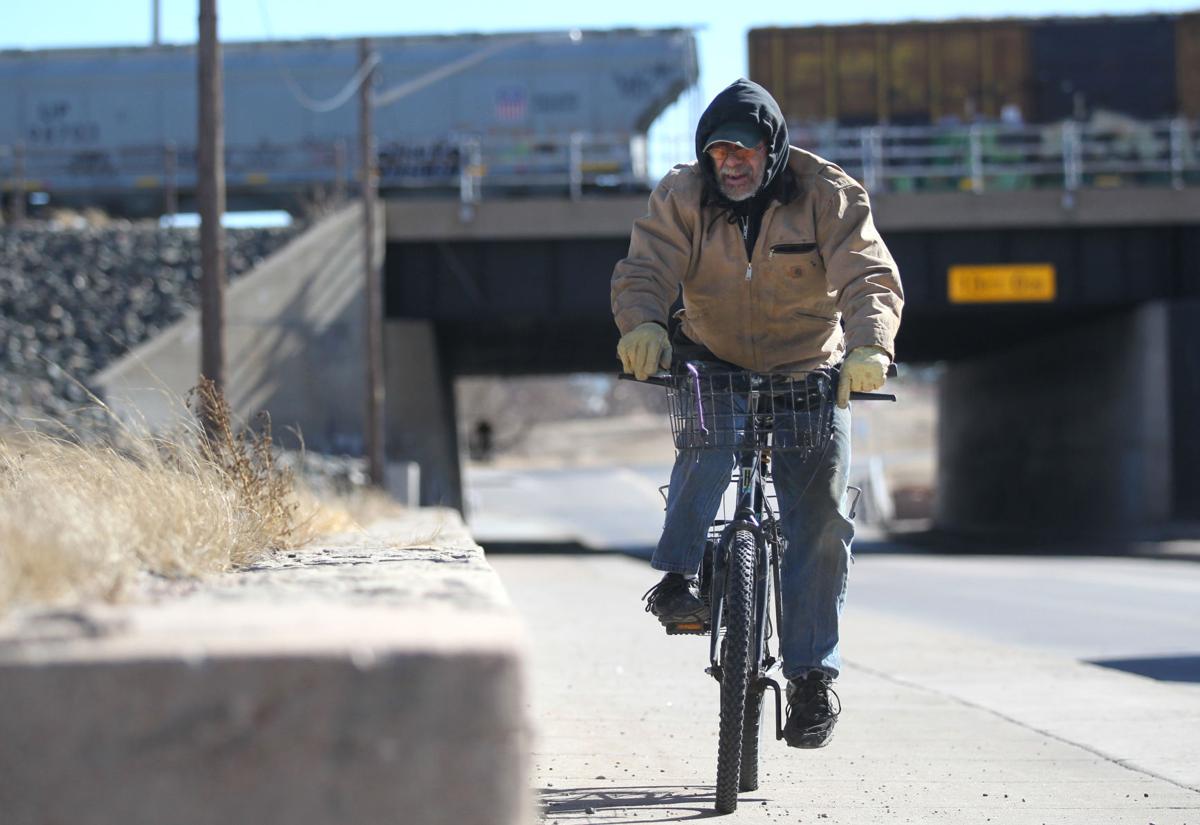
20180218_feature_bicycle rider_01.JPG
Cheyenne resident Dave Flores riding in his hometown.

But I digress.  Wyoming's stunning vistas and open spaces mean that people travel great distances for work, school or almost anything else in their lives.  So, getting the state to invest in bike or pedestrian lanes can't be the easiest "sell" in the world.  And that is what the Bicycle and Pedestrian System Task Force is telling the state to do.  

Although people often vacation in, or even move to, places like Wyoming because they believe the environment is pristine, there are environmental problems  not found in the larger, denser coastal cities.  Like neighbors Colorado and Montana, much of the state lies two kilometers or more above sea level.  Since the air is thinner at such high altitudes, it doesn't take very many vehicles to pollute the air. (Denver has some of the worst smog of major American cities.)  So, perhaps, Wyoming needs to encourage people to walk and cycle as much as, or more than, even Los Angeles--especially if more people decide to move there and enjoy its "rustic" charms.

23 February 2018

Gerry-cycling or Bike-Mandering?

Here in the US, it seems that political campaigns never end.  El Cheeto Grande has been in office barely a year, yet there is already talk about whether he'll run for re-election--or make it through this term.  There's even more talk about the midterm elections:  This November, many members of Congress are retiring, not running for re-election or face challenges to retain their seats.  Such things are normal after a new President is elected, especially if he is from a different party from his predecessor's:  The "opposite" party usually gains a few Congressional seats in the "midterm".


Some politicians will do just about anything to get themselves re-elected, including re-drawing maps. The purpose is to isolate voters of the opposing party in districts that vote for the party of the candidate who is running for re-election.  The boundaries of some redrawn districts are abstract, to put it charitably.  Others are creative in perhaps unintentionally perverse ways, such as the infamous one drawn for Elbridge Gerry (hence the name) in early 19th Century Massachusetts.


Now, if politicians are really interested in "fair and free" elections, their maps should look more like this:


which, by the way, is a GPS map of the ride Bill and I took Saturday!

22 February 2018

Playing Hooky--Sort Of

Yesterday and the day before, the weather was more like May--or even June!--than February.  Best of all, I managed to get out of work early enough the other day, and have enough time between classes and a late-day meeting yesterday, to do some non-commute riding.

I wasn't really "playing hooky", but I like to feel as if I were.  (Do people who say "as if I were" play hooky?)  In my defense, I'll say that I took my "guilty pleasures" in the Bronx, where I work.

New York City's most maligned borough has some of the most amazing murals.  I saw this one while riding a bike lane in the Hunts Point Market area that must have opened in the last year or two.  At least, I hadn't ridden there in a year or two, until the other day.  


Then I took in a view of the East River and South and North Brother Islands--the latter of which was the site of one of the worst maritime disasters in this city's history--from Barretto Park.


Not a bad way to end a work day, don't you think?

21 February 2018

Losing The War He Described: Andrew Tilin

Riders take to the road and take their chances.  There, they can encounter distracted, impatient or drunk drivers, lane-hogging SUVs, deteriorating pavement and traffic-clogged grids.  Multiple dangers exist from coast to coast.

So wrote Andrew Tilin in a 2014 issue of Outside magazine.  A frequent contributor to that magazine, Bicycling and other related publications.  A dedicated cyclist and amateur racer, he knew the hazards he described as well as anyone did.

Well, he became a victim of those very dangers.  On Saturday morning, he was riding in fog with the Gruppo VOP Cycling Club, based in Austin, Texas, when he got a flat tire.  He pulled to the side of the road to change a flat tire.  Meantime, a car skidded on the slick pavement and crashed into a truck, sending it careening into the side of the road--and Tilin.  He died soon after.

Andrew Tilin (center)


In addition to his columns, he is known in and out of the cycling community for what may have been our equivalent of Super Size MeSeveral years after Morgan Spurlock lived on McDonald's food and made a documentary of his resulting weight gain and other health issues, Tilin spent a year taking testosterone and wrote about how it affected his athletic performance and life in The Doper Next Door.

Members of Gruppo VOP are planning a memorial for him.

20 February 2018

Imprisoned In The Mist

I must say, I am really enjoying my morning commutes, now that I go through Randall's Island.  Even the knowledge of what lies beyond does not dampen (pardon the pun) my mood.


In this case, beyond that flock of geese--who are free to go wherever they like--and the fog are the most un-free people in this city.  Yes, Rikers Island is shrouded in that scrim of mist!

Well, almost:  It's hard not to feel down--no, let's say it, angry--when thinking about that place now, during Black History Month.  Instead of slave ships pulling into the harbor (Slavery was legal in New York until 1827.), black people--mostly young and male--are locked up on an island.

I channeled some of that anger into my pedals. And, I assure you, it goes into other kinds of activity!

19 February 2018

Just A Banana Peel Away...

Today is Presidents' Day in the US.

In past years, I've shown pictures of our leaders on bikes. Two years ago, I wrote about the origins of Presidents' Day automobile sales in the Washington's Birthday bicycle sales late in the 19th century.

Today I'm going to talk about one of the most maligned Presidents of our history.

To be fair, Gerald Ford ascended to the office under difficult circumstances:  His predecessor, Richard Nixon, had resigned because he was on the brink of impeachment.  

People might've cut Ford some slack had they elected him as Vice President.  The problem was, Ford became Nixon's second-in-command when his predecessor, Spiro Agnew, resigned his office as part of a deal to keep himself out of prison for, among other things, tax evasion.

Thus did Ford become the first unelected President in US history.  Some people felt resentful of this, which alone would have been enough to sully his reputation. Fair or not, it's not the only reason why, whether professional historians or laypeople are polled, he ranks low among Presidents.  

Aside from the way he came into the office, another thing some people hold against him was his pardoning of Nixon.  But, whatever people think of that, or any of his other actions, the only other thing people seem to remember about him is his clumsiness.  According to a popular joke of the time, Nelson Rockefeller, his vice-president, was just a banana peel away from the presidency.

From what I understand, though, "Gerry" wasn't always so cllumsy.  After all, he was an athlete in his youth.  And he managed to look pretty good on a bike:


Gerald Ford, surrounded by his cousins in front of his childhood home in Grand Rapids, Michigan

18 February 2018

Out For A Walk?

Sometimes, when I see a small person with a really big dog, I wonder who is walking whom?

Of course, if the dog is leashed to a bike, neither the canine nor the cyclist are walking each other.  But I have to wonder whether the dog is pulling the cyclist:


What's that about a dog's life?

17 February 2018

Ebony, Ivory....And Rubies

Did Stevie Wonder and Paul McCartney go to the North American Handmade Bicycle Show?

They probably didn't. But Helio Ascari did.


Of course, he brought something he crafted in his Brooklyn workshop.  The Brazilian-born custom bike builder is probably best known for wrapping leather string around his frame tubes to make them look as if they're woven, like baskets.  While the work is eye-catching, it's probably not surprising when one realizes that Ascari has made furniture and leather goods, and restored antiques.

The "something" he brought to the show takes his showmanship to another level.  It draws on skills acquired in other work he did before he became a bike builder:  as a fabricator of steel goods, and in the fashion industry. 


The bike in question, which starts with one of his leather-wrapped, Columbus-tubed frames, includes dynamo hub lighting and a Brooks B17 saddle with large copper rivets.  All right, those things are nice, but not terribly unusual. 

There's more copper-- and brass-- in accents on  the frame.  Oh, and carbon fiber-reinforced beech wood Ghisallo rims.


But the pieces de resistance are the brake levers made of gold and ebony--and 13 rubies applied on various parts of the bike, including the levers.


For only $38,000, it could be yours.  Or Paul's.  Or Stevie's.


16 February 2018

Where You Can Get Your Kicks

"You shouldn't let other people get your kicks for you."

That, of course, is a line from Bob Dylan's "Like A Rolling Stone."   When I was growing up, people said that whatever they did for pleasure was how they "got their kicks."

And, of course, there was that famous Nat King Cole song, "Get Your Kicks On Route 66."

I don't hear that expression much anymore.  But if I were to use it, I would say that cycling is one of the ways I get my kicks.

If I manage to get out to Missouri and Kansas, I must might be able to "get my kicks on Route 66."  Officials in those states are working to have part of the iconic highway, much of which fell into disuse after the Interstate system was built, as a bicycle route.

 
Joplin, Missouri bicycle shop owner Debra Johnson says designating a stretch of Route 66 as a bicycle route would be great for business.


So far, it seems that Missouri is closer to that goal.  According to a report, the designation could occur in the "Show Me" State some time this year.  To be fair, Kansas, which has the shortest stretch of Route 66, isn't far behind.


If efforts in those states succeed, we might be able to get our kicks on Route 66 in a way that Nat might not have imagined.  And we would be following Bob's admonition.