15 February 2020

Where We've Escaped Death--For The Past Two Years

As I have mentioned in earlier posts, Florida has had, for several years running, the highest--by far--bicycle fatality rate of any US state.  

A number of factors contribute to the high body count:  a car-centric culture, a lack of consciousness of cyclists among motorists, high rates of alcohol consumption and a lack of shoulders or sidewalks, let alone bike or pedestrian lanes, on most thoroughfares.  


One notable exception to the dark side of the Sunshine State is Flagler County.  It's the only county in Central Florida (roughly defined as anything within a two-hour drive of Orlando) in which a cyclist wasn't killed in 2018 or 2019.


I can attest that the county is indeed safer for bike-riding than other parts of the state (at least the parts in which I've ridden).  In fact, I enjoyed riding there and immediately saw the difference when I crossed into neighboring St.John's or Volusia counties, especially when I neared St. Augustine or Daytona Beach.


You see, the largest city in Flagler is Palm Coast, where my parents lived.  I've documented a few of my visits in this blog.  There are a number of paths in the city and county, and most of the major roads have, if not actual bike lanes, then wide sidewalks where cycling is permitted.  And, I must say, pedestrians, in my experience, were very courteous.


Plus, there just seemed to be more cyclists in Palm Coast and Flagler than in neighboring areas, or even in the areas around Jacksonville, Miami or Fort Lauderdale, where I've also ridden.  I don't know whether more people ride because the conditions are favorable, or those conditions exist because of the cyclists.  


My mother is gone and I don't know how much longer my father will stay in Palm Coast.  At least I have pleasant memories of riding there.  Little did I know that I was in an island in a storm of cycling mishaps!


14 February 2020

Rose, Thou Art Sick

Here's something romantic to tell your spouse, boyfriend, girlfriend, life partner, significant other or whatever you call him/her/them:


Of course, you would say it only if that person is also a cyclist.  If he/she/they are/is not a cyclist, you might witness aviation history in whatever space you share!

One Valentine's Day many, many years ago, I was riding my bike by the Rutgers campus.  I was flat broke, as I often was (and would often be on many occasions later).  What would I give, or do with, my girlfriend?  I could have made something, I suppose, but I wouldn't have felt right, knowing that I slapped it together in even less time than I wrote at least one of my papers.  And, at that point, my cooking skills consisted mainly of boiling and frying.

While pondering all of the things I couldn't give, or do for, her, I pedaled by the botany lab.  A blur of red, deep red, streamed into the corner of my eye.  Rose, thou art sickI'd read William Blake's poem at least a few times, but why was I thinking of it then--with a riot of deep crimson in my line of vision.

The dumpster outside the botany lab overflowed with those flowers.  Roses, redder than any in the Queen's garden--or any upper Madison Avenue florist. Rose, thou art sick.  They probably are not well if they're in that dumpster, I realized.  But they were so, so red, like the bloom of one who grows more beautiful while drawing closer to death. (I'd recently read a Japanese story like that.)  

Giving no thought to what might be keeping those petals redder than Mississippi in any election during my lifetime, I yanked my handlebar and made a beeline for that corrugated steel cornucopia of floral bounty.  I propped my bike and scooped as many roses--their stems still attached!--as I could handle.  I found a piece of twine lying nearby and used it to tie whatever I couldn't carry to my handlebars, top tube and seat tube.

On my way back to my apartment, I stopped by an art studio and appropriated some ribbon, and large vase from a conference room.  Then I pedaled to the language houses, where my girlfriend stayed.

One of her housemates answered the door.  Slackjawed, she darted up the stairs and summoned, it seemed, all the other girls in that house--and my girlfriend.  They watched as I handed her more roses than any of them had seen in their lives.  Oh, and those roses were redder--even if they were sicker.

About the only thing that's the same in my life is that I still ride my bikes.  I have a few more than I had then, not to mention the memory of that day, when I might have made someone happier (and a few of her friends more envious) than I've made anyone since.

I still wonder what kept those roses so red--for almost two weeks after I found them!  Rose, thou art sick.  A few years ago, I looked her up, worried that those roses may have made her give birth to sick children.  As far as I can tell, she remained childless.  Because of the roses?  

They don't seem to have affected me.  I still ride, after all.  

10 February 2020

A Motor City Gets A Bicycle Mayor

It's no surprise that cities like Amsterdam and Paris have "Bicycle Mayors."  But what if, say, Detroit were to select such a person?

Turns out, the equivalent of that has happened in England.  Adam Tranter, who runs a public relations and marketing agency, has just been appointed as the first Bicycle Mayor of Coventry, often referred to as Britain's "Motor City."

Bicycle Mayor of Coventry.
Adam Tratner


Interestingly, during the 1950s, Great Britain was the second-largest producer of automobiles (after the US) and the largest exporter of cars.  But the decline of Coventry, and the British automotive industry, mirrors that of its American counterpart and Detroit:  more innovative and higher-quality machines, competitively priced, began to enter both countries from France, Germany and Japan from the 1960s through the 1980's, at the same time the perceived (and sometimes actual) quality of domestically-produced vehicles plummeted.   The British decline was exacerbated by the introduction of low-priced cars from Eastern Europe and Asian countries not named Japan.

Ironically, both Coventry and Detroit were centers of their countries' bicycle industry:  In fact, many developments--including the "safety" bicycle, with two wheels of equal size driven by chain and sprocket gearing--come from the Midlands area around Coventry.

 The fact that both countries were incubators, if not cradles, of their nations' bicycle industry is one of the reasons why they became automotive centers:  Just as Henry Ford and other pioneers of the American automobile began as bicycle mechanics or designers, British bicycle designers transitioned into motorcycles and cars. 

A further irony is that as the automobile manufacturing disappeared, both cities actually became more auto-dependent:  According to one survey, 64 percent of all trips to work or school in Coventry were made by car, as opposed to 3 percent by bicycle.  One of Mr. Tratner's jobs, in his voluntary position, will be to get more feet away from gas pedals and onto bicycle pedals.  

Perhaps one day Coventry will return to its "roots," if you will.  Could Detroit go the same way.


09 February 2020

08 February 2020

Who Owns The Road In Gaborone?

I own the road:  I pay road tax.

I've heard some version of this argument over the years.  What drivers often forget is that those of us who don't drive are paying all of the same taxes as those who use their cars to get to the corner store.  As I pointed out to someone who accused me of taking "his" parking space, the only tax I don't pay that a driver pays is the one levied on gasoline.  But, in a sense, I pay for it, as other taxes, at least to some degree, subsidize the relatively low cost of petrol here in the US, just as the deductions from my paychecks help to pay for road building and maintenance.


The "I pay, I own" argument is even more emphatic, or vehement, in those places where a newly-emergent middle class is forsaking two wheels and pedals in favor of four wheels and gas pedals.  That, of course, was the story of Chinese cities early in this century.  Now it seems to be the narrative in Gaborone, the capital of Botswana.


Whereas most people rode bikes to school or work just a few years ago, now the bicycle has a double stigma:  It is seen as archaic and something that you use only if you're poor.  


I've never been to Gaborone, but according to BBC correspondent Sharon Tshipa, it's "the worst place in the world to ride a bike."  Not only are the drivers as reckless as the worst kinds of teenagers, they are quite open in expressing their hostility toward cyclists.  Some even threaten or promise to mow down riders.


These dangers to bicycle riders’ physical safety and mental well-being are compounded by hazards to their internal medical condition. Gaborone has some of the world’s worst air quality.  The sheer volume of vehicular traffic would, by itself, be enough to degrade the city’s environment.  But a particular quality of the city’s fleet makes things worse.  While some new cars are imported from neighboring South Africa, many more used vehicles come from other countries, where they failed to meet emission standards.

Whether or not Gaborone is the worst place to cycle, it’s sad to see people forsake their bikes, and disturbing that such hostility has developed against remaining cyclists.  From what I understand, some Chinese cities are re-discovering the bicycle.  Perhaps Gaborone will do likewise one day.

07 February 2020

The Novel Coronavirus And New Bikes

Perhaps the novel coronavirus hasn't gotten you sick--yet.  It might, however, keep you from buying the new bike you want.

Even though some major bicycle manufacturers shifted their production to Vietnam, Cambodia or Taiwan in response to the tariffs imposed on Chinese goods,  there is a chance that the new Bianchi or Rocky Mountain machine you've been eyeing is nonetheless made by Chinese workers.  Some of those factories are, out of caution or fear (depending on your point of view), shutting down temporarily.  While some company executives and factory managers believe they are protecting their native workers from possible contamination, others may be acting out of anti-Chinese sentiment sparked by the virus outbreak.

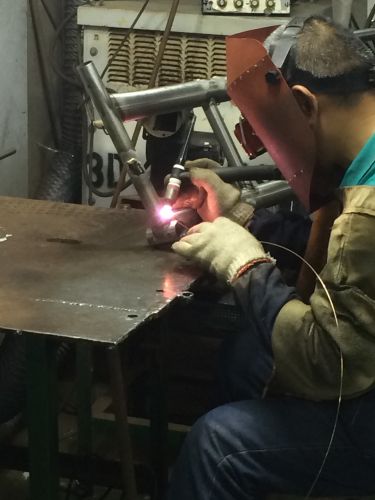
A welder at a Taiwanese bike factory. BRAIN photo.


Even those factories that haven't shut down could experience (or are experiencing) slowdowns because they're supplied with parts or machinery made in other affected factories.  As an example, one factory in Vietnam is a major supplier of frame tubes to plants in Cambodia and China that turn out bicycles for Trek, Specialized, Norco and other familiar brands.  

Stoppages or slowdowns in production at Asian factories could, moreover, disrupt the manufacture of bikes in other countires, as many depend on Asian suppliers.

So, be well and, if you want to buy a new bike, be patient!

06 February 2020

Will The Velo Continue to Vive After The Greve?

I can recall three transit strikes in New York City.  The first began with the new year in 1966.  I was a child then, and the main thing I recall is my father missing a couple of days of work, then taking cabs with co-workers.  

The second lasted nearly as long, and began on April Fools' Day in 1980.  I was a student at Rutgers but was making frequent trips into New York.  Back then, buses along the Princeton-to-New York/Port Authority Route had large luggage hatches on their undersides.  Since they were almost never used for the intended purpose, and because the bus operating company didn't seem to have any written policy against using those hatches for any other purpose, I and a few other cyclists would stow our bikes in them.  I recall one friendly driver who'd help us angle our bikes into the compartments and make sure the door was shut; other drivers simply looked the other way.  So, once I arrived in the city, I had a convenient way of getting around.

The last strike I recall began just before Christmas in 2005. Subway and bus workers walked off their jobs for three days.  I was teaching at another college and, since the strike coincided with the end of the semester, we were concerned that exams would be postponed until January--and that I'd have to postpone or cancel a trip I'd booked for then.  Thankfully, that strike ended before the holiday and only a few classes and exams, none of which were mine, had to be rescheduled.

During the 1980 and 2005 strikes, many commuters walked or rode bicycles to work.  (In fact, the practice of wearing a business suit with sneakers and carrying dress pumps or wingtips in a bag is said to have begun with the 1980 strike.)  I have had a difficult time finding statistics to confirm my observation that, while some continued to pedal to their offices, stores, factories or schools after each of those labor stoppages, more people continued to ride to work after the 2005 walkout than after the 1980 halt to the trains and buses.  

If my observation can indeed be borne out by empirical data, it would indeed be interesting, especially because the conditions of each strike were very different:  The 1980 strike unfolded with some of the blooms in the city's gardens, while the 2005 strike coincided with both the official beginning of winter and that season's first cold spell. 

Also, because the 1980 strike was much longer, one might expect the habit of cycling or walking to become more ingrained than it would have during the 2005 stoppage.  

Then again, some who weren't so inclined to ride or walk might have seen having to do so during the long 1980 strike in the way people viewed shortages and other privations during World War II or other protracted national emergencies:  They were eager to get back to their old ways.  On the other hand, having to bike or walk for only three days might leave people with more pleasant memories.

Moreover, as I recall, 1980 was a "year without a spring".  A cold, damp April gave way to a heat wave in early May that presaged a hot, dry summer.   Perhaps such weather was a disincentive to continue cycling, at least for some people.  On the other hand, after the cold wave during the strike, the winter of 2005-2006 was mild.  Perhaps it is no coincidence that the surge in the number of commuters and recreational cyclists began to surge right around that time.

I mention all of these things because the strikes in France--which include greves on the Transports Parisiens et Transiliens--have ended.  The trains and buses, with a few exceptions, came to a halt for most of December and January.  So there is a valid basis for comparing the change in transportation habits as opposed to the previous year.


Turns out, on the whole, the number of January cyclists in the City of Light--at least as measured on its major bike lanes--increased by 131 percent--over the first month of 2019.  That is to say, the numbers more than doubled and on two--the Voie Georges Pompidou and le Pont National--more than three times as many cyclists rode by.


It will be interesting to see how many of those "new" cyclists continue their riding habit as Metro and bus services return to normal.  I suspect they will, simply because cycling culture, while not as prevalent in Paris as in other parts of France, existed to a greater degree than it did in the Big Apple when its conductors, drivers and maintenance workers walked off their jobs.  Also, Paris' system of bike lanes and other infrastructure is more extensive and generally more useful than what New York has even now, let alone 15 years ago or 40 years ago, when it was all but nonexistent.

All I can say is to Paris is Vive la Velo!


05 February 2020

Capital Fine

Even a stopped clock is right twice a day.

I could say something like that on those rare occasions when I agree with the Automobile Association of America or the Washington Times.  Well, today I hit the "daily double," if you will.

The District of Columbia's Department of Public Works says that, later this month, it will begin to levy $150 fines on drivers who stop or park in bicycle lanes.  Perhaps not surprisingly, both the WT and AAA hate the idea.  

One point on which I agree with them is that the move probably won't help to improve cyclists' safety or the flow of traffic.  I am not familiar with that city's bike routes, but if they're anything like some that I've seen here in New York, they're worse than no lanes at all for cyclists.  And, of course, they frustrate drivers.


Perhaps more to the point, though, is this:  New York's ban against stopping or parking in bike lanes is rarely, if ever, enforced.  Will the Capital City do better in making drivers better at respecting the rights and safety of cyclists as well as pedestrians?

If it doesn't, the result will most likely be more injuries and fatalities--and frustrated drivers, which could lead to more deaths and injuries.  

Even more important, though, is the design of both lanes and streets.  Unless that is improved, no other policy or piece of bicycle "infrastructure" will do anything to help both motorists and cyclists navigate often-chaotic conditions. 

03 February 2020

Am I Worth Half?

Nobody likes it when somebody gets away with murder.

At least, that is my belief. Too often, though, it's put to the test when the dead person is a cyclist.  It seems that too many police officers are unwilling to arrest intoxicated or negligent drivers who run down people on bicycles.  And, if the cops do their jobs, too many jurors and judges are willing to let such drivers go with a "slap on the wrist."


In fact, hostility is directed toward the cyclist in much the same way it was, not so long ago, directed at rape victims:  Somehow, in the minds of some people, the cyclist or rape victim brought it on him/her self.

So, it catches my attention when a hit-and-run driver who kills a cyclist is actually brought to account for her actions.

I used the female pronoun because, in this case, the perpetrator is indeed female.  Lacey Jade Jordan of Oakdale, Louisiana was driving a Chevrolet Silverado south on U.S. 165 when she struck Taurus McQuarn, who was cycling in the same direction.  She struck him and fled the scene.


Lacey Jade Jordan


Notice that I said "her actions."  You see, it's not the first time Ms. Jordan has done something like that.  In November 2012, she struck and killed another cyclist along the very same road.  Then, she and the cyclist were both traveling on the northbound side.

So, it took two cyclists' deaths before a negligent driver was arrested and charged.  Does it mean that, in the eyes of Louisiana law enforcement, each of our lives is worth half of a non-cyclist's life?