
Some time during today’s ride, Governor Cuomo resigned. It’s not related to my ride or the weather. At least, I don’t think it is.
Whatever I can or can’t affect, I don’t feel resigned to anything when I ride.
I've been called "crazy" and worse for crossing city, county, state and national boundaries--and mountain ranges--on my bike. And for working as a bike messenger in Manhattan. And riding on a velodrome.
But I admit there are some things I haven't tried, and don't plan to. I don't know whether I fear heights more than other people, but what these women are doing is above my pay grade.
They weren't doing a "one off" stunt. Rather, the contraption they're pedaling almost 1000 feet above Wansheng Ordovician Theme Park in China is an attraction open to the public.
Last week, I did four rides on four different bikes--all of them mine.
If you've been following this blog, you've seen three of them: Dee-Lilah, my Mercian Vincitore Special; Tosca, my Mercian fixed gear and Negrosa, my vintage Mercian Olympic. But I didn't mention what I rode to Point Lookout that Friday.

La-Vande, a Mercian King of Mercia, rose from the wreck of Arielle, the Mercian Audax I crashed last June. One of the few good things that came from that mishap--save for the support you, dear readers, showed--was a settlement to cover another bike.


I intended La-Vande to be the "winter" and "rainy day" version of Dee-Lilah, my Mercian Vincitore Special. So, I specified the same geometry but a slightly heavier tubing--Reynolds 725. And I'd asked for a different color scheme because I'm not trying to build a "Stepford" fleet.
Well, the frame was built with the same Reynolds 853 tubing as Dee-Lilah. And it was painted in the same colors, though La-Vande's lilac paint is slightly lighter. Grant at Mercian said it was probably a result of a "different batch" of paint. He apologized, but I wasn't upset, really. What La-Vande is, essentially, Dee-Lilah with less fancy (though still lovely) lug work--and some slightly less expensive components, most of which came from my parts bin.
Anyway, I pleased with the bike. It's a "younger sister" to Dee-Lilah. I figure that since she has a geometry and build I like, it doesn't hurt to have another bike like her.
Here is a list of La-Vande's specs.
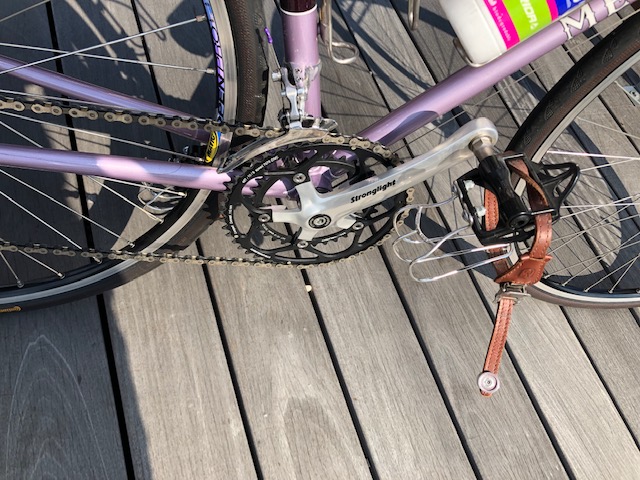
Frame: Mercian King of Mercia, Reynolds 853 tubing.
Headset: Tange sealed bearing.
Wheels: Phil Wood hubs.
Mavic Open Pro 36 hole rims.
DT Competition spokes.
Tires: Continental Gator Skin folding 700 X28
Brakes: Shimano BR-R451
Tektro RL 340 levers
Mathauser Kool-Stop salmon pads
Crankset: Stronglight Impact, 170 mm, 48-34 chainrings
Bottom Bracket: Shimano UN-72, 68x107mm
Derailleurs: Shimano Ultegra 6500 rear
Shimano Dura Ace 7400
Dura Ace downtube levers
Cassette: Shimano 105 9 speed, 12-25
Chain: SRAM PC-971
Pedals: MKS Urban Platform with "basket" toe clips and Velo Orange toe straps
Handlebars: Nitto 177 "Noodle" 42 cm, wrapped with Newbaum's Eggplant-colored cloth tape
Stem: Nitto NP 110 mm
Seatpost: Nitto 65
Saddle: Brooks Professional
Accessories: Nitto M18 front rack, Zefal HPX pump, King "Iris" water bottle cages

In another post, I'll tell you about the bags on this bike--which I've also been using on some of my other bikes.

I’m not cycling to Connecticut today. Instead, I’m on another familiar ride: to Point Lookout.

Another thing is familiar: the weather. While it’s a couple of degrees warmer than it was yesterday, today feels more like early June than early August. I don’t mind that, or even the veil of blue-gray clouds that conceal the sun but pose no threat of rain. Those clouds even rein in the wind and tides, or so it seems.

I will not complain: It’s been a while since riding has felt as good as it has during the past few days!

I have done what just might be the strangest sequence of cycling I’ve done in a while. What makes it so odd is its familiarity: I have done the same ride three times in five days: today, Monday and Saturday.
Why did I do that? Well, I took Negrosa, my vintage Mercian Olympic, to Greenwich, Connecticut on Saturday. That has become a frequent weekend day ride for me. I took that same ride on Monday because I wanted to start the week right. And today I hopped on Dee-Lilah, my Mercian Vincitore Special. The weather—overcast, with no threat of rain and temperatures that maxed out at 24C (75F)—was ideal and I just wanted to ride and ride. Somehow I ended up taking that 140 kilometer round trip again.

Perhaps an unconscious, or at least unacknowledged, wish guided to today’s ride. Whether it had to do with Dee-Lilah, the weather or me, today I felt better riding today than at any time since last June, when a crash led to a weekend stay in Westchester Medical Center.
If I can say “this is the best I’ve felt” at my age, I guess things are pretty good.
Tosca, my Mercian fixed-gear bike, has some NJS-approved parts on it. I have never made any effort, however, to make it or any other bike I’ve owned NJS-compliant.
Parts and bikes with the designation are approved for use in keirin, a form of track racing in Japan. As I understand, NJS standards were created so that no racer is at an unfair advantage or disadvantage because of his equipment. That is why NJS- approved equipment perpetuates standards from the 1970’s and ‘80’s: Frames are steel and wheels have 36 spokes.
Because bets are placed on riders, officials also want to ensure that a race isn’t decided by broken equipment. Thus, NJS standards emphasize strength and reliability.
A consequence of NJS standards is that they don’t make for putting together the lightest possible bikes. That is why, for example, Olympic track racers don’t ride NJS equipment.
Those racers include Australian Alex Porter. He and his fellow Team Pursuit teammates were seen as possible gold medal winners in Tokyo. That is, until he came crashing down on the track and sliding across the boards. That ended Australia’s qualifying run after a minute. The team was able to make a second attempt, in which they finished fifth. Now they have a difficult task ahead of them if they are to contend for even a bronze medal.

What sent Porter, and his team’s hopes, crashing down? A broken handlebar.
He was riding an Argon 18 bike. Argon VP Martin Faubert said, “While Argon 18 has designed a handlebar for the bike, and provided that bar to the team, it was not our bar in use during the incident.”
Somehow I think NJS standards also preclude statements like that from executives of Sugino, MKS and other companies that make equipment for Kerin.
Lockdowns and other restrictions induced by COVID-19 have left people dependent on deliveries for everything from pharmaceutical s to pizza.
Here in New York, as in much of the developed world, Amazon trucks and electric bicycles with delivery boxes have become ubiquitous. A shrinking but still significant number of restaurant and store delivery workers, however, still use bicycles that have only the riders’ legs as their power source.
It seems that the less-developed and poorer parts of the world depend to an even greater degree on regular pedal bicycle. Those are also areas that, because they have fewer resources, have been even more devastated by the pandemic. They also tend to have tighter restrictions on people’s movements and on businesses because their hospitals are even more overburdened than those in wealthier areas.
Just about everything I’ve mentioned in my previous paragraph could be used to describe the situation in Semarang. This city of three million (roughly the same as Chicago) is one of the worst-hit areas of Indonesia , which has become Asia’s epicenter of the epidemic.
Such places also tend to rely to a greater degree on volunteers. They include 35-year-old Arrahman Surya Atmaja, who delivers food, prescriptions and other items to isolated residents as part of the volunteer delivery service he started in April.
 |
| Arrahman Surya Abakan, left, with another volunteer .Phoro by Budi Purvanto, for Reuters. |
He says his most common deliveries include medicines or vitamins he picks up via WhatsApp or Instagram. He and other volunteers have had to lift their bikes over barricades blocking off “red zones” with high rates of infection. “Maybe because we are helping the community, it will somehow boost our immunity,” he joked.
While most of his runs are to residences, he unwittingly went to an ICU ward. “I got scared, but my feelings went away when I remembered I only want to help.” He added that he and other cyclists try to make contactless deliveries.


