15 December 2021

Stolen Elections And Traffic Lanes

There is nothing so demonstrably false that, if repeated often enough, large numbers of people will take as fact.  

This is especially true today, with social media as such a powerful tool for amplifying misinformation or outright lies.  (I know, you're reading this over social media.  What can I say?) If the election of Donald Trump--and the notion that he had re-election "stolen" from him--hasn't taught us as much, I don't know what will.

One problem, I think, is that people who are in a position to question such stories---a polite way of saying "folks who ought to have well-tuned bullshit detectors"--accept, wittingly or not, misinformation at face value.  They don't question the sources of such stories, let alone how anyone came to the conclusions that are spread as lies or disinformation.

A recent example came in the form of a questionable study that morphed into an urban legend via the British media.  To be fair, such a scenario could have--and probably has--played out in other countries and cities.  It's one thing when the Daily Mail (which, as best as I can tell, seems like England's equivalent of the New York Post) spreads, as we would say in the academic argot, narratives with a tenuous relationship with verities. It's another when outlets as august as the BBC spread such nonsense.  The Daily Mail's headline proclaimed, "Cycle lanes installed at start of COVID pandemic help make London most congested city in the world."  BBC London made it sound more reasonable, or simply toned it down:  "Cycle lanes blamed as city named most congested."

The story could have gotten even more traction had Peter Walker, a reporter on transportation and environmental issues for the Guardian, spoken about it  on a national radio program.  At least, more people would have taken the narrative as an article of faith if he’d spoken about it as the program’s producers might have expected. 

He had been contacted to do that, he says.  As he checked the story, the program's producers decided to bring on somebody else.  From what Walker says, I can't help but to wonder whether the person they chose parroted the lines from the Daily Mail and BBC London items.

Turns out, the business about London being the most congested city came from a report called the "Global Traffic Scorecard."  Its title makes it seem plausible enough--until you realize that it was issued by a company called Inrix, which sells traffic data.


Photo by Dominika Zarzycka, from the Guardian


Now, I haven't been to London in a long time, so I can't offer even anecdotal evidence to confirm or refute the report's conclusion.  For all I know, London might be more congested than Paris or Athens, two large cities in which I've cycled during the past couple of years.  And it may well be more choked with traffic than cities like Luang Prbang or Siem Reap, which I've also recently ridden.  

One problem is that whoever compiled the Inrix report couldn't tell us whether the British capital is more congested than any Asian, African or Latin American city because no such places were included in the study.  

Another is that their determination of London as the most congested city is based on--again I'll revert to academic argot--flawed methodology.  It seems to be based on the premise that traffic is like water:  its flow is determined by the width of the pipe, or road.  Decades of research have refuted this idea (commonly called "induced demand" or, for laypeople, "build it and they will come") about traffic, but it seems to be a foundation for the report--and an Inrix employee who embellished and amplified it.

Peter Lees' official Inrix title is "Director of Operations--Media."  In other words, he's a publicist (which, I blush to admit, I was for a (thankfully) brief time). Such people tend not to be "traffic wonks," Walker says, or a wonks of any kind.   Now whether Lees is a bald-faced liar, or simply someone who doesn't actually read the stuff he represents to the media, I won't say. I will, however mention this:  He linked London's congestion to bike lanes--which are not mentioned anywhere in the 21-page report.

Now, I have all sorts of issues with bike lanes, at least as they exist in too many places.  I've ridden too many, especially here in New York, that are poorly conceived, designed, constructed and maintained.  They don't provide practical or safe routes for transportation cycling:  Few link to other bike (or bikeable) routes or to places where significant numbers or would-be cycle commuters study, work or shop.  But any traffic congestion--including that of Crescent Street in Astoria, where I live--existed before bike lanes were built.

Misinformation, whether or not it's intended as such, can cause people to believe things that are demonstrably false and act in irrational ways, especially when it's amplified by folks with actual or metaphorical microphones.  So, in that sense, what leads folks to think that bike lanes cause traffic congestion is basically the same as what causes them to believe their candidate had an election "stolen" from him.


14 December 2021

The Girl Puzzle

Yesterday I managed to sneak in a ride before sunset.  It wasn't long, but it took me to familiar haunts I hadn't ridden in a while:  a few loops around Roosevelt Island.

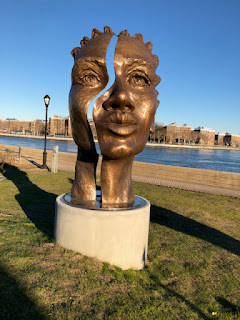
It's probably been a couple, maybe a few, months since I last took a spin on the island.  However long it was, enough time had passed to see something new:


Actually, it's been under wraps for a while.  It was supposed to be unveiled last year, but the COVID pandemic delayed that, and other things.  


The "Girl Puzzle" installation is an homage to Nellie Bly, a pioneering journalist.  Next year will mark the centennial of her death:  two years after she, and other American women, won the right to vote. 


In a way, it's appropriate that the installation stands before the lighthouse, as she shed light on all sorts of terrible, scandalous and interesting situations.  One of them prevailed at the other end of the island, in its now-closed sanitorium.  As flimsy as this country's mental health care system is, it was much worse in her day.


She was able to write an expose of it--which morphed from a series of articles into a book (Ten Days In A Mad House)--and much of her other work by going under cover.  That, of course, makes it ironic that the installation is by the lighthouse.  Perhaps equally ironic is that she was able to go undercover at a time when she was conspicuous simply by being a woman doing paid work, let alone journalism.  Then again, her first published work, in the Pittsburgh Dispatch, was a response to a previously-published misogynistic complaint about female wage-earners.

The title of that piece was..."The Girl Puzzle." While it garnered complaints and other negative reactions, the editor realized her potential and had her write more pieces.  Soon after, he hired her as a full-time reporter.

Although women in professions like journalism have become the norm, we still have to solve "The Girl Puzzle":  How do we--whatever our gender identities, however we express them--realize our potential and our dreams while remaining true to ourselves and dealing with those who try to enforce their notions of what men or women, boys or girls, should be?  


As I looked at "The Girl Puzzle," I couldn't help but to think about Simone Biles and the other female gymnasts who, yesterday, reached a settlement against their sport's governing bodies in their case against their coach--and abuser.  It sounds like a story Nellie Bly would have covered--and been appalled that she had to at this late date.


13 December 2021

A Turn: A Curtain Lifts

Why do I take the same rides again and again?

Sometimes I just want to ride on "autopilot":  I don't want to think about navigating.  Or, conversely, I might want to lose myself in the rhythm of pedaling and navigating, especially if I'm weaving through traffic.

But, oddly enough, sometimes I'll ride a route I've pedaled dozens or even hundreds of times before because I somehow know that within the familiarity, I'll see something new:  a turn might reveal a new view of something I've seen for years.

That is what happened the other day, late in the afternoon.  I took Tosca, my Mercian fixie, for a spin along the Flushing Bay Promenade, which starts by LaGuardia Airport and passes the World's Fair Marina and Citi Field on its way to Flushing.

On my way back, I saw a Midtown Manhattan sunset through a scrim of winter branches:


A second or two, a few pedal strokes and a left turn later, the curtain lifted, so to speak:


There is always a show, a spectacle, even on the most quotidian ride.  Maybe that's what's kept me on my bike for all of these years!


11 December 2021

An Oxymoron Ride

Peter White is an original.   He has been helpful when I've  consulted him, whether or not I bought anything.  His sense of humor, though, is, shall we say, quirky.  I like it, but it may not be for everybody.

An example is his attitude about downhill riders.  His shop doesn't carry parts for bikes ridden by "those poor unfortunate people with green or pink hair who have to be carried up the mountain on a ski lift so they can ride down yelling "Yo Dude!" He calls their machines "invalid bikes" which, he claims, is a play on what he regards as "valid" bikes.  Naturally, some  folks believe he's denigrating folks with disabilities and send him nasty e-mails, or worse.

I'd love to hear what he'd say about a "downhill bike tour."  I never knew such things exist until someone sent me an article about people who want to regulate them in Hawaii. Apparently, tour groups meet their guide and support vehicle at the top of a mountain, where they watch the sunrise before barreling down into the town.  


Photo by Matthew Thayer, for the Maui News


Me, I don't know how you can call something a "bike tour" if it's only downhill.  I can understand a ride that's flat.  But whatever anyone wants to say about the speed at which I currently ride, I can say that on every tour--or even every transportation ride--I've taken, if I've ridden down something, I've ridden up it, or something else.  Well, OK, once I went on a downhill mountain bike ride back in the 90s when that first became a "thing."  Yes, I went up on a lift, as everyone else in my group did.  But I did it on a hardtail bike, albeit with a Rock Shox front fork.

Now some folks in Maui want to impose tighter regulations on those downhill tours.  They complain that even the guided tours show little regard for the safety of children and pedestrians.  Not surprisingly, they believe the "wildcat" riders are even worse.

Not only have I never taken a "downhill tour;" I've also never been to Hawaii.  So I have to take their word about those tours. I, though, would want to regulate them in another way:  They shouldn't be allowed to call themselves "tours."  I'd bet that at least half of the people on those rides don't pedal even a single stroke.  To me, if all you do is coast down a hill--as much fun as it is--you don't have the right to say you did a "tour."

In other words, I believe the phrase "downhill tour" is an oxymoron.

10 December 2021

If A Police Officer Rolls A Bike Over Your Head....

If someone rolls a bicycle over someone else's head, could that be construed as excessive use of force?

Hmm...I must admit I'd never pondered that question.  Most likely, there aren't very many people who have. One who had to is Andrew Myerberg.

He is the director of Seattle's Office of Police Accountability (OPA).  The poor fellow who got tire tracks on his forehead was Camillo Massagli, who was known for showing up at street protests and playing his trumpet.  At one of those events last year, held in the wake of a grand jury's decision not to indict Louisville police officers in the killing of Breonna Taylor, Seattle PD Officer Eric D. Walter rolled his Department-issued bike--with two flat tires--over a supine Massagli's head.

Massagli, for his part, declined to pursue charges because, he explained, "I cannot use a penal system I reject for revenge, not in good conscience," though he added that Walter's and other officers' actions showed "disregard for human life."

King County Sheriff's Detective Mike Mellis investigated Walter for assault but did not find probable cause.  He reasoned that Walter and other officers had a right to "peacefully" remove protesters from the street.  Although he conceded that Walter "purposely rolled his bike over" Massagli's head, as recounted in an OPA summary, he said that such an action "would not necessarily be expected to cause someone pain."

Okay...I'll try that if I ever roll a bicycle over someone's head:  "Officer, I really meant no harm!"

At least Mellis, Walter and the officers who worked with him weren't the only ones who had input on the OPA summary.  It didn't dispute Walter's claim that that he "needed to stay on his line and could not move as it might confuse the officers following behind him."  It, however, averred that a review of video from that day found "no indication that he ever lifted the bicycle while walking over" Massagli.  

So what was the result of this investigation?  Walter got a seven-day unpaid suspension. (It's unclear as to whether or not he's served it.) Walter and the union are, of course, appealing it.  As a 14-year veteran of the force, Walter had a base salary of $130,471 in 2020 and made another $20,544. (I wonder whether working that protest was part of his regular salary or overtime.)  So the suspension, should or has he served it, would cost him about $2509 of his base pay. One wonders whether Massagli will pay in some other way--whether through physical pain or emotional trauma, now or in the future, whether or not Officer Walter meant to hurt him.

Screen grab from a video at the protest. (Courtesy of C.J Halliburton and Joey Weiser, for the Seattle Times.


09 December 2021

More Bikes, More Parts, More Help Needed

 The COVID-19 pandemic has affected the cycling world in all sorts of ways.  You've probably noticed more people on bikes during the past year and a half.  And, if you wanted to buy or fix a bike, you probably found it more difficult, or even impossible, to find the bikes, parts or accessories you need--and that, if you can find them, they're more expensive.

That last factor--scarcity and expense--has been particularly difficult for programs that distribute bikes during the holidays.  Some, such as the Boise Bicycle Project, have, in years past, relied on bikes refurbished in local jails and prisons.  Those programs, which typically trained volunteer detainees, have been suspended or stopped altogether due to distancing requirements.  Also, the businesses--whether bike shops or big-box stores like Wal-Mart--that donated bikes or sold them at significant discounts (sometimes at wholesale prices or not much more) just don't have bikes or even helmets or other accessories to donate.  And, individuals who donate bikes often do so after buying new bikes for themselves or their kids:  the old bike is the one that gets donated.

That last fact relates to another of the problems I mentioned.  Donated bikes are usually fixed by volunteers in the distribution programs before being passed on to a needy kid or adult.   Just as the Idaho prison program mentioned in the article has been put on hold, so have other programs in which volunteers refurbish bikes, such as those in Recycle-a-Bicycle type operations, local bike clubs, schools or other organizations.  It's pretty hard to show someone how to true wheels or replace brake cables while maintaining social distance.


And, while some volunteers in distribution programs have the skills and tools to fix the bikes, they may not have the necessary parts, or any way of getting them.

So, the program in the article--and, I am sure, others--are urging people not only to donate bikes, but also to fix them, if necessary, before giving them.

If you donate or fix bikes in a program like BBP, you deserve special kudos this year.  And, whether or not we receive one of those bikes, we should be grateful for the extra effort they're surely expending this year!

08 December 2021

Imagine There's A White Bicycle

In a terrible irony, John Lennon was murdered the day after Pearl Harbor Day.

That was 41 years ago today.  I don't think it's hyperbolic to say that it shook some of us in the way that the "surprise" attack roused Americans and the world. 

In another terrible irony, the man responsible for "Imagine" and other songs calling for peace and unity was cut down by a lone gunman who claimed to be inspired by a fictional character who probably would have listened to Lennon's (and the Beatles') music and probably wouldn't have committed violence simply because he turned all of his anger inward.

(Of course, Lennon's murder points up to one of the ways in which the US gets things backwards.  In other countries, everyone has access to health care--which includes mental health services-- but very few people who aren't police officers or military personnel have access to firearms.)

Anyway, apart from his music and being married to the woman blamed for the breakup of the Beatles (I think she was a catalyst, not a cause), he and she were known for their "bed-ins" for peace.  At their second, in Amsterdam, they were given a white bike that was part of the Provo plan. 


Think of Provo as a kind of Dutch proto-Occupy Wall Street:  It began as a counter-culture movement during the mid-1960s.  It had a cultural wing,  which staged "happenings" and an activist wing that provoked (hence the name) the police through non-violent means. 

There was also a political faction that actually won a seat on Amsterdam's city council and had a number of goals to make their city and country more liveable and what we would now call "green." Those goals included the closing of central Amsterdam to motorized traffic.  That, of course, is probably Provo's most recognizable and lasting legacy:  One could say that the "White Bicycle" plan set the Dutch capital on its path to becoming the cycling haven it is today.

That, I believe, is something of which John Lennon would have approved.


07 December 2021

It Wasn’t His Fault

 When I was a Manhattan bike messenger, I sluiced through taxis, delivery trucks, buses and pedestrians with craned necks. 

But I had nothing on this courier:


The photo is fabricated, but it symbolizes a real story:  A Japanese-American bicycle messenger pedaled through the attack on Pearl Harbor with a message for General Walter Short, who was in charge of defending it.

The message?  A warning of an attack.

Japan had intended to issue a declaration of war half an hour before the attack.  The US Army had already decrypted the message the evening before, and had dispatched alerts to all Pacific-area commands. But communication problems delayed receipt of the warning in Honolulu.

Meanwhile, bureaucrats in the Japanese embassy were slow in decoding, typing and delivering the formal message to Secretary of State Cordell Hull.

The result is, of course, the “surprise “ attack.  And the bike messenger, who was sent out some time after 7:30 local time, when the warning arrived, was caught in the rain of bombs and bullets at 7:55 am.  Two hours later, he arrived, with the message.

Richard Masoner wryly wonders whether that messenger received a tip for his troubles. He certainly deserved it:  I got tips for much less!

P.S. Today is the 80th anniversary of the Pearl Harbor attack. There are very few remaining survivors. This may well be their last opportunity to collectively commemorate the event.

(Photo from Richard Masoner’s blog, Cyclelicious.)


06 December 2021

The Fall

 When you ride for more than a couple of decades you realize that there's no idea so ridiculous, no "innovation" so pointless or "improvement" so useless that someone won't revive it, oh, about every decade or so.

Also, you hear the same alarms about the terrible things cycling will do to you.  The only difference between now and the 1970s, when I first became a dedicated rider, is that those rumors and urban legends, and all of that junk science, can now be found on the Internet, whereas back in the day, we got it through word-of-mouth or from questionable publications. 

One of those stories is about all of the male cyclists who've become infertile, or simply have lower sperm counts, supposedly because of cycling.  Germaine Greer once repeated that bit of nonsense in one of her screeds.  Now, I've known more than a few male cyclists, including current and former riding partners, who have had multiple children.  So have many members of the pro peloton.

What about cycling could render a man incapable of replicating himself?  Usually, the saddles are blamed; a few have even cited the motion of cycling.  I think a more likely cause in low population growth in some countries might be those massive shift levers mounted on the top tubes of "muscle" bikes like the 1960s-1970s Schwinn Krate  or on the stems of many Bike Boom-era ten-speeds.  Even those, however, might have played an extremely minor role in less-than-replacement birth rates. 


Could this be the cause?


Now, I know that fall must have been painful for the young man. But I have to wonder which pain was worse:  that of the impact or of having his accident broadcast all over his nation.