18 December 2021

A "Walk Audit" In Tulsa

Yesterday I decried, as I often do, the sorry state of bike lanes here in New York City and much of the US.  It seems that bike and pedestrian lanes are, too often, conceived and designed by people who never have actually set foot, let alone walked or ridden a bike, where the lanes are built.  The result is lanes that actually put bicyclists and pedestrians in more danger than they'd experience without it and that don't offer safe and practical routes to and from wherever people live, work, go to school or shop.

Well, it seems that some folks in Tulsa, Oklahoma are reading this blog--or they have great minds that think like mine. ;=)  They are doing at least part of what I think anyone planning a bike or pedestrian lane should  do.  What's more, they plan to continue the practice for at least a year.

The other day, some of the city's business owners, neighborhood association members, city councilors and other citizens took the first "walk audit" of an area with crash areas. More such "walk audits" will be conducted through the coming year.  The purpose is to determine what needs to be changed in order to make those areas safer for walking, cycling and using public transportation.


Photo by Josh New, for Oklahoma Magazine


It sounds like a good idea, although I'd also like to see "bike audits":  Much, but not all, of what will make walking safer will also help cyclists.  As an example, the audit identified a lack of sidewalks in one area which, of course, forces pedestrians to walk in the street.  While I certainly favor installing a sidewalk, it generates this question:  Will cyclists and other wheeled (but non-motorized) vehicles be permitted on it?  In some places, like some areas of Florida I've ridden, bike lanes double as sidewalks (or vice versa, depending on your point of view).  That works out as long as there isn't a high volume of pedestrian or bicycle traffic, which seems to go against the purpose of having safe bike and pedestrian routes.

So, I think the good folks of Tulsa have begun to move in the right direction.  Now I'd like to see whether they expand their efforts, and whether they can export them--or whether they will be imported by--cities like the one in which I live.


17 December 2021

Bike Lane Mayhem: Just Don't Yell At The Cops.

I ride the bike lane on Crescent Street in Astoria only because it passes directly in front of my apartment--and I use it only to get home or to a street that will take me wherever I'm going.  

In that sense, the Crescent Street lane is actually better than some:  It not only takes me to my apartment; it also provides a direct connection between two major bridges with bike lanes: the Triborough/RFK and Queensborough/59th Street.  

For a while, I was crossing the Triborough almost every day to work, and often use it for rides to points north, including Connecticut.  But I take the Queensborough/59th Street only if I'm going to someplace within a few blocks of the Manhattan side.  If I'm going to Midtown or downtown Manhattan, I prefer to pedal into Brooklyn and cross the Williamsburg or Manhattan Bridges.  

The reason I like those bridges better is that the bike lanes are relatively wide and accessible.  The Queensborough/59th Street Bridge, on the other hand, is--like the Crescent Street lane--narrow.  How narrow?  Well, I've come within a chain link width of brushing, or being brushed by, cyclists traveling in the opposite direction.  

That problem has been exacerbated by motorized bikes and scooters.  I was under the impression that they're supposed to be limited to a maximum speed of 40 kph (about 25 mph).  But I've seen more than a few that were traveling well above that speed.  And I have seen many more of them than cyclists run red lights, make careless turns and sideswipe cyclists and pedestrians.  

Photo by Scott Gries--Getty Images


I know I'm not the only one who's noticed.  Christopher Ketcham said as much yesterday, in a New York Daily News guest editorial.  He also points out something I've mentioned:  It's illegal to operate those motorized vehicles in bike lanes.  People do it; they endanger others; cops see it and do nothing.

Ketcham described such a scenario of which he had to be a part.  Someone riding a motorized bike nearly knocked him off his bike on the Manhattan Bridge Lane.  When he stopped to complain to the cops sitting on the complain to two cops stationed on the Manhattan side, one of them said, "We're here for the bikes."

So that officer admitted what many of us know:  the police come after us because we're easy prey--and because, as former Transportation Alternatives head Charlie Komanoff said, "Cycling is everything cops are acculturated to despise:  urban, improvisatory and joyous rather than suburban, rulebook and buttoned-up."  I have noticed the hostility he and Ketcham describe even in cops who patrol on bicycles: I suspect that none of them ride when they're off the clock.

Some might say that Ketcham, Komanoff and I are paranoid or "not seeing the whole picture."  Well, if we can't see from the proverbial 30,000 feet, we certainly can look through the wide-angle lens of statistics:  In 2019, the NYPD handed cyclists 35,000 tickets for all sorts of infractions, from not having bells (more about that in a moment) to running red lights (even when, as I have described, crossing at the red light is safer for the cyclist and drivers). Truck drivers received 400 fewer tickets, although there are ten times as many trucks as bicycles on New York City streets.

When Ketcham complained to the cops at the foot of the Manhattan Bridge, they gave him a $98 ticket--for not having a bell and, allegedly, for yelling at the officers, according to the "Description/Narrative" portion of the ticket.  

I wonder how many folks driving motorized bikes were ticketed for riding illegally in bike lanes (or on sidewalks), sideswiping cyclists and pedestrians--or yelling at police officers.


16 December 2021

If You Like This Blog, Thank bell hooks

If you've been following this blog for a while, you may have noticed that every once in a while I invoke what I'll call herein the Howard Cosell Rule. I am so naming it for the sportscaster who interrupted his play-by-play and commentary of an NFL game to announce the murder of John Lennon.  About a dozen years earlier, he deviated from the format of his radio program to talk about the assassinations of Robert F. Kennedy and Martin Luther King Jr.

He received a lot of hate mail--which included slurs against his Jewishness and questioning of his manhood--for reminding viewers that, indeed, some things are more important than what your favorite football or baseball team is doing on the field.  That, of course, is what some fans didn't want to hear:  When it wasn't impugning his heritage, actual or perceived sexual orientation or political leanings, the angry responses said, in essence, that he should stick to sports because that's what they tuned in to hear.

Of course, these days, you'd have to be comatose to think that politics, economics, history, gender identity and expression and sexual orientation can be separated from games, matches or tournaments. (Simone Biles and Colin Kaepernick, anyone?) And I am always conscious of the fact that I started this blog because I am a middle-aged (depending on your definition of it!) transgender woman who has cycling in one form or another for longer than she’s been living as the person she is.

That said, I am writing today about someone who, to my knowledge, didn't do much cycling. And I have not previously mentioned her on this blog.  But she has as much to do with the person I am, and why I have continued to ride, as anyone has.


bell hooks, from the bell hooks institute


Yesterday Gloria Jean Watkins--better known as bell hooks*--died at age 69 from renal failure.  As I understand, she'd been in failing health for some time.  Physically, that is. I can't get inside her mind, any more than anyone else can, but I feel confident in saying that until her last moment, it worked better than that of most people (including me) at their cognitive best.

So what does she have to do with me, or this blog? Well, first of all, any transgender person owes at least something to her.  Laverne Cox said as much.  hooks, a black feminist scholar who described her sexuality as "queer-pas-gay,"  sowed the seeds of what Kimberle Crenshaw would later call "intersectionality" in feminism and the studies of race, class and culture.  For those of you who didn't take a graduate seminar in gender studies (no shame there, really!), intersectionality explores, as its name implies, the connections between social categories such as race, gender and class--though hooks (and Crenshaw) were careful to point out that while sexism, racism, class bias and homo- and trans-phobia are related, they are not identical.  Thus, while hooks took pains to respect the differences between, say, a white cisgender woman from an upper middle class background trying to break the "glass ceiling" of an organization or profession and an Afro-Latina transgender trying to get medical treatment, she could also see the parallels between, and empathise with, their struggles.

Most important, she challenged her readers to empathise, and to embrace, the ways in which their identities, whatever they are, express themselves.  That is not to say she believed that "anything goes:" her critique of Beyonce says as much.  Rather, she wanted people to free themselves from the mostly-unspoken dictates (many of which she identified as patriarchical) about gender and race into which people are immersed from an early age.

So how did that lead to this blog?  Well, when I was starting my gender affirmation process, I struggled with the question of what, exactly, it would mean to live as a woman.  It changed, it seemed, almost from one day to the next.  In part, that had to do with the time in which I started my process:  In 2003, books like Jennifer Boylan's She's Not There had just come out.  In a recent interview, Boylan said that in re-reading it, she realizes that much of it had an apologetic tone.  She, who started her process about a decade before mine, was trying to conform to some of the very same notions I was--and which bell hooks didn't denounce as much as she said were outmoded and, in some cases, crippling.  

I think that most people who experience gender identity as I have, until recently, realized that they weren't the sex by which they were identified from birth before they understood what living by the gender by which they identify themselves would mean.  That meant, for some of us, things that we look back on with embarrassment: I realize now that, at times, I was performing an exaggerated version of femininity.  Young trans and queer people have the advantage, in part because of people like bell hooks, of realizing that they don't have to accept those notions of gender (I include the ones to which some trans men conform) that were formed by notions of the superiority of a particular gender, race, class or religious group.

For me, figuring out what kind of woman I would be included answering the question of whether I would continue cycling.  At the time I started my affirmation process, I didn't see many female cyclists. I take that back:  I didn't see many who rode as much, as long, as hard, as I was riding in those days.  So I wondered just how much (if any) cycling I could do and still be the woman I was envisioning at the time. 

Then, I realized that I had bought into a frankly hyper-masculine idea about cycling, modeled after the wannabe Eddy Mercxes, Bernard Hinaults and Russian sprinters I saw and sometimes rode with. Over time, my ideas about cycling--and womanhood--changed.  

These days, I am a woman who rides because I love being a woman and I love riding.  The forms each take have changed, and will change, in part because age inevitably changes our minds as well as our bodies.  It took time, but I think I've come to a place where I live and ride as I see fit, whether or not it fits into someone else's ideas about what a woman, a person in mid-life, or a cyclist should be.  For that, I have bell hooks, among others to thank.  She is as good a reason as any for me to invoke the Howard Cosell rule today. 

*--bell hooks always spelled her nom de plume with lower case letters. It's her grandmother's name, which she took in honor of her fighting spirit.  But bell hooks wouldn't capitalize the first letters of her name, she said, because she didn't want to draw attention to herself at the expense of her works.  I hope I don't seem cynical when I say someone as intelligent and perceptive as she was must have known that, for some people, it's exactly what drew attention to her.  I confess:  I am one of them.  I knew nothing about her when I first saw her name and started reading her works out of curiosity because of how she spelled her name.

15 December 2021

Stolen Elections And Traffic Lanes

There is nothing so demonstrably false that, if repeated often enough, large numbers of people will take as fact.  

This is especially true today, with social media as such a powerful tool for amplifying misinformation or outright lies.  (I know, you're reading this over social media.  What can I say?) If the election of Donald Trump--and the notion that he had re-election "stolen" from him--hasn't taught us as much, I don't know what will.

One problem, I think, is that people who are in a position to question such stories---a polite way of saying "folks who ought to have well-tuned bullshit detectors"--accept, wittingly or not, misinformation at face value.  They don't question the sources of such stories, let alone how anyone came to the conclusions that are spread as lies or disinformation.

A recent example came in the form of a questionable study that morphed into an urban legend via the British media.  To be fair, such a scenario could have--and probably has--played out in other countries and cities.  It's one thing when the Daily Mail (which, as best as I can tell, seems like England's equivalent of the New York Post) spreads, as we would say in the academic argot, narratives with a tenuous relationship with verities. It's another when outlets as august as the BBC spread such nonsense.  The Daily Mail's headline proclaimed, "Cycle lanes installed at start of COVID pandemic help make London most congested city in the world."  BBC London made it sound more reasonable, or simply toned it down:  "Cycle lanes blamed as city named most congested."

The story could have gotten even more traction had Peter Walker, a reporter on transportation and environmental issues for the Guardian, spoken about it  on a national radio program.  At least, more people would have taken the narrative as an article of faith if he’d spoken about it as the program’s producers might have expected. 

He had been contacted to do that, he says.  As he checked the story, the program's producers decided to bring on somebody else.  From what Walker says, I can't help but to wonder whether the person they chose parroted the lines from the Daily Mail and BBC London items.

Turns out, the business about London being the most congested city came from a report called the "Global Traffic Scorecard."  Its title makes it seem plausible enough--until you realize that it was issued by a company called Inrix, which sells traffic data.


Photo by Dominika Zarzycka, from the Guardian


Now, I haven't been to London in a long time, so I can't offer even anecdotal evidence to confirm or refute the report's conclusion.  For all I know, London might be more congested than Paris or Athens, two large cities in which I've cycled during the past couple of years.  And it may well be more choked with traffic than cities like Luang Prbang or Siem Reap, which I've also recently ridden.  

One problem is that whoever compiled the Inrix report couldn't tell us whether the British capital is more congested than any Asian, African or Latin American city because no such places were included in the study.  

Another is that their determination of London as the most congested city is based on--again I'll revert to academic argot--flawed methodology.  It seems to be based on the premise that traffic is like water:  its flow is determined by the width of the pipe, or road.  Decades of research have refuted this idea (commonly called "induced demand" or, for laypeople, "build it and they will come") about traffic, but it seems to be a foundation for the report--and an Inrix employee who embellished and amplified it.

Peter Lees' official Inrix title is "Director of Operations--Media."  In other words, he's a publicist (which, I blush to admit, I was for a (thankfully) brief time). Such people tend not to be "traffic wonks," Walker says, or a wonks of any kind.   Now whether Lees is a bald-faced liar, or simply someone who doesn't actually read the stuff he represents to the media, I won't say. I will, however mention this:  He linked London's congestion to bike lanes--which are not mentioned anywhere in the 21-page report.

Now, I have all sorts of issues with bike lanes, at least as they exist in too many places.  I've ridden too many, especially here in New York, that are poorly conceived, designed, constructed and maintained.  They don't provide practical or safe routes for transportation cycling:  Few link to other bike (or bikeable) routes or to places where significant numbers or would-be cycle commuters study, work or shop.  But any traffic congestion--including that of Crescent Street in Astoria, where I live--existed before bike lanes were built.

Misinformation, whether or not it's intended as such, can cause people to believe things that are demonstrably false and act in irrational ways, especially when it's amplified by folks with actual or metaphorical microphones.  So, in that sense, what leads folks to think that bike lanes cause traffic congestion is basically the same as what causes them to believe their candidate had an election "stolen" from him.


14 December 2021

The Girl Puzzle

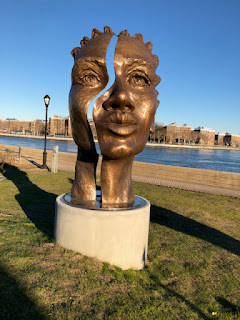
Yesterday I managed to sneak in a ride before sunset.  It wasn't long, but it took me to familiar haunts I hadn't ridden in a while:  a few loops around Roosevelt Island.

It's probably been a couple, maybe a few, months since I last took a spin on the island.  However long it was, enough time had passed to see something new:


Actually, it's been under wraps for a while.  It was supposed to be unveiled last year, but the COVID pandemic delayed that, and other things.  


The "Girl Puzzle" installation is an homage to Nellie Bly, a pioneering journalist.  Next year will mark the centennial of her death:  two years after she, and other American women, won the right to vote. 


In a way, it's appropriate that the installation stands before the lighthouse, as she shed light on all sorts of terrible, scandalous and interesting situations.  One of them prevailed at the other end of the island, in its now-closed sanitorium.  As flimsy as this country's mental health care system is, it was much worse in her day.


She was able to write an expose of it--which morphed from a series of articles into a book (Ten Days In A Mad House)--and much of her other work by going under cover.  That, of course, makes it ironic that the installation is by the lighthouse.  Perhaps equally ironic is that she was able to go undercover at a time when she was conspicuous simply by being a woman doing paid work, let alone journalism.  Then again, her first published work, in the Pittsburgh Dispatch, was a response to a previously-published misogynistic complaint about female wage-earners.

The title of that piece was..."The Girl Puzzle." While it garnered complaints and other negative reactions, the editor realized her potential and had her write more pieces.  Soon after, he hired her as a full-time reporter.

Although women in professions like journalism have become the norm, we still have to solve "The Girl Puzzle":  How do we--whatever our gender identities, however we express them--realize our potential and our dreams while remaining true to ourselves and dealing with those who try to enforce their notions of what men or women, boys or girls, should be?  


As I looked at "The Girl Puzzle," I couldn't help but to think about Simone Biles and the other female gymnasts who, yesterday, reached a settlement against their sport's governing bodies in their case against their coach--and abuser.  It sounds like a story Nellie Bly would have covered--and been appalled that she had to at this late date.


13 December 2021

A Turn: A Curtain Lifts

Why do I take the same rides again and again?

Sometimes I just want to ride on "autopilot":  I don't want to think about navigating.  Or, conversely, I might want to lose myself in the rhythm of pedaling and navigating, especially if I'm weaving through traffic.

But, oddly enough, sometimes I'll ride a route I've pedaled dozens or even hundreds of times before because I somehow know that within the familiarity, I'll see something new:  a turn might reveal a new view of something I've seen for years.

That is what happened the other day, late in the afternoon.  I took Tosca, my Mercian fixie, for a spin along the Flushing Bay Promenade, which starts by LaGuardia Airport and passes the World's Fair Marina and Citi Field on its way to Flushing.

On my way back, I saw a Midtown Manhattan sunset through a scrim of winter branches:


A second or two, a few pedal strokes and a left turn later, the curtain lifted, so to speak:


There is always a show, a spectacle, even on the most quotidian ride.  Maybe that's what's kept me on my bike for all of these years!


11 December 2021

An Oxymoron Ride

Peter White is an original.   He has been helpful when I've  consulted him, whether or not I bought anything.  His sense of humor, though, is, shall we say, quirky.  I like it, but it may not be for everybody.

An example is his attitude about downhill riders.  His shop doesn't carry parts for bikes ridden by "those poor unfortunate people with green or pink hair who have to be carried up the mountain on a ski lift so they can ride down yelling "Yo Dude!" He calls their machines "invalid bikes" which, he claims, is a play on what he regards as "valid" bikes.  Naturally, some  folks believe he's denigrating folks with disabilities and send him nasty e-mails, or worse.

I'd love to hear what he'd say about a "downhill bike tour."  I never knew such things exist until someone sent me an article about people who want to regulate them in Hawaii. Apparently, tour groups meet their guide and support vehicle at the top of a mountain, where they watch the sunrise before barreling down into the town.  


Photo by Matthew Thayer, for the Maui News


Me, I don't know how you can call something a "bike tour" if it's only downhill.  I can understand a ride that's flat.  But whatever anyone wants to say about the speed at which I currently ride, I can say that on every tour--or even every transportation ride--I've taken, if I've ridden down something, I've ridden up it, or something else.  Well, OK, once I went on a downhill mountain bike ride back in the 90s when that first became a "thing."  Yes, I went up on a lift, as everyone else in my group did.  But I did it on a hardtail bike, albeit with a Rock Shox front fork.

Now some folks in Maui want to impose tighter regulations on those downhill tours.  They complain that even the guided tours show little regard for the safety of children and pedestrians.  Not surprisingly, they believe the "wildcat" riders are even worse.

Not only have I never taken a "downhill tour;" I've also never been to Hawaii.  So I have to take their word about those tours. I, though, would want to regulate them in another way:  They shouldn't be allowed to call themselves "tours."  I'd bet that at least half of the people on those rides don't pedal even a single stroke.  To me, if all you do is coast down a hill--as much fun as it is--you don't have the right to say you did a "tour."

In other words, I believe the phrase "downhill tour" is an oxymoron.

10 December 2021

If A Police Officer Rolls A Bike Over Your Head....

If someone rolls a bicycle over someone else's head, could that be construed as excessive use of force?

Hmm...I must admit I'd never pondered that question.  Most likely, there aren't very many people who have. One who had to is Andrew Myerberg.

He is the director of Seattle's Office of Police Accountability (OPA).  The poor fellow who got tire tracks on his forehead was Camillo Massagli, who was known for showing up at street protests and playing his trumpet.  At one of those events last year, held in the wake of a grand jury's decision not to indict Louisville police officers in the killing of Breonna Taylor, Seattle PD Officer Eric D. Walter rolled his Department-issued bike--with two flat tires--over a supine Massagli's head.

Massagli, for his part, declined to pursue charges because, he explained, "I cannot use a penal system I reject for revenge, not in good conscience," though he added that Walter's and other officers' actions showed "disregard for human life."

King County Sheriff's Detective Mike Mellis investigated Walter for assault but did not find probable cause.  He reasoned that Walter and other officers had a right to "peacefully" remove protesters from the street.  Although he conceded that Walter "purposely rolled his bike over" Massagli's head, as recounted in an OPA summary, he said that such an action "would not necessarily be expected to cause someone pain."

Okay...I'll try that if I ever roll a bicycle over someone's head:  "Officer, I really meant no harm!"

At least Mellis, Walter and the officers who worked with him weren't the only ones who had input on the OPA summary.  It didn't dispute Walter's claim that that he "needed to stay on his line and could not move as it might confuse the officers following behind him."  It, however, averred that a review of video from that day found "no indication that he ever lifted the bicycle while walking over" Massagli.  

So what was the result of this investigation?  Walter got a seven-day unpaid suspension. (It's unclear as to whether or not he's served it.) Walter and the union are, of course, appealing it.  As a 14-year veteran of the force, Walter had a base salary of $130,471 in 2020 and made another $20,544. (I wonder whether working that protest was part of his regular salary or overtime.)  So the suspension, should or has he served it, would cost him about $2509 of his base pay. One wonders whether Massagli will pay in some other way--whether through physical pain or emotional trauma, now or in the future, whether or not Officer Walter meant to hurt him.

Screen grab from a video at the protest. (Courtesy of C.J Halliburton and Joey Weiser, for the Seattle Times.


09 December 2021

More Bikes, More Parts, More Help Needed

 The COVID-19 pandemic has affected the cycling world in all sorts of ways.  You've probably noticed more people on bikes during the past year and a half.  And, if you wanted to buy or fix a bike, you probably found it more difficult, or even impossible, to find the bikes, parts or accessories you need--and that, if you can find them, they're more expensive.

That last factor--scarcity and expense--has been particularly difficult for programs that distribute bikes during the holidays.  Some, such as the Boise Bicycle Project, have, in years past, relied on bikes refurbished in local jails and prisons.  Those programs, which typically trained volunteer detainees, have been suspended or stopped altogether due to distancing requirements.  Also, the businesses--whether bike shops or big-box stores like Wal-Mart--that donated bikes or sold them at significant discounts (sometimes at wholesale prices or not much more) just don't have bikes or even helmets or other accessories to donate.  And, individuals who donate bikes often do so after buying new bikes for themselves or their kids:  the old bike is the one that gets donated.

That last fact relates to another of the problems I mentioned.  Donated bikes are usually fixed by volunteers in the distribution programs before being passed on to a needy kid or adult.   Just as the Idaho prison program mentioned in the article has been put on hold, so have other programs in which volunteers refurbish bikes, such as those in Recycle-a-Bicycle type operations, local bike clubs, schools or other organizations.  It's pretty hard to show someone how to true wheels or replace brake cables while maintaining social distance.


And, while some volunteers in distribution programs have the skills and tools to fix the bikes, they may not have the necessary parts, or any way of getting them.

So, the program in the article--and, I am sure, others--are urging people not only to donate bikes, but also to fix them, if necessary, before giving them.

If you donate or fix bikes in a program like BBP, you deserve special kudos this year.  And, whether or not we receive one of those bikes, we should be grateful for the extra effort they're surely expending this year!