17 April 2022

Bunnies On Bikes And Cycling Chicks

Happy Easter!

I know that today is also in the middle of Ramadan and is the third day of Passover.  But I'm going with Easter, not because I was raised Catholic.  Rather, Easter is just a good excuse to post cute and silly images of cycling chicks (who aren't me) and bunnies on bikes.

Enjoy!


This might've been Picasso's Easter card:


And this, because cyclists are "good eggs":


16 April 2022

Assaulted For "Not Riding In The Lane"

A decade ago, a driver nearly hit me when she made a careless turn. (I think she was distracted.)  I yelled a few things they don't teach immigrants in English classes and flashed a one-fingered peace sign. She rolled down her window and lectured me on how I "should be riding on the bike lane."  Never mind that the lane was on another street and wouldn't have taken me where I was going.

To this day, too many drivers and  seem beholden to the same notion.  I was once stopped by a cop when I turned out of a bike lane onto a side street.  Said cop claimed that I went through a light--which I wasn't--and that I "should stay in the lane."  Never mind that I turned off the lane to go where I needed to go and that, in any event, even if I had gone through the light when there was no cross-traffic--or ahead of a driver who would turn right when the light turned green--I (and the driver) would be safer than if I'd strictly followed the signal.  When I pointed that out, the cop said, "I ride a bicycle, too," in a tone of reminded me of people who tell me about a gay brother, sister or friend before doing or saying something to hurt me.

If bicyclists could ride only in bike lanes, we couldn't go anywhere--unless, of course, the lane goes right to the doors of our homes, schools, workplaces or favorite stores, cafes, museums or anyplace else we go.

Erin Riediger understands as much.  The Manitoba-based architect and host of Plain Bicycle Podcast veered from the bike lane into the traffic lane so she could turn onto a side street.  A man walked in front of her bike, struck her and said, "The bike lane is over there."


Fortunately, she wasn't hurt, at least not physically.  She posted a series of Tweets about the incident and most of the responses were sympathetic.  However, as almost invariably happens on Twitter, trolls clambered from under their rocks.  One upbraided her for "wasting her time" with those posts (If she was "wasting her time," wha does that say about the troll?), she should have "called the cops"--which she did.  Others posted stuff that nobody should be subjected to.  

Still other twits (what I call trolls on Twitter) lectured her about how she should have handled the incident or stayed in the bike lane.  Then there were the ones who used the occasion to rant about how cyclists should have licenses, insurance, etc.--which many, if not most, of us have--never mind that those things have nothing to do with the real issue at hand:  someone--a woman--was assaulted--by a man--when she rode her bike.

A woman was assaulted by a man as she rode her bicycle. She was within the law; he wasn't.  Those are the facts of this case; they have nothing to do with licenses, insurance or anything else that's bothering trolls with too much time on their hands.

15 April 2022

Happy Ramadan, Passover, Good Friday—And Jackie Robinson Day

 Today I am invoking the Howard Cosell Rule. Today’s post, therefore, will not relate to my rides or bikes, and may not be connected to much else in the cycling world.  But what I’m about to mention is just too important to ignore. 

The athlete I’m about to mention has something in common with Simone Biles, Colin Kaepernick, Billie Jean King, Muhammad Ali and “Major Taylor.  Like them, he was a pioneer, not only in his sport, but in the struggle to be recognized and understood as full-fledged human beings.  In other words, they (have) had as much impact away from the field, court or track as they had on it.

On this date 75 years ago, a second baseman took his position at Brooklyn’s Ebbets Field.  At 28 years old, he was older than most rookies. But that wasn’t because he was a “late bloomer.” Rather, his debut in Major League Baseball was delayed by his World War II military service, where he experienced the very thing that kept him from playing for the Dodgers earlier than he did.

When he was drafted into the Army, he applied for Officers’ Candidate School, for which he was qualified.  His application was delayed for several months.  When he was finally accepted, he led soldiers who, like him, were racially segregated from other soldiers as they fought for the freedom of people in faraway countries.

What this man had in common with the other athletes I mentioned, with the exception of Billie Jean King, is that he was Black.  So, upon returning to the United States, he played a year for the Kansas City Monarchs of the Negro Leagues and another for the MontrĂ©al Royals, the Brooklyn Dodgers’ top minor-league team.


When Jackie Robinson took to the field for the Brooklyn Dodgers on 15 April 1947, he was the first known Black major-league player* since Moses Fleetwood Walker in 1884.  Robinson’s debut also came half a century after “Major” Taylor, the record-setting cyclist, became the first Black world champion in any sport. 

Consider this:  When Robinson played his first game as a Dodger, the United States armed forces had yet to integrate.  Yes, you read that right:  Black soldiers could still be sent to fight for freedoms they couldn’t enjoy themselves.  And, a year later, Strom Thurmond would run for President on a platform of “Segregation Forever!”

All right, this post does relate to cycling in at least one way:  In spite of his accomplishments on and off the field, Jackie Robinson, like Taylor before him, had to endure insults, indignities and even death threats. And, in a sort of parallel, Robinson had to go to other leagues, as Taylor had to go to other countries , for professional opportunities commensurate with their talents and work ethic.


So, if Jackie Robinson doesn’t deserve a mention on this or any other forum, I don’t know who does.

*—For all of the respect I have for Jackie Robinson, I am willing to entertain the notion that he wasn’t the first Black major league player since Walker.  It’s entirely possible that some Black player who “passed” as White—including, it’s been rumored, Babe Ruth—could have played in the major leagues.  

14 April 2022

What Did Dee-Lilah See When She Woke?


 Yesterday I roused Dee-Lilah, my custom Mercian Vincitore Special, from her long winter’s nap. 

For a few weeks, the season hasn’t been able to make up its mind: The weather has gone from February to May and back, and from clear skies to downpours faster than you can say “spin.”  As a result, streets and roads have been sprinkled or coated with the remnants of change-of-season storms:  sand, road salt, fallen branches and other kinds of debris. That’s why I let my “queen” extend her rest.

She experienced some of the changes I’ve described during our ride to Point Lookout.  When we began, the sky was as blue as, well, the sea, depending on where you are.  And the air was warm enough that a few minutes into our ride, I thought I might’ve over-dressed.

About half an hour later, though, I felt the temperature about 10 degrees (Celsius) as I pedaled into a seaborne wind on the Cross-Bay Bridge.  That is typical at this time of year because, even if the air is 10 or 20 degrees Celsius (50 or 68 F), the ocean is still only about 5C (40F).

Those differences, playing off or fighting (depending on your point of view) each other made for this view from the bridge.


The water in the foreground is Jamaica Bay.  The gray haze behind the buildings on Rockaway Beach could have been fog—or the ocean.  Just as the day could have been late winter or early spring.


13 April 2022

Riding From The Tooth Fairy To Ukrainian Children

 What did I do with my money from the tooth fairy?

I still have my wisdom teeth, but they don’t seem to help with memory.  For all I know, I never got money from the tooth fairy.

But Carina and Ariana Dinu did.  And they’re donating it to a charity bike ride—to benefit Ukrainian children.

Their ride was dedicated Iryna Filkina, a Ukrainian mother who was shot to death while she rode her bike home from work.  Carina and Ariana collectively rode 53 miles:  a mile for each year Iryna had lived before she was murdered.

Yes, you read that right.  Ten-year-old Ariana and seven-year-old Carina (Can you come up with better names?) gave their tooth fairy money to Ukrainian children.  That was “seed money,” if you will:  It was the first donation to the Go Fund Me page they started.


Actually, their ride wasn’t organized for the purpose:  They rode as part of the Ignite Women’s Bike Event.  And their fund-raising didn’t start with Ignite: a week earlier, they’d pedaled 45 miles in El Tour de Mesa.  By then, they’d collected about $1000, mostly from friends and family. El Tour has not only grown the amount of money they raised but expanded their donor bases.

What was I doing at seven or ten years old? I can remember some of it, but not what I did with my tooth fairy money, if I got any.  But said fairy, I am sure, would be proud of Ariana and Carina Dinu.

12 April 2022

Going Nowhere, Unsafely

What's the easiest way to anger urban drivers?  Take a lane out of "their" street or roadway and turn it into a bike lane.

Here's something that will leave them more enraged (I can't blame them):  When we, cyclists, don't use the lane designated for us.

We eschew those pieces of "bicycle infrastructure" our cities and counties "provide" for us, not because we're ingrates.  Rather, we avoid them because they're unsafe or impractical.  As I've said in other posts, paint does not infrastructure make:  Simply painting lines on asphalt does nothing to improve the safety of motorists driving at 30MPH (a typical urban speed limit)  or cyclists pedaling at half that velocity.  And too many bike lanes simply go from nowhere to nowhere.

Both of those flaws, it seems, came together this winter, Chicago's Department of Transportation constructed a "protected" bike lane on the city's West Side, along Jackson Boulevard between Central Avenue and Austin Boulevard.  The lane is only ten blocks long (which, if those blocks are anything like those here in New York, means that the lane is only half a mile long).  The worst thing about it, for both motorists and cyclists, is that it took a lane in each direction from a busy if narrow thoroughfare that connects the northern part of Columbus Park with Oak Park, an adjacent suburb.


The Jackson Boulevard Bike Lane. Photo by Colin Boyle, Block Club Chicago


In doing so, the Chicago DOT made an often-congested route even more crowded.  One problem is that drivers often use Jackson to reach the Central Avenue onramp for the Eisenhower Expressway.  Drivers making a right turn on Central get backed up behind drivers going east on Jackson because they can't make the turn on a red light.

Things are even worse during rush hour, school dismissals and when the 126 bus makes one of its four stops along the route.  The result is "total chaos and confusion," according to Salone.  It might be a reason why "I have yet to see one bike there."  City and school buses may be picking up and discharging passengers in the lane, and having to cross an entrance to a freeway is, for me, a reason to avoid a lane or street. (That is one reason why, when cycling back from Point Lookout or the Rockaways, I detour off Cross Bay Boulevard a block or two after crossing the North Channel (a.k.a. Joseph Addabo Memorial) Bridge:  I want to avoid the Belt Parkway entrance and exit ramps.)

The result, according to resident Mildred Salone, is "total chaos and confusion."  That might be a reason why she has "yet to see one bike there."  An equally important reason was voiced by someone else, who called Jackson Boulevard a "bike lane to nowhere."  

That title was bestowed upon it by Oboi Reed, who founded Equicity, a mobility justice organization that seeks, among other things, to start a bicycling culture in the area.  "When the bike lanes drop out of nowhere, people are turned off," he explained.  "People have to feel ownership and excitement."  

He says that in addition to the lane's faulty planning and design, people were alienated because they see the bike lanes as vectors of gentrification.  The Jackson Boulevard neighborhood is full of longtime residents, some of whom live in multi-generational homes, and most of whom are black and working-class.  They cyclists they see are mainly younger and whiter than they are, and don't share their roots in the neighborhood.

So, it seems to me, Chicago's Jackson Boulevard bike lane encapsulates all of the faults of "bicycle infrastructure" in the U.S.:  It was poorly planned and designed, with little or no regard for whom it would serve or the neighborhood through which it was built.  The result is something that makes motorists and cyclists equally unhappy.  Unfortunately, unless planners and policy-makers pay more attention to cyclists as well as other people who might be affected, we will see more unsafe bike lanes to nowhere.


11 April 2022

From Men In Black To The World In Pink

For me, Flushing Meadow-Corona Park brings back memories of the World's Fair, which I visited with my family when I was about six years old.

For you, it might be associated with one of the most popular movies of all time:  Men In BlackI saw and enjoyed it, too, but those early memories and associations never leave us, or so it seems.

Nonetheless, I will grant that I think of MIB, especially with the 25th anniversary of its release imminent. In the movie,  the mothership crashes through the Unisphere, the large globe sculpture that has become an emblem of Queens, "the world's borough."  (It's said to be the most linguistically and culturally diverse county in the U.S.)  

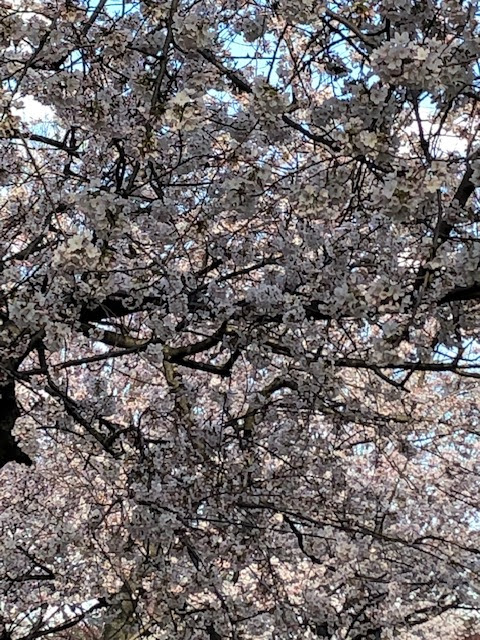
I would bet that the Men In Black never envisioned a World In Pink.


I stopped by the park the other day, during a ride out to Nassau County, down to the South Shore and up to the North.  A couple of years ago, on that very same piece of land, I saw a bloom of cherry blossoms that rivals any other I've seen.  If I recall correctly, it was around the third week, or possibly near the end of, this month.  Still, when I saw the trees the other day, their buds had bloomed enough to color the world in a way that, I believe, even the Men In Black would appreciate.


10 April 2022

Bliss

 One reason I cycle is its effect on my mental health.

In short, bicycling makes me happy.  How happy?

When I cycle, I'm a cat on a tandem and I allow a mouse ride on the rear.  And I mean ride:  The mouse doesn't even have to pedal.


Wheee!

09 April 2022

Late Afternoon Ride, Early Spring

Bare branches veil

late afternoon windows

before they open


early Spring 

red buds 

pink blossoms


my ride ahead

opens


late afternoon 

early Spring.


08 April 2022

Terror On Two Wheels

 Whitney Gregory turned her son into a menace to society.

No, she didn't teach 12-year-old Jeffrey how to vandalize, steal, assault people or torture puppies and kittens.  She told him to do something done by nearly all boys his age in his milieu--in a different place from where he'd been doing it before.

Susan Garcia felt so threatened by it.  The Homeowners Association member in Santa Ana, California--no doubt motivated by the possible threat to her property value as well as her corporeal security--yelled at the boy and pushed him.

His mother probably taught him not to respond violently.  If that was enough to get Martin Luther King Jr. arrested more times than he could count, it was more than sufficient to escalate Ms. Garcia's ire.

"Please don't touch me," he pleads with her.

She smacked him. "Why did you just hit me?" he asks.

Being a master of the Socratic and Talmudic methods of inquiry, she responded with a question,  "Want me to hit you again?"

Jeffrey's parents came out of their house at that point.  Not surprisingly, given the lessons they taught their boy, they de-escalated the situation and sent Jeffrey into their house.  

So what did his mother tell him to do that so threatened Ms. Garcia?

She told him to ride his bicycle on the sidewalk.


Now, to you, dear reader, and to me, that may seem misguided.  But Ms. Gregory, being the concerned mother she is, told Jeffrey to ride on the sidewalk because when he rode on the street, he almost was hit by a car.  Were I not a cyclist myself, I might do the same for my kid.

I have to wonder, though, about what lessons Jeffrey Gregory has learned from the incident.  Actually, I don't.  You see, even though I have always had an independent spirit (for which I've been praised and scolded), as a kid--even at his age--I obeyed my parents, and most authority figures, to the degree that I could.  And that is why, by that time in my life, I'd learned that at some point, doing what my parents, or some other adult, told me to do could get me into trouble with some other adult.  And, of course, as an adult, you can obey the law and still get arrested or do whatever is expected of you and get into some kind of trouble.

All I can hope is that Jeffrey doesn't give up bicycle riding--and that he's not too emotionally scarred--as a result of an encounter with a woman who saw him as a menace--for riding his bicycle on the sidewalk.