16 August 2022

In 1962, It Was Superior

It was what Sheldon Brown called "the Dark Ages of American Cycling."  Or it was the "dark before the dawn" of the North American Bike Boom that began, depending on whom you ask, around 1969.

I am talking about 1962: 60 years ago. At the end of Bob Seger’s "Night Moves," the reminiscing narrator is "humming a song" from that year: the Ronette's "Be My Baby,” according to Seger. 

That year, Algeria won its independence--at least, in name--from France as Jamaica did from England.  A certain English band was playing at the Star-Club in Hamburg, West (yes, it was West) Germany. And--what I am about to reveal might cause some of you to never read this blog again--my favorite baseball team, the New York Mets, made their lovably, comically inept debut. (Their manager, Casey Stengel, lamented, "Can't anybody here play this game?")

And, although there were custom builders who made frames for the small but enthusiastic cycling communities of New York, Boston, Detroit, Chicago and a few other American locales, the name most Americans associated with quality bicycles was Schwinn.

Their company's top model, the Paramount, was built by hand in a separate area from the other bikes.  I have heard, from more than one source, that Schwinn actually lost money on Paramounts.  That sounds plausible:  Similar British, French and other European bikes with Reynolds tubing and Campagnolo components cost less (1962 Paramount price:  $175.00), mainly because the labor was less expensive.  Supposedly, Schwinn continued to build Paramounts because they were the official bike of the U.S. Olympic team and Arnold Schwinn saw equipping the riders who represented his country as an act of patriotism.  It also helped to support Schwinn's reputation as the only American bike-maker of that time with even a pretense of quality.


In 1962, Schwinn's second-line bike was the Superior.  Its frame was similar to the model of the same name Schwinn introduced in 1976:  chrome-molybdenum tubing filet-brazed without lugs into smooth joints and forged rear dropouts.  Both bikes also had Weinmann centerpull brakes (the cool engraved version on the 1962 bike) and rims with Schwinn-approved large-flange hubs made in France, probably by Normandy.


Oh, and I love the stem and handlebars--made for Schwinn by Gerry Burgess (GB) of England.  I can't get over that "lugged" sleeve on the handlebar:


Beyond those features, though, the 1960s and 1970s versions were very different. While both had Huret rear dropouts, the older version was equipped with the Huret Allvit derailleur:  standard touring gear of that time.  
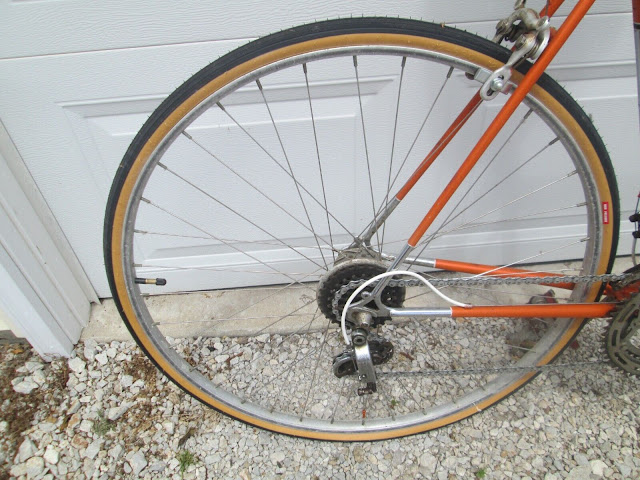


The later Superiors came with Schwinn-branded Shimano or SunTour rear derailleurs--with, interestingly, Huret front derailleurs and shifters.  While the Shimano and SunTour mechanisms shifted much better in almost any condition, they seemed to have an almost unfair advantage on the 1970s bike, a ten-speed with the Nervar crankset that used the Specialites TA Pro Vis 5/Stronglight 49D bolt pattern and a wide-range rear freewheel.  On the other hand, the Allvit had to wrap up the yards and yards (OK, that's just a slight exaggeration) of chain necessitated by this:


The 1962 Superior certainly had 15 speeds--exotic for that time.  To achieve it, Schwinn used something I've seen maybe a couple of times in all of my years of cycling and working in bike shops:  a triple (with three chainrings)  Ashtabula (one-piece) crankset. Made from solid forged steel, it probably weighed as much as the frame!

To be fair, there weren't as many cotterless cranks, or triples,  available as there are now.  Schwinn used three-piece cottered cranks only on their early Paramounts.  Even the heaviest cottered cranks were lighter than any Ashtabula cranks, and some companies like Chater Lea, Stronglight and Duprat made cranks with pencil-thin arms.  But, once Stronglight and Campagnolo came out with durable alloy cotterless cranksets, cottered cranks disappeared from high-end road bikes (though they would continue to be used on the track until around 1960).  

Still, even in light of what I've just mentioned, that Ashtabula crank seems so incongruous with the rest of the bike.  But, for most Americans in 1962, the Superior would have seemed as other-worldly as a spaceship.

By the way:  the Superior cost $132 in 1962.  That model was made for only another year and, interestingly, the price dropped to $126.50.  From 1964 until 1970, the Super Sport--basically, a ten-speed version of the Superior--was Schwinn's #2 bike behind the Paramount.  In 1971, the Sports Tourer would knock the Super Sport to #3 and become the new Superior in 1976.


15 August 2022

How A Perfect Weekend Of Riding Began

 Yesterday I spun to Point Lookout on La-Vande, my Mercian Vincitore Special.  The day before--Saturday--I pedaled her "sister" LaVande--my Mercian King of Mercia--to Greenwich, Connecticut.  The riding was wonderful: For one thing, the weather was perfect:  dry air, clear skies and high temperatures of 27-28C (81 to 83F).  But I got my best photos from the "appetizer" ride I did Friday evening on Tosca, my Mercian fixed-gear.

On an all-but-perfect summer evening, the waterfront promenades of Williamsburg were full of picnickers, dog-walkers, families and people simply hanging out and enjoying the weather and light.  But somehow the spaces didn't seem so crowded.  Perhaps it had something to do with the nearly-clear skies, the expanse of river and the kind of sunset the cynic in me associated only with postcard images:


14 August 2022

I'll Drink To That!

In my youth, one of the few midlife (!) cyclists I knew gave me this bit of advice:  "The three most important things to do while riding are to hydrate, hydrate and hydrate, in that order."

My memory might be a bit fuzzy, but I believe his cupboard looked something like this:


13 August 2022

Good For What Ails You!

Most people associate doctors' prescriptions with pharmaceutical concoctions.  But now physicians in a Houston clinic are prescribing, in addition to medications, something else for patients with prehypertension, hypertension, diabetes and prediabetes.

What is the new "wonder drug?"  A one-year membership in Houston BCycle, the city's bike-share program. Thanks to a collaboration between Houston Bicycle, the American Heart Association and Legacy Community Health in the city's Fifth Ward, patients can take a traditional or electric bicycle for 90 minutes at any BCycle location.


Photo by Lucio Vasquez


Those organizations began to work on the collaboration more than two years ago. Then the pandemic struck.  The director of Legacy continued to talk with the AHA and Houston Bicycle and the collaboration, called Bike Rx, finally started in February.  

The collaboration also helps to fulfill a goal articulated by Houston BCycle communications manager Mary De Bauche:  improving transportation options as well as the health and well-being of people in underserved communities.   Most residents of Legacy's Fifth Ward locale are Black or Hispanic, many of whom live below the official poverty level. In such communities, hypertension and diabetes are more common than in more affluent areas, in part because of the limited transportation and recreation options, which compound the stresses of being poor and experiencing racial and ethnic bigotry.

While the "bike prescription" program is, for the moment, available only at Legacy, De Bauche and officials of the other participating organizations hope that it will expand to other sites in the city.


12 August 2022

They Are Supposed To Protect Us. Who Will Protect Us From Them?

They park their work--and personal--vehicles in bike lanes while munching on Big Macs.  They tail you at intersections, just as the light is changing, and force you to choose between going through the intersection or stopping and getting rammed from behind. Or they jump out from behind bushes in a park and make cyclists speed up--above the speed limit--to avoid them.

Oh, and sometimes they don't bother with those tactics and cut to the chase:  They assault, in some cases sexually, cyclists.

By now, you've probably guessed that I'm talking about police officers.  I have witnessed or experienced everything I've experienced from "men in blue" here in New York.  But, perhaps not surprisingly, none of those things are unique to my hometown.

According to Molly Hurford, Toronto police have turned that city's High Park into a "battleground" in which cyclists have been spuriously ticketed for "speeding" and "trespassing."  


Oh, but it gets worse.  Last Tuesday, an officer--one who has been ticketing cyclists, no less--drove his SUV into the park.  Just outside the park, a cyclist who was riding in the bike lane stopped at a four-way stop, with the officer to his left.  The officer turned his vehicle directly into him. The cyclist wasn't injured, but his bike sustained over $2000 in damage.  

The officer claimed that the sun was in his eyes.  Lawyer and cycling advocate David Shelnutt, who has taken up the cyclist's case pro bono, said, "In no other incident would 'the sun being in his eyes' be an acceptable excuse for any traffic violation."  At the very least, he says, that officer ran a red light; the sun shouldn't have made a cyclist invisible only four feet from the officer.  The city's Traffic Services says it's continuing its investigation.

The Roman poet Juvenal could have had the incident in mind when he wrote, "Quis custodiet ipsos custodes?"--Who will guard the guardians?  Who protect cyclists (or anyone else) from those who are supposed to protect them?


11 August 2022

Why They Left Out Bicycles

On Sunday, the US Senate passed the Inflation Reduction Act. Perhaps not surprisingly, the vote split along party lines, with the 50 Democrats voting for it and 50 Republicans rejecting it.  Vice President Kamala Harris, a Democrat, broke the tie.

As I understand it, the Inflation Reduction Act is a shrink-wrapped, rebranded version of what Biden and other Democrats actually wanted. The fact that some things that were included in the Build Back Better Act, which passed in the House of Representatives, were omitted from the IRA is no more an oversight than calling it the "Inflation Reduction Act" was not an attempt to make the energy- and environmentally-related aspects of it more palatable to the Senate's two most right-leaning Democrats, Kirsten Sinema and Joe Manchin.

One key omission were tax breaks and other subsidies for bicycles and other two-wheeled vehicles that are powered wholly or in part by human energy. The original Build Back Better proposal included a $900 tax credit for the purchase of an electric bicycle and a pre-tax benefit to help commuters with the costs of bicycling to work.  


That tax credit was available to cyclists before 2017, when Republicans repealed it as part of the Tax Cuts and Jobs Act.  The Build Back Better Act would have essentially restored it but I think Chuck Schumer, the Democratic leader of the Senate, who worked with Manchin on the IRA, realized that he had to take out some of its "greener" parts to get Manchin and Sinema to agree to it.

I say that it's unfortunate, not only because I am a cyclist.  As Harvard Kennedy Center visiting  fellow David Zipper told Alex Dougherty of POLITICO, "We need not just to shift people from gasoline to electric cars. We need people to shift from cars, period." But, as he points out, there's nothing in IRA that "makes that process easier or faster or more likely to happen."

Any piece of legislation that ostensibly has anything to do with the environment or energy but omits bicycles is a bit like a bouillabaisse without fish or a caponata without eggplant. 


10 August 2022

"You Rode All The Way Here?"

We're in the grip of another heat wave.  According to the weather forecasters, yesterday was the hottest day so far:  96F, or 35.6C.  The humidity, though, is what makes it so oppressive:  As soon as you step out, you feel as if you're wearing the air.


So, once again, I'm taking early rides on Tosca, my Mercian fixed gear.  Yesterday I rode out to Red Hook, where an almost preternaturally blue (for that area, anyway) sea and sky provided a visual, if not visceral, relief. 


And they allowed me to fantasize about traveling to exotic, faraway places--even if I know, thanks to family members who worked the docks, how un-romantic it actually is to travel the world by working on ships.

Anyway, today's ride had an interesting twist:  I crossed a pedestrian bridge over Hamilton Avenue, which is more like a highway than a city street.  A construction crew was installing new guardrails.  The foreman or supervisor, a fellow named Wallace who's a few years older than me, had to fill out some sort of report or form but didn't have a pen.  I overheard him, stopped and said, "I'm pretty sure I have one."  Which I did, and he was grateful.  We talked for a while; he asked where I was coming from. "Astoria."  

"Really?  All the way from there?"

I nodded.  

"You have a nice bike."  He picked it up and accidentally kicked the pedal.  "You rode a fixed gear all the way from Astoria?"

I said that, for me, it's not a really long ride and if he started riding, he probably could do it after a couple of months or so.  He demurred.  We got to talking about a lot of things--music, what life was like when we were teens, the state of the city and favorite foods.  But he just couldn't get over the fact that I'd ridden from my place--about 17 kilometers--on my fixie, and that I would continue to the Red Hook waterfront and head home--about 40 kilometers, in all, before the worst of the day's heat and humidity.


09 August 2022

A Motorist Strikes--And Shoots--A Cyclist In Florida

It's bad enough when any motorist's vehicle strikes any cyclist.  It's even worse, at least in some ways, when said motorist does so intentionally.

What can be worse than that? 

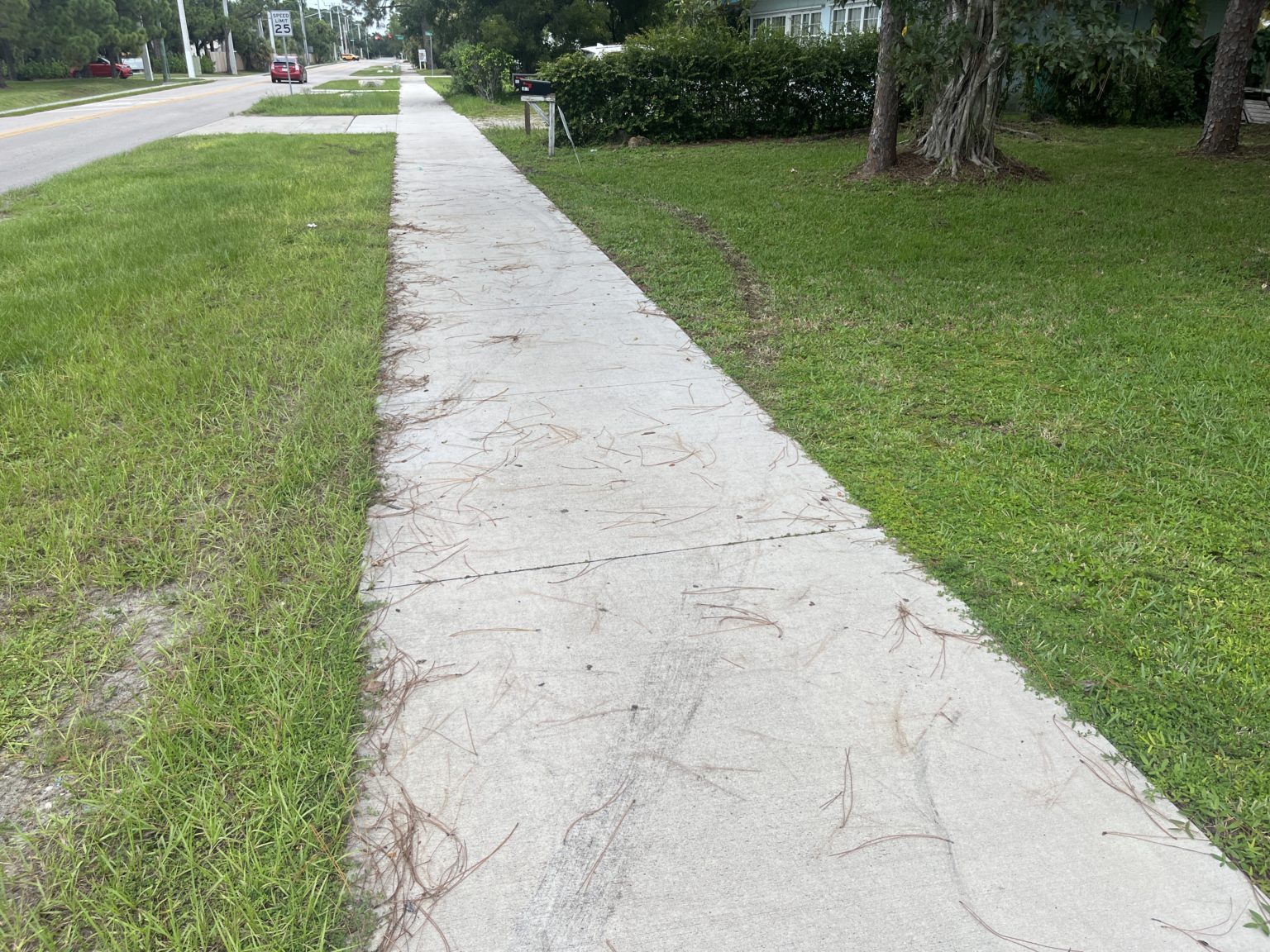
An account that came my way provided an answer.  On Saturday, in Florida (surprise, surprise), on the Gulf Coast specifically, two men were cycling when they heard a car behind them. Before they could react, a driver them and knocked them to the ground.


Tire marks where a motorist struck--and shot--a cyclist.  (From WINK news.)


What makes this incident especially galling is that, according to investigations, the driver deliberately left the road to hit them.  Both cyclists saw that driver pilot the SUV past them, in the opposite direction, before circling around to approach them from behind, at a high rate of speed.

Oh, but it gets even worse. After driver struck them, the cyclists leapt and tried to flee.  The driver then got out of the SUV and shot one of the cyclists before getting back in and driving off.

Luckily for the cyclist who was shot, his injuries are non-life threatening.  

The Collier County Sheriff's Office says it has a "person of interest" but did not mention any suspects or a description of the shooter.

08 August 2022

Generating Electricity At Newport

Perhaps the Newport Folk Festival's most famous or infamous (depending on your point of view) came in 1963, when Bob Dylan plugged in his guitar. 

That moment's fame might be eclipsed by something that electrified the audience at this year's Festival--and folks like me who saw it only on video.  Joni Mitchell, who performed at the 1969 edition, appeared for the first time, in any venue, with guitar in hand, since her 55th birthday--23 years ago.  Since then, she has suffered a number of health problems, including a brain aneurism in 2015 that left her unable to speak or walk, much less play a guitar.

What may not be as well-remembered as Bob Dylan's electric guitar or the electricity Joni Mitchell generated by, well, simply showing up is the way one stage's electricity was powered.  You guessed it:  Some festival-goers pedaled stationary bicycles for the Bicycle Stage, a brainchild of the environmentally-conscious Virginia indie rock duo Illiterate Light.  


Mardi Diaz, right, performs on a stage powered by festival-goers on bicycles. (Photo by Pat Eaton-Robb for the AP) 


Jeff Gorman, the band's front man, said that the Bike Stage in Newport marked the first time the idea has been tried at a festival.  The idea came to him at the 2019 edition of the festival, when about 1300 of the 10,000 or so attendees pedaled to the Rhode Island festival.  Festival-goers take turns pedaling the bike for about five minutes of a twenty-minute set.  For their efforts, they get spritzes of water from a spray bottle, a free can of iced tea and a front-row view of the performance.


07 August 2022

Who Leads The Way?

Susan B. Anthony remarked that the bicycle did more than anything else to liberate women.

Sometimes I wonder what she would have made of couples on tandems.  Almost any time I've seen a male-female riding duo, the male is in the front, or "captain's" position and the female is in the rear.  That means the man/boy is steering and, depending on how much input he gets or takes from his partner, is determining the course of the ride. 

Is there any way to correct that imbalance?