When I was living as a guy named Nick, I never had an easier time getting dates than when I was teaching in a language institute near the United Nations. My pupils included tourists, business people, students who were trying to improve their English skills so they could attend American colleges and universities and young Japanese women from wealthy families who sent them to New York for the summer. It didn't matter whether I was actually looking for a date; at the end of every week I had at least one.
I was, at best, an average-looking guy, though I was in really good shape from cycling. I never thought I was particularly charming, intriguing or even intelligent. Could teaching English really be that much of a turn-on?
Whatever the answer might be to that question, I believe that, today, I just may have found the easiest way to get a date now that I am a woman of, shall we say, "a certain age". Within a span of a few minutes, three different men offered themselves to me. Now, you might say that it's because I'm in Paris and some would argue that the true "national sport" of French men isn't cycling or football, but flirtation. I wouldn't disagree.
Actually, I think it had to do with other things. One is the specific location in Paris. Yes, I was on the Left Bank--but not of the Seine. Rather, it was the starboard side, a.k.a. le Quai de Jemmapes, of the City of Light's other major--and, to me, equally romantic--body of water: the Canal Saint Martin, which connects the Seine with the Marne via the Canal de l'Ourcq.

I have always enjoyed spending time there. Once I even took a barge ride. Today, though, on a nearly perfect Parisian summer afternoon, I kicked off my shoes and sat with my feet dangling over the water. I wasn't trying to attract attention: I was just enjoying the light that softens the green tint of the water and the leaves flickering in the breeze. But I wasn't the only female swinging my legs over the water--and I certainly wasn't the most attractive. And although my sandals are, if I say so myself, kinda cute, I wear them because they're comfortable. I couldn't understand why one of the men who asked me on a date was staring at them and said they were "sexy."
Hey...I just realized what was attracting their attention. It was...the bike.

I'd parked it beside me while I was drinking some Badoit and munching on a "pumpkin" tomato I found in a market along the way.

That tomato was really good but I'm not sure that anyone was paying attention to me while I ate it. Usually, guys watch girls when they're eating cherries or strawberries or other things I won't mention. I don't recall a woman eating a tomato in an image that's supposed to titillate men or lesbians. (Then again, I haven't looked at a lot of such images. Really!)
So, really, what else could have gotten three guys to ask me on dates in a few minutes but the bike?
Perhaps I should tell that to Paris Bike Tour, from whom I rented the bike.
Then again, bikes always attract attention. Just take a look at this

hung on a building across the street from the Picasso Museum. Or this, in the window of a lighting shop on the Boulevard Raspail:

Flick off the switch on that one and it's really "lights out"!
I was, at best, an average-looking guy, though I was in really good shape from cycling. I never thought I was particularly charming, intriguing or even intelligent. Could teaching English really be that much of a turn-on?
Whatever the answer might be to that question, I believe that, today, I just may have found the easiest way to get a date now that I am a woman of, shall we say, "a certain age". Within a span of a few minutes, three different men offered themselves to me. Now, you might say that it's because I'm in Paris and some would argue that the true "national sport" of French men isn't cycling or football, but flirtation. I wouldn't disagree.
Actually, I think it had to do with other things. One is the specific location in Paris. Yes, I was on the Left Bank--but not of the Seine. Rather, it was the starboard side, a.k.a. le Quai de Jemmapes, of the City of Light's other major--and, to me, equally romantic--body of water: the Canal Saint Martin, which connects the Seine with the Marne via the Canal de l'Ourcq.

I have always enjoyed spending time there. Once I even took a barge ride. Today, though, on a nearly perfect Parisian summer afternoon, I kicked off my shoes and sat with my feet dangling over the water. I wasn't trying to attract attention: I was just enjoying the light that softens the green tint of the water and the leaves flickering in the breeze. But I wasn't the only female swinging my legs over the water--and I certainly wasn't the most attractive. And although my sandals are, if I say so myself, kinda cute, I wear them because they're comfortable. I couldn't understand why one of the men who asked me on a date was staring at them and said they were "sexy."
Hey...I just realized what was attracting their attention. It was...the bike.

I'd parked it beside me while I was drinking some Badoit and munching on a "pumpkin" tomato I found in a market along the way.
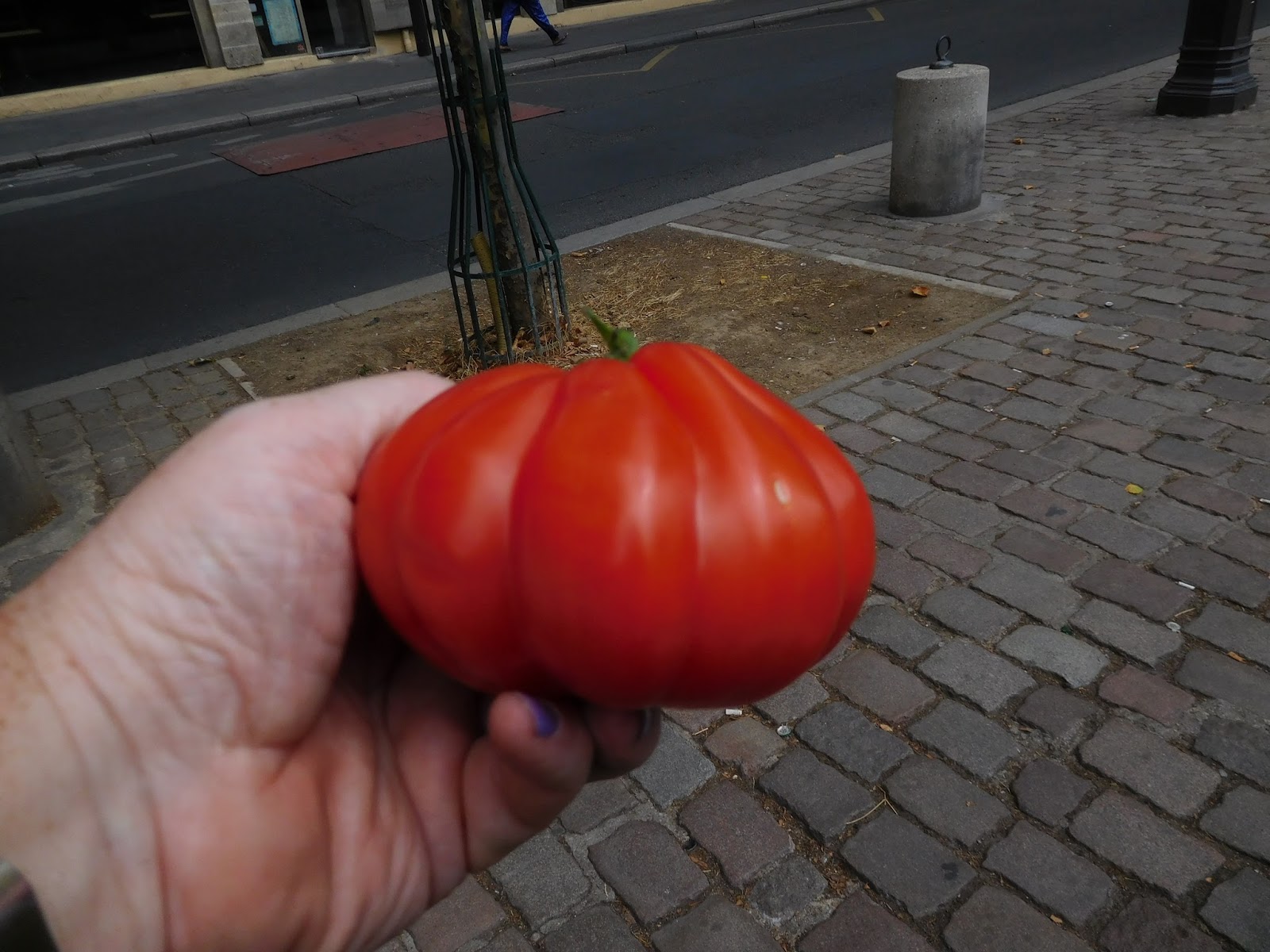
That tomato was really good but I'm not sure that anyone was paying attention to me while I ate it. Usually, guys watch girls when they're eating cherries or strawberries or other things I won't mention. I don't recall a woman eating a tomato in an image that's supposed to titillate men or lesbians. (Then again, I haven't looked at a lot of such images. Really!)
So, really, what else could have gotten three guys to ask me on dates in a few minutes but the bike?
Perhaps I should tell that to Paris Bike Tour, from whom I rented the bike.
Then again, bikes always attract attention. Just take a look at this

hung on a building across the street from the Picasso Museum. Or this, in the window of a lighting shop on the Boulevard Raspail:

Flick off the switch on that one and it's really "lights out"!