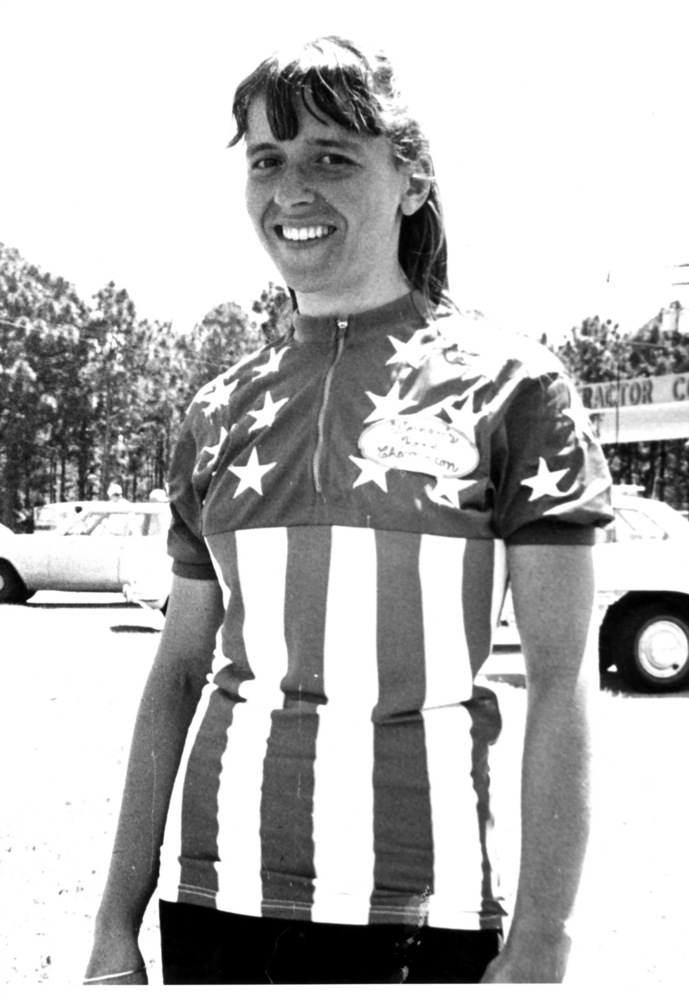
In the middle of the journey of my life, I am--as always--a woman on a bike. Although I do not know where this road will lead, the way is not lost, for I have arrived here. And I am on my bicycle, again.
If you commute by bicycle, you know that sometimes your ride home can feel very different from your ride to work. Sometimes you're happy to get out and get on your bike at the end of your work day, especially if you have a couple of hours of daylight. Then, your ride home might seem easier and go more quickly than the ride to your job. You might even take a longer route, or a side trip, as you head home. Then there are other days when the ride back seems longer and more tired because, well, you're tired. You mght have had a stressful, or simply long, workday. I know that when I have early morning classes, conferences with students and a meeting or two--or any unforeseen situation--the ride back might take me a few minutes longer, especially if I'm pedaling in the dark, in the dead of winter. But yesterday, I felt as if I'd been pedaling through a sea of molasses for my ride home. That sensation began with my first pedal stroke. Even mounting my bike seemed more arduous than it did in the morning. Mind you, I didn't have a tough day at work. Things went well, actually: Students were prepared and engaged. So was I. Exchanges with colleagues and office staff were pleasant. Heck, I even stayed a bit longer to get a few things done--and write yesterday's post on a computer at my job. By the time I got home, though, I felt as if I'd pedaled up every major climb in the Rockies, Alps, Appalachians and Pyrenees, and maybe one or two other mountain ranges. Those eleven kilometers or so felt like a Tour de France stage--one that combined the mountains with a sprint.
Well, today I realize that I wasn't as out of shape as I feared I was. My sinuses were spewing more than Mount Vesuvius and Mount Etna, and what it was spewing probably would have qualified my respiratory system as a Superfund site. And, instead of eating pasta or noodles, my body has the lateral rigidity (sorry for the bikespeak!) of those foods--when they're overcooked. So today I didn't go to work--or ride for any other reason. It's odd that I managed not to be sick all winter, and the first week of Spring brought me to this. Oh, well. It's temporary--I hope. At least I'm not hurt.
Mention the year 1976 to most Americans, and they will think of their country's Bicentennial.
Mention that same year to most American cyclists--at least those of a certain age--and Bikecentennial will come to their minds.
Something else that became an important part of our lives is also about to turn 40 this year.
I'm not talking about punk rock. (Whether you date it to the Ramones' release of their self-titled album in February or the debut of "New Rose" by The Damned that October, punk rock began in 1976.) And I'm not talking about the founding of Apple or the debut of Big Red Gum or the Honda Accord--or, for that matter, the Laverne and Shirleyseries.
What I am referring to is the first race in Somerville. But wait a minute, you say. First of all, it's the Tourof Somerville, though it is in fact a race. Second, it first ran in 1940. Didn't it?
Well, yes--for half of the population. For its first thirty-two editions (it was not held from 1943 until 1946 because of World War II), only men competed in what has been called "The Kentucky Derby of Cycling". But in 1976, the Mildred Kugler Women's Open--named for the daughter of Somerville's first winner, a top competitor in her own right--ran for the first time. Held on Memorial Day, the same day as the men's race, its list of competitors and winners reads like a who's who of women's cycling. As an example, Sue Novara, one of the best of the generation of female racers that put the sport "on the map" during the late 1970s and early 1980s, won the race four times.
The very first winner of the Women's Open is someone who, unless you are around my age or are immersed in cycling history, you probably haven't heard about. But in her day, she--a few years older than Novara and Sue Young--was one of the riders who picked up the torch from those who kept bicycle racing in the US alive during its Dark Ages and became, not only a world-class racer, but later a coach to the generation of riders who included Young and Novara, as well as later riders like Rebecca Twigg and Connie Carpenter.
Mary Jane "Miji" Reoch first won the US National Road Race championship in 1971, at the age of 26. She would go on to win ten more national championships on the road and track before retiring from racing at the end of the decade. She also led a contagion of American women cyclists on a tour of Europe, where they competed in, and won, still more events.
She also helped to shatter some prevalent myths about pregnancy and cycling. While she was racing, most obstetricians--nearly all of whom were male--recommended that women stop cycling as soon as they knew they were pregnant. Their advice was based on the notion, since discredited, that a woman would harm her fetus or baby if she continued to ride.
Well, Miji continued to ride all through her pregnancy. In fact, she pedaled to the hospital where she delivered her baby!
Miji--almost nobody called her by her full name--managed to earn the respect and garner the affection of a generation of those who raced with and against her, as well as those she coached and fans of racing. While coaching in Texas, she went for a training ride with one of her students on the morning of 11 September 1993. She was riding behind that trainee to better study that student's position and technique on the bike when an out-of control motorist struck her from behind. That motorist--Mario Nambo Lara--was driving well over the 20mph speed limit on the wrong side of the road when he lost control. Reports said that she flew more than 90 feet through the air before landing in White Rock Lake. That night, she was pronounced dead at Doctors' Hospital in Dallas.
The pickup truck Lara drove was later found, abandoned. By then, Lara had fled to his native Mexico, where he was captured nearly three years later. It is believed that he was intoxicated on the day he crashed into, and killed, Miji.
The following year she was inducted into the US Cycling Hall of Fame. Women's racing, as we know it, might not exist had it not been for her work. And it's not hard to imagine how much more it could have advanced had Miji not met such an untimely and tragic death. She'd be 70 years old now, but if she could cycle to her delivery room, it's not difficult imagine she'd be cycling and coaching now.
Yesterday, dear reader, I subjected you to another one of my "I remember when" posts. If I do say so myself, I suspect some of you may have liked it, as the thing I was remembering is the sort of bike that's, sadly, not made anymore. Today's post will also begin with "I remember when". What am I recalling from the good ol' days? Listening to a song with the lyric "all of the colors of black" with rainbows of polyester all around me? Hearing Bruce Springsteen before the rest of the world would hear of him? (Yes, I did!) Seeing Michael Jackson when he was still black? No, I'll tell you about something that, if you're not of a certain age, you will find truly incredible. No, I'm not talking about a time when the Rolling Stones and Joni Mitchell were actually worth listening to. (Believe me: There was such a time!) I'm also not talking about the Knicks winning the NBA Championship. (Yo lo vi, I swear!) Instead, I'm about to tell you something you may find even more unbelievable. But I swear it's true. Here goes: Saturday Night Live was once actually worth watching. In fact, it was the funniest, and simply the best, program on TV for a time. Really, it was. In those days, it offered skits like this: It's a dessert topping. No, it's a floor wax. Dan Ackyroyd, Gilda Radner and Chevy Chase were parodying all of those products hawked on late-night TV that try to serve disparate functions. Can you imagine what the original SNL cast would have done with smart phones when they first came out? Now, I'm not against products that can perform more than one function or task. But just about every product has at least one thing it should never, ever be made to do. As an example, I don't see how any device could be a juicer and a deep fryer at the same time. At least, I don't think I'd want to eat or drink anything that came from such a device. I have seen bicycles used to generate power for hair dryers and laptops, or spin grinding stones used to sharpen knives and cut keys. I have even seen them used as amphibious vehicles. I don't mind such uses; in fact, I applaud them. But I don't think I like this: If the bars and stem can flex enough to double as a gym machine for upper-body workouts, I'm not sure I'd want to ride them. And, really, you have to wonder just how good of a workout someone would get---whether in the upper body or legs--from the Revolution.
You know the '80's were, like, totally, about big hair and leg warmers. Yeah, totally. And neon. Neon, totally. The '80's were just awesome! All right. I didn't talk like that in the '80's. Even though I was, like, young enough. That is the '80's everybody seems to remember. Or, at least, that's the stereotype of the decade. You had to love it, though. In what other decade could The Cosby Show and Miami Vice have made their debuts during the same week? Those '80's really began, I think, around 1984. Before then, during the early part of the decade, the '70's were hanging on: Men were wearing ridiculous moustaches and even more ridiculous sport coats and ties, and young women could be seen in butterscotch-colored leather jackets and boots. But leisure suits were gone--thankfully!--along with men getting perms. And--something else for which I'm thankful--some very, very tasteful and functional bikes were being made. In 1983, while I was working at Highland Park Cyclery (before I embarked on life as a New York City messenger), it seemed that every bike manufacturer--at least the ones whose bikes I assembled and we sold--offered at least one model in charcoal gray with red highlights--whether the decals or transfers, head tube, seat tube panels or bands, or some combination thereof. The red really was a highlight: It accented the understated nature of the gray finish rather than called attention to itself, as the red-white-and-black blocks and and bands on every other new bike sold today seem to do. That year, I assembled bikes from Panasonic, Motobecane, Trek, Miyata, Peugeot and Ross--the latter's "Signature" series as well as their cheaper bikes. I saw red and gray in every one of those brands' gray bikes. But I didn't get tired of it: Those bikes all seemed tastefully finished, especially this one:
The 1983 Miyata 310 was--is-- a very nice bike. I think they, along with Panasonic, made some of the best mass-market bikes I've ever seen. Their lugwork was on par with all but the small builders. Their component choices always seemed to be made with function and value in mind: lower- and mid-priced alloy parts from Shimano, SunTour, Dia Compe, Sugino, KKT, MKS and the like. And, of course, SR Laprade seatposts.
It seemed that every bike and component maker had a product or line called "signature". I know, it was a marketing gimmick, but it was pretty inoffensive, I think, compared to some that I've seen since.
Shmano made derailleurs with the "arrow" you see. This version, as far as I know, was made only for the Miyata 310 and a couple of other manufacturers' models: The derailleur was usually finished in silver and the arrow was gold-toned. Shimano didn't call them "arrow"; they just had some boring numerical designation. Nobody--not even the Shimano sales rep who came to our shop--seemed to know what, if anything, the arrow meant. Sarcasm aside, seeing the bike reminded me--in good ways--of what bikes used to be: nice lugged frames and components that had real functionality. Today you have to go to small builders like Mercian or Royal H to get new bikes like them. I wish that Miyata weren't locked up behind a fence: I would've liked to have taken better photos. I hope that I still managed to give you a taste of what people could buy off a showroom floor in the moment before reason and taste vacated much of the bike industry. Note: There's one thing I don't like about the 310: the shift levers. But they're forgivable on a bike that has so much else going for it!