17 November 2017

Meet Mr. Bicycle of Harrisburg

I can't begin to count how many times I've seen people riding bikes with quick release levers that were twisted shut without engaging the cam.  Or racks, fenders or other accessories or parts that were just a bump away from falling off the bike--or into the wheel. Or, worse yet (for anyone who's not riding on a velodrome), brakes that are improperly set up or adjusted.

Now I've seen all sorts of other problems on peoples' bikes, such as rusty chains and soft or flat tires.  But the other problems I've mentioned can result in accidents and injuries.

Ross Willard understands this.  About 15 years ago, when the retired railroad executive was volunteering with a food program, he noticed children riding bicycles with brakes that didn't work.  The Harrisburg, Pennsylvania resident then started to fix bikes on street corners, at community events and in other venues, using tools he kept in the back seat of his car.
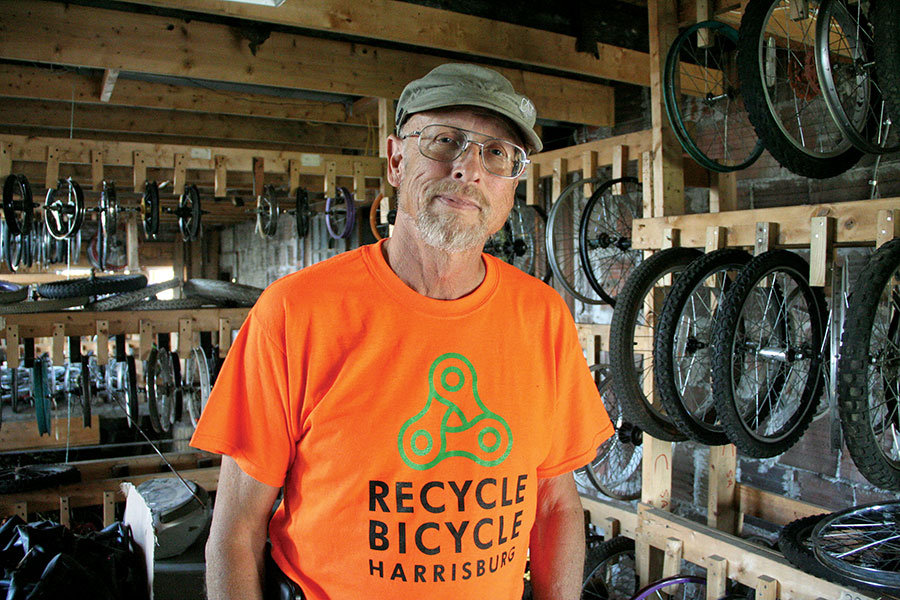
Ross Willard


That toolbox in which he kept his wares became "a bigger toolbox", then "the van, the trailer and the warehouse".  The enterprise he couldn't contain would become Recycle Bicycle Harrisburg, which opened its first shop ten years ago.  He, the founder, still serves as its "chief mechanical officer."  And he operates a bicycle collection point, repair facility and teaching center for repair and maintenance.  

Recycle Bicycle Harrisburg has a "do it yourself" philosophy, according to Willard. There is no charge for any repair, or even a bike, but visitors (except for very young children) are expected to make their own repairs, with the assistance of volunteers.  And people can take bikes in exchange for helping with repairs or other shop work.

He sees an irony in all of this. "In a sense, it's socialism," he says.  "I don't own the bikes....the people own the bikes."  That ethos, however, developed out of a sense of personal responsibility bordering on libertarianism that was inculcated in him by his parents.  "If you see something that needs to be done, don't call the government.  Go fix it," he says.  "And that's what we do."

He started fixing bikes for kids because he saw how important they are to young peoples' sense of well-being.  "The bicycle is freedom," he explains.  "The kids need bikes to see the world." 

The same could be said for adults and bicycles.  In particular, Willard's organization has another "target audience" in addition to children:  residents of halfway houses.  A prison guard from Willard's church told him about the needs of those recently released from jail and prison.  Among them is transportation--to and from job interviews, work, group meetings and other required programs.  Most cannot afford a car; even those who can might have trouble paying for gas and insurance.  Also, "if you give them a car and the computer dies, they have gpt to pay somebody" to fix it, Willard notes.  But they can bring their bikes to Willard's shop as necessary.

Recycle Bicycle Harrisburg also provides other valuable resources for halfway house residents.  For one thing, they can perform their prescribed community service by volunteering in the shop.  And for those who are trying to build up their resumes, that work counts as experience.  And Willard is willing to provide them with a reference, which nearly all of them need. 

On top of everything else, the halfway house residents experience, like the rest of us, freedom while riding a bicycle--though they, having been incarcerated, might feel it even more intensely.  Also, for some of them, daily or several-times-a-week bike rides are the first regular exercise they've had for years, or ever.

For what he has brought to his community, parolees, kids and other residents of Harrisburg have affectionately dubbed him "Mr. Bicycle".

16 November 2017

If It's Good Enough For Bond, James Bond...

This is just what the world needs:  another bicycle from a maker of luxury cars, with a price to match.

Of course, these days, $21,000 won't get you anything that most people (at least in the developed world) would define as a "luxury car."  But I can remember when such a sum was sufficient for two, or even three such vehicles, and a good new basic transporter vehicle could be had for about $2000.

For that matter, I can remember when $27,000 would pay for the contents of even the best-stocked bicycle shops: even the most stratospheric custom and racing machines didn't cost much more than $500.  When I was 14, the idea of paying $250 for a new bike--a Peugeot PX-10--seemed decadent or simply crazy. 

(Three years later, I would buy a PX-10--used--for that amount of money!)

So, what kind of a bike does $21,000 fetch?  


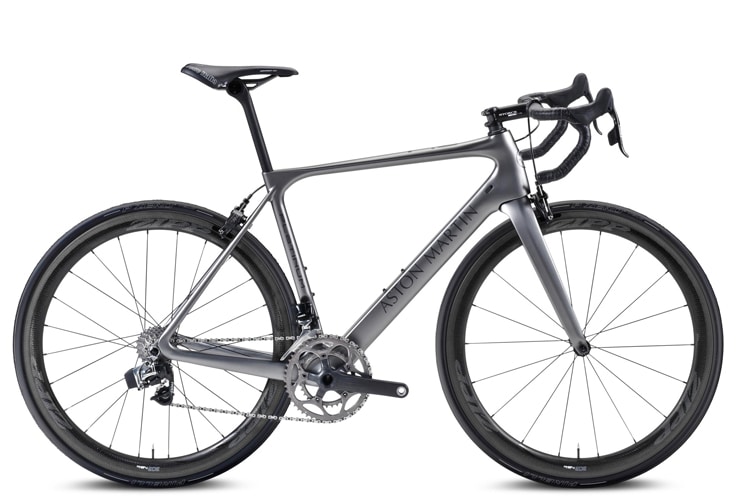
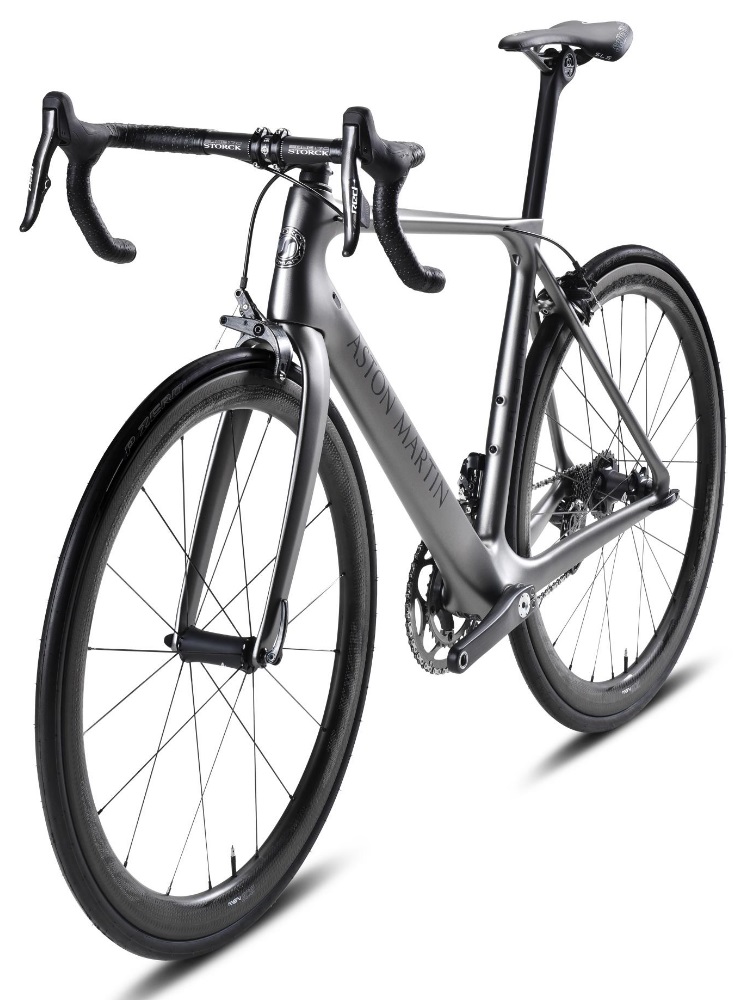
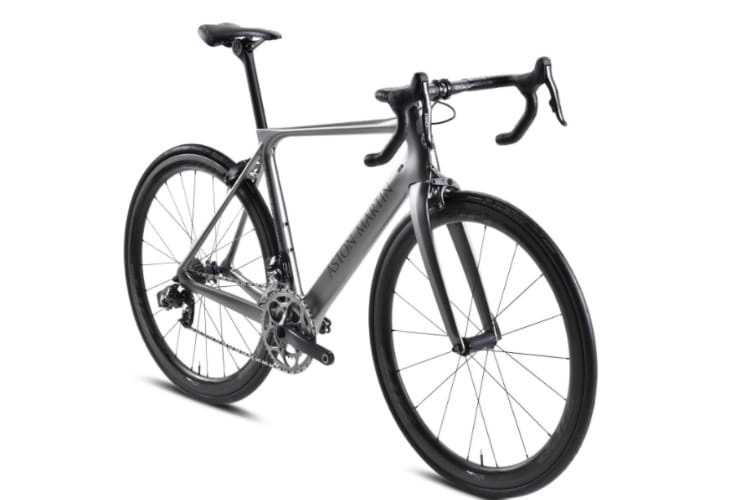
Not surprisingly, the frame is made from carbon fiber.   It weighs 770 grams (1.7 pounds) and the complete bike tips the scales at 5.9 kilos (13 pounds), according to the company's press release.  That same release says the bike is designed for comfort as well as performance.  One way this is achieved is through a wider-than-normal fork design, which leaves more room around the front wheel than other designs, thus preventing "aerodynamically unfavorable vortices."

The bike features, among other things, SRAM's wireless shifting,  with levers that "operate just like the paddles found behind the steering wheels on Aston Martin's sports cars."


OK--so now you know the luxury car maker behind the bike.  Aston Martin indeed collaborated with Storck bicycles to create the "Fascinerio.3"  While Storck probably had more to do with the design of the bike, one aspect is distinctly Aston Martin:  the finish.  In the photos, it looks like a shade of gray one sees on many other carbon bikes and parts.  However, depending on the light in which it's viewed, it can change subtly to silver or green--specifically, a variant of AM's iconic "Racing Green". 


We can all cringe or wince at the price.  But if you were James Bond, would you want to ride any other bike?

Note:  The article I've linked quoted the price in Australian dollars (27,000).  I've converted it to US dollars at current exchange rates.

15 November 2017

From The Sound Of It...

Manufacturers of cheap bikes have long tried to make their bikes look like pricer stuff--at least, to those who aren't so knowledgeable or discerning.  That's why about half of the new bikes you see today are finished in some combination of black, white and red geometric whooshes and slashes.

But how do you make a cheap bike sound like a high-quality velocipede--especially when said HQV is named for a racing legend?


It seems that the company behind this bicycle-shaped object did just that. 


Or am I the only one who thinks the name is intended to rhyme with Mercx?

You have to just love what's on the bike's top tube:


I saw the Meirx parked on Broadway yesterday morning during a pre-work bagel run.

14 November 2017

Now Why Didn't I Think Of That?

Hey, I found it!  The miracle cure!

For what?, you ask.

Cravings for drugs, alcohol, sex and Friends.

The cure is really, really simple--and you might even have it on your iPhone.

All right, I'll tell you what it is: playing Tetris.

I'm not kidding:  that is the conclusion of a research team.  According to their findings, "cognitive interference"  can be used to reduce cravings for substances and addictive behaviors.

Of course, a term like "cognitive interference" could only be coined by someone trying to get or keep a research grant (or by someone paid to explain how a celebrity ran over some unfortunate soul).  In plain English, it means "distraction":  Playing Tetris deflects your attention away from eating pizzas, drinking beer, making love or the "He's her lobster!" episode.

Believe it or not, greater minds than the ones who discovered "cognitive interference" have come up with even more ludicrous conclusions from funded research.


As an example, the esteemed fellows at the National Highway Traffic Administration have figured out how to prevent 90 percent of all bicycle accidents.  Their conclusion is so simple, and so commonsensical that I wondered how I didn't come up with it myself.

According to lead researcher Dr. Laura Gafferty, "Our data confirm that the vast majority of cyclist injuries can be avoided by driving an automobile instead of biking around like some weirdo."  She added that while bicycle riding is perfectly acceptable for children under 12, it isn't recommended for any adult who isn't competing in the Tour de France.  "Regular people drive cars because it's the normal and not the abnormal thing to do," she explained. If every cyclist drove a car "like you're supposed to as an adult", cycling-related fatalities would "drop by 40 percent in the first six months alone," she claimed.

Her team's study was published in that most respected of all journals:  The Onion.

13 November 2017

The New Station Wagon?

Whenever someone mentions "suburban family", my mind still conjures an image of a mother driving a station wagon full of kids.

At least, that was the sort of suburban family I saw--and my Brooklyn family became--when we moved to New Jersey right about the time I was hitting puberty (my first).  

These days, it seems that suburban families don't have as many kids.  (Actually, that's the case for families in most places in the US.)  Paradoxically, as family size has shrunk, motor vehicles have gotten larger:  Families that used to shuttle between school, the mall, kids' practices and home in station wagons are now getting around in SUVs.


Well, maybe not all of them.  

You can see more families like them on the Madsen Bike blog.  


I'm told those kids eat healthy snacks:


Note:  This is not an endorsement of Madsen bikes, as I know almost nothing about them.  I like the idea behind them, though!