17 February 2019

Follow The Money?

I suppose we should be grateful any time a town installs a bicycle parking rack.  And we should thank whoever donated the funds for it.

Still, this one left me wondering, "What were they thinking?"


A special bike parking rack was unveiled the other day, for Valentine's Day.  It's red, which is appropriate enough.  And I can understand the wish to use the unveiling to celebrate some aspect of the town's history.

But I think there's something a bit incongruous, to say the least, about putting an image of an oil rig on the bike.  

Maybe I shouldn't complain too loudly. After all, cycling, like the arts, have been used to glorify or sell all sorts of things that haven't been good for the planet, or the spirit.  The Charge of the Light Brigade, anyone?

16 February 2019

What We Can See Because of Ken Bukowski

During a conversation with an acquaintance of mine, I mentioned that I served as a "captain" on tandem rides for the blind and visually impaired.

This acquaintance, who makes workplaces ADA-compliant, wasn't surprised.  "Really, the only thing a visually-impaired, or even a blind, person can do that you or I can't is to drive a car," she declared.

Still, I must admit that of the ways one can become disabled, losing my sight is the one I fear most.  Even after hearing my acquaintance's words, and similar claims from others who are, or who work with people who are, visually impaired, I have a difficult time imagining how I would do almost anything I do now without my sight.

Certainly, I don't know how I'd ride (except, of course, on the back of a tandem) or how I might have worked as a bike mechanic. There are, however, people who have assembled and fixed bikes without the ability to see.

From The Buffalo News


One of them was Ken Bukowski.  Until September, he'd worked at Shickluna Bikes and Darts in Buffalo, New York.  For more than three decades, he assembled and repaired bikes, and gave customers lessons on how to shift gears and ride safely.  He was so good at all of these things that some customers were unaware, at first, that he was blind.  According to shop owner Tom Pallas, "many times he steered us to a missing tool because he heard where we had set it down."

Left sightless from a gunshot wound to the head at age 24, Bukowski went to the Blind Association of Western New York (now the Olmsted Center for Sight) to learn how to type.  Soon, he was enrolled in the Association's pilot program for bike repair.  When he completed that training, the Association convinced Pallas to hire him.

They worked--and-- rode together.  In fact, they pedaled the Five Borough Bike Tour on a tandem in 1987.  The thing that made him a good rider is probably the same thing that made him a good mechanic:  "concentration", according to Pallas. 

In addition to fixing bikes, riding and organizing rides, Bukowski did other things people don't normally associate with the blind:  bowling, skydiving and cooking. About the latter, his wife, Elaine Filer, said that because he didn't work much during the winter, by the time she got home from work "he'd have almost the whole dinner prepared."  

She was not the only one to benefit from his culinary skills:  For many years, he also volunteered as a cook at the Little Portion Friary, a homeless shelter in Buffalo.

He finally stopped working at the shop because of his bout with cancer, which claimed his life on 11 November.  He was 65.  Whether or not you think he lived a long life, you can't deny this:  He left an example. That, certainly, is something any of us, regardless of our abilities or disabilities, can do. 


15 February 2019

Motorist Who Mowed Down Cyclist Arrested

On this blog, I have often decried the lackadaisical or even hostile response from law enforcement officials when a cyclist is maimed or killed by a motorist who was speeding, driving while impaired or operating the vehicle in some other illegal manner.

I also try to bring attention to law enforcement officials who are diligent in pursuing those who endanger or destroy lives by hurtling down the road inside two tons of steel.  In Michigan's Macomb County, just outside of Detroit, such work by the constables has led to the arrest of a man who blew through an intersection at 70 MPH, mowed down a cyclist who happened to be crossing the road, and didn't stop or even slow down.


Randy Menendez  


Randy Menendez, a 60-year-old father,  was riding his bike home from a friend's house at 6:27 pm on 3 February.  He'd planned to watch the Super Bowl with his family, according to his sister Roseanne Menendez.  He was crossing Groesbeck Highway in Warren when a gray Dodge Charger with a temporary tag in the rear window, and tinted side windows, struck him.  

He didn't make it. His clothes and mangled bike were scattered across the road.  


Some time after the crash, the driver had the Charger towed to a house in Detroit, where police found it under a tarp.  

The car, it turned out, had been leased.  That no doubt helped police in finding the driver, a 24-year-old man whose name hasn't yet been released.  He faces a charge of leaving the scene of a fatal crash, a felony that carries a 15-year sentence.


Although I commend the police officers' work, I have to wonder whether other charges will be brought against him.  At the risk of seeming vengeful, I'd like to be sure that someone who took a cyclist's--and father's--life with such seeming disregard won't get out for "good behavior" after, say, five years.


14 February 2019

Happy Velo-tine's Day!

To my readers:


I love you!  

The Velo-tine's Day bike tour will take place on Saturday the 16th in Albuquerque, New Mexico,  and has been organized by Routes, a local bicycle tour and rental company.  If I were in the neighborhood, I just might join them!

13 February 2019

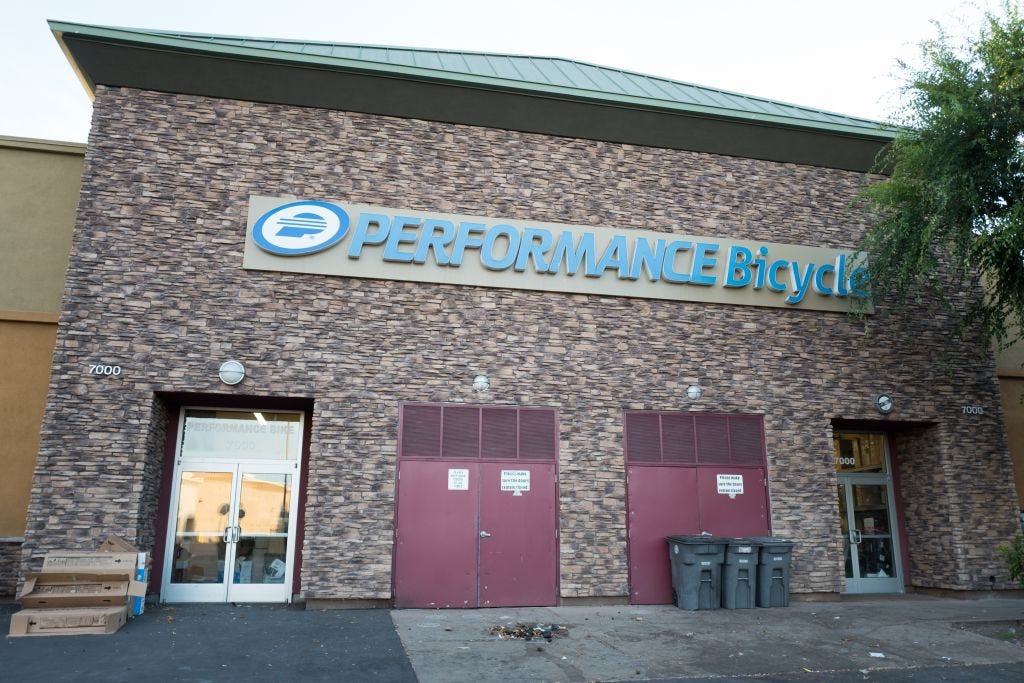
Performance: The End Of An Era?

When I first became a dedicated cyclist, as a teenager, I discovered the mail-order catalogues.  They had all sorts of exotic bikes and parts, most of which I couldn't afford and weren't found in the local bike shops.  I pored over those catalogues the way other kids devoured comic books or teen magazines--or the way some young person in a remote village might indulge him or her self in magazines filled with images of the latest fashions from New York or Paris.

Before the '70's Bike Boom, there was Gene Porteusi's Cyclopedia, that printed cornucopia of, seemingly, all things bike-related.  He was one of the old-timers who kept the flame flickering during the Dark Ages of cycling in the US.  

Somehow I don't think much of anything changed in his catalogues during their history.  For most of his career, he was dealing with a small audience--few American adults were cycling during the quarter-century or so after World War II--and a limited selection of goods.  Actually, in the later years of Cyclopedia's run, he limited his selection:  He didn't offer any Japanese parts, not even a SunTour derailleur, even after people started to choose them for custom-built frames.

For making those wonderful V-series and Cyclone derailleurs, and other great stuff from the Land of the Rising Sun, widely available, much of the credit goes to the mail-order companies that launched in the wake of the Bike Boom.  I am thinking now of Bike Warehouse, which later became Bike Nashbar; Bikecology, renamed Supergo; and, possibly the 800-pound gorilla among them:  Performance Bike.

Well, it looks like Nashbar is the last catalogue standing.  Well, not exactly:  Nashbar still exists, but I reckon that hardly anybody shops from its catalogue anymore. For all I know, they might not even have a printed catalogue these days:  I'd guess that, save for their outlet store, all of their sales are on the web.

And the web, ironically, is one of the things that destroyed the other two.  Actually, Performance took over Supergo.  But now it looks like Performance is nigh:  Its parent company filed for bankruptcy protection last fall, and all of its retail stores will close next month.  In addition, over 100 staff members have been laid off at Performance's Chapel Hill, North Carolina headquarters.


Add caption

Although you could buy stuff from Performance's website, it never seemed to generate business in the same way that other retailers' websites did for them.  Plus, the web made it easier to order from overseas retailers when they offered better prices or the exchange rate was favorable. As an example, during the past few years, it's often been cheaper to buy Shimano components--Performance's bread-and-butter, if you will--from UK retailers like Ribble or Chain Reaction because, in addition to the favorable exchange rates, US customers benefited from not having to pay the value-added tax (VAT) levied on purchases made by native or European Union customers.

The coup de grace for Performance, though, might have been tariffs the Trump administration imposed last year on bikes, e-bikes and products related to them.  An already-reeling Performance was hit with higher overhead costs and, from what I've read, had no choice but to raise prices.  That, of course, would drive away an already-dwindling customer base that was attracted mainly by the company's low prices.

So, for better or worse, we may be witnessing the end of an era: the one of the mail-order catalogue, in the bicycle industry as well as in other businesses.