12 January 2021

For $300, "Up To 48 Times Better"

I wonder whether this dude bought this helmet.

Back in September, I wrote about a guy who wiped out on a turn.  Banged up and bleeding, he was worried about scratching his $12,000 bike and $300 helmet.

Well, if he wants a reason to be upset for paying such a price for head protection, he should talk to Andrew Glancey of Stattsburg, New York.  Mr. Glancey is the lead plaintiff in a class-action suit against Trek Bicycle Corporation related to its Bontrager brand.  

According to the suit, the company used "false, deceptive" claims that the technology in Bontrager WaveCel helmets is "up to 48 times more effective than traditional foam helmets" in preventing concussions from a bicycle crash.  


 Cutaway view of Trek/Bontrager WaveCel helmet, introduced in 2019.


First of all, whenever an ad says a product is "up to X times" better, more effective, longer or whatever, I am suspicious.  I wouldn't be surprised if Mr. Glancey, who doesn't allege any injuries while using the helmet, felt the same way.  But, there is something more than my paranoid mind to back up skepticism about Trek's claim. 

Turns out, the tests cited in the claims weren't conducted with the helmet in question.  Rather, according to the report from the very laboratory--the Helmet Impact Testing facility of the Portland Biomechanics Laboratory--that did the test, a Scott ARX helmet modified to include the feature that is supposed to make the WaveCel helmet more effective. 

According to a press release from 2019, the year the helmet was introduced, the traditional EPS foam found in most helmets is replaced with layers of cells designed to move independently until the cell walls crumple and glide, dissipating both direct and rotational energy from the wearer's head.  That may well offer better protection than other helmets but, as I said, I am skeptical about "up to 48 times."  Also, there may well be other structural differences between the Scott and Bontrager helmet that could have affected the test's outcome.

So, if I were that guy I met on a ride to the Rockaways, I'd be upset about paying $300 for a helmet--unless, of course, it did its job. My Giro Atmos did just that when I crashed:  I had injuries, but, as the doctor said, it could have been much worse.

11 January 2021

Am I Normal Yet?

Public figures and everyday people talk about the world or their lives "returning to normal" once Mango* Mussolini is out of the White House or "when the pandemic is over."  Of course, the new "normal" is never the same as the old "normal;" it never can be.  When our routines or the machinations of society are disrupted, things change and we, hopefully, learn.

Even with this knowledge, however, I am going to give in to the temptation to say that something in my life might be returning to normal.  Yesterday and the day before, I did something I hadn't done since I was "doored" in October:  On Saturday, I pedaled up to Connecticut; on Sunday, I rode to Point Lookout.


The Saturday trek was my standard route to the Greenwich Common via Glenville Road, about 140 kilometers (85 miles) round-trip.  As I hadn't done the ride in about three months, I actually wondered whether I'd get up the last climb on the ridge, just after I crossed the state line.  But partway up, I realized that I was fighting not only "rust," but also a headwind.  


The last time I saw the Common, leaves were turning red and gold and orange.  On Saturday, bare trees bore witness to the cold and wind through which I'd pedaled.

On my way home, I felt ready to challenge Jeanne Longo, Rebecca Twigg and Missy Giove in their prime.  Pedaling downhill with the wind at your back can make you feel that way!


Yesterday's ride took me to the South Shore of Queens and Nassau County, through the Rockaways and Atlantic Beach to Point Lookout.  Under a clear, bright sky, the water barely rippled.  And, in contrast to Saturday's ride, this one is flat, and I encountered barely a breeze on the 120 km (72 mile) round trip.

In late summer or early fall, when I'd normally have pedaled a lot of miles, the Point Lookout jaunt would be a "recovery" ride if I did it the day after a Connecticut ride.  But it seems odd to call it a "recovery" ride when the past three months have been a time of recovery for me!


One thing I couldn't help but to notice was how little traffic, motorized or otherwise, I encountered on both rides.  I guess the cold kept people in their homes in spite of the bright sunshine.

In case you were wondering:  I rode Dee-Lilah, my Mercian Vincitore Special, to Connecticut and Zebbie, my 1984 Mercian King of Mercia, to Point Lookout.  Being able to do those rides again was enough to make me feel good, but being on bikes that look and ride the way they do made me feel even better.

Things may not be "normal" yet.  But at least one part of my life is getting there, I hope!


*--I feel guilty about equating  a mango, a fruit that brings nothing but pleasure to those who eat it, to someone who's slammed democracy and people's lives with a baseball bat.

10 January 2021

Making Sure It Doesn't Get Worse

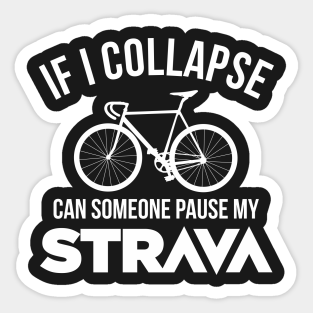
 After nearly half a century of cycling without a serious accident, last year I suffered through two mishaps--a crash and getting "doored"--that resulted in a two-night stay at a trauma center and a visit to an emergency room, respectively.  Oh, and the crash ended my journey with Arielle, my Mercian Audax (the first Mercian I acquired).  

I suppose things could have been worse, though:

From Teepublic


I mean, if I'd had a Strava (or any electronic measuring device), it would have shown an average speed of O.O5 mph or something by the time I got home.


09 January 2021

You Can't Sell Snow To The Eskimos Or Buy This In England

 Last week, the United Kingdom's "divorce" from the European Union, commonly called "Brexit," took effect.  Not surprisingly, this has affected the country's bicycle business--though, in some instances, in unintended ways.

Anyone who has ever reported on business and finance will tell you, "The markets don't like uncertainty."  The stock exchanges, whether in New York or London or Tokyo, usually fall when traders don't know who will be in offices or what policies will or won't be in place.  And businesspeople don't like to make investments when a change in a law could adversely affect them.

So it's no surprise that, for the time being, Canyon, based in Germany, stopped shipping bikes to the UK on 19 December.  A message on the company's website says that this stoppage will continue at least until Monday the 11th and is a result of "changes in tariffs and logistics in clearing points of entry into the UK."  

In other words, Canyon wants more clarity--more certainty--about the UK's new policies on imports from the EU.   So does Campagnolo, which has suspended all deliveries to the UK as the Italian component and wheel maker is "awaiting for EU dispositions in regards to the Brexit situation."

Now, it makes sense that because Italy is part of the EU, Campagnolo would want more certainty about Brexit-induced shipping and tariff regulations before sending its derailleurs and brakes to Derby or Birmingham.  But an Italian wish for clarity about policies is also delaying or halting deliveries of at least one British company's products--including what might be the most iconic English bike part of all.

Brooks leather saddles, including the B-17, Professional and Swift, are still made in England.  They are, however, shipped to a distribution center in Italy--where Brooks' parent company, Selle Royal, is based.  (SR purchased Brooks in 2002.)  From there, orders are shipped worldwide--including to UK customers.


You can buy this--as long as you don't want it delivered to you in England!

That is, at least, how things work in normal (whatever that means anymore) times.  But for the time being, "ongoing changes in the Brexit situation have made it necessary to suspend all new orders from brooksengland.com to the UK."  The company's website doesn't give a timeline as to when shipments to UK customers might resume.


08 January 2021

From The Heights To The Cutoff—And Joe

Sometimes, when I ride through the industrial areas of Queens and Brooklyn, I feel like an archaeologist.

Tuesday afternoon I took Negrosa, my vintage Mercian Olympic, for a spin along some landmarked blocks in central Brooklyn.  I hadn’t planned to ride anywhere in particular; I just found myself spinning my pedals out that way.  

Brooklyn has, probably, the greatest concentration—and some of the best examples—of brownstone houses. Long-since-gentrified (and bleached, if you know what I mean) neighborhoods like Park Slope and Carroll Gardens regularly (during non-pandemic times) witness throngs of architecture students and tourists savoring the details of those buildings.  But some equally-beautiful areas like Stuyvesant Heights are less known because they are “off the beaten path. Stuyvesant Heights is still mainly an African- and Caribbean-American neighborhood.  Hmm...Could that be a reason why tourists (or White New Yorkers, except for those in the know) don’t beat a path to it?

These houses on Decatur Street have details even more intricate than what I saw every day when I was living in “the Slope.” 


I would love to see this neighborhood to keep the characteristics—including some interesting shops and cafes—that make it worth seeing.  But I hope it doesn’t turn into a masoleum, I mean museum or, worse, a Brownstone Theme Park.

Likewise, I could see this railroad underpass—under which I passed on my way home—turning into what many of us hoped the High Line would become.  The Montauk Cutoff, as it’s called, bears striking resemblances to The High Line before it became  catwalk for the well-heeled high-heeled:  Like the HL about 20 years ago, the MC is a weed-grown railroad right-of-way previously used by freight trains making deliveries to and from an old industrial area that’s starting to de-industrialize.


As I understand, the MC belongs to the Long Island Rail Road. (Yes, the LIRR still spells “Rail Road” as two words, just as they did in 1834!) Some reports say the Rail Road wants to add some trackage and connect it to their recently-expanded Sunnyside Yards.  Others say it’s structurally unsound and will be torn down.  Then there are stories that some city or state agency or investors want to acquire it and create a High Line, especially since some of the industrial sites could become upscale residential and commercial areas.

Me, I’d love for it to become a High Line for the people. It would include a bike lane (of course!), green spaces and art studios, galleries, craft shops, educational centers and cafes that could represent the many communities of Queens, the most culturally and linguistically diverse county in the United States, if not the world.

(Examples of the diversity include members of Central American indigenous groups who may or may not speak Spanish and Africans who might speak Wolof or some other native language and practice a religion far older than Christianity or Islam.)

Hmm...If someone takes me up on my idea, there might be a plaque or something with my name and likeness. Perhaps someone would look at it and wonder who, exactly, Justine was


just as I wonder what happened to Joe, or whether Marty and Janet stayed together. I mentioned these bits of graffiti on the Review Avenue wall of the Calvary Cemetery eight years ago.  I first saw it many years ago—if I recall correctly, with my family, on our way to visit relatives who were living in Queens.

I never know what I’ll unearth on a ride!