21 March 2014

From Pedals To Motors And Back In Detroit

Today everyone thinks of Portland as the cycling capital of the United States.  That is, everyone except us New Yorkers because, well, we know that the Big Apple is the capital of everything.

Anyway, we may have the nation's oldest bike lane in continuous use (the one in Brooklyn that runs along Ocean Parkway from Prospect Park Southwest to the ocean) and Portland can lay claim to the world's first handknitted granola guard that is compatible with Shimano, SRAM and Campagnolo.  However, the American city with the richest cycling tradition may be the one people least expect.

Shinola is now crafting some beautiful and useful two-wheelers.  However, contrary to what some people believe, they are not the first bicycle manufacturer in Detroit.  They are at least 130 years too late to make such a claim (which, to be fair, they never did):  John Shire was listed as a bicycle maker--Detroit's first--in the city's 1878 business directory.  The previous year, he was listed as a carriage-maker; the following year, he would patent his improvements on the velocipede designed to make it more comfortable on the city's brick-paved streets.

From Hometown History Tours

 Shire's trajectory mirrored Detroit's industrial history:  Before it became the nation's (and the world's) motor mecca, "the D" was the North American center of carriage making, and would become one of the major hubs of the nascent bicycle industry.  In fact, some of the early automakers--including Henry Ford himself--started off by building or fixing bikes.

Henry Ford


In the 1890's and the early part of the 2Oth Century, the city on the banks of the Detroit River (the city's name is the French word for "strait")  was a port of call, if you will, for racers and other cyclists from all over the world.  It was estimated that 80 percent of the city's population rode the heavy but delicate two-wheeled vehicles, some of which snapped in half on the brick-paved streets and potholed lanes.  

There are several reasons why cycling of all kinds was so popular. One is that, in part because of its location, it attracted people from many different places--including cities and countries that had cycling traditions.  Another is that Detroit is one of the flattest major cities in America.  And, finally, even though it had become the fourth-largest city in the US by 1900, it was still pretty compact, much like downtown Manhattan or many European capitals.  So, most people didn't have to ride very far to get to work or school, or simply to get out.

What makes the history of cycling in Detroit so interesting,though, is how vigorous the city's two-wheeled scene remained even as the people (except for children) in the rest of the United Stats largely abandoned bikes in favor of the automobiles that were being produced, ironically, in Detroit.  Through most of the 20th Century--even during the "Dark Ages" of the 1950's--the Detroit News carried announcements of the Wolverine Wheelmen's rides.  Until World War II, the only American six-day race more popular than the one held in New York (at Madison Square Garden) was Detroit's. Even after it--and most other competitive cycling in the US--disappeared during World War II, criteriums and track races maintained active participation and loyal followings.  

Among those active in the Detroit cycling scene was Gene Porteusi, who opened the Cycle Sport shop on Michigan Avenue near Livernois.  At the time, it was one of the few stores anywhere in the US that carried the best racing bikes and components, most of which were imported from Europe.   His Cyclo-Pedia was also one of the first, if not the first, mail-order catalogue devoted to such goods.

But Detroit's greatest contributions to the history of American cycling may have come during the 1970's:  in another irony, during the auto industry's last "golden age" in that city.  In a previous post, I mentioned Nancy Burghart, who utterly dominated women's racing during the 1960's.  As great as she was, it took the exploits of two other racers, both from the Detroit area, to bring women's cycling (and women's sports generally) to prominence--and to establish American women as the best in that field.

In the mid- and late- 1970's, one of the most interesting rivalries developed between Sue Novara and Sheila Young.  Both were track racers and both, interestingly, came into the sport after distinguishing themselves as speed skaters. (Young won Olympic gold for the 500 meter race in the 1976 Innsbruck games.) And, as it happened, both called the Detroit area home.

Sue Novara in 1976


Cycling helped to make Detroit one of the world's great industrial centers and maintain the fabric of its life through many decades.  Perhaps people pedaling two wheels can help to bring about a renaissance of the city David Byrne counts as one of his favorites for a bike ride.


20 March 2014

Commuting On The First Day Of Spring

Many people ride their bicycles to work for the first time on the first day of Spring--or, at least, the first day with Spring-like weather.

Somehow, though, I don't think the ride Marc Boudreau filmed today was his first bike commute.


The twelve-minute spin takes him from his home to his office in Victoria, British Colombia (Canada).

19 March 2014

Carrying, Not Riding, Gaspipes

Some would argue that one can tell what kind of a cyclist someone is by what he or she carries while riding.  

That was certainly true for me during my days as a messenger.  It's also been true at other times in my cycling life.  Hey, I've even moved myself from one living quarter to another on my bike.

But at no time could I ever have held a candle to this man:


Chris Jones of Weymouth, Dorset (UK) started carrying his plumbing equipment because, he said, construction that preceded the 2012 Olympics blocked traffic.  Some of the sailing events took place in his town.

He said his service to his customers actually improved.  "On the  bike, I can tell the customers that I will be there at a certain time and know I will be there," he explained.  He knows he won't be "sitting in a traffic queue for half an hour" and therefore won't be late.

I tried to find out whether he still goes to his jobs on his bike. Somehow I imagine he does, as his bike is purpose-built.

18 March 2014

A Day Begins With A Setting Cloud

Yesterday's post ended with a pot of gold over the rainbow.  Well, sort of.

Today's post begins--as my day did--with a cloud moving across the cityscape. 


From its path between these buldings, it "sets":


Then it recedes, eventually disappearing behind one of the buildings:


17 March 2014

One Of Our Patron Saints

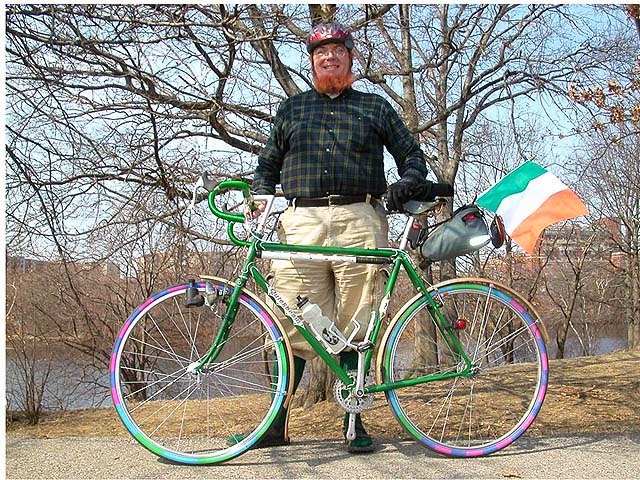
Happy St. Patrick's Day!

As I am not Irish, others can--and did-- convey the spirit of this day much better than I ever could.

Here's one of them:


He is, of course, Sheldon Brown--one of the patron saints of the cycling world.  


I can't believe he's been gone for six years already.  I hope that, wherever he's gone, he's found this:


 No doubt he's sharing a ride, a story and a Guinness Stout or two with this fellow:


16 March 2014

A Door To A Season

Perhaps it's strange to talk about a "typical March day" in this part of the world, as this month's weather is the least predictable of all.  On any of the 31 days between February and April, we can have (and have had) everything from summer-like heat waves to the most intense blizzards.  

But somehow today seems like it could only be of this month: chilly winds are blowing under clear skies streaked by the faintest wisps of cumulus clouds.

It feels, to me, like the door to a new season.  I can see what's inside even if I can't enter yet.

Somehow this photo seems apt:

From Pinterest
 

15 March 2014

The End Of A Short Journey On This Trek

You probably saw this coming.

In an earlier post, I mentioned the Trek 720 hybrid frame that came my way. 


Well, I put it together with some parts I had lying around and others I scrounged from bike shops where I do business.  And what little riding I've done during the past few weeks (We've had lots of ice on the streets, bridges and bike lanes!) has been done on that bike.  I didn't feel like getting road salt and sand all over my Mercians.

Now someone else has that bike.  A young female grad student I know needed some basic transportation.   

What did she give me in return?  Gratitude.  You see, I took off the seat (Brooks B 17) and pedals (MKS Lambda, a.k.a. Grip King) and let her take the rest of the bike.  

I look at it this way:  I didn't spend any money on the bike and I rode it for a couple of months.    All right, so I spent some time--but not much--putting it together.  I guess I can call that service.

14 March 2014

The Real Way To Find The Right Bike For You


I found this neat graphic on the Osprey Packs blog

You've gotta love some of the questions on it: "Ever worked as a bike messenger or dreamed of it?" "What's your favorite kind of equestrian event?" "Which are you more likely to consume while riding?"

 But my favorite question is the one at the top of the "chain": "Are you wearing a top hat?" Honestly, I am not, and never have.

 I've worn all sorts of things--and very little of anything at all--while riding my bike. And, before I started wearing helmet, I sported all manner of headgear, from bonnets to berets--and, yes, cycling caps. But no top hat. Or spats.

13 March 2014

Before Portland, There Was Portland

Mention "the history of cycling"--or, in particular, "the history of road (or track) racing", and chances are people would think of Europe--perhaps specifically of France or Italy.

However, in spite of the "Dark Ages" in the post-World War II years, the United States has its own history of bicycle racing.  Most of it is still unwritten and exists--to the extent that it does--in photographs that are fading and becoming brittle as leaves in October.

I have alluded to a few episodes of that history in earlier posts about Nancy Burghart and the Six Day Races, and others in which I mention the annual Tour of Somerville (NJ) and the 1951 tandem race in New Brunswick, NJ.

Now I've come across another interesting piece of that history:  the 1967 National Road Championships in Portland, OR.

American Cycling:  October 1967 issue featuring National Championships held in Portland, OR


Yes, in Portland.  Believe it or not, people cycled there before the first hipsters moved in.  (To be fair, a lot of the newcomers were trying to live the kinds of lives they hoped to live--and couldn't afford--in San Francisco and Seattle.)  Before there were commuters and nude races there were, well, races.

Actually, it's not so surprising when you consider that most of the cycling scene of that time was concentrated on the West Coast and in parts of New England and, inerestingly, the Detroit area.  In 1967, the American racing scene was taking its first pedal strokes on its return to a place among the cycling superpowers.  Tim Mountford, Jackie Simes, Skip Cutting and John Howard--and, of course, Nancy Burghart-- were the stars in that still-limited but growing firmament of American bicycle racing.

Given that Stars and Stripes cycling was drawing the first breaths of its resuscitation, Pete Hoffman's account of the Portland championships makes for a remarkably good read.  And, of course, the photos are not to be missed.

12 March 2014

My First Mountain (Bike)

There's a good chance you've seen one of these bikes:


For a time in my life, I owned and rode one.  In fact, I was one of the first people to do so.

Early in 1983, I was working at Highland Park (NJ) Cyclery again.  At that time, I had the Columbus-tubed Trek 930  racing bike and Peugeot PX-10 I've mentioned in other posts.  

I didn't really want or need another bike.  However, at that time, I couldn't help but to notice the then-newfangled mountain bikes that were appearing for the first time outside of northern California and New England.  

Two years earlier, the first mass-produced mountain bike came to market:  The Specialized Stumpjumper.  Up to that time, mountain bikes were made by specialty framebuilders like Joe Breeze and Tom Ritchey and had components that the builders made themselves or adapted from existing parts.  Needless to say, those bikes were expensive:  even more costly than the best racing bikes available at the time.  In spite of the time and effort that went into building them, most early bikes rode and handled like shopping carts, at least compared to today's bikes.

Although the Stumpjumper was "mass market", it wasn't cheap:  For its sticker price, one could get a decent racing bike or a good fully-loaded tourer.  It, too, is clunky compared to modern mountain bikes, let alone road machines.  However, every once in a while I see one outfitted with decent components (some of which are original).  Because of their long wheelbases and slack angles, those early Stumpjumpers offer a cushier and even more stable (at slow speeds) ride than some cruisers, which some people love.  And, it almost goes without saying, the early Stumpjumpers are collectors' items.

I'm not sure the Ross Force 1 will ever attain such status. Nonetheless,  it holds the distinction of being the first mountain bike Ross produced, as well as the first bike with cantilever brakes to be built in the company's Allentown, PA factory.  (To my knowledge, no such bikes were ever made in their Rockaway Beach, NY factory.)

Some time in the 1970's, I believe, Ross started to make ten-speed bikes with lugged high-tensile steel frames after a decade or so of importing them from Japan.  Until then, Rosses were made like most other American bikes of the time:  from welded steel tubes.  Not surprisingly, they were about as heavy as most other American bikes.

The Force 1 featured a frame that looked--and rode--the way one of their lugged high-tensile bikes would have ridden if its wheelbase had been stretched a few inches and its angles slackened by about seven  degrees.  I couldn't complain, though:  I knew I wasn't getting a high-performance machine.  

So why did I buy it?  Well, for one thing, it was cheap:  The retail price was about the same as that of the company's mid-level ten-speed and, of course, as an employee, I didn't pay retail.  Also, I figured I could beat the stuffin's out of it, which I did.  Finally, as I said, I was curious about mountain bikes.

And, oh, I'll admit it:  I liked the way the bike looked, with its black frame and gold-anodized wheels.  

The bike was about what I expected:  heavy and sturdy.  It was the first bike I used as a messenger, and it served me well.  All through slushy, snowy, rainy deliveries, the bike held up nicely.  One particular surprise was the Normandy/Maillard five-speed freewheel that came with it.  For one thing, it was the only French, let alone European, part on the bike.  For another, it was the most impervious part:  The cogs barely wore at all, and none of the grit or slush seemed to enter the bearings or other parts of the mechanism.  Aside from cleaning the cogs when I degreased the chain, I didn't have to perform any maintenance on it.

Most of the other parts performed well (e.g., Sun Tour derailleurs) or were barely noticeable (cranks, seat post, and others).  The handlebars were rock-steady.  They should have been:  They were the "bull-moose" type, welded to the stem's two extensions.  I suspected that, removed from the bike, they'd make good weapons, though I never tested that idea.

It did come with one really weird component, though:  the Shimano Admas AX pedals.  In those days, Shimano had a reputation for weirdness, but these pedals made some of those early aerodynamic components seem sober.  Depending on which Shimano rep you believed, the pedals were more aerodynamic or more ergonomic than any others.  As far as I could tell, they simply had less ground clearance than any other pedal, save for one, I've ever ridden.  They met an untimely (or, perhaps not, for them) demise from curbs and such.

About a year after acquiring the bike--and a few months into my time as a messenger--I parked the Force I outside Rockefeller Center to make a delivery on a high floor. When I returned, it was gone.  All that glitters may not be gold, but it still attracts thieves, I guess.

Note:  The bike was eventually renamed the Mount Hood because of trademark issues with the Force 1 name.  The Mount Hood remained in production for several more years, first in Allentown and later in Taiwan.

11 March 2014

Three Years Ago Today: Fukushima-Daiichi

Partly because I am a cyclist, I am concerned about the environment and its effects on our health and well-being.  Therefore, I could not help but to note that three years ago today, a tsunami caused a catastrophic failure, which led to a meltdown, in the Fukushima-Daiichi nuclear power plant in Japan.

Fukushima-Daichi Nuclear Power Plant


Last month, higher-than-normal levels of radioactive isotopes were found in Pacific Ocean water off British Colombia, Canada.  Scientists say that those same infected tides could wash up on beaches and cliffs in California, Oregon and Washington State next month.

This catastrophe came less than a year after the BP oil spill in the Gulf of Mexico.  Consequences of that disaster are still unfolding, but it seems that the aftermath of Fukushima could be even longer-lasting and reach even further.

I don't mean to rain on anybody's brevet or audax.  I just want to have an environment in which we can ride--and otherwise play, and live and work, in good health and peace.

10 March 2014

A Straightforward Oxymoron?

The first time you saw or heard the word "oxymoron", what did you think?

Perhaps it's indicative of the time in my life when I learned it that I thought about a stupid kid with zits.  Back then, a product for treating acne that had "Oxy" in its name had recently been introduced.  Is that product still being made?

Anyway, being the sort of person who remembers examples better than abstract definitions, whenever I heard the word "oxymoron", I would think of "military intelligence", "dietetic candy", "authentic reproduction" and "business ethics".  Oh, and there was a sign I saw in a supermarket:  "Fresh frozen jumbo baby shrimp."

Here's another one to add to the list:  a riderless bicycle.   

From Wired.com


Now, such a thing may be plausible, at least in an etymological or epistemological sense.  (I teach college. I have to use words like those at least once a year.  There, I got it over with!)  After all, a bicycle is nothing more than a vehicle with two wheels.  So, I suppose, one could have a bicycle without a rider.  Of course, I have to ask:  Why?

Well, someone seems to have a reason:  research.  Yes, you can get away with inventing practically anything for research purposes. But I think this project may have practical applications:  The riderless bicycle's creators are trying to learn more about gyroscopic forces and what keeps wheeled vehicles stable.

Maybe one day, if I have money to burn, I'll buy one of those bicycles for someone whom I tried, and failed, to turn into a cyclist!

09 March 2014

What You Can't Leave Home Without

Seems that some people believe in carrying absolutely everything:


That image comes to you from a post on strange bicycles from Japan (where else?) in TechEBlog.

08 March 2014

Back to the Future(ism)

The other day I wrote about Skycycle, an elevated bicycle highway proposed for London.

When I looked at the artist's rendition of it, I couldn't help but to think about Futurism, which began in Italy early in the twentieth century.  Artists, designers, architects, musicians writers and even fashion designers and gourmet chefs wanted to "free" Italy from the "shackles" of its history.  

The chefs and food critics associated with the movement even wanted to convert Italians from eating pasta to eating rice!  

The visions of the future presented by creative people associated with the movement sometimes look like episodes of The Jetsons--which is especially striking when you consider motion pictures were just past their naissance and television was about half a century in the future.

What ruined it for a lot of people, though, is that Benito Mussolini embraced it as part of his vision of reforming "a nation of illiterate peasants, manual labors, waiters, barbers and tourist guides".  Also, a paralell movement developed in Russia (and in the nascent Soviet Union). Thus, futurism would be bound, in many people's minds, with fascism or other kinds of totalitarianism.

The irony is that when Futurism was embraced--admittedly, by relatively few--in the United States, the resulting designs were lavish--almost a post-modern baroque, if you will.


This "Spacelander" bike was designed by Benjamin G. Bowden and made by Bomard Industires during the early 1960's.  Only 500 or so were ever sold; now they are sought by collectors.

07 March 2014

Does Size Matter?

Recently, I met a seminarian who used to work in the fashion industry.  (Now there's a journey!)  She recounted dressing Christy Turlington for a show:   "Her arms were so thin I thought I'd snap them off!", she recounted.

We all know that most bicycle racers are thin.  Jan Ullrich, who won the 1997 Tour de France and might've won in 2001 had he not crashed, was often criticised for his weight. Even so, he was fitter and trimmer than 99 percent of people in the industrialised world.

Believe it or not, back in the 1890's, some fans as well as trainers believed "bigger is better" in cycling.  The rationale seemed to be that bigger men had more muscle and more weight to propel it, which would make them more powerful cyclists.  

There was even a cyclist who went only by the name of "Grimes" who carried  257 kilograms (567 pounds) on his 183 cm (6 foot) frame.  His chest measured  157 cm (62 inches) in circumference; perhaps that gave him more lung capacity.

Here he is, on a bike specially designed for him:


This illustration accompanied an article called "Grotesque Forms of Cycles" in the 30 December 1899 issue of Scientific American.  Check it out for illustrations of other bike that live up to the title's claim.

06 March 2014

Cycles In The Sky

I took a walk on the High Line (Is that the title of a Lou Reed song?) shortly after it opened.  I enjoyed its green space and overall attractiveness.  But I also had a sinking feeling in my stomach.  About two years later, I realized why:  Upon returning about two years later, it had become, essentially, an elevated version of Times Square with more trees and more expensive lattes. It became an "it" destination for tourists to the Big Apple in a way that the Viaduc des Arts, after which it was modeled, never did in Paris. 

Now, that all might be unrelated to what I am about to discuss, save for the fact that a proposed bicycle highway made me think about the High Line.


No less than Sir Norman Foster, Britain's most prolific architect (and a passionate cyclist) backs a "Skycycle" thoroughfare that would allow two-wheeled commuters and tourists to whisk into, out of and through Central London.  The elevated lanes would be built above existing railroad tracks so that buildings and other structures would not have to be demolished.

On one hand, I like the idea.  One thing I actually liked about riding in the Five Borough Bike Tour, as well as other organized rides, was the opportunity to ride on elevated expressways (and the lower deck of the Verrazano-Narrows Bridge) that were closed to automobile traffic.  Although I missed the street-level contact I'd normally experience in riding through some Brooklyn neighborhoods I know well, I enjoyed the views of the harbor and waterfront.

Some might argue that building an elevated bicycle highway might entice people who are intimidated by traffic into riding to work.  That may well be true, if the increase in the number of cyclists following the construction (or, in some cases, segregation) of bike lanes on New York City streets is any indication.  However, as Mark Ames points out in the Sustainable Cities Collective blog, a bicycle highway is probably unnecessary.  He argues that there is plenty of room for cyclists and pedestrians on London Streets, but not for cars.  Therefore, he says, the solution is to limit the number of cars in the central city, which London does through a "congestion surcharge."

Mike Bloomberg floated the idea of such a levy for Manhattan below 60th Street.  It was about as popular as the notion of banning bagels.  The loudest objections came from family-owned construction companies and the like that are based in the far reaches of the outer boroughs but do much of their business in Midtown and Downtown. 

I hope that our current Mayor, Bill de Blasio revisits the idea.  Perhaps he will if he's elected to a second term.  From what I've seen, he is smart enough to realize that if it's simply not possible to squeeze more cars and trucks into Manhattan right now, we might be near that point.  I don't think he'd want to be remembered as the mayor who was in office when Manhattan froze in a state of permanent gridlock.

Then, about all anyone will be able to do is to sip those $15 lattes on the High Line.

05 March 2014

A Vittoria Ridden To Victory

When I saw this photo, I remembered why I love classic frames a lot but classic gear systems, not so much.


The Stucchi frame is indeed elegant, especially with the wooden rims and chromed parts.  Back in the days when Gino Bartali ruled the pelotons, racers rode bikes much like it.

Most of the bike would not seem out of place today.  But the Vittoria gear system would.  Still, it represented an advance over anything that had been available previously.

Before derailleur-type mechanisms were created, racers typically rode double-sided rear hubs, sometimes with two sprockets on each side.  To change gears, a racer had to dismount and move the chain by hand (if he wanted to use the second gear on the same side of the hub) or "flip" the wheel.  

Choosing the right moment for such a maneuver was part of a racer's strategy, and legend has it that breaking a wingnut while trying to "flip" a wheel on a cold day led a certain racer named Tullio Campagnolo to invent the quick-release axles and skewers we use today.

Gear systems like the Vittoria still required the rider to move the chain by hand from one sprocket to another. However, the cyclist did not have to dismount or remove the wheel.  He could push the lever on the downtube draw the pulley on the chainstay inward, which slackened the chain and made it possible to push the chain from one side to another with his gloved hand--without getting off the bike.

Bartali won the Giro d'Italia on a Legnano equipped with the Vittoria system.  But he didn't win the Tour de France with it, as the race's organizers still forbade derailleurs!

04 March 2014

Lovely Lilac Gazelle

Yesterday I wrote about a bike made in the shadow of the World Trade Center.  Today I saw this bike just steps from where the bike in yesterday's post was made:


Yes, I like the color.

03 March 2014

Made For Two, Only A Mile Away

This bike was parked at West 23rd Street and Eighth Avenue in Manhattan:


Whoever owns and/or rides it probably doesn't realize that it was made not much more than a mile from where it was parked.


Rollfast bicycles, which I mentioned in a previous post, were manufactured literally steps from where the Liberty Tower now stands--at the site where the Twin Towers of the World Trade Center stood until 11 September 2001.

To my knowledge, Rollfast went out of business--or simply stopped making bicycles--some time during the 1970's or early 1980's.

02 March 2014

A Conversion That Should Have Been 650B, Perhaps


Today I am going to recall another bike from a respected one-man builder.  Like my LandShark, it didn’t have his name on it. In fact, when I acquired the bike, it didn’t have any name on it at all.

After deciding that my Raleigh Competition was too big for me—and wanting a bike I could ride on paths without getting a mountain bike (At the time, mountain bikes were still clunky.)-- I ended up with an accidental conversion.

Frank, my old boss at Highland Park Cyclery, had a Ross Signature frame.  Now, you might ask, “Since when was Ross a one-man operation?”  Actually, it never was.  However, for a time, they contracted builder Tom Kellogg to build a series of bikes that would rival the best of any other builder.  Like Trek, Ross seemed to have designs on becoming the Great American Bike.


A Tom Kellogg bike.

In spite of its high quality and the sort of clientele to whom HPC catered, the frame gathered dust.  It may have had to do with having been painted a color (grayish-green) nobody wanted.   Also, the bike frame, which was built for touring, didn’t have braze-ons for cantilever brakes, racks or shift levers (or cable guides for bar-end shifters:  STI and Ergo were still a decade or so on the horizon).  It also had only one pair of braze-on mounts for a water bottle cage.

Frank sent the frame back and asked for braze-ons.  By that time, Kellogg was no longer working for Ross.  For all Frank or I knew, the bits may have been brazed by whoever welded Ross kids’ bikes.   The frame came back painted in a pewter color, which I rather liked, and with the requested braze-ons: for a rack, a water bottle cage and cantilever brakes.  The latter were exactly where they should have been on the frame—for a 26” mountain bike wheel.

The only problem was that the frame was built for 700 C wheels. So, the there was more vertical clearance between the seat stay bridge or the front fork crown and the tires than on just about any other bike I’ve ever seen.
That would have been great if it were possible to ride large studded tires.  However, that wasn’t possible because the clearance between the chainstays (at the bottom bracket) and the front fork blades was too narrow for a true off-road tire.  They could have accommodated, at most, a tire 38C (1.5 inches) wide, which was still wider than most touring cyclists (at least here in the US) were riding at the time.

 So I set up the bike with some of the earliest mountain bike “slicks” from, if I recall correctly, Tioga.   Later, when Avocet introduced their slicks with inverted treads, I switched to them:  They may have been the best city/commuter tires ever made.  And I installed fenders.  There was enough space between them and the tire treads to ride a Worksman Cycle through.

I used that bike as a commuter and on a couple of longer trips—including the one I took when I stormed out after an argument I had with Eva.  A lot of people gawked at it:  It was the bicycle equivalent of a platypus.  But I really enjoyed it:  Certainly, it turned out to be one of the more versatile bikes I’ve owned.  But, after about two years, it met its untimely demise at the rear end of a taxi behind Penn Station. (“And lead us not into Penn Station..”)

By now, you may be thinking what I’m thinking:  What if that bike had been a 650B conversion?  Given the state of bicycling and the bike business of that time (ca. 1986-88), I don’t think that whoever brazed on those cantilever brake bosses had even heard of such a size.  Rims and tires of that size were not available in the US at that time and were even, by that time, difficult to find in Europe. 
I tried to find a photo of that bike.  It really was like nothing else you’ve seen or ridden.

After I crashed it, I got the Miyata 912 I mentioned in an earlier post. Both of those bikes were worthy companions to my Colnago Arabesque.