07 March 2017

Speed Weaponry?

One of the best things about getting older is that the statute of limitations expires.

At least, it's expired for anything I did in my youth.  Now, I wasn't a juvenile crime spree.  Most of my misdeeds, I would say, fall under the category of indiscretions rather than real, hard-core criminality.


Probably the most serious offense I committed was when I crossed the border from Quebec to Vermont more than three decades ago.  I was riding; when the border guard asked where I was going, I said "home".


"Where is that?"


"New York."


He waved me through. Perhaps he thought I was going to ride to Lake Champlain and take the ferry from the Vermont to the Empire State.  Little did he know I was on my way to the Big Apple.


Or what was inside my handlebars.  I'd heard that others had smuggled, uh, medicinal herbs in a similar fashion.  And, in those days, people used to cross the US-Canada border the way people cross the George Washington Bridge on any work day. If anything, I may have been questioned more than the average border-crosser because, not only way I riding a bike, I had long hair and a beard(!).


Of course, that trick wouldn't work today.  But, apparently, that doesn't stop people from trying a new version of it in a place where it has even less chance of working.


Last week, a Transportation Security Administration employee confiscated a disassembled gun someone tried to hide in the tires of a packed bicycle.  I guess the would-be smuggler thought the rubber would somehow render the gun parts and ammo invisible to scanners.   


Or maybe he or she was going to a race and packing heat in the tires is a new form of "mechanical doping".  For all I know, the reaction of the gun firing--even if accidentally--might make the bike go faster.  

Whatever the failed smuggler's motivation, the incident made me think of Zipp, which advertises its carbon fiber wheels, handlebars and other wares as "speed weaponry."

06 March 2017

What's Worse Than A Bad Bike Lane? Bad Bike Lane Regulation!

One of the reasons why I don't like to use bike lanes, at least here in New York, is that motorized vehicles frequently pull in and out, and sometimes park in them.  I've even seen drivers use bike lanes for passing.

The problem is that if a car pulls in, or parks, in the lane, there is no room for you to get around it, especially if the lane is "protected", i.e., has a barrier between it and the street.  At least, if only a painted line separates you from the street, you can veer into the traffic lane.  

Another problem is that drivers often pull into the lane without warning--and, it seems, without looking to see whether cyclists are in the lane. If you are riding in the street and someone makes a sudden turn, you most likely can move over or shift into another lane.  You don't have that option in a bike lane--again, especially a "protected" one. 

I did not notice such problems when I recently rode bike lanes in Paris and Montreal:  Drivers in those cities seem more cognizant that bike lanes are for, well, bikes.  That, or the regulations that prohibit motor vehicles are more strictly enforced.  

On the other hand, it seems that cyclists in other American cities have experiences with bike lanes similar to the ones I and other cyclists have in New York.  Bob Collins, a blogger and news editor for Minnesota Public Radio, offers this:  "The biggest problem with bike lanes in the Twin Cities isn't cyclists; it's people who insist on parking their cars in them."


That statement is particularly notable because during the past few years, Minneapolis has stolen some of Portland's, as well as San Francisco's and New York's, thunder as a "bike friendly" city.  In 2015, Minneapolis was the only US municipality in Copenhagenize Design Company's index of the world's 20 most bike-friendly cities.  Montreal was the only other North American city on the list.

(Copenhagenize's previous indexes were published in 2011 and 2013.  I am guessing they will publish another this year, though I have seen no indication of that on their site.)

Anyway, Mr. Collins shows us that there is no end to the ignorance or hostility of lawmakers when it comes to cycling.  Some want, or claim to want, to make things safer for us.  Others simply don't want to upset drivers, who make up a much larger constituency than cyclists, or see us as renegades, scofflaws or worse.

I don't know which, if either, of those categories includes Minnesota State Representative Duane Quam.  Instead of working on regulations to keep motorists from driving or parking in bike lanes--or, for that matter, from texting or talking on cell phones while driving--he has the brilliant idea of limiting access to bike lanes and deterring young people from cycling.  


At least, that seems to be the intent of the bill he's filed with the State Legislature.  Among other things, it would require anyone who wants to use the bike lanes to take a safety course, register his or her bike and pay an annual $5 fee.

But the most absurd part of that bill stipulates that anyone who rides in a bike lane has to be at least 15 years old.  "It's not clear where people under 15--kids going to school comes to mind--are supposed to ride their bikes," Collins wryly notes.  He also notes another onerous aspect of the bill:  that it applies only to areas with "structures devoted to business, industry or dwelling houses situated at intervals of less than 100 feet for a distance of a quarter mile or more.  

In other words, as Collins astutely observes, it is aimed at Minneapolis and St. Paul.  Representative Byron comes from Byron, a town of 5063 residents--and no bike lanes.


05 March 2017

How I've Stayed Ahead Of Them

After my family moved to New Jersey, I started delivering The Asbury Park Press on my bicycle.  Every once in a while, I'd be chased by a dog.  But none ever caught me.  

Years later, I realized it had been a long time since I'd been been the object of a canine pursuit.  Even when I rode through the countrysides of France, Italy, Vermont, Pennsylvania, western New Jersey, upstate New York, California and Nevada--all places where various shepherds and terriers and such roam free--I didn't have to outrun anyone's pooch.  

"Well, that's because they've given up on you.  You're too fast."  That, from Greg, an old riding partner, is one of the best compliments I ever received, even if it was, shall we say, somewhat exaggerated.

Now I realize why I haven't been pursued:  


Now you know what is meant by "a dog's life":  one without a bicycle!

04 March 2017

A Champion's Journey On The Blood Road

On this date in 1965, more than 30 US Air Force jets bombed the Ho Chi Minh Trail in Laos.  It was not such the first such raid, nor was it the first to be reported in the press.  After the attacks on this date, however, the State Department felt compelled to assert that these missions were authorized by the powers granted to President Lyndon B. Johnson with the Tonkin Gulf Resolution of August 1964.

(Four decades later, newly-declassified documents would reveal what many had suspected:  The incident that served as the rationale for the resolution had not, in fact, happened.  Sound familiar?)

Anyway, I don't have to tell you about the carnage that resulted from the Vietnam War.  When I was writing about a Veterans' event for a local newspaper, I talked to someone who'd fought in Cambodia and still had nightmares.  He reminded me that more than 55,000 members of the American Armed Forces died there (not to mention many more Vietnamese, Cambodian, Laotian, Chinese, Russian, and other fighters).  "That's a whole stadium full of people," he exclaimed.  "Whenever I think of that war, I picture a whole stadium full of people getting killed."

One of those casualties was Rebecca Rusch's father.  He was shot down and killed during the war.

Today she is a firefighter and EMT in Ketcham, Idaho, where she lives.  But she is better known as "The Queen of Pain" for her exploits as a rock climber, white-water rafter---and mountain biker. 

Among her feats in the latter sport is a record for riding the length of the 228 kilometer Kokopelli Trail.  As if that weren't enough, she rode the 1800 kilometer Ho Chi Minh Trail, in part, to get to know her father better.  She was only three and a half years old when he was killed.


A full-length feature film about her journey, Blood Road, will open in the Sun Valley Film Festival on 15 March.  I won't be able to make it, so I hope the film makes it out my way soon!

03 March 2017

KISS My Carbon Fiber

If you read this blog regularly, chances are that you won't buy the bike that is the subject of this post.

So why am I writing about it?  Well, it was licensed by a band you've all heard.  In fact, if you came of age when I did, you probably bought one of their albums and attended one of their concerts.  You might have even gone through a stage when you dressed like them.

The band in question is KISS.  They, like the Ramones, is one of the most important--and, depending on your preferences, best--bands to come out of the New York City borough of Queens, where I live.

Now, if you remember them from back in the day, you recall their makeup, costumes and their wild antics as well as their frentic music.  So it's hard to imagine their name and logo on, say, a classic British builder's or French constructeur's frame.  It's even difficult to picture their likeness on one of those flashy Italian bikes, let alone anything from a Japanese craftsperson or American custom builder of that era.

Really, the only kind of bicycle that could have ever been licensed to KISS is one made from carbon fiber.  And that is what has just become available from a company called Sciacallo.


I have to admit that I had never heard of Sciacallo up until now.  Then again, I don't pay much attention to carbon bikes.  And that is all that Sciacallo offers.  

And, really, if they were going to "front", if you will, for any band, what other band could it be?  The Eagles?  Chicago? Would you want anything licensed by those guys?

02 March 2017

Bike Share Bikes Seized In Shanghai

Drivers here in NYC all complain about parking, or the lack thereof.  

Some, it seems, simply don't drive their cars for that very reason.  Or, at least, I came to believe that after seeing cars parked in the same spot for months at a time.  I still recall the Cadillac Seville (the model with the slanted rear end) I saw parked on a Washington Heights street when I moved into the neighborhood. It was still in the exact same spot seven years later!


I've often heard that you "don't have to worry about parking" if you ride your bike to work or school, or for errands.  That's somewhat true:  It's certainly easier to park two motorless wheels than four turbo-powered ones.  Still, there have been times I wasn't able to park my bike:  I arrived at an office, store or other place, only to find that other cyclists had already locked their steeds the signposts, parking meters and other structures to which bicycles could be secured.

Apparently, in China, cyclists have an even harder time parking their bikes.  Residents of Shanghai have complained about that:  They say they can't find places to leave their own bicycles or electric bicycles because parking spaces designated for them are taken by...other cyclists.  

So far, that doesn't sound like much of an emergency.  At least, most people wouldn't see it that way.  The bikes parked in designated spots, however, are taken up with bicycles from bike-sharing programs.  


In Shanghai, there are hundreds of thousands of such bikes. People who use them leave them, not only in the designated spaces for residents' bikes and electric bikes, but also on the streets.  Sometimes they block traffic, especially in older areas of the city, where streets are as narrow as three meters.


So, city authorities have picked up about 4000 illegally-parked bikes--most of them owned by bike-share operator Mobike--and penned up in a public parking area.

Mobike, for its part, says it will cooperate with authorities, in part by paying a management fee to help with the problem.

01 March 2017

Into The Rain, In The Pink

Fog dissipated as I rode across the RFK Bridge this morning on my way to work.

The rest of the day has been overcast, if unseasonably warm.  Rain was promised for late in the day; I will probably pedal home in it.

My philosophy about raingear was best summed up by Robert Browning:  Less is more.   When it's warm, I simply wear as little as possible.  When it's a bit cooler, I try to keep at least my extremities dry.  I've learned I have a choice of getting wet from outside or within:  If I am uncovered, I will get drenched in the rain, but if I cover myself up, I'll bathe in my own sweat even when I'm wearing "breathable" raingear.

Now, if I want to be stylish, of course, I'll ride with an umbrella.  Believe it or not, it's something I've actually done:  umbrella in one hand, handlebar in the other.  I also saw it done in England and France.  Of course, pedaling with your parapluie in one hand is best done at slow speeds in places with light vehicular traffic.


But since riding with an umbrella is about style--or, at least, fashion--one's color choices are important.  

Thanks to "Sancycles" of Malabon, Philippines for that image.

28 February 2017

A Royal Family Goes Dutch

When people think of "cycling nations", one of the first that comes to mind is the Netherlands.

Indeed, in a country of 16 million inhabitants, there are 18 million bikes.  More important, though, are Dutch attitudes about cycling.  Someone who rides to work or for pleasure is not seen as an outlier or renegade:  Even Prime Minister Mark Rutte rides to work.  Hmm...What kind of a country would the US be if our President rode to his office every day?


Oh, but it gets even better.  You see, although the Dutch royal family--like its counterparts in the UK, Denmark and other European countries--has little actual power, it is still seen as a "face" of the nation.  Their day-to-day activities help to form the image their subjects have of their nation, and the image that nation projects to the world.


So it's no surprise that King Willem-Alexander, who has occupied the throne for nearly four years, cycles--as a Cycling NL video notes, "not only for the annual so-called photo opportunities, but also in private."  He is regularly accompanied by his Argentinian wife--Queen Maxima Zorreguieta-- and their daughters.


It's also not surprising that he inherited his love of cycling from his family.  His mother, Queen Beatrix, did not cycle much while she was queen, but did enough riding before that to warrant a statue of her astride a bike in the Dutch capital. 


 Her mother, Queen Juliana--one of the best-loved monarchs in Dutch history--was an avid cyclist throughout her life.  Here we see her during a visit to the Frisian Islands in 1967:


It's widely reported that her entourage didn't ride behind her merely for appearances or out of courtesy:  the Queen actually could, and did, out-ride all of those men!


27 February 2017

On The Streets And The Silkroad

Today I will start with a quiz.

Take a look at this bike:


Now check out this:


What do they have in common?

Now, if you know anything about either of these bikes, you might think it's absolute heresy to posit that they might share any trait besides two wheels.  The first machine, a Schwinn Clairmont, can be purchased in Wal-Mart and other fine stores. ;-)  


The second, on the other hand, is a Silkroad from Tout Terrain.  Somehow I don't expect to see it parked on a street near me, or anywhere else.


So what trait could such disparate bikes share?

Believe it or not, it's in the frame!


All right, I'll tell you:  They both have rear racks that are integral to their frames.  In other words, you can't remove them.

Such an arrangement has been uncommon for a long time.  Interestingly, even it was more common, it was found on bikes at the top and bottom of the price spectrum.  

Once upon a time, British and French custom builders made frames of which the rear carrier--intended to lug loaded panniers and other items for long tours--were constructed as part of the frame.  Of course, those were special-order items and customers would wait months, or even years, for theirs. 

I recall seeing a Jack Taylor tandem and Rene Herse single built in this way.  I tried finding photos of bikes like them, to no avail.  

You won't find such an integrated carrier/frame on anything but a bike dedicated to loaded touring, even from the elite builders I've mentioned.  I'm not sure that any of today's builders construct bikes in that way:  It is an extremely labor-intensive process, and if the height of a stay is off even by a little, the carrier--and possibly the frame--will be misaligned.  

Also, the market for fully-loaded tourers---even during the peak of their popularity (at least here in the US) during the early- and mid-1980s--has always been small.  Not many people want a bike that is so purpose-specific:  Few cyclists go on more than one long tour in their lives.  Most cyclists, understandably, would rather press their racing or trekking bike into touring service and remove the racks and bags once the tour is over.

Of course, loaded touring is not the only purpose for which an integrated rack is useful.  They also make a lot of sense on cargo bikes, or even city bikes that are abused.  I think those purposes are the ones Tout Terrain had in mind when they designed the Silkroad and other models.  

But you have to wonder for what purpose--other than big-box store sales--the Schwinn Clairmont was designed. Perhaps it is meant to evoke balloon-tired kids' bikes sold in the US during the 1940s and 1950s, some of which came with built-in racks.  The funny thing is that on such bikes--from the likes of Columbia, AMF and other low-budget manufacturers--the rear racks were seldom used to carry books, sneakers or anything else besides other kids.

If anyone from Tout Terrain (or Peter White, who seems to be their main dealer here in the US) is reading this, I hope you are not offended by my comparison.  I simply find it ironic that your bikes can have something in common with a bike that just might disintegrate in the very spot where I saw and photographed it (with my cell phone) today--or end up in a landfill in a year or two.


26 February 2017

What To Ride On The Streets

It's expensive to live here in New York.  Maybe not London-expensive or Tokyo-expensive, but plenty expensive nonetheless. Probably the only US city where it costs more simply to let the force of gravity hold you in place is San Francisco.

Still, even with our high housing costs and such, there are ways to have a good time for little or no money. Sure, it costs more to go to the movies in The Big Apple than it costs anywhere else.  And it's long been rumored that one needs a winning lottery ticket in order to buy a ticket to a Broadway show.  

But why would you want to spend your money to see 42nd Street?  That's for tourists, as we're fond of saying.  And you didn't move here to go to the movies, now, did you?


There are all kinds of other entertainments available.  Some include poetry readings, art openings and concerts in small spaces.  And you can even get into most museums for little or no cash--as long as the admission price is "suggested" or a donation.  Of course, if you're a student with a valid ID card, you can get into a lot of places for free or not much.


(Once, years ago, I was dating a woman from Italy.  I made it a point of showing her some of our fair city's cultural treasures. One day we went to the American Museum of Folk Art.  I got us both in for free when I told the young man and woman at the counter that we were both students:  I was teaching her English and she was teaching me Italian.)


But the real entertainment in this city is found on its streets.  I guess you could say that about other large cities.  Here in New York, though, you can see things that you never imagined.  Then there are the performers.  The best, to me, are the ones who don't have to rustle a hair on their heads to perform.  I have seen folks made up and costumed as various public statues and other structures, and their ruse wasn't apparent until they passed their donation cups!


Better yet are people who can stand, sit or lie beside street signs and other markers:


I'd put money in that guy's donation cup!

25 February 2017

Spring Fever---Now?

So...Yesterday I experienced a change of seasons--or, perhaps, climates (all right, weather) while riding my bike across a bridge.

Today I didn't experience anything like that.  I did, however, see driving habits change.  Or so it seemed.

My ride took me down Hipster Hook into Brooklyn--DUMBO, to be exact.  After stopping at Recycle a Bicycle, I pedaled up through some central Brooklyn neighborhoods up to the other end of my neighborhood and the north shore of Queens.  

It seemed that everywhere I rode--even through the quietest residential areas--I saw more traffic.  Not only that, it seemed that teenagers of all ages had taken over the roads.  They were sideswiping each other, swooping as close to pedestrians trying to cross streets and honking their horns for no apparent reason.  In short, they were driving like kids who'd just gotten their licenses--or who were going to the beach on the day after they graduated.

At least they keep their eyes on the road!


Or, perhaps, they were driving under the influence of Spring Fever.  Even though the season doesn't officially arrive for almost another month, today felt like the first Saturday of spring.  In the very young--again, of all ages--the first wave of warmth and sunshine seems to stir up their hormones or shake their brains.  

In a way, seeing their behavior was kind of funny.  (I guess I can say that because I didn't, thankfully, have any close encounters with any of them.)  Why?  Well, this evening a storm brought us wind, hard rain and, in some places, hail.  As I write this, the temperature has dropped considerably from its earlier highs, and is expected to fall further.  Tomorrow, the weather is supposed to be more or less seasonal, which will seem almost polar compared to what we've experienced during the past few days.

I have to wonder whether those drivers I saw today will calm down--or return to hibernation.

24 February 2017

No, The Chinese Aren't Responsible For Climate Change. I Am: I Took A Ride Today!

It was spring-- almost summer, really--until I crossed the bridge.


In past years, I have noticed a seasonal change when I rode across the Cross Bay Veterans' Memorial Bridge.  To be specific, when I'd be riding through Broad Channel--a shoestring of land dangling from the "mainland' of Queens--the temperature is about 20 to 22 degrees Celsius (68 to 72F) and I would feel the sun against my face.  That is, until I reached the Bridge, which spans Jamaica Bay.  While riding up the ramp to the bridge, the wind would whip waves on the water and I would feel the cold through whatever I was wearing.  By the time I got to the Rockaways--another shoestring of land, this one splayed between the Bay and the Atlantic Ocean--the temperature would have fallen to about 10 degrees C (50F) but it would feel much colder.


I usually experience such momentary climate change in early or mid-April, when the ocean water might be about 8 degrees C (45F).  But I had such an experience today.  It was 64F (17C) when I left my apartment just before noon; the temperature would climb another few degrees by the time I reached Broad Channel.  But, as I crossed the bridge, I was glad I'd brought an "extra" layer with me. (Is something "extra" when you end up needing it?)  A thermometer in Rockaway Beach read 50F, but the wind--which I didn't notice until then--blew the cold from the very depths of the ocean.  According to at least one source, the water was 41F (just over 5C) today.  During the next few weeks, that temperature will fall by another couple of degrees to its seasonal low, which it reaches at the beginning of Spring.


I imagine that the water at Point Lookout, my destination today, was a little warmer, if only by a degree or two.  Knowing that, I understand why down is such an effective insulator!


Anyway, I had a great ride:  I saw a few other cyclists and joggers along the boardwalk and on the streets of Long Beach.  As best as I could tell, they weren't wearing down.

23 February 2017

His Stance On Discs

Nearly two years ago, a driver in China narrowly missed death when a runaway circular saw blade impaled the front of his car.

I was reminded of that today after reading about what happened to Owain Doull.


The Sky Team rider crashed with one kilometre remaining in the opening stage of the Abu Dabhi Tour.  Normally, that wouldn't elicit much attention--riders crash during races all the time.  What is causing controversy, though, is an injury he suffered and, more important, what he believes to be the cause.


When he was being treated for road rash on his back side, he pointed to his foot and showed a cut that was visible through a tear in his sock.  


It's unusual, to say the least, for  riders to incur that sort of cut on their feet.  Even if they are wearing flip-flops, they are unlikely to incur more than some scrapes, painful as those wounds may be. 


So what could have cut through Doull's shoe and caused such a wound?  He says that it was the rotor of a disc brake.  "If anything, I've come off lucky here," he said.  "If that'd been my leg, it would have cut straight through it, for sure."


In other words, by a dint of fate, he narrowly avoided--at the very least--the kind of injury Francisco Ventoso suffered last year in the Paris-Roubaix race.  The directeur sportif of Movistar, Ventoso's team, said "The cut was so deep you could see the tibia."

That mishap led to a temporary ban on disc brakes in the peloton, which was recently lifted "on a trial basis" according to the sport's governing body, the Union Cycliste Internationale.  Disc brakes were allowed on the condition that the rotors' edges were rounded off. Marcel Kittel, the only rider using disc brakes in the Abu Dabhi tour, was using rounded Shimano rotors after insisting he wouldn't use technology otherwise.

Doull was asked whether he has a stance on disc brakes.  "I do now," he said.  "In my opinion, unless there are covers on those things, they're pretty lethal."

Others have expressed the opinion that "everybody or nobody" should use them in a race.  Whatever one thinks of disc brakes (I have never used them myself, and probably won't unless some compelling reason presents itself.), I think it's fair to ask why Kittel or anyone else saw the need to use them in pancake-flat Abu Dabhi.


22 February 2017

Rubber Matches Leather?

Almost two years ago, I wrote about one of the funniest listings I've ever seen on eBay, or anywhere.  It expresses the seller's loathing for the saddle he or she was trying to sell:  a Brooks Cambium C15.

Now, I am not going to offer an opinion on it, or the C17, as I have never tried either.  I probably won't (unless someone offers me one for free), as I am satisfied with the Brooks saddles I have (Professionals and B17s) and don't want to change.

The idea behind Cambium saddles is, however, intriguing--and not new.  For one thing, Cambiums are certainly not the first saddles to come with canvas tops, though, when they were introduced a couple of years ago, they might have been the first such saddles in half a century or so.

More important, however, is what lies underneath that cloth covering:  a vulcanized rubber base.  That, too, is something that most cyclists who aren't collecting Social Security haven't seen before.  Rubber in a bike seat?  

Turns out, it was once fairly common, or at least not unusual. (Fifty shades of equivocation?)  I was reminded of that when I came across this:


Cyclists of a certain age will recall the name Wolber.  Until the '80's or thereabouts, it was the chief rival of Michelin in the world of bicycle tires.  In fact, to many cyclists, Wolber was even more highly regarded, as they made a more extensive line of tubular tires, which included one of the nicest pairs of tubulars I ever owned and rode. (I can't remember the model name.)  They also improved upon Michelin's "Elan", widely considered to be the first high-performance clincher.


So it's fair to assume that Wolber knew a thing or two about making things from rubber.  The saddle in the above photo was made by Ideale, the premiere French saddle-maker, from a "skin" Wolber fabricated.  The undercarriage appears to be the one used on the Ideale B6, which is remarkably similar to the Brooks B72:  the saddle that came with many classic English three-speed bikes.

A B6/B72 with a rubber top actually makes sense, at least in theory, for commuters and others who ride or park their bikes in the rain.  I wonder how long those saddles lasted.


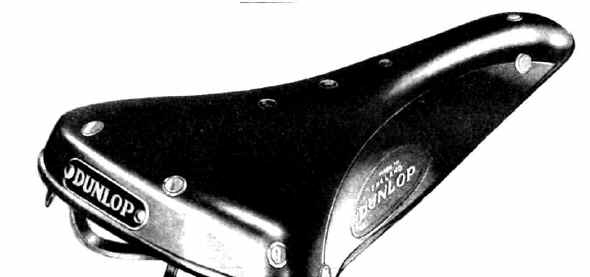
Perhaps it's not surprising that another leading bicycle-tire maker of the time also made bicycle saddles, or at least the tops for them:


I don't know whether Dunlop made the carriages for their saddles, or whether--as  is apparently the case with Wolber saddles--they were made by a company that made leather saddles.  

Interestingly, Raleigh bicycles came with Dunlop tires, which were considered to be the finest quality (Riders did everything they could to extend the life of those tires!), until Dunlop stopped making bicycle tires in the late 1960s. To my knowledge, however, those same Raleigh bicycles were not equipped with Dunlop saddles:  Instead, they came with B72s or other Brooks models.  

Like the Cambiums, the Wolber/Ideale and Dunlop saddles were constructed of a rubber base layer topped with cloth that was treated with a rubber compound for waterproofing. The Cambium looks more cloth-like than the others--a conscious decision, I am sure, on the company's part.  The Wolber/Ideale has a textured appearance that makes me think of a cross between carbon fiber and leather, while the Dunlop looks like leather, at least from a few feet away.

Although Dunlop hasn't made bicycle tires in nearly half a century, they continue to make tires for motorized vehicles as well as other rubber products.  In the late '80s, Wolber absorbed Super Champion, then the best rim-maker in France (or anywhere else) with the exception of Mavic. (For a few years, Super Champion rims were marketed under the Wolber name.)  Then, a few years later, Michelin took over Wolber!

21 February 2017

Did This Idea Ever Fly?

We have all felt, at least once, that we were "flying" while riding our bicycles.

In a sense, it always feels that way because we're not surrounded by walls or sheets of steel.  More often, though, when we say that we were, or felt as if we were, "flying", we mean that the ride was fast and effortless:  We were feeling good and spinning our gears while the wind pushed at our backs.

Most of us don't mean that we were literally aloft.  However, a few cyclists have gotten their wheels off the ground.  And I'm not talking about the kid on E.T.!

Nearly half a century before one of the world's favorite movies came out, a French inventor came up with this:


In the November 1936 issue of Popular Science, it was described thusly:

PROPELLER DRIVES NOVEL BICYCLE
A whirling, three-bladed propeller provides the motive power for a bicycle of odd design recently exhibited in Paris by a French inventor. Mounted at the front, the propeller is attached to a driving rod in a gear box supported over the front wheel by a metal frame. The gear mechanism is connected by a chain to the conventional bicycle sprocket wheel, which is pedaled in the usual manner. An extremely high gear ratio, it is said, enables the cyclist to drive the propeller at high speed. A hand lever is used to operate a rear-wheel brake, as in ordinary European bicycles.
As a cyclist who came of age during the 1970s--in the twilight of that decade's Bike Boom--I find the last sentence particularly fascinating.  I'm guessing that in 1936, most Americans had never seen or ridden a bike with a hand brake:  Most American bikes at that time were made for kids and had coaster brakes.  

I wonder whether that bike got off the ground, literally and figuratively.

20 February 2017

Presidents, Pedals And Pets

Here in the US, it's Presidents' Day.  

When I was growing up, we used to have two Presidential holidays in February--Lincoln's Birthday on the 12th and Washington's on th 22nd.  Somewhere along the way, the government decided to consolidate the two observances into one, which would be on the third Monday in February.  At the same time, some other traditional holidays, such as Memorial Day, also became Monday fetes.

Now, if you've been reading my recent posts, you know what I think about the current President, whose name I dare not speak!  I must say, though, that it's ironic that the most anti-bike President we've had in a long time (perhaps in all of history) is also the only one ever to have sponsored a bike race.  That is how, for two years, the Tour DuPont--at that time, the most important race in the US--became the Tour de Trump.

In past posts, I wrote about, and included photos of, presidents (including a couple in other countries) riding bikes.  One of my favorites is of Jimmy Carter three decades after leaving the White House, and looking younger than he did then.  I also liked the one of former French President Nicolas Sarkozy, his politics notwithstanding, and of former candidate Mitt Romney on his bike while doing Mormon missionary work in France.

Back when I was working for American Youth Hostels, I read somewhere--a biography, perhaps?--that Franklin D Roosevelt cycled "all over Europe" during his youth, freqeuently staying in hostels.  As a child and young man, he frequently took trips there, as someone of his social and economic status was wont to do.  If I recall correctly, his early trips were made, not surprisingly, with his parents and other family members, while as a teenager he went with his tutor, who also enjoyed cycling.

I also seem to recall that one or both of them were arrested in Germany for eating cherries they picked on a roadside, and that they committed a few other misdeeds.  I have read, elsewhere, that he was a fun-loving young man who skated along the surface of life.

Anyway, I tried to find a photo of FDR on a bike.  I couldn't, but I found this, by artist Mike Joos:


By the way, today is also National Love Your Pet Day.  This is the first time I've heard of the holiday.  I wonder whether it's held on a fixed date, as nearly all holidays were when I was a kid, or whether it's a "movable feast" and it just happened to fall on President's Day.

I know one thing:  I'd rather spend time with Max or Marlee than just about any President!